Why "Is It Genetic?" Is the First Question Parents Ask
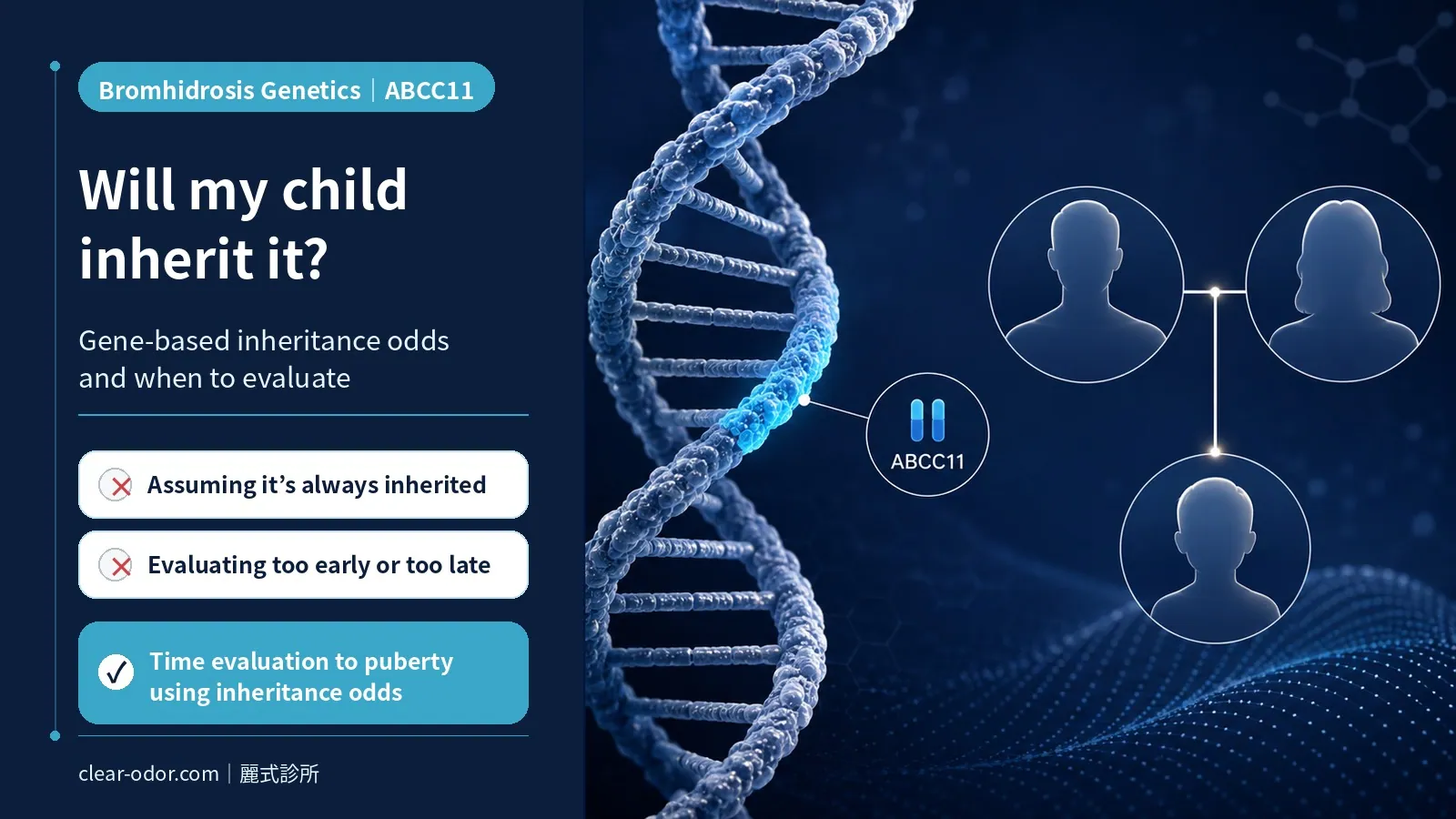
Yes, bromhidrosis runs in families. It is driven mainly by the ABCC11 gene and follows dominant inheritance: 98.7% of 79 Japanese osmidrosis patients carried the G allele (Nakano 2009, PMID 19650936). In a Hangzhou series of 174 patients who had apocrine gland surgery, 77.6% (135/174) reported a family history (Ren 2017, PMID 28485377).
When parents bring a child for consultation, the first question is often: "I have bromhidrosis — will my child have it too?" "If only one of us has it, what are the odds for our child?" There is still a gap between "inheriting the gene" and "actually showing strong odor." This article covers how to estimate the odds from family history, why the same gene can mean different intensities, and how to watch a child when there is a family history.
Inheritance Probability at a Glance
The table below is a Mendelian estimate of the chance that a child carries G. Carrying G is not the same as having bromhidrosis: 35.4% of 161 people in a Japanese general-population sample carried G, and most had no clinically troubling odor (Nakano 2009, PMID 19650936).
| Parent status | Estimated chance child carries G | Likelihood of detectable odor |
|---|---|---|
| Both parents affected | ~75% or higher | High; intensity often pronounced |
| One parent affected | ~50% or higher | Moderate; large individual variation |
| Neither parent affected, both with dry earwax | Close to 0 (both parents are A/A) | Very low; odor in the child is usually ordinary sweat odor |
"Or higher" because an affected parent who is G/G passes G to every child. "Close to 0" in the third row assumes both parents are genetically A/A; judging earwax by eye can be wrong, so ask a doctor if unsure. Carrying the gene also does not mean the same odor intensity — see the modulating factors below.
ABCC11 and the Dominant Inheritance Mechanism
Bromhidrosis predisposition is set by position 538 of the ABCC11 gene on chromosome 16. The G version pushes odor precursors out of apocrine gland cells; in people with two A copies (A/A), these precursors are barely secreted (Martin 2010, PMID 19710689). The same gene decides whether earwax is wet or dry; the mechanism and population differences are covered in Does Wet Earwax Mean Bromhidrosis? A Home Self-Check.
- ABCC11 dominant allele (G type): high apocrine secretion activity; secretion contains more lipids and proteins susceptible to bacterial breakdown — prone to bromhidrosis odor and wet earwax.
- ABCC11 recessive allele (A type): low apocrine activity; secretion is sparse and less likely to generate strong odor — associated with dry earwax and minimal bromhidrosis.
Because G is dominant over A, inheriting just one G allele from either parent can produce a bromhidrosis tendency.
This also explains why East Asian populations (high A-type frequency) have lower overall bromhidrosis prevalence than European populations. Within any individual family that carries G, however, the inheritance probability still needs to be assessed case by case.
Probabilities by Parent Status
Following dominant inheritance:
Both parents affected (genotypes typically GG or GA)
- The child almost certainly inherits at least one G allele
- Chance that the child carries G is around 75% or higher
- If both parents are GG, theoretically all children carry G
One parent affected, the other not
- The affected parent carries at least one G; the unaffected parent is AA
- Chance that the child carries G is around 50%; if the affected parent is G/G, every child carries G
Neither parent obviously affected
- If both parents are genetically A/A (dry-earwax type), the child can only inherit A, so a bromhidrosis predisposition is very unlikely; judging earwax by eye can be wrong, though
- When "neither parent has it, but the child does," one parent usually carries G (wet earwax) with odor mild enough to go unnoticed; the child's chance of carrying G is then at least half, the same as "one parent affected"
Probabilities are guides, not guarantees — individual results may vary. Family history "intensity" and "age of onset" are additional clues a doctor will weigh during assessment.
To estimate a child's odds, the parents' earwax is a more practical clue than trying to recall whether they smell. Genetically, A/A (the dry-earwax type) cannot pass on G, and wet earwax means at least one G (Yoshiura 2006, PMID 16444273). Self-assessment can be wrong, though: of 15 Han Chinese osmidrosis patients who reported dry earwax, 9 were actually G/A (Ren 2017, PMID 28485377). If unsure, ask a doctor. A child's own earwax type is visible from birth, but odor only appears once the apocrine glands start secreting around puberty.
Why "Same Gene" Can Still Mean Different Intensities
Parents often ask: "Both my spouse and I have bromhidrosis — why is one child very noticeable and the other almost not?" This is common. The reason is that carrying the ABCC11 G gene only sets the potential of secretion composition; it does not directly fix odor intensity. Final intensity is modulated by:
- Number and density of apocrine glands — varies between individuals; partly polygenic
- Strength of pubertal hormonal stimulation — sex hormones trigger apocrine activation
- Skin microbiome composition — different Corynebacterium ratios change breakdown product levels
- Environment — climate, humidity, fabric, hygiene habits, stress, diet
- Body weight and sweat activity — higher BMI or coexisting hyperhidrosis tends to amplify odor
In short: inheritance provides the "fuel" (apocrine secretion); whether the "fire" is large or small depends on the other variables. This is why siblings in the same family can differ widely in odor strength.
When Does Childhood Bromhidrosis Usually Begin
Even a child who carries G usually has no noticeable odor until around puberty, because apocrine glands need hormonal stimulation to start secreting. Adrenarche, when the adrenal glands begin producing androgen precursors, typically occurs at around 5 to 8 years of age (Voutilainen 2015, PMID 24923732). Adult-type body odor before age 8 in girls or age 9 in boys counts as early and is worth a pediatric endocrinology visit first (Novello 2018, PMID 29323690).
Onset age varies widely, and earlier does not mean more severe. Whether and when to treat is covered in more depth in Child Bromhidrosis: Which Doctor, and When Not to Operate.
Parent Self-Check When There Is a Family History
If you or your spouse has bromhidrosis, watch your child for:
Signals worth attention
- Pale yellow staining starts appearing on shirt armpits
- Detectable underarm odor returns within hours of bathing
- Your child becomes self-conscious (uses perfume, washes underarms repeatedly, avoids raising arms)
- Classmates or teachers have mentioned odor
- Your child has wet earwax (highly correlated with ABCC11 G)
Not yet a concern
- No odor yet and no staining on clothes
- Occasional sweat smell after exercise that disappears after a shower
- No wet earwax and only distant relatives are affected
Self-observation is a guide, not a diagnosis. If your child is already self-conscious or social life is affected, an in-clinic evaluation can distinguish "bromhidrosis tendency" from "ordinary adolescent sweat odor."
Recommended Evaluation Timeline for Children
For a child with a family history, timing is set by the child's own situation. For children under 12 we take a conservative, case-by-case approach: odor is often still changing at this stage and severity is hard to judge, the child needs to be able to cooperate with post-operative care, and the child needs to be psychologically ready. If odor is already affecting a child's social life or mood, we suggest coming in to talk at any age.
Fully removed apocrine glands do not grow back; the caution under 12 comes from the three reasons above. For how evaluation works and how to manage the waiting period, see Child Bromhidrosis: Which Doctor, and When Not to Operate. Dr. Ta-Ju Liu has 20 years of focus on axillary bromhidrosis, with over 10,000 cases (adolescent and adult combined), and can help families judge the right timing. Individual results may vary.
FAQ
I have bromhidrosis but my spouse doesn't — will our child definitely have it?
Not necessarily. The theoretical chance that the child carries G is about half (every child, if you are G/G), and even with G the child's odor may be much milder than yours. Start watching for shirt staining and odor changes around puberty; there is no need for preemptive worry.
Neither of us has bromhidrosis — could our child still have it?
Start with your own earwax. If you are both genetically A/A (dry-earwax type), the child can only inherit A, a bromhidrosis predisposition is very unlikely, and odor at puberty is usually ordinary sweat odor; judging earwax by eye can be wrong, so ask a doctor if unsure. If one of you has wet earwax, that parent may carry G with odor too mild to notice, and the child's chance of carrying G is about half. If clear odor emerges at puberty, an evaluation is still worth doing.
My child started having odor early — does that mean it will be especially severe?
Not necessarily. Onset age has no fixed relationship with adult odor intensity, and severity assessment cannot rely on onset age alone; a doctor combines secretion characteristics, staining patterns, and family history. Adult-type body odor before age 8 in girls or age 9 in boys is early, though, and a pediatric endocrinology visit comes first to rule out other hormonal causes (Novello 2018, PMID 29323690).
Will pediatric surgery affect development?
Bromhidrosis surgery (micro rotational curettage and similar techniques) addresses the apocrine layer beneath the skin, and in clinical practice it does not affect bone growth, sexual development, or height. For children under 12 we take a conservative, case-by-case approach; indications and timing require physician evaluation (see Child Bromhidrosis: Which Doctor, and When Not to Operate).
What if evaluation shows surgery isn't needed yet — what else can we do?
If the assessment is mild bromhidrosis or predominantly sweat odor, the doctor will usually start with: thorough washing and drying, breathable fabrics, age-appropriate antiperspirants, and, if the doctor judges it appropriate, short-term botulinum toxin injection. Re-evaluate based on how odor develops once full puberty is reached.
If the mother has bromhidrosis, is it passed to sons or daughters?
Sons and daughters have the same chance. ABCC11 sits on chromosome 16 (16q12.1), not a sex chromosome (Ren 2017, PMID 28485377), so it is passed on the same way from either parent. Actual odor intensity is shaped by pubertal hormones and varies from person to person.
Related Reading
- Apocrine Glands Explained: Anatomy, Function & Body Odor
- Body Odor, Sweat Smell & Bromhidrosis: 3 Different Smells
- How to Tell Three Body Odors Apart: Aging, Bromhidrosis, Sweat
- Child Teased for Body Odor at School? A 5-Step Parent Guide
- Kids' Body Odor: Normal Puberty or Clinical Bromhidrosis?
- Axillary Bromhidrosis
- Pediatric Bromhidrosis
Conclusion
Bromhidrosis is a notably inherited condition, but what's inherited is potential, not destiny:
- Both parents affected: ~75% or higher chance the child carries G
- One parent affected: ~50% or higher
- Both parents genetically A/A (dry-earwax type): the child is very unlikely to carry G
- Even with the gene, intensity is modulated by hormones, microbiome, and environment
- Odor usually appears around puberty; under 12 we take a conservative, case-by-case approach
If there's a family history, build the habit of observation before puberty (shirt staining, how soon odor returns after bathing, presence of wet earwax) and consult earlier when needed. Dr. Ta-Ju Liu has dedicated 20 years to axillary bromhidrosis treatment, with over 10,000 cases including multi-generational family experience, and can help map a sensible timeline.
Related Reading
- Child Bromhidrosis: Which Doctor, and When Not to Operate
- Body Odor, Sweat Smell & Bromhidrosis: 3 Different Smells
- Child Teased for Body Odor at School? A 5-Step Parent Guide
- Axillary Bromhidrosis
- Pediatric Bromhidrosis
This article is educational. Individual results may vary; actual treatment requires in-person evaluation by Dr. Ta-Ju Liu.