
Pediatric Body Odor: A Complete Micro-Surgery Guide
Busting the “Wait Until 20” Myth:Long-Lasting Results from Age 9 Through a Small (~4 mm) Incision
As children develop earlier than ever, body odor can appear as young as age 9. Dr. Liu stresses there is no need to wait until 20. Using a pediatric-specific micro rotational curettage through an entry incision of only about 4 mm, children can watch their favorite cartoons during the procedure and go back to school usually about 1 week after surgery (the dressing comes off around 3–5 days after surgery). Early treatment prevents bullying and psychological harm, with no recurrence reported to date over 15+ years of follow-up.
Table of Contents

Don't Let "Smelly Fox" Become a Childhood Trauma
Children today have better nutrition and develop earlier, combined with westernized diets, body odor is trending younger. Many parents bring their 5th-6th grade children for consultation, usually not for physical discomfort, but because they're psychologically hurt.

Social Exclusion
Being given hurtful nicknames by classmates (like "Smelly Fox", "Durian Person", "Big Smell")

Behavioral Withdrawal
Once cheerful children become quiet and afraid to leave their seats during breaks

Abandoning Interests
Deliberately giving up favorite sports to reduce sweating

Academic Decline
Unable to concentrate in class due to judgmental looks
"Treating children's body odor saves not just their sense of smell, but their social relationships and self-confidence."
— Dr. Ta-Ju Liu
Not sure which condition applies to you? See the body odor & hyperhidrosis conditions overview to compare each condition — definitions, ICD-10 codes, common symptoms, and when to see a doctor.
Myth Busted: Why Not Wait Until Age 20?
Once removed, apocrine glands do not grow back; whether it recurs depends on how thoroughly they are cleared, not on age — our youngest case was 9.
Internet rumors often say: "Body odor surgery should wait until fully developed at 20, otherwise stem cells will detect insufficient glands and 'regenerate' them, causing recurrence."
This is medically incorrect!
Apocrine glands, like hair follicles, cannot regenerate once destroyed or removed.
Dr. Liu's Clinical Evidence (15+ Years Experience)
Surgery performed at age 9
3+ years follow-up shows no recurrence reported to date, with normal development
Recurrence depends on "whether surgery removes glands completely," not age. With skilled technique and direct vision removal, long-lasting effect is achieved.
Is Surgery Safe for Children? Will My Child Be Scared?
Performed under gentle pain-relief anesthesia with cartoons and audio to keep the child calm; surgery is possible from age 9, and what matters is the child's cooperation and readiness, assessed by the doctor in clinic.
Considering children's fear of "surgery," Clear Odor Clinic has specially designed a child-friendly treatment process.

Gentle Pain-Relief Anesthesia
Local anesthesia at the underarm plus gentle pain-relief anesthesia — keeping the child relaxed and discomfort to a minimum; no general anesthesia

Entertainment Support
Operating room equipped with video equipment. Children can watch favorite cartoons (like Demon Slayer, YouTube) during surgery. Many children complete surgery while laughing at cartoons

Rapid Recovery
Extremely small incision (about 4mm at entry). Children's skin regenerates better than adults - dressing off around day 3–5, usually back to school in about 1 week, scars nearly invisible after healing

Golden Treatment Period
Strongly recommend surgery during winter or summer breaks. Adequate time for wound care, returning to school with a fresh start
If your child also has excessive sweating, in our own records this surgery also cuts underarm sweating by about 80–90% (individual results vary).See Hyperhidrosis Treatment
Real Case: 12-Year-Old Wei Wei's Transformation
Background
When Mrs. Chen brought 12-year-old Wei Wei to the clinic, Wei Wei kept his head down the entire time, not saying a word. Mrs. Chen said: "Wei Wei used to love playing basketball, but recently his sweat smell got strong and classmates called him 'Durian Person.' He's become very withdrawn now, refuses to play basketball, and locks himself in his room after coming home."
Treatment
After evaluation, Wei Wei had micro rotational curettage during summer break. During surgery, he watched "Demon Slayer" intently and was surprised when it ended, asking "It's done already?"
Follow-up Result
At the follow-up about one month after surgery, Wei Wei was already back on the basketball court. Mrs. Chen expressed relief that her child no longer worries about others smelling him, smiles more, and has returned to his previous cheerful personality.
Does My Child Need General Anesthesia? Will It Hurt?
Child-Friendly × Full Support × Fast Recovery
Performed under gentle pain-relief anesthesia — not general anesthesia — with cartoons and audio for comfort; safety is assessed case by case by the doctor.
Family Consultation
Detailed discussion with parents and child, assess suitability; the doctor assesses the odor source and marks the treatment area
Gentle Pain-Relief Anesthesia
Local anesthesia combined with gentle pain-relief anesthesia — the child stays relaxed, breathes on their own, and is monitored throughout, with discomfort kept very low
Micro Rotational Curettage
Through a micro-incision about 4mm at entry, thoroughly remove apocrine glands under direct vision. Can watch cartoons throughout, procedure takes about 1.5–2 hours
Post-op Care Instructions
Compression dressing (removed 3–5 days after surgery), detailed post-op care guidance, stitches removed at the day-14 visit to ensure smooth recovery


Want to Learn More?
Every patient is unique. Dr. Liu will personally evaluate the best treatment plan for you.
Book Online ConsultationHow Soon Can My Child Return to School After Surgery?
Rest at home is recommended until the dressing comes off (around 3–5 days after surgery); once the wound is more stable, your child can usually go back to school about 1 week after surgery, with care around arm movement, wound care and keeping the area dry. Scheduling during a school break is recommended, and the details are assessed case by case by the doctor.
Dressing off around day 3–5, usually back to school in about 1 week, normal arm use from about day 30, once the wound has fully healed
- •Mild swelling for first 2-3 days is normal
- •Keep the underarms dry until the stitches are removed on day 14 and the clinic confirms the wound has healed (you can send the clinic a photo; slower healers may need another 2–3 weeks)
- •No lifting, pushing or carrying heavy objects and no strenuous exercise for 14 days; keep arm movement light from day 14 to day 30, and from about day 30, once the wound has fully healed, normal arm use can resume (check with the doctor before strenuous exercise)
- •Recommend scheduling surgery during school breaks
- •Stitches removed at the day-14 visit to ensure proper healing
About the Author

Dr. Ta-Ju Liu
Lead Physician, Clear Odor Clinic
- Over 15 years of pediatric/adolescent body odor surgery experience
- Over 10,000 micro-incision procedures (adults and children)
- Board-certified Dermatologist
- Adheres to "Clean First" principle - no recurrence reported to date in pediatric cases
- Expert in micro rotational curettage for apocrine glands
"Watching a child go from lowering their head in shame to laughing confidently after surgery - this is my greatest achievement as a doctor."
FAQ - Six Essential Questions for Parents
Q1: At what age can children have body odor surgery?
Generally recommended for ages 9 and above. As long as the child can cooperate lying on the operating table for about 1.5–2 hours (we play cartoons to help), and the doctor assesses good physical condition, surgery can be performed.
Q2: Will surgery affect my child's development?
In our experience not. Surgery only removes the "apocrine glands" under the skin, without involving growth hormones, bones, muscles, or lymphatic system. Our long-term clinical follow-up shows that children who had surgery developed completely normally in height, weight, and secondary sexual characteristics.
Q3: My child is very afraid of pain. Will they cry on the operating table?
Parents can rest assured. We pay great attention to children's psychological feelings. Besides a detailed, gentle pre-operative explanation, we use "local anesthesia plus gentle pain-relief anesthesia": on top of numbing the underarm with local anesthesia, we add gentle pain-relief anesthesia to keep the child relaxed and discomfort very low (no general anesthesia; the child breathes on their own throughout). With cartoons playing, most children complete the surgery calmly and smoothly.
Q4: Will it really not recur?
As long as removal is thorough, recurrence is uncommon. Dr. Liu follows the "Clean First" principle, using rotational curettage to carefully remove apocrine glands. Apocrine glands cannot regenerate - our pediatric cases have had no recurrence reported to date.
Q5: When is the best time for surgery?
Winter or summer break is ideal. The compression dressing comes off around 3–5 days after surgery; once the wound is more stable, children can usually go back to school about 1 week after surgery, but the underarms must stay dry until the stitches are removed on day 14 and the clinic confirms the wound has healed, and arm movement and heavy lifting still need care. Surgery during long breaks allows children to recover at home without worrying about PE class absences or changing dressings at school.
Q6: What if my child is too young or strongly resists surgery?
There are options. If surgery isn't suitable yet, we can discuss non-surgical suppression therapies (like non-invasive thermal energy or Botox injections). While not as long-lasting as surgery, they can help children through social difficulties until they're older and mentally ready for surgery.
How is the appropriate treatment plan determined?
Treatment depth varies based on the child age and development stage, severity, and whether hyperhidrosis is involved. Dr. Liu will explain the appropriate plan in detail after personally evaluating your child at the initial consultation. Parents can also start with a LINE consultation to understand the process and whether bringing the child in is needed yet.
How many days off school will my child need after surgery?
We recommend rest at home until the dressing comes off, around 3–5 days after surgery; once the wound is more stable, your child can usually go back to school about 1 week after surgery. Once back, take care with arm movement and wound care, and keep the underarms dry until the stitches are out.
Related Services
Learn More About Pediatric Odor
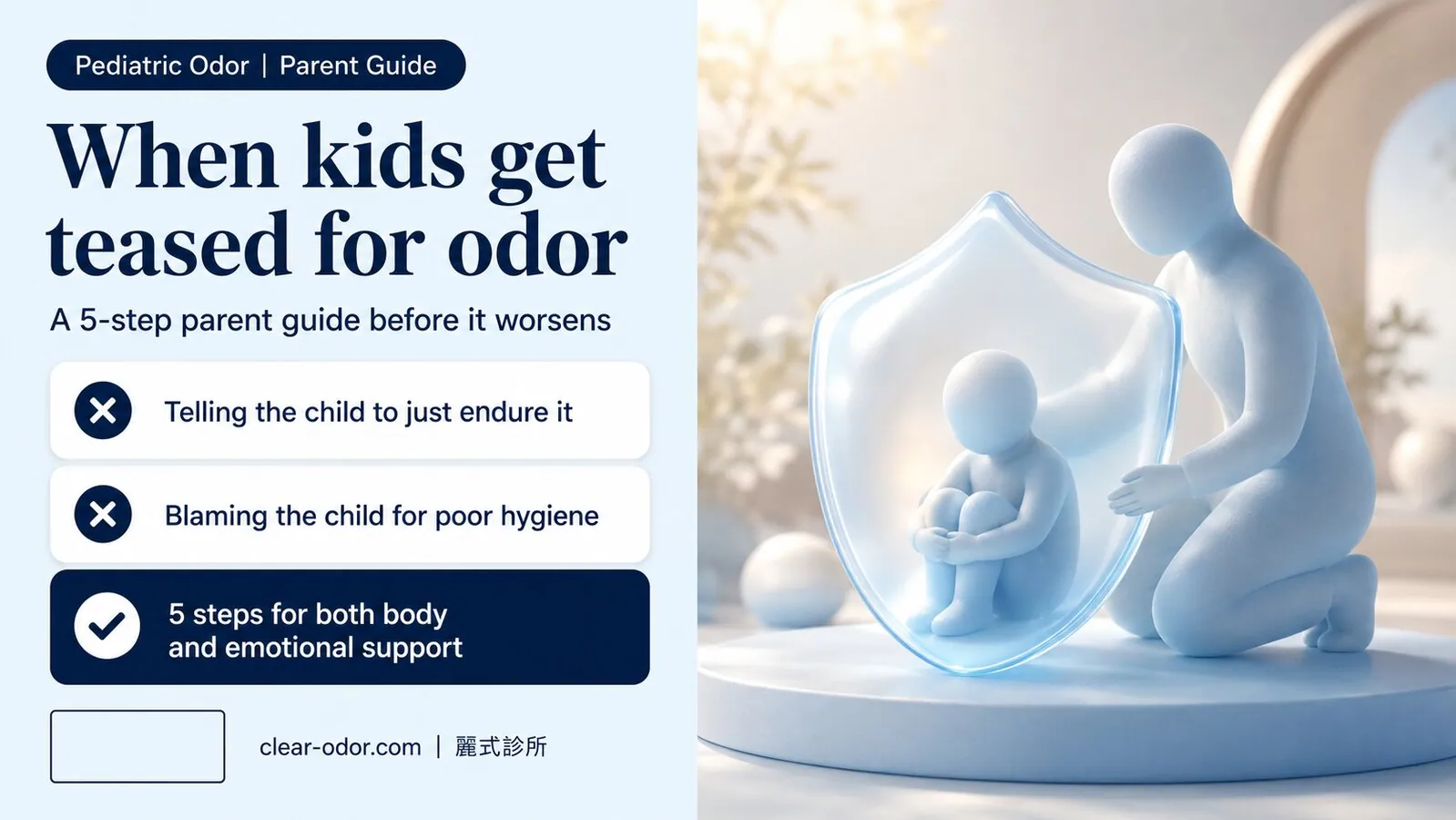
Child Teased for Body Odor at School? A 5-Step Parent Guide
When a child gets a nickname, gets left out of group work, or suddenly refuses to go to school, the parental instinct is often to interrogate or charge into the teacher's office. That usually makes things worse. Dr. Ta-Ju Liu walks through a 5-step intervention guide.
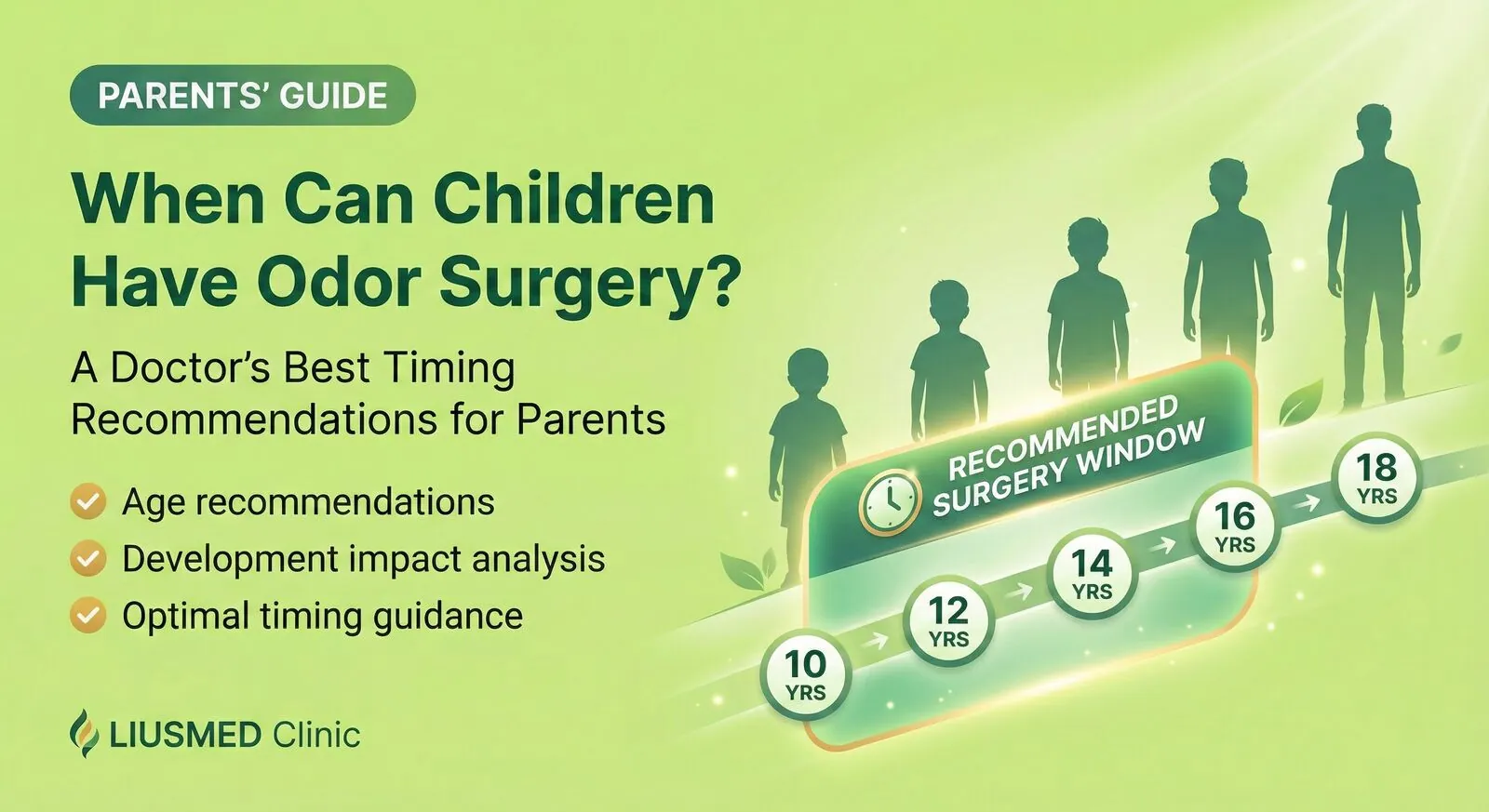
Child Bromhidrosis: Which Doctor, and When Not to Operate
Which specialty should you see, and at what age? Dr. Ta-Ju Liu on why the question isn't 'how young can we operate' but 'should we operate now' — and the cases where he tells parents to wait.
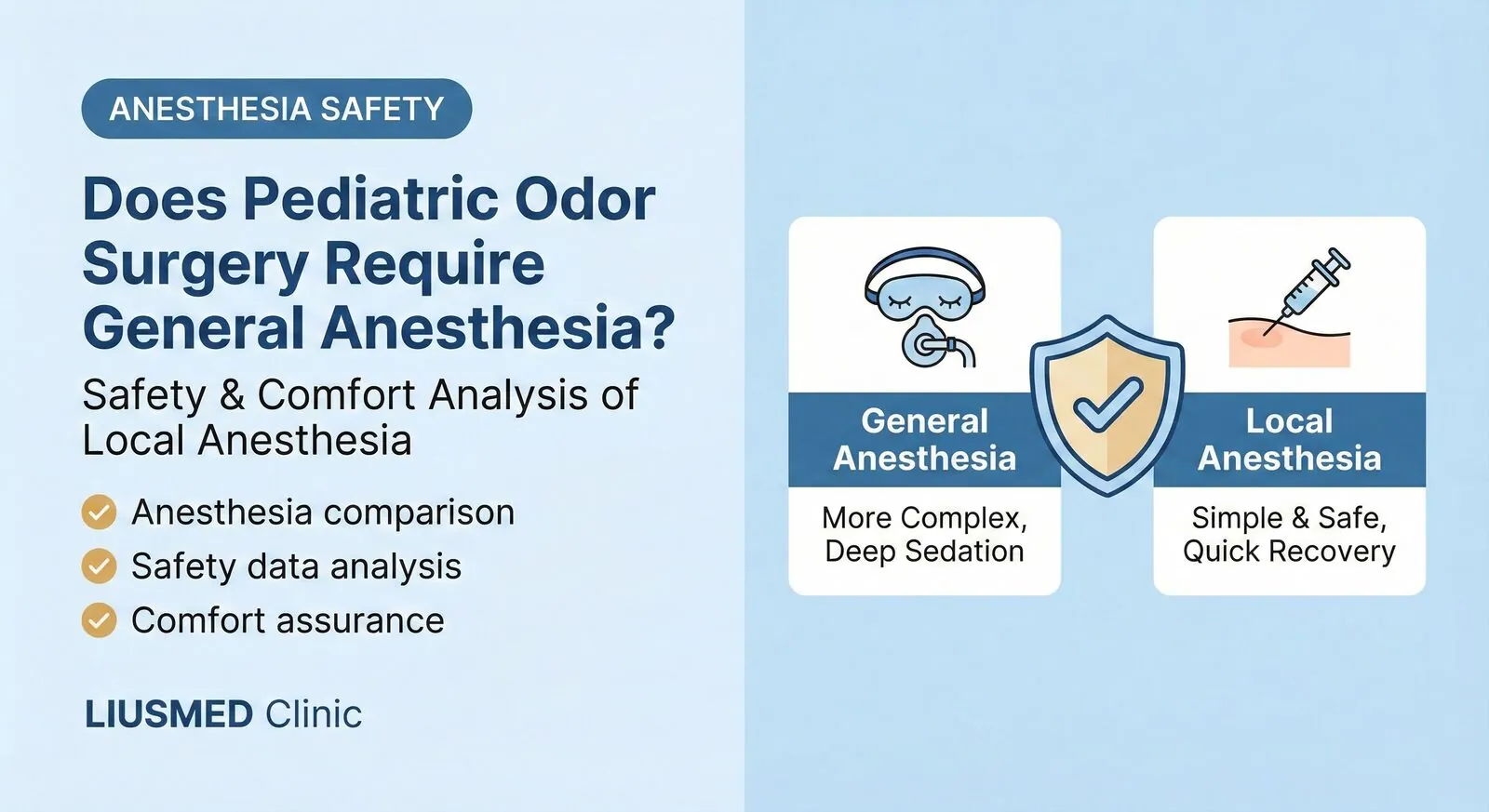
Children's Odor Surgery Without General Anesthesia
For pediatric body odor surgery, our clinic uses gentle pain-relief anesthesia across the board—not general anesthesia. On top of local anesthesia at the underarm, we add gentle pain-relief anesthesia to minimize discomfort during surgery. Dr. Liu explains how this approach balances safety and comfort.
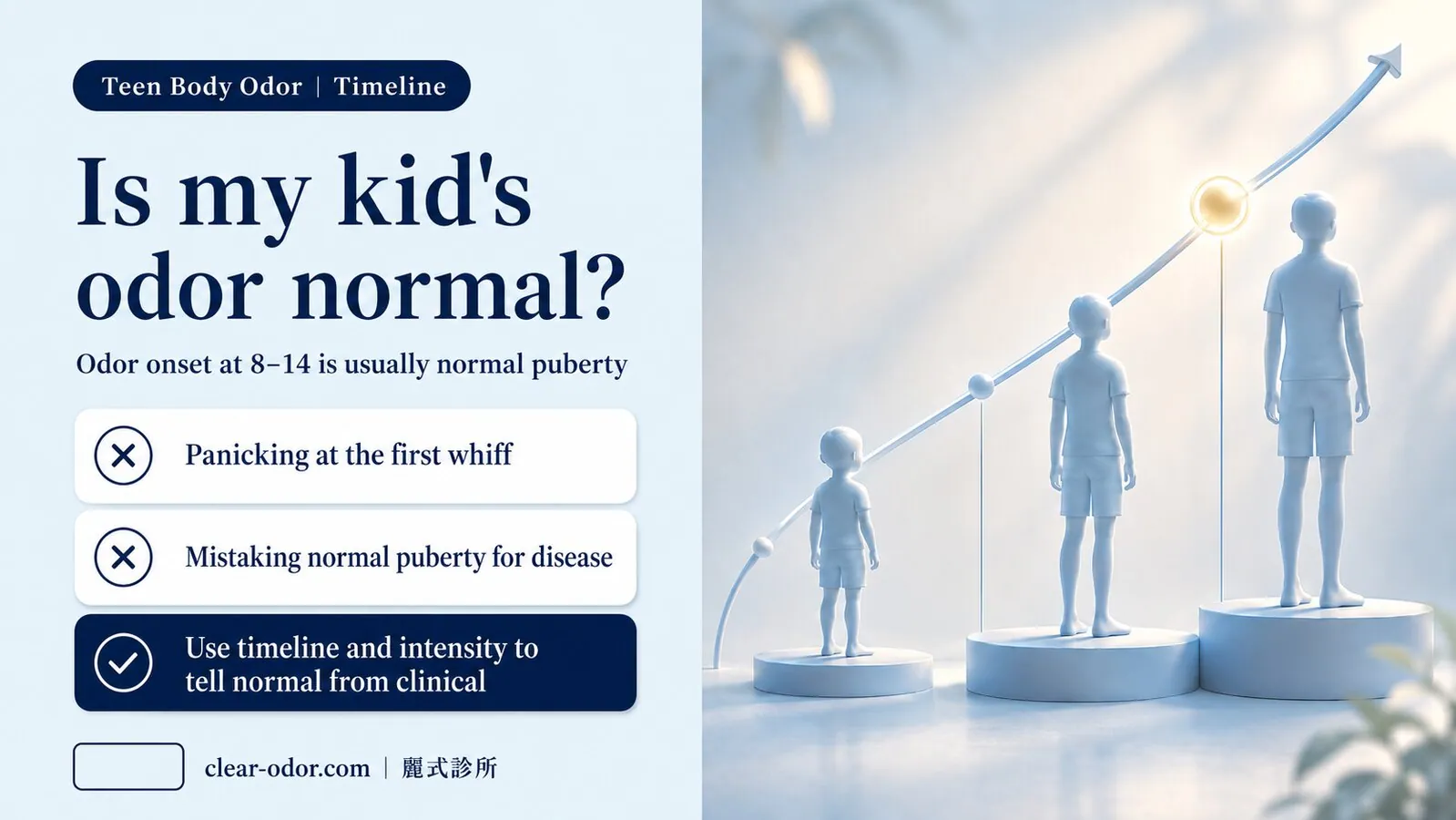
Kids' Body Odor: Normal Puberty or Clinical Bromhidrosis?
Your 10-year-old's underarms suddenly smell — is this normal puberty or something more? Body odor onset between ages 8 and 14 is all within the normal range, but the chemistry, intensity, and timing matter. Dr. Ta-Ju Liu explains the developmental timeline, how to distinguish typical puberty odor from clinical bromhidrosis, and when parents should book a consultation.

Is Bromhidrosis Genetic? Inheritance & When to Check Kids
Bromhidrosis has a strong inherited tendency. Dr. Ta-Ju Liu explains the dominant inheritance of the ABCC11 gene, the probabilities when one or both parents are affected, why carrying the gene does not always mean the same intensity, and a sensible observation and evaluation timeline for children with a family history.
Conservative care not enough?
Your child's source is apocrine odor?
If your child's source is apocrine bromhidrosis, the surgical page covers evaluation for children and teens, by Dr. Ta-Ju Liu.
⚕️ Medical Disclaimer
The medical information provided on this page is for reference only and cannot replace individual face-to-face diagnosis, advice, or treatment from a physician. All medical procedures carry risks. Individual constitution and post-operative recovery vary from person to person. Please discuss any treatment plan with your attending physician before making decisions.

Help Your Child Regain Confidence
Early resolution of body odor concerns for happy childhood growth. Book a consultation for professional evaluation of the best treatment plan for your child.
Book ConsultationWhat this treatment delivers
Core procedure
- Suitable for ages 9+ · micro-incision about 4mm at entry
- Watch cartoons during the procedure · parent stays with the child
- Dressing off around day 3–5, usually back to school in about 1 week · winter/summer break ideal
- Does not affect growth, development, or puberty
Clinical track record
- Extensive clinical experience in pediatric body odor surgery
- 15 years of clinical follow-up · no recurrence reported
- One of the few clinics in Taiwan focused on pediatric odor treatment
Individual results may vary. Clinical data referenced from internal long-term follow-up records.
Included in your treatment
- Suture removal included
- 30-day wound care follow-up
- Post-op visits at day 14, month 1, month 3 — all included
Recovery bonus included
Every patient receives this
- Post-op LED light therapy session ×1 (included)
Liu's Post-Op Recovery Protocol
- Swelling integration program
- Bruising-clearance program
- Tissue-recovery integration program
Individual results may vary. Listed items are included in the treatment package.
Our commitment to you
Personalized treatment plan
Treatment ladder recommendations based on severity and lifestyle · including non-surgical options
30-minute direct evaluation by surgeon
Not a sales pitch · Dr. Liu performs the evaluation in person
Pre-op guide + 90-day LINE follow-up
Reach us via LINE anytime in the first 90 days · replies within 2 hours during business hours
Sutures, follow-ups, recovery protocol all included
Day-14, month-1, month-3 visits + post-op LED therapy + Liu's Post-Op Recovery Protocol — all included
Written informed consent
Procedure scope and recovery timeline confirmed in writing · signed only after Dr. Liu explains in person
Want to talk it through first?
Message our clinic team in your own language — messages are auto-translated.
LIUSMED International Patient Services
Start a consultationReal staff usually reply within 2 hours during business hours. A trained AI assistant answers basic questions right away, and you can ask for a person at any time. Available in 19 languages: just write in your own language and we will reply in it. Your conversation is saved, so you can pick up where you left off.
Telegram
Message us on Telegram
Scan to start
Chat with our clinic team — real staff reply, auto-translated in real time.
Opens in a new tabLINE
Add us on LINE
Scan to add
Our international LINE — real staff reply, messages auto-translated.
Opens in a new tab