
Gentle Palm & Foot Sweat Treatment Guide
Break Free from Compensatory Sweating FearGentle Nerve Block × Precision Gentle Botox
One non-surgical option for palmar and plantar hyperhidrosis is Botox injection to temporarily suppress sweat gland activity (use on the palms and soles is off-label and requires a physician's assessment). Palms are densely innervated, and injection pain puts many people off. The gentle nerve block used at Clear Odor Clinic, combined with gentle pain-relief anesthesia (not general anesthesia), substantially reduces discomfort during injection, so the physician can cover the palm at roughly one injection per centimetre while you stay relaxed. A single session lasts about 4–6 months, varying by person.
Botox treatment details & booking
Palm Botox treatment is covered on our sister clinic site
The palm Botox treatment (nerve block + gentle pain-relief anesthesia, not general anesthesia) is fully explained and booked on our sister site, minimalcutsurgery.com, with assessment by Dr. Ta-Ju Liu.
Prefer to start with conservative care? See our guides on iontophoresis and topical antiperspirants and other non-surgical options.
Table of Contents

Why Are Palm and Foot Sweating So Severe?
Primary hyperhidrosis comes from an overactive sympathetic nervous system — not hygiene or psychology — and a US national survey put the prevalence at 4.8% (Doolittle 2016, PMID 27744497 — a self-report online panel funded by a pharmaceutical company; an earlier 2004 survey put it at 2.8%).
Constantly wiping hands before important meetings, exam papers always wrinkled and smudged, fingers slipping on piano keys during practice — Primary Hyperhidrosis stems from an overactive sympathetic nervous system. It's not a hygiene or psychological issue; a US national survey put the prevalence at 4.8% (Doolittle 2016, PMID 27744497 — a self-report online panel funded by a pharmaceutical company; an earlier 2004 survey put it at 2.8%). Several treatment options exist today, and you can discuss with a physician which one suits you.

Social Anxiety
Cold, clammy palms prevent confident handshakes at important events

Daily Struggles
Wrinkled papers, slippery phone, affected typing

Activity Limitations
Can't grip properly for sports, foot sweat makes sandals impossible

Psychological Burden
Painful past treatment puts people off, so they suffer in silence
"When the patient can relax, the physician can focus on placing each injection and cover the whole palm, fingertips included — that is why we take pain control seriously."
— Dr. Ta-Ju Liu
Not sure which condition applies to you? See the body odor & hyperhidrosis conditions overview to compare each condition — definitions, ICD-10 codes, common symptoms, and when to see a doctor.
Why ETS Surgery and Standard Injections Don't Suit Everyone
Compensatory sweating after ETS runs about 62% in pooled data (3,117 patients); when pain is poorly controlled, palm injections are harder to spread evenly.
Many patients believe "only surgery handles hand sweating long-term" or "Botox injections must be very painful." Both ideas are worth revisiting.
Compensatory sweating after ETS runs about 62%; with poorly controlled pain, even coverage is harder.
ETS severs nerves on a long-term basis; a meta-analysis of 10 studies and 3,117 patients puts compensatory sweating at 62% (95% CI 51–72%), with 23% severe (PMID 40124609). Palms are densely innervated with thick skin, so topical numbing alone is not enough for some people; in pain it is hard to relax, spacing tends to widen, and the fingertips are harder to cover fully.
Why Pain Control Matters: A More Comfortable, More Complete Injection
Tense → Spacing tends to widen → Fingertips harder to cover → More likely to stop treatment midway
Relaxed → About 1 injection/cm → More complete coverage to the fingertips → More likely to finish the full session
Pain control makes the injection more comfortable and coverage more complete; it does not mean results last longer. Results last about 4–6 months, varying by person.
What Non-Surgical Options Treat Palm and Foot Sweating?
Nerve-block Botox, iontophoresis, and topical antiperspirant medication — three non-surgical options matched to severity.
Depending on sweating severity and lifestyle, these are the common non-surgical choices. In most markets Botox is approved only for severe primary axillary (underarm) hyperhidrosis; use on the palms and soles is off-label and requires a physician's assessment.

Gentle Nerve Block Botox
A nerve block at the wrist numbs the median, ulnar, and superficial radial nerves, combined with gentle pain-relief anesthesia (not general anesthesia) to substantially reduce injection discomfort. In a relaxed state, Botox is injected at about 1 injection/cm, ~50-80 per hand, covering the fingertips. The effect appears within about 1 week and lasts about 4–6 months, varying by person.

Smart Iontophoresis STOPWET
Taiwan's first iontophoresis device with US FDA 510(k) clearance. A mild electrical current temporarily reduces sweat output. A non-invasive home maintenance option, suitable for ages 13+, and a good fit for mild-to-moderate cases or patients who prefer to avoid injections.

Anticholinergic Topical Lotion
Anticholinergic prescription lotion (oxybutynin 20%), approved in Taiwan for primary palmar hyperhidrosis in patients aged 12 and over and prescribed after a physician's assessment. Applied once nightly; sweating gradually returns when stopped. Not for people with narrow-angle glaucoma, urinary retention or who are breastfeeding, among other contraindications.

Simultaneous Hand & Foot Treatment
Nerve block principles are identical for hands and feet. Hands: median, ulnar, and superficial radial nerves. Feet: a nerve block at the ankle. Both can be completed in a single visit, and feet can also be done one at a time.
We provide customized treatment recommendations based on your sweating severity and lifestyle.See Hyperhidrosis Treatment
A Common Clinic Scenario: Stopping Treatment Out of Fear of Pain
The Situation
We often see people like this: their work involves frequent handshakes and they have lived with sweaty palms for years; they had palm Botox before, found it very painful, never completed treatment, and wipe their hands in secret before important meetings.
Our Approach
In these cases we first explain the anesthesia: a wrist nerve block combined with gentle pain-relief anesthesia (not general anesthesia), and you can talk with the physician, pause, or adjust at any time. In a relaxed state, the physician can more fully cover both hands at about one injection per centimetre.
What to Expect
The Botox effect usually appears within a week and lasts about 4–6 months on the palms, varying by person; it is temporary, gradually wears off, and needs periodic repeat injections.
How Is the Treatment Done? Will It Hurt?
Nerve Block + Gentle Pain Relief × High-Density Injection × Done in One Visit
Done under a nerve block (local anesthesia) plus gentle pain-relief anesthesia — not general anesthesia — with greatly reduced discomfort, completed in one visit. Do not drive yourself that day.
Personalized Consultation & Assessment
An iodine-starch test maps the sweating area and severity, and we discuss a suitable treatment plan
Nerve Block + Gentle Pain Relief
Sensory nerves are located at the wrist/ankle for a nerve block, then gentle pain-relief anesthesia helps you relax (not general anesthesia); you can talk with the physician throughout
High-Density Injection
In a relaxed state, Botox is injected evenly at about 1 injection/cm, covering the fingertips
On the Day
Completed in one visit; after a brief observation period, do not drive yourself that day. The nerve block leaves the hands dull and clearly numb for about 4–6 hours; keep them away from water for the first 4 hours. The anti-sweat effect appears within about a week and lasts about 4–6 months, varying by person


Want to Learn More?
Every patient is unique. Dr. Liu will personally evaluate the best treatment plan for you.
Book Online ConsultationPost-Treatment Recovery
You can go home after a brief observation period; the nerve block leaves the hands dull and clearly numb for about 4–6 hours, after which most people return to daily activities. The effect appears within about a week
- •Do not drive yourself on the day of gentle pain-relief anesthesia; please arrange a ride
- •For about 4–6 hours after the nerve block your hands are clearly numb: fine movements and properly bending your fingers are not possible, and your hands should stay away from water for the first 4 hours
- •Botox acts mainly on sweat glands; a few people notice temporary grip weakness that usually fades within weeks
- •Typing and phone use are fine once the numbness wears off
- •Come back for assessment when the effect fades (about 4–6 months, varies by person)
- •Hand and foot sweating can be treated in the same visit; if both feet are done together, the feet feel weak and walking is harder for about 4–6 hours, so you can also choose to treat one foot at a time
- •Several Botox brands are available; you can discuss the choice with your physician
About the Author

Dr. Ta-Ju Liu
Director, Clear Odor Clinic
- 20+ years in clinical aesthetic medicine; 15+ years treating hyperhidrosis
- Board-certified Dermatologist (Taiwan)
- Upholds "Precision Seeing, Minimal Incision, Minimal Discomfort"
"Helping every patient return to daily life with dry, warm hands — this belief drives our continuous pursuit of technical excellence."
Frequently Asked Questions (FAQ)
Q1: Does Botox for hand/foot sweating hurt?
Discomfort can be greatly reduced. We use a nerve block (local anesthesia) on the sensory nerves of the hand/foot, plus gentle pain-relief anesthesia to help you relax (not general anesthesia), so the high-density injections that follow are much more comfortable; some sensation may remain, varying by person.
Q2: Will it cause compensatory sweating?
Botox is a local, temporary suppression of sweat glands that does not cut nerves. Its mechanism differs from ETS surgery, which severs the sympathetic nerve, and it generally does not cause the kind of compensatory sweating seen after ETS.
Q3: How long do results last?
About 4–6 months per session, varying by person. The effect is temporary, gradually wears off, and needs periodic repeat injections.
Q4: Will hand dexterity be affected?
Botox acts mainly on sweat glands, and superficial injection lowers the chance of affecting deeper muscles; a few people notice temporary grip weakness that usually fades within weeks. Typing is fine once the numbness wears off.
Q5: Do I need rest after treatment? Will daily activities be affected?
You can go home after a brief observation period, but do not drive yourself on the day of gentle pain-relief anesthesia; please arrange a ride. The nerve block leaves your hands dull and clearly numb for about 4–6 hours: fine movements and properly bending your fingers are not possible during that time, and your hands should stay away from water for the first 4 hours. Once the numbness wears off, most people return to work and daily life.
Q6: Can pregnant/breastfeeding women receive treatment?
Not recommended due to insufficient safety data. We suggest iontophoresis or topical medications as alternatives.
Q7: How do topical meds/iontophoresis differ from Botox?
Topical meds and iontophoresis are ongoing maintenance — stop using them and sweating returns. A Botox session lasts about 4–6 months, varying by person, with no daily routine needed.
Q8: Can hand and foot sweating be treated simultaneously?
Yes. Same principles, different nerve locations. Hands: median, ulnar, and superficial radial nerves. Feet: a nerve block at the ankle. Both in one visit. If both feet are done together, the feet feel weak and walking is harder for about 4–6 hours after the nerve block, so you can also choose to treat one foot at a time.
Q9: Can long-term injections cause resistance?
A small number of people may develop antibodies over long-term use, reducing the effect; the likelihood depends on the individual. Several Botox brands are available, and you can discuss brand choice with your physician. Come back for assessment when the effect fades.
Q10: Which treatment should I choose for my first visit?
Milder cases can start with iontophoresis or topical antiperspirant medication; if hand/foot sweating clearly affects daily life (e.g., handshakes or typing), you can discuss Botox with your physician. The choice depends on your assessment.
Related Services
Learn More About Palmar Hyperhidrosis
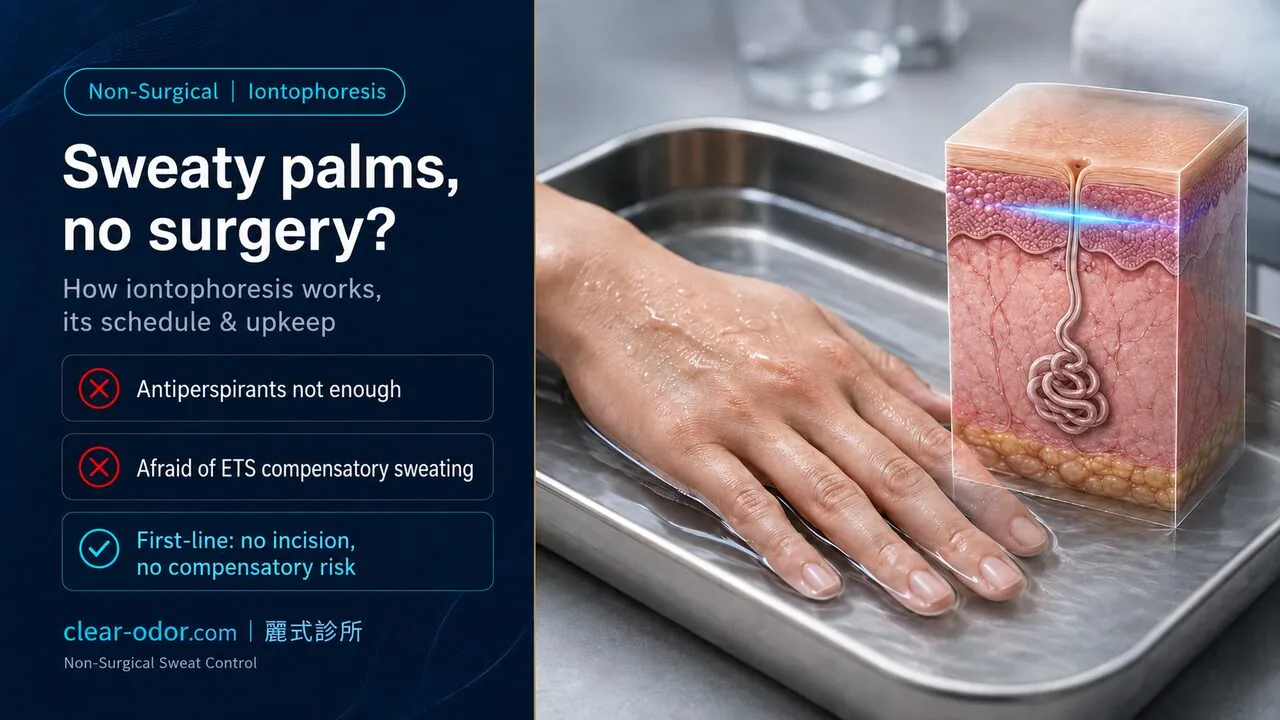
Iontophoresis for Sweaty Palms: Devices, Frequency, Results
Iontophoresis is the first-line non-surgical treatment for palmar hyperhidrosis — the step between antiperspirants and surgery. Dr. Ta-Ju Liu explains how it works, clinic vs home devices, loading and maintenance schedules, and contraindications.
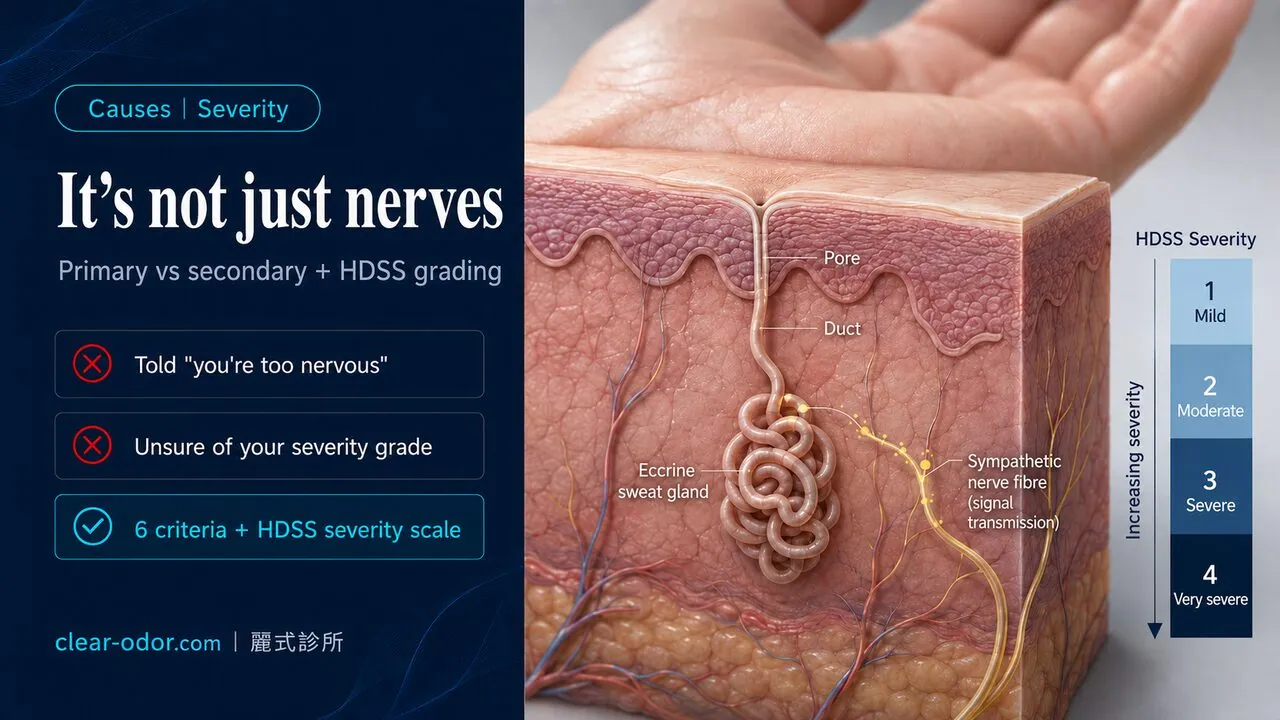
Why Palms Sweat: Primary vs Secondary & a Severity Check
Sweaty palms are not simply about being nervous. Dr. Ta-Ju Liu explains primary vs secondary hyperhidrosis, the sympathetic-nerve signal overload behind it, 6 diagnostic criteria and the HDSS severity scale.

Sweaty Palms Without Surgery: Iontophoresis, Topicals, or Botox?
Primary hyperhidrosis affects about 5% of people, and traditional surgery carries a risk of compensatory sweating. This article compares three non-surgical options: home iontophoresis devices, topical anticholinergic prescriptions, and Botox injections given under nerve-block anesthesia.
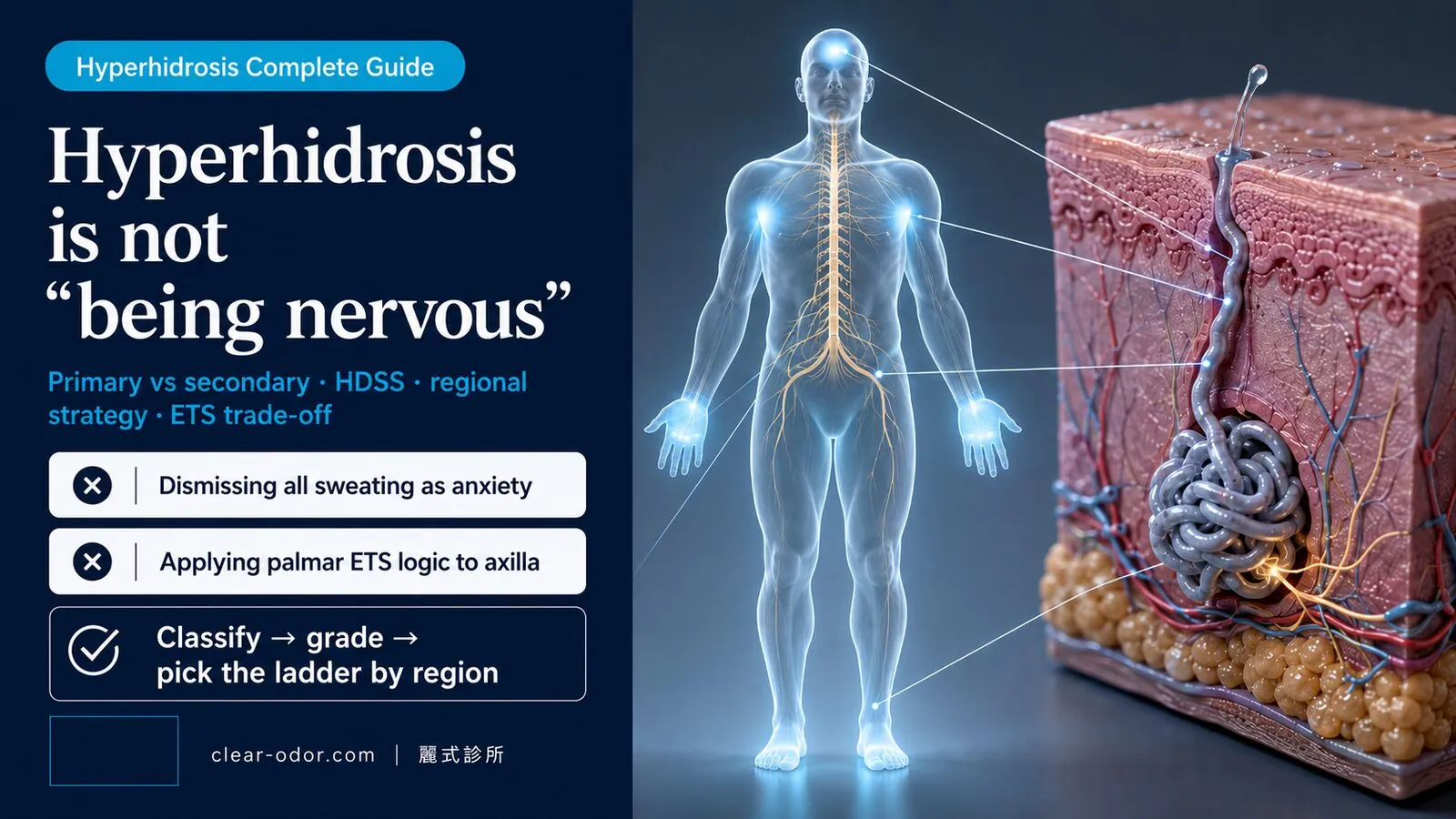
Hyperhidrosis Guide: Types, Severity, Treatments & ETS
Hyperhidrosis is not 'being nervous' — it's a constitutional condition where overactive sympathetic signaling drives sweat glands beyond thermoregulatory need. Dr. Ta-Ju Liu walks through the primary vs secondary distinction, HDSS grading, body-region strategy (palmar, axillary, plantar, craniofacial, generalized), the full antiperspirant→iontophoresis→anticholinergic→Botox→microwave→ETS ladder, the ETS compensatory-sweating trade-off, and a non-nerve-cutting thermolysis pathway for patients already affected by compensatory hyperhidrosis. 12 of the most common decision-making questions.
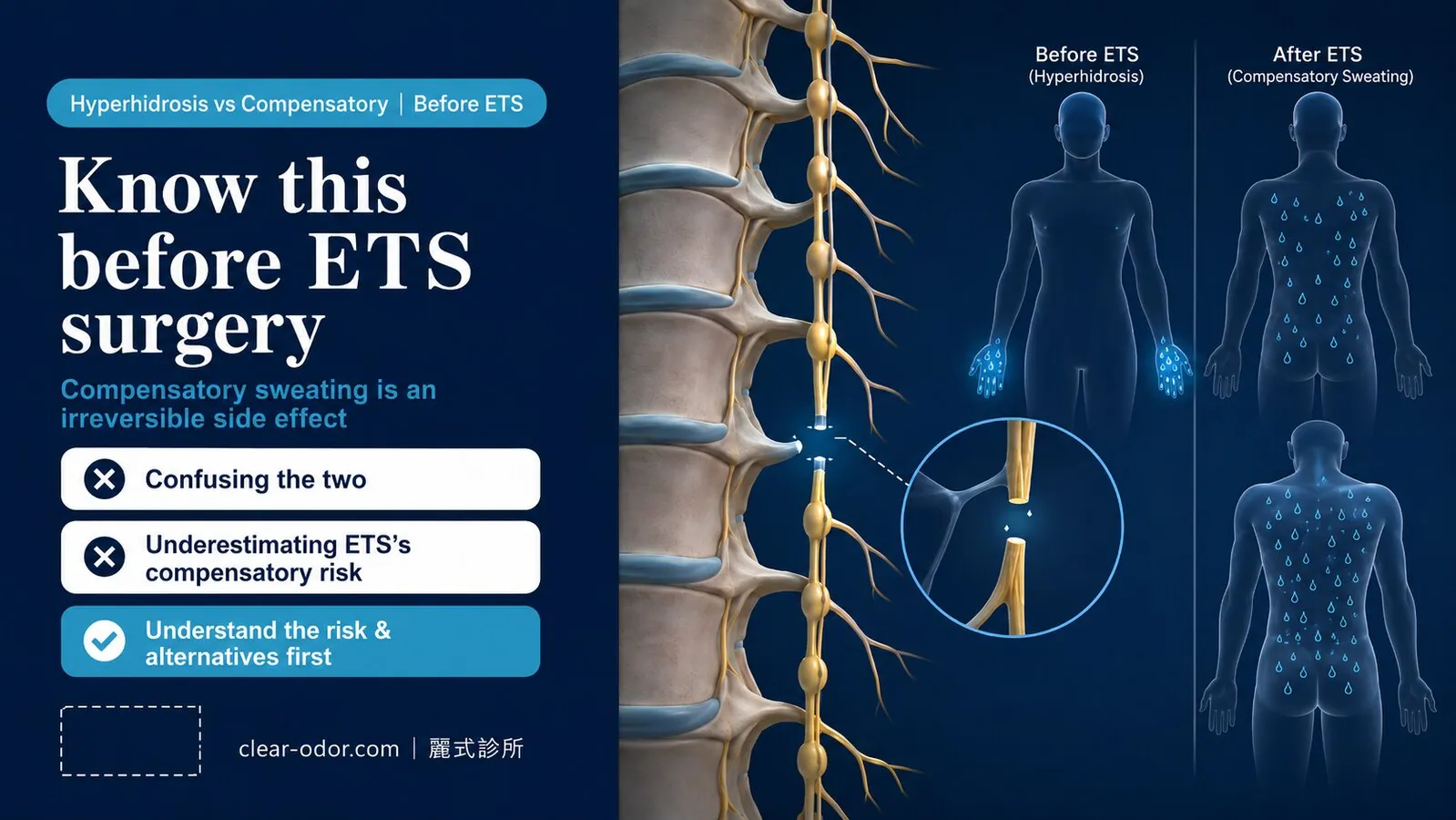
Hyperhidrosis vs Compensatory Sweating: Before ETS Surgery
Hyperhidrosis and compensatory sweating are often confused, but the first is a constitutional overactivity of the sweat glands while the second is a side effect of ETS sympathetic nerve surgery. Dr. Ta-Ju Liu explains how they differ in cause, location, and management, and what to know before considering ETS surgery.
Conservative care not enough?
Palmar / plantar sweat disrupting daily life?
If palm or foot sweating disrupts work and daily life, the surgical page explains the matching sweat-gland options, evaluated by Dr. Ta-Ju Liu.
⚕️ Medical Disclaimer
The medical information provided on this page is for reference only and cannot replace individual face-to-face diagnosis, advice, or treatment from a physician. All medical procedures carry risks. Individual constitution and post-operative recovery vary from person to person. Please discuss any treatment plan with your attending physician before making decisions.

Reclaim Your Dry, Confident Hands
There are several ways to manage hand sweating. Book a consultation so a physician can assess your situation and discuss a suitable plan.
Book ConsultationWhat this treatment delivers
Core procedure
- Nerve block + gentle pain-relief anesthesia · not general anesthesia
- About 1cm-interval high-density Botox · ~50-80 injections per hand
- Hands stay clearly numb for about 4–6 hours · do not drive yourself that day
- A single session lasts about 4–6 months, varying by person
Clinical track record
- Patients typically report substantially reduced discomfort
- Superficial injection lowers the chance of affecting hand strength
- A nerve-block approach Dr. Liu has used in clinical practice for years
Individual results may vary. Clinical data referenced from internal long-term follow-up records.
Included in your treatment
- Suture removal included
- 30-day wound care follow-up
- Post-op visits at day 14, month 1, month 3 — all included
Recovery bonus included
Every patient receives this
- Post-op LED light therapy session ×1 (included)
Liu's Post-Op Recovery Protocol
- Swelling integration program
- Bruising-clearance program
- Tissue-recovery integration program
Individual results may vary. Listed items are included in the treatment package.
Our commitment to you
Personalized treatment plan
Treatment ladder recommendations based on severity and lifestyle · including non-surgical options
30-minute direct evaluation by surgeon
Not a sales pitch · Dr. Liu performs the evaluation in person
Pre-op guide + 90-day LINE follow-up
Reach us via LINE anytime in the first 90 days · replies within 2 hours during business hours
Sutures, follow-ups, recovery protocol all included
Day-14, month-1, month-3 visits + post-op LED therapy + Liu's Post-Op Recovery Protocol — all included
Written informed consent
Procedure scope and recovery timeline confirmed in writing · signed only after Dr. Liu explains in person
Want to talk it through first?
Message our clinic team in your own language — messages are auto-translated.
LIUSMED International Patient Services
Start a consultationReal staff usually reply within 2 hours during business hours. A trained AI assistant answers basic questions right away, and you can ask for a person at any time. Available in 19 languages: just write in your own language and we will reply in it. Your conversation is saved, so you can pick up where you left off.
Telegram
Message us on Telegram
Scan to start
Chat with our clinic team — real staff reply, auto-translated in real time.
Opens in a new tabLINE
Add us on LINE
Scan to add
Our international LINE — real staff reply, messages auto-translated.
Opens in a new tab