4mm Incision, Gentle & Long-Lasting Effect with Rotational Curettage
Micro rotational curettage for bromhidrosis is a long-lasting treatment using a 4mm micro-incision to thoroughly remove apocrine glands. Based on 15 years of clinical follow-up by Dr. Ta-Ju Liu, apocrine clearance can reach >99% with no recurrence reported to date (varies by individual). Tumescent anesthesia keeps discomfort minimal, with no compensatory sweating, nearly invisible scars, and simultaneous improvement of sweat and hair issues.
15+
Years Experience
10000+
Procedures
4mm
Entry Incision
14 days
To stitch removal
Table of Contents
What is Apocrine Gland? Why Choose Rotational Curettage?
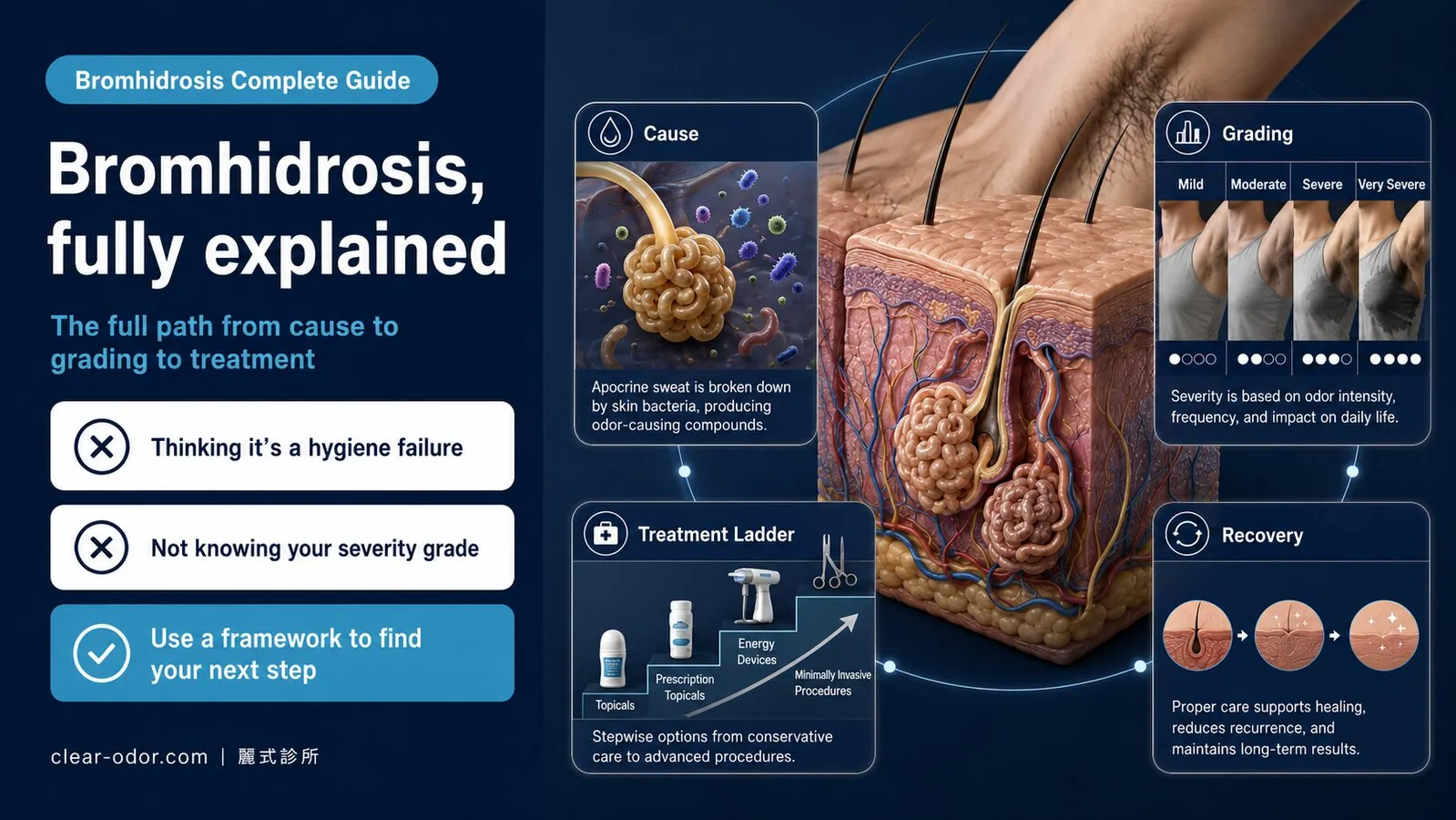
Body odor comes from apocrine-gland secretions broken down by skin bacteria — it is body odor, not an infection.
Axillary bromhidrosis (body odor) is caused by the bacterial fermentation of apocrine gland secretions on the skin surface. Apocrine glands are mainly located in the armpits, areola, and perineal area. Body odor commonly develops after puberty and can affect social confidence and quality of life.
Not sure which condition applies to you? See the body odor & hyperhidrosis conditions overview to compare each condition — definitions, ICD-10 codes, common symptoms, and when to see a doctor.
Causes & Genetics of Body Odor
Body odor is primarily influenced by genetics. In the ABCC11 variant that governs it, the G allele is dominant over A: if one parent has body odor, a child has roughly a one-in-two chance of inheriting a G allele, and the chance is higher when both parents have it. That is Mendelian inference, not a figure from any single study. The oils and proteins secreted by apocrine glands, when broken down by skin bacteria, produce the characteristic odor. Hormonal changes during puberty activate apocrine glands, which is why body odor typically becomes noticeable after puberty.
Why Physical Removal Offers a Lasting Solution?
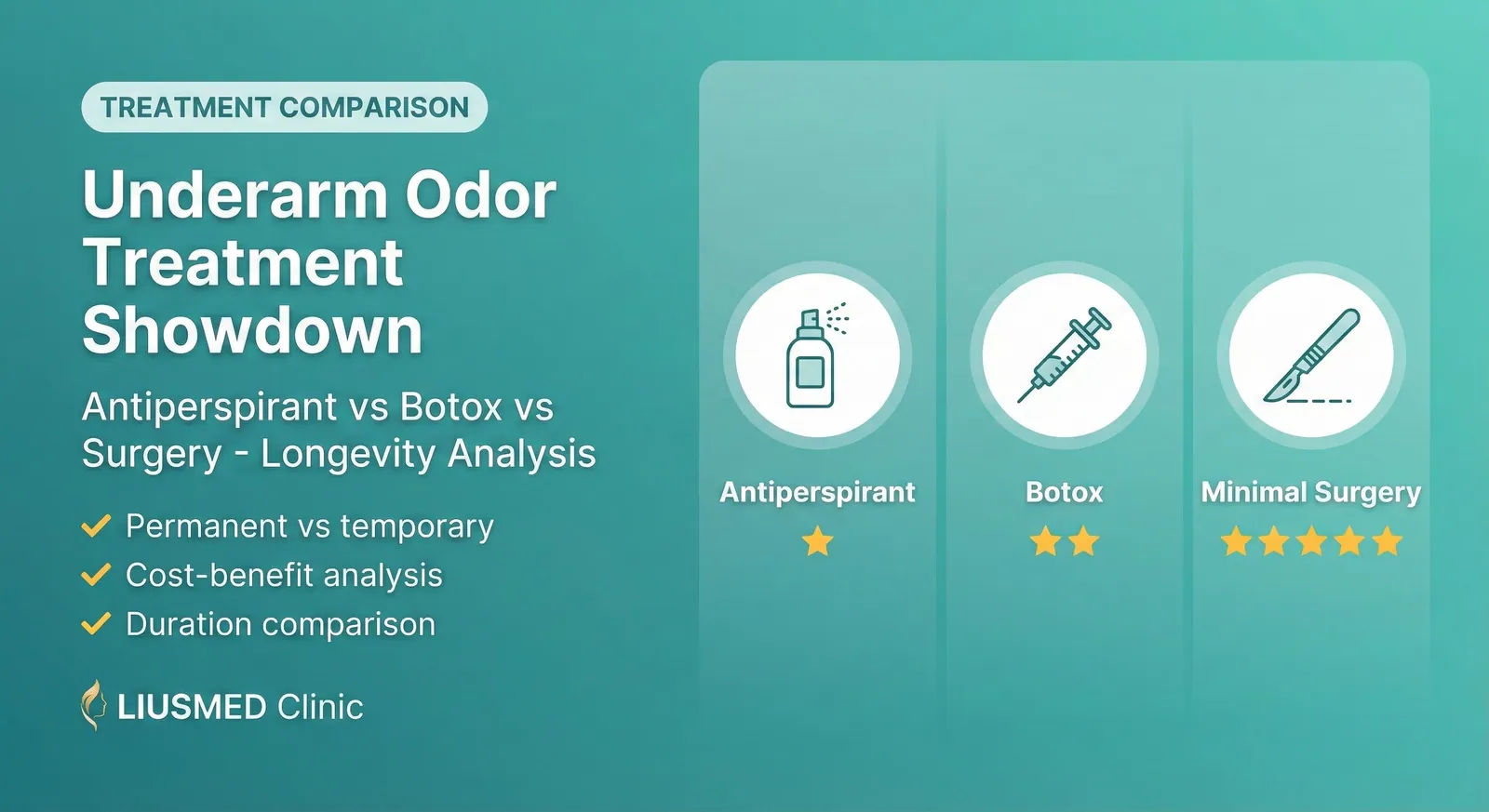
Antiperspirants and Botox only temporarily suppress secretion without resolving the condition. MiraDry microwave treatment leaves no wound, but the energy is delivered blind and may not reach deeper apocrine glands: in a study comparing microwave directly with subcutaneous curettage, effective improvement at 3 years was 90% in the surgery group versus 23% in the microwave group (Dermatol Surg 2022, PMID 34856594). **Two endpoints, kept separate**: for sweating, our own records put a single MiraDry session at roughly a 70-80% reduction in underarm sweat — but sweat and odor are different things, and the 3-year figures above measure odor. Surgical "physical removal" of apocrine glands provides a long-lasting solution. Micro rotational curettage achieves a high removal rate per clinic records with minimal scarring, making it the ideal solution.
When to Consider Surgery?
Body odor detectable within 1 meter by self or others
Antiperspirants and Botox prove ineffective
Odor affects social, professional, or intimate relationships
Avoiding sleeveless or short-sleeved clothing in summer
Combined excessive sweating and odor issues
Do You Have to Get Surgery for Body Odor?How Do the Options Compare?
Why Choose Clear Odor Micro Rotational Curettage?
Antiperspirants and Botox only suppress odor temporarily; lasting improvement requires physically removing the apocrine glands.
This table scrolls horizontally. Focus the table region, then use arrow keys, Shift plus mouse wheel, or touch to view all columns.
Treatment
Removal Rate
Recurrence
Incision
Recovery
Notes
Traditional Surgery
Removal under direct vision
No consistent figure in the literature
5-10 cm
2-4 weeks
Large wound, visible scar
MiraDry Microwave
Energy delivered blind
Only 23% still effective at 3 years*
None
3-5 days
Multiple sessions needed
Laser/Electrocautery
Blind, incomplete removal
No consistent figure in the literature
Pinhole
1 week
Incomplete removal
Clear Odor Micro Curettage
complete clearance (goal)
no recurrence reported to date
About 4mm entry
Dressing off day 3–5
Direct vision precise removal
Note: *Chen 2022 (Dermatol Surg 48(1):126-130, PMID 34856594) compared subcutaneous curettage with microwave head to head: at 3 years, effective improvement was 90% in the surgery group and 23% in the microwave group — the only cell in this table with primary literature behind it. The other cells have no consistent figure in the literature and are described by mechanism instead. The 'no recurrence reported to date' entry for Clear Odor comes from Dr. Liu's 15 years of in-clinic records; individual results vary.
4mm Incision × Three-in-One Benefits
Will Rotational Curettage Leave Scars or Side Effects?
The 4mm micro-incision leaves a nearly invisible scar; only the apocrine glands are removed and nerves are untouched, so there is no compensatory sweating.
Traditional body odor surgery requires 5-10cm incisions to ensure complete removal, leaving obvious scars with long recovery. Clear Odor Clinic uses a special micro rotational curettage probe (only 0.4cm diameter), through a 4mm micro-incision, precisely removing apocrine glands at the dermal-subcutaneous junction under direct vision, with complete apocrine gland clearance as the goal.
4mm Ultra-Minimal
Tiny incision, nearly invisible scar
Three-in-One
Odor: complete clearance as the goal; in our records underarm sweating drops by about 80–90%, with underarm hair down about 50–70% too
No Compensatory Sweating
No nerve cutting, no temperature regulation impact
Long-lasting Results
15-year follow-up, no recurrence reported in long-term follow-up
Three-in-One: Solving Three Problems at Once
Micro rotational curettage surgery removes apocrine glands while also treating eccrine sweat glands and hair follicles in the area. Therefore, one surgery simultaneously improves: body odor (complete apocrine gland clearance as the goal), with underarm sweating down by about 80–90% and underarm hair down by about 50–70% in our own records (individual results vary). For patients with both sweating and odor issues, this is the most cost-effective solution.
Why Does Clear Odor Technique Not Cause Compensatory Sweating?
Compensatory sweating (like hand sweat transferring to the back) only occurs when the "sympathetic nerve" is cut. Clear Odor micro-surgery only targets the "apocrine glands" under the skin, without involving the sympathetic nerves, so the mechanism behind compensatory sweating does not apply. This is why we insist on not using sympathetic nerve cutting procedures.
How Is the Surgery Done? Will It Hurt?
Tumescent Anesthesia × Direct Vision × Fast Recovery
Performed under local plus gentle pain-relief anesthesia — not general anesthesia — with greatly reduced discomfort, and the doctor can talk with you throughout.
Professional Consultation
Doctor personally assesses odor severity and source, then marks the treatment area based on the extent of underarm hair
Local + Gentle Pain-Relief Anesthesia
Tumescent local anesthesia at the underarm plus gentle pain-relief anesthesia — you stay relaxed, monitored throughout, with discomfort kept to a minimum; no general anesthesia
Micro Rotational Curettage
Through 4mm incision, using rotational probe to thoroughly remove apocrine glands under direct vision, with complete apocrine gland clearance as the goal
Post-op Care Instructions
Compression dressing (removed 3–5 days after surgery), detailed care instructions provided, stitches removed at the day-14 visit
Want to Learn More?
Every patient is unique. Dr. Liu will personally evaluate the best treatment plan for you.
How Soon Can I Return to Work or Exercise After Surgery?
We recommend resting at home until the dressing comes off (3–5 days after surgery). Some people take the full 14 days off; if that is not possible, you can go back to work once the dressing is off, with care around arm movement, wound care and keeping the area dry.
The compression dressing comes off 3–5 days after surgery, and that ends the compression; stitches come out on day 14
•Until the stitches are removed on day 14 and the clinic confirms the wound has healed (you can send the clinic a photo), sponge-bathe or shower while keeping the underarm dry; slower healers may need another 2–3 weeks
•Do not raise your arms overhead for at least 2 weeks after surgery
•No compression garment is needed once the dressing is off
•No strenuous exercise for at least 2 weeks after surgery; resume only once your doctor confirms
•Use antibiotic ointment as prescribed to prevent infection
•Stitches removed at the day-14 visit, with a recovery check
How Rotational Curettage Works — A Closer Look
'Why can a 4mm incision clean more thoroughly than a 5cm cut?' — it is the most intuitive question patients ask. The answer lies in where apocrine glands grow, and in how the rotational curettage probe operates.
Which Layer Do Apocrine Glands Grow In — and Why Are They Hard to Remove?
Apocrine glands (the large sweat glands) do not sit on the skin surface. They lie deep in the dermis, at the junction with the subcutaneous fat, with their ducts connecting to hair follicles. To remove the source of body odor, the procedure must act precisely on this dermal-subcutaneous interface — too shallow misses the glands, too deep injures tissue unnecessarily.
To 'see' this layer, traditional surgery often has to fold the skin open through a 5 to 10 cm incision and trim it directly with scissors. The clearance area is wide, but the trade-off is an obvious scar, a longer recovery, and a circulation risk from lifting the skin flap.
How Does the Rotational Curettage Probe Work?
Micro rotational curettage uses a slim probe only about 0.4 cm in diameter, with a rotating curette blade at the tip. Inserted through a 4mm micro-incision in the armpit, the probe glides along the dermal-subcutaneous interface, rotating to scrape away the apocrine glands together with the surrounding sweat glands and hair-follicle tissue.
Because it acts at a precise layer, rotational curettage can address the odor source (apocrine glands), underarm sweating (eccrine glands), and underarm hair (follicles) at once — this is the origin of the 'three-in-one' effect. A single procedure improves all three concerns, which is especially efficient for patients who have both sweating and odor.
Why Is 'Direct Vision' the Key Difference?
Some micro odor procedures rely on 'blind scraping' or pure suction, where the surgeon cannot see the actual clearance — leaving blind spots of uneven removal and residual glands, a common reason some patients see recurrence.
Dr. Ta-Ju Liu insists on operating under direct vision — confirming the degree of clearance in each zone with the eyes rather than by feel alone. How thoroughly the glands are removed directly determines whether the long-term result stays stable. This is the core of the Clear Odor 'Clean First' philosophy.
How It Compares to Skin-Flap and Suction Techniques
Traditional skin-flap excision: wide clearance, but a long incision, an obvious scar, a 2-4 week recovery, and a risk of poor skin circulation in the flap area.
Pure suction / blind scraping: a small wound, but without direct-vision confirmation, evenness and thoroughness of clearance are harder to control, so residual tissue and recurrence risk are relatively higher.
Micro rotational curettage (direct vision): a 4mm micro-incision that balances a small wound with direct-vision confirmation — a balance of thoroughness and recovery speed, currently the more ideal middle ground.
Sympathetic nerve interruption (ETS): targets sweating, not odor, and cutting the nerve can trigger compensatory sweating. It is an entirely different procedure from odor surgery and should not be confused with it.
Grading Body Odor Severity & Self-Assessment
Before deciding on surgery, knowing which severity level your body odor falls into helps you and your doctor communicate treatment goals more precisely. Severity is not a single metric — it is an overall judgment combining odor intensity, sweat volume, clothing staining, and social impact.
How Body Odor Is Graded Clinically
When assessing body odor, doctors usually group severity into four levels. Mild means the odor is noticeable only after strenuous exercise, anxious sweating, or at very close range, and can usually be masked by antiperspirant in daily life. Moderate means others within one meter can detect it under normal room temperature and ordinary activity, and antiperspirant only suppresses it briefly.
Severe means the odor remains obvious even at rest in a cool room, often accompanied by yellowing and stiffening of underarm clothing. Very severe means the odor is strong enough to affect interpersonal distance in enclosed spaces — elevators, train cars, meeting rooms — and the person has often long avoided social contact. In general, those at moderate level or above, with a poor response to conservative treatment, are better suited to consider a surgical assessment.
Self-Checks You Can Do at Home
Cotton test: after showering, apply no antiperspirant, go about normal activity for three to four hours, then wipe the underarm with a clean cotton pad, let it sit for a few minutes, and smell it — an obvious odor suggests active apocrine secretion.
Clothing clues: yellowish, stiffened marks under the arms of white or light-colored tops are a typical sign of apocrine secretion, different from the clear watery marks of plain sweat.
Earwax type: apocrine glands and the ear-canal glands are influenced by the same gene; people with wet (sticky, yellowish) earwax have a noticeably higher chance of underarm odor.
Family history: if one parent has body odor, a child has roughly a one-in-two chance of it; if both parents do, the chance is higher. Family history is an important clue to constitution.
Social feedback: whether someone close has kindly mentioned it, or whether you deliberately keep your distance or avoid raising your arms — these behavioral signals often reflect true severity better than a single sniff test.
Self-Assessment Cannot Replace Professional Diagnosis
Self-checks help you judge whether to see a doctor, but they cannot replace an in-person assessment. Odor can also come from eccrine glands (sweat odor), an imbalance of skin-surface bacteria, or even certain dietary and metabolic factors — and these are handled in completely different ways from apocrine gland surgery.
In the clinic, Dr. Ta-Ju Liu confirms the distribution of apocrine glands by palpation, combines it with earwax type and family history for an overall judgment, and marks the treatment area based on the extent of underarm hair before discussing surgery or other options based on your situation. Individual results may vary; precise treatment planning still depends on an in-person consultation.
Preparing for Surgery & What to Ask at Your Consultation
A smooth surgery begins well before the operating day. Good consultation and physical preparation make the procedure safer and the recovery easier.
Questions Worth Clarifying at Your Consultation
Which severity level is my body odor? Do I genuinely need surgery, or could I try conservative treatment first?
Which technique will be used — direct-vision operation, or blind scraping or suction?
How much improvement in odor, sweating, and hair can I expect, and how do results vary from person to person?
What is the expected incision size, location, and scarring?
How long is recovery, and when can I return to work and exercise?
If the result falls short of expectations or recurs, how is it handled afterward?
Physical Preparation in the Week Before Surgery
Proactively tell the doctor your full medical history, allergies, and current medications — especially anticoagulants, aspirin, and certain supplements, which may need to be paused as advised.
Avoid alcohol, and consider reducing smoking — both affect wound healing and blood circulation.
Keep the underarm skin healthy; if there is folliculitis, eczema, or infection, tell the doctor first to assess whether to postpone.
Arrange your life for the days after surgery — leave time to keep the upper arms still, and avoid scheduling travel or heavy work right after.
What to Note on the Day of Surgery
On the day, wear a loose, front-opening top so you can dress and undress after surgery without raising your arms. Underarm hair is usually handled by the clinic before surgery — there is no need to shave it yourself to the point of bleeding or causing folliculitis.
Micro rotational curettage for body odor is an outpatient procedure under local anesthesia, with no hospital stay. The surgery takes about 1.5–2 hours (not counting post-op observation); after a short rest and a stable check, you can go home. A family member or friend needs to take you home that day, and you should not drive or ride a scooter.
Recovery Timeline: From Surgery Day to Scar Maturity
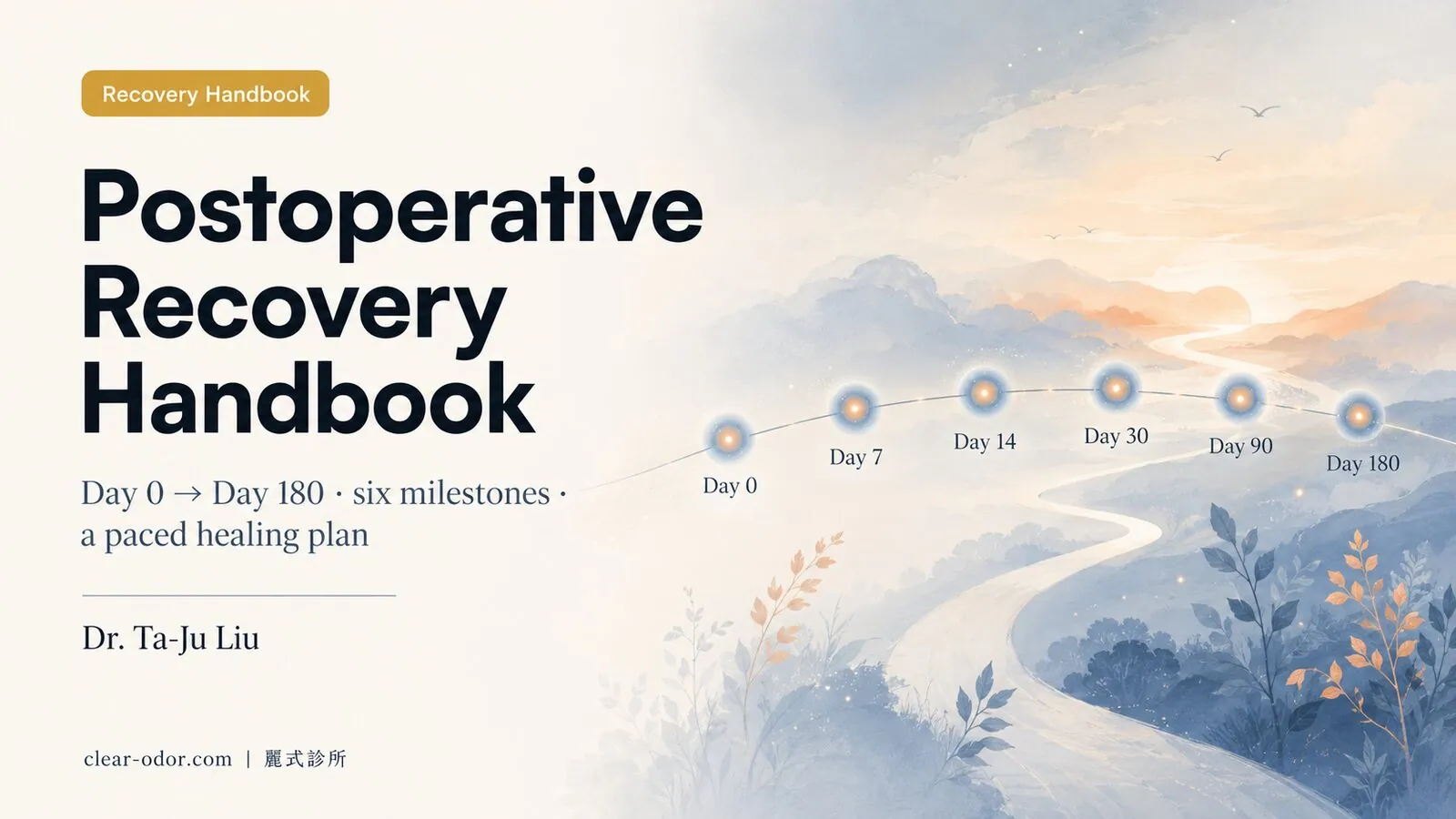
Understanding each stage of recovery lets you plan work and life with more confidence. Below is the typical recovery rhythm for most patients; the actual course still varies somewhat with individual constitution and the extent of clearance.
Days 0 to 5 — The Compression Dressing Phase
After surgery, the underarm is dressed with gauze and an elastic bandage under moderate compression, to reduce fluid and hematoma and help the skin and subcutaneous tissue adhere. During this period the underarm feels tight, mildly swollen and tender, with a pulling sensation — all normal, and usually eased with ordinary painkillers.
The most important principle these days is to move the upper arm as little as possible. Avoid raising your arms widely, lifting heavy objects, or spreading your arms forcefully, so the compression can do its work. The compression dressing comes off 3–5 days after surgery, and that is the end of compression; no compression garment is needed afterwards. Until then, resting at home is recommended.
Day 3–5 to Day 14 — Dressing Off, Back to Work, Stitches Out
Three to five days after surgery you return for the compression dressing to be removed, and the doctor checks wound healing and skin adhesion. Swelling and tightness ease noticeably, but the underarm may still feel locally firm and show bruising — this is part of tissue repair and will gradually soften and fade over the following weeks.
Once the dressing is off you can go back to work (some people take the full 14 days off) and resume most daily activities and light upper-limb movement, with care around arm movement; do not raise your arms overhead for at least two weeks after surgery, and still avoid strenuous exercise and weight training. Stitches come out at the day-14 visit. Until then, and until the clinic confirms the wound has healed (you can send the clinic a photo), sponge-bathe or shower while keeping the underarm dry (slower healers may need another 2–3 weeks); use ointment as directed.
Weeks 2 to 4 — Swelling Subsides and Tissue Softens
Most swelling and bruising subside during this period. The firmness once felt in the underarm gradually softens, and range of motion returns close to normal. Swimming, weight training, and strenuous exercise are resumed progressively from about Day 30, once the wound has fully healed and your doctor confirms.
Some patients feel temporary numbness or tightness in part of the underarm; this relates to superficial sensory nerve endings touched during surgery, usually improves gradually over about 6–12 months, and needs no special treatment.
Months 1 to 3 — The Scar Maturation Phase
The 4mm micro-wound goes through scar maturation in this phase: it may look slightly pink or feel firm at first, then gradually flatten and fade, eventually settling into the natural fold of the armpit, inconspicuous in most cases.
Odor improvement is usually noticeable once the swelling subsides; changes in sweating and hair become clearer after the tissue is fully stable. To evaluate the long-term result, it is best to use the state at three or more months after surgery as the baseline. Individual results may vary, and follow-up visits let the doctor give personalized advice based on your recovery.
Risks and Complications: The Full Picture You Should Know
Every surgery carries risk, and body odor surgery is no exception. Disclosing risk honestly is the precondition for you to make a sound decision. Micro rotational curettage is a relatively safe outpatient procedure, but you should still understand the possible reactions and how they are managed before surgery.
Common, Mostly Temporary Reactions
Swelling and tightness: the most common after surgery, usually subsiding noticeably within one to two weeks.
Bruising: the underarm and upper arm may bruise, with color usually fading within seven to ten days.
Local firmness: a normal phenomenon during tissue repair, gradually improving over about 6–12 months.
Temporary numbness: caused by superficial sensory nerve endings touched during surgery, gradually improving over about 6–12 months.
Minor fluid seepage: the wound may seep slightly in the early period — the compression dressing is precisely to reduce this.
Less Common Complications That Warrant Attention
Hematoma: if compression is insufficient or the upper arm is moved widely too soon, blood may pool under the skin to form a hematoma, sometimes needing drainage — which is why moving the upper arm as little as possible after surgery is essential.
Wound infection: the rate is low and it can mostly be prevented with post-op care and ointment; if redness, swelling, heat, and worsening pain or abnormal discharge appear, return to the clinic promptly.
Poor local skin circulation: compared with traditional skin-flap surgery, micro rotational curettage carries a noticeably lower risk here because the skin is not lifted over a wide area — but it is still not zero.
Uneven clearance or a result short of expectations: this relates to how thorough the surgery is, and operating under direct vision is precisely how this risk is minimized.
How Is Risk Kept to a Minimum?
The level of risk depends on both the surgical method and post-op cooperation. On the surgical side, a minimally invasive, direct-vision technique performed by an experienced doctor significantly lowers the chance of poor circulation and uneven clearance. Dr. Ta-Ju Liu has been dedicated to this field for over 20 years, and the depth of clinical experience accumulated is one key to lowering risk.
On the patient side, faithfully following post-op guidance — not moving the upper arm widely during the compression phase, not exercising too early, caring for the wound as directed, and returning for follow-up on schedule — greatly reduces the occurrence of hematoma and infection. Communicating your medical history, medications, and allergies fully before surgery is also an important part of safety. No surgery can guarantee being one hundred percent risk-free, but with the right choice of technique and post-op cooperation, risk can be kept within a very low range.
Common Myths About Body Odor Treatment, Debunked
Plenty of plausible-sounding but mistaken claims circulate online about body odor and its surgery. Clearing up these myths helps you avoid ineffective attempts — and avoid unnecessary fear.
Myth 1: 'Frequent showering and antiperspirant will solve body odor'
Cleansing and antiperspirant products can reduce surface bacteria and sweat and temporarily lessen the odor, but they cannot change the secreting nature of the apocrine glands. The source of body odor is the smell produced when apocrine secretions are broken down by bacteria; as long as the glands remain and keep secreting, the odor returns. Conservative methods manage rather than remove, and often fall short for moderate-to-severe body odor.
Myth 2: 'Body odor surgery always leaves an obvious scar'
This impression comes from the traditional long-incision skin-flap surgery. Micro rotational curettage needs only a 4mm micro-incision, usually placed in the natural fold of the armpit, and the scar is mostly quite inconspicuous once matured. A different technique gives a completely different scar result — it cannot be generalized.
Myth 3: 'Body odor surgery causes compensatory sweating like ETS'
This confuses two entirely different surgeries. Compensatory sweating is a side effect that appears only when the sympathetic nerve is cut (as in ETS surgery for hyperhidrosis). Micro rotational curettage for body odor removes only the apocrine glands under the skin and does not involve the sympathetic nerves, so the mechanism behind compensatory sweating does not apply.
Myth 4: 'Body odor surgery recurs easily, so it is pointless'
Whether it recurs hinges on whether the apocrine glands are thoroughly removed. Uneven clearance and residual glands are the main causes of recurrence. A technique that confirms evenness of clearance under direct vision keeps this risk very low. Dr. Ta-Ju Liu has had no recurrence reported across long-term clinical follow-up — thoroughness is precisely the key to a stable long-term result. Individual results may still vary.
Myth 5: 'The odor is faint, so I should just ignore it'
Whether to treat depends on the real impact the odor has on your life, not simply on its 'objective' strength. Some people have only a faint odor yet live in long-term social anxiety; others have an obvious odor but are little bothered. What matters is how you feel. If the odor already affects your confidence, relationships, or performance at work, seeking a professional assessment is never too early; conversely, if it causes no distress, there is no need to force surgery.
About the Author
Dr. Ta-Ju Liu
Director, Clear Odor Clinic
Over 20 years of micro body odor surgery experience
Over 10,000 procedures performed
Board-certified Dermatologist
Expert in micro rotational curettage for apocrine glands
Practitioner of the "Clean First" philosophy
"I adhere to the 'Clean First' philosophy, ensuring every apocrine gland is removed under direct vision. In 15 years, our patients have had no recurrence reported in long-term follow-up cases - this is the Clear Odor commitment."
Frequently Asked Questions
Is the surgery uncomfortable?
Discomfort is kept very low. We use "local anesthesia plus gentle pain-relief anesthesia": besides tumescent local anesthesia at the underarm, gentle pain-relief anesthesia is added to keep you relaxed (no general anesthesia). During surgery you'll only feel the vibration of the doctor operating.
Will I experience compensatory sweating after surgery?
In our experience not. Compensatory sweating (like hand sweat transferring to the back) only occurs with sympathetic nerve cutting. Our micro-surgery only targets the apocrine glands under the skin, without involving the sympathetic nerves, so the mechanism behind compensatory sweating does not apply.
I heard odor surgery has high recurrence rates?
This depends on how thorough the surgery is. Recurrence usually happens when apocrine glands aren't completely removed. Dr. Liu follows a "Clean First" principle, removing apocrine glands under direct vision. Based on 15 years of clinical follow-up by Dr. Ta-Ju Liu, axillary apocrine clearance can reach >99%, with no recurrence reported to date (varies by individual).
How soon can I return to work or exercise?
We recommend resting at home until the compression dressing comes off, 3–5 days after surgery. After that you can go back to work (such as office work), with care around arm movement, wound care and keeping the area dry. For better wound healing, do not raise your arms overhead or do strenuous exercise for at least 2 weeks after surgery; resume only once your doctor confirms.
How is the appropriate treatment plan determined?
Treatment depth varies based on severity, whether hyperhidrosis is involved, and the treatment area. Dr. Liu will explain the differences between conservative care, Botox, thermolysis, and micro-surgical options after personally evaluating you at the initial consultation.
How severe should odor be before considering surgery? Can mild cases get surgery?
We generally recommend surgery for moderate to severe cases (detectable within 1 meter by self or others). Mild cases can try conservative treatments first (antiperspirants, Botox injections). If these don't work or you want a long-lasting solution, micro-surgery is an option. Dr. Liu provides personalized recommendations during pre-operative assessment.
Will body odor surgery leave an obvious scar?
The micro rotational curettage entry incision is about 4mm (the final wound is about 4–7mm), and is usually placed in the natural fold of the armpit. During the scar maturation phase one to three months after surgery, it gradually flattens and fades, and is quite inconspicuous in most cases. This is completely different from the scar of a traditional 5 to 10 cm long-incision skin-flap surgery. Actual results still vary with individual skin type and constitution.
How soon after surgery can I notice the odor improving?
Improvement in odor is usually noticeable once the post-operative swelling subsides. Changes in sweating and hair become clearer after the tissue is fully stable. To evaluate the long-term, stable result, it is best to use the state at three or more months after surgery as the baseline. Individual results may vary.
Can one surgery improve sweating and hair at the same time?
Yes. While removing the apocrine glands, micro rotational curettage also addresses the eccrine sweat glands and hair follicles in the same area, so a single procedure improves body odor, underarm sweating, and underarm hair together - the so-called three-in-one effect. It is especially efficient for patients who have both sweating and odor. The degree of improvement still varies from person to person.
Do I need to take time off work? How many days of rest?
Micro rotational curettage is an outpatient procedure under local anesthesia, with no hospital stay. The compression dressing comes off 3–5 days after surgery, and we recommend resting at home until then. Some patients take the full 14 days off; if you cannot, you can go back to work once the dressing is off, with care around arm movement and wound care, keeping the underarms dry until the stitches come out on day 14 and the clinic confirms the wound has healed (slower healers may need another 2–3 weeks). Do not raise your arms overhead, lift heavy objects, or do strenuous exercise for at least two weeks after surgery; if your work requires frequent exertion or holding the arms up, allow a few extra buffer days, and resume exercise only once your doctor confirms.
Is body odor surgery suitable for adolescents or students?
Body odor usually becomes noticeable after puberty as the apocrine glands grow active, and some adolescents are genuinely troubled by it, affecting school social life and confidence. Whether surgery is suitable requires the doctor to weigh the stage of development, the severity of the odor, and the individual's own wishes; for minors, a parent must also take part in the decision. We recommend arranging a consultation first, then discussing surgery or other options.
I have had laser, microwave, or traditional odor surgery - can I still have micro rotational curettage?
In most cases, yes. If a previous laser, microwave (such as MiraDry), or surgery did not clear the glands thoroughly and odor remains, micro rotational curettage can still address the residual apocrine glands under direct vision. However, an underarm that has had previous surgery may have scar tissue, which adds to the complexity of the operation. The doctor needs to assess the extent of the prior treatment and the skin condition in person before deciding on the suitable approach.
The medical information provided on this page is for reference only and cannot replace individual face-to-face diagnosis, advice, or treatment from a physician. All medical procedures carry risks. Individual constitution and post-operative recovery vary from person to person. Please discuss any treatment plan with your attending physician before making decisions.
Book Professional Consultation
Let us evaluate the best treatment plan for you. Micro rotational curettage solves odor, sweat, and hair problems in one procedure.
•Same-day procedure · back to work once the dressing is off (day 3–5)
Clinical track record
•Dr. Liu — 20 years of dedicated practice · over 10,000 cases
•15 years of clinical follow-up with no recurrence reported to date
•Sustained, in-depth clinical experience in this field in Taiwan
Individual results may vary. Clinical data referenced from internal long-term follow-up records.
Included in your treatment
✓Suture removal included
✓30-day wound care follow-up
✓Post-op visits at day 14, month 1, month 3 — all included
Recovery bonus included
Every patient receives this
✓Post-op LED light therapy session ×1 (included)
Liu's Post-Op Recovery Protocol
✓Swelling integration program
✓Bruising-clearance program
✓Tissue-recovery integration program
Individual results may vary. Listed items are included in the treatment package.
Patient Experiences
Anonymous patient sharing — not an efficacy guarantee. Individual experience may vary.
I had the bilateral apocrine-gland excision procedure. The whole process — from consultation to surgery to suture removal — felt reassuring. The pre-op explanation was clear enough that I no longer felt nervous, and the nursing team checked in during recovery.
— M. · adult · office worker
Individual experience · results may vary · 2025-10
I had struggled with axillary odor since middle school. Summers were the hardest — I often sensed odd looks from people around me. After working up the courage for the procedure, my personal experience is that I feel much more at ease, and I no longer subconsciously avoid being close to others in summer.
— Young adult · onset since school years
Individual experience · results may vary · 2025-06
Our commitment to you
Personalized treatment plan
Treatment ladder recommendations based on severity and lifestyle · including non-surgical options
30-minute direct evaluation by surgeon
Not a sales pitch · Dr. Liu performs the evaluation in person
Pre-op guide + 90-day LINE follow-up
Reach us via LINE anytime in the first 90 days · replies within 2 hours during business hours
Sutures, follow-ups, recovery protocol all included
Day-14, month-1, month-3 visits + post-op LED therapy + Liu's Post-Op Recovery Protocol — all included
Written informed consent
Procedure scope and recovery timeline confirmed in writing · signed only after Dr. Liu explains in person
Want to talk it through first?
Message our clinic team in your own language — messages are auto-translated.