Why Another Bromhidrosis Guide?
Most people first notice their body odor in adolescence — and most never get a clear framework for understanding what's actually happening or what the realistic options are.
In 20 years of clinical practice, the single most common pattern I see in the consultation room is not severity — it's uncertainty. Patients don't know which grade they fall into, don't know whether to try conservative treatment or move straight to surgery, don't know whether axillary odor and areolar odor are the same problem.
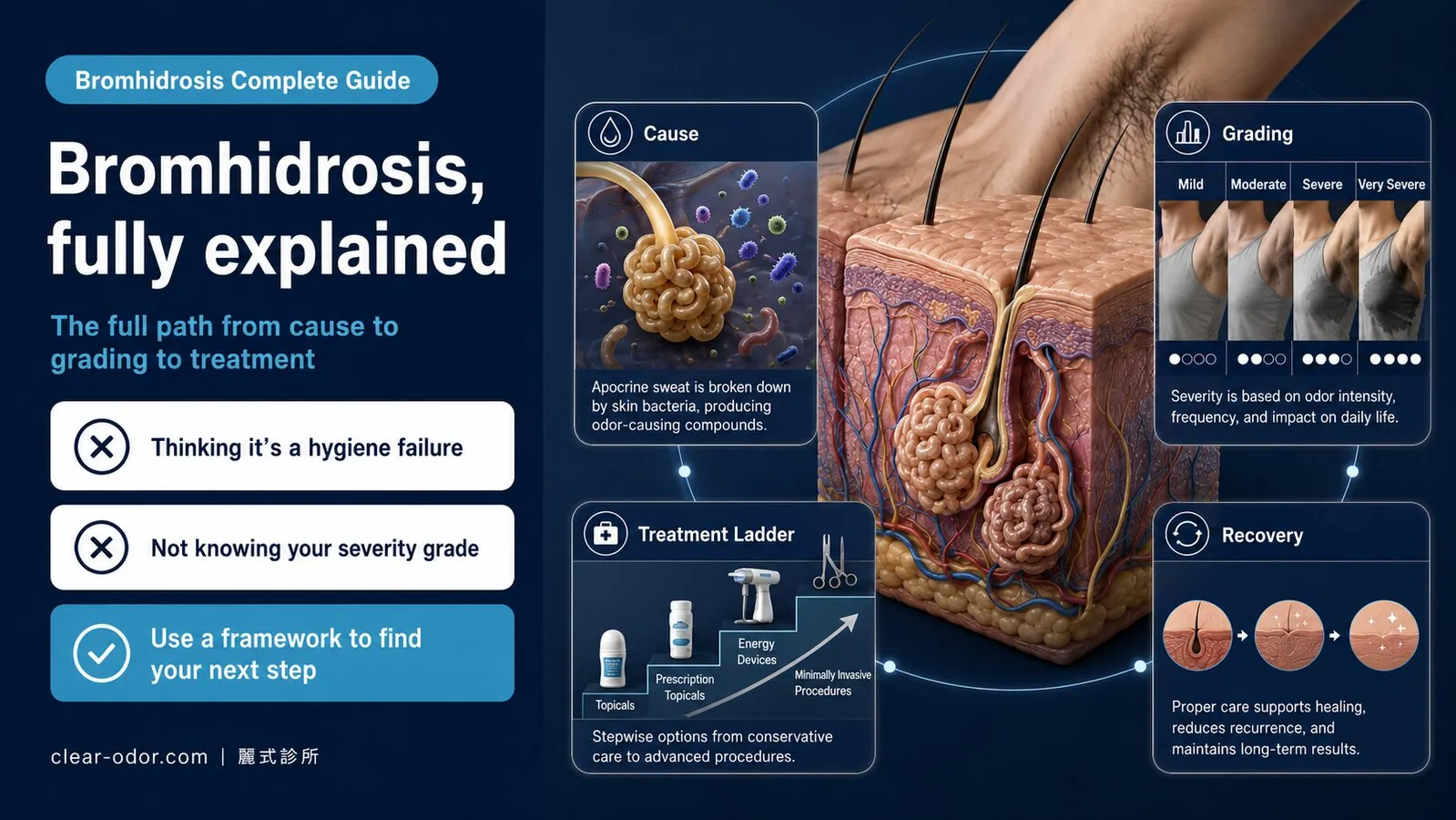
This guide consolidates the questions I get asked most often into one path: causes → self-grading → treatment ladder → surgical options → recovery timeline → long-term follow-up. By the end you should be able to answer:
- Which severity grade fits my situation?
- Is the odor at different body regions (underarm, areola, perineal) handled the same way?
- Antiperspirant, Botox, micro rotational curettage — where should I start on the ladder?
- How long until I can return to normal life after surgery? What's the recurrence rate?
Individual outcomes vary. This guide provides a decision framework, not a diagnosis. The final treatment choice still requires in-person evaluation.
Multi-site odor? Start with the map, then the self-check. If you have odor in more than one area, see the Odor Map for site-by-site triage first, then run the Self-Assessment to score severity — usually faster than booking a single specialty up front.
What is bromhidrosis, and is the cause really not "poor hygiene"?
Bromhidrosis is the medical term for underarm odor; it arises when apocrine secretions are broken down by skin-surface bacteria into the characteristic smell — driven by genetics and hormones, not poor hygiene, which is why washing harder only suppresses it temporarily and can't cure it.
Bromhidrosis is the medical term for the characteristic body odor most commonly associated with the underarms, but it also covers the areolae, perineum, and groin.
A frequent misconception: sweat itself smells. It does not. Fresh sweat is odorless. The smell comes from a three-part chemical reaction:
- Apocrine gland secretions — protein, fatty acids, steroid precursors
- Skin microflora — primarily Corynebacterium spp. and Staphylococcus spp.
- Enzymatic breakdown — bacteria cleave long-chain apocrine secretions into short-chain volatile fatty acids (such as 3-methyl-2-hexenoic acid and 3-hydroxy-3-methyl-hexanoic acid). These short-chain acids are the chemical signature of bromhidrosis.
In short: active apocrine glands + dense skin flora = readily produces odor. This is a constitutional issue, not a hygiene issue.
Why Is Bromhidrosis Genetic?
East Asian populations show a strong correlation between bromhidrosis and the ABCC11 gene (538G→A polymorphism): G/G and G/A are the wet earwax types, while A/A is the dry earwax type, with scant apocrine secretion and little tendency to odor.
In a Japanese study, 78 of 79 bromhidrosis patients who had surgery (98.7%) carried a wet-earwax genotype, but so did 35.4% of the Japanese general-population controls (Nakano 2009, PMID 19650936). So wet earwax is a prerequisite for bromhidrosis, not proof of it; if your earwax is dry, bromhidrosis is unlikely. That's why I ask in clinic: "Is your earwax wet or dry?"
Whether it runs in your family, and the odds for your children, is covered in Is Bromhidrosis Genetic? Inheritance & When to Check Kids; the earwax link itself is in Does Wet Earwax Mean Bromhidrosis? A Home Self-Check.
When Do Apocrine Glands Become Active?
For most people bromhidrosis appears at puberty, because apocrine glands are driven by sex hormones. The adrenal glands typically start producing androgen precursors at around 5–8 years of age; adult-type body odor before age 8 in girls or 9 in boys counts as early, other hormonal causes need to be ruled out, and a pediatric endocrinologist is the place to start (Voutilainen 2015, PMID 24923732; Novello 2018, PMID 29323690).
There's no age at which bromhidrosis switches itself off. Once constitutional bromhidrosis appears, it usually carries on into adulthood; if it fades in later life, that's decades away. It does not "spontaneously resolve," because the underlying glandular tissue persists.
Will bromhidrosis go away on its own? Is surgery the only option?
Bromhidrosis does not resolve on its own — it is driven by your apocrine gland constitution, and once those glands have developed they keep secreting, so no amount of washing does more than temporarily mask it. But surgery is not the only option either: mild-to-moderate cases can first use antiperspirants and Botox to bring the odor down to an acceptable level, and only people who want long-term stability — without managing it again every few months — need to move toward gland-removal surgery.
Many people hope that "it should settle once puberty is over" or "it will fade with age if I just put up with it." Physiologically, that is only half true. Apocrine glands are driven by sex hormones; the odor may soften in later life, but that's decades away — through adolescence and adulthood, when social life and appearance matter a great deal, they do not recede on their own.
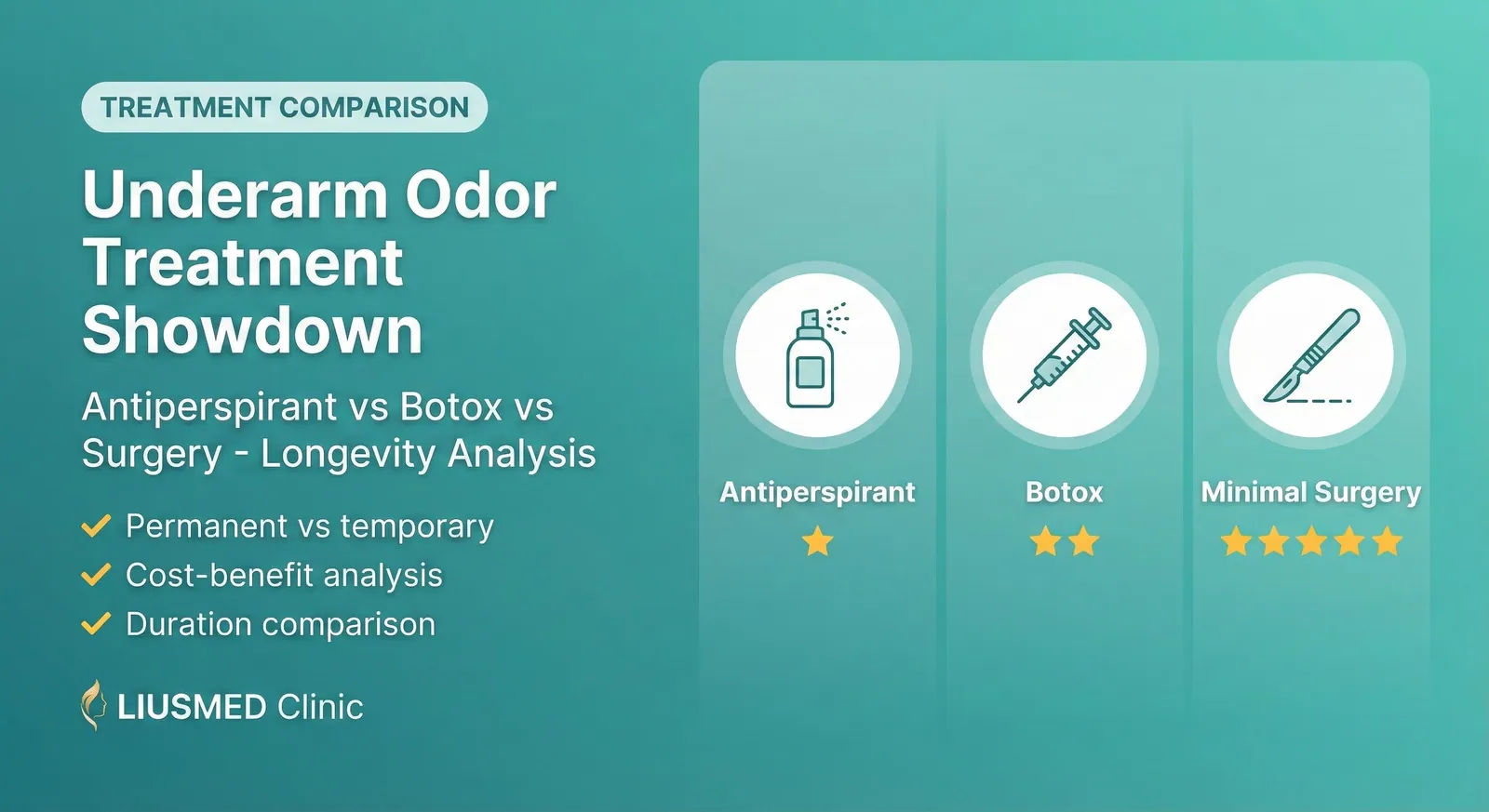
As for "is surgery the only option," the answer is no. Think of the choices as three tiers, stepping up with how much it bothers you:
- Temporary masking (antiperspirants, deodorant): effective for grade 1–2 mild cases, reverses as soon as you stop, and does nothing to the glands themselves.
- Temporary suppression (Botox): lasts 4–6 months, suited to short-term occasions or those still deciding, but needs repeating.
- Long-term clearance (micro rotational curettage surgery): treats the apocrine glands directly and is one of the options for moderate-to-severe bromhidrosis supported by long-term follow-up studies; our clinic aims for complete apocrine gland clearance, with no recurrence reported in clinical follow-up (individual results may vary).
In other words, "will it go away" and "should I have surgery" are two separate questions: the first answer is no, while the second depends on your severity, how thorough you want to be, and whether you are willing to repeat treatment every few months. If you are not sure which tier you fall into, when you book a one-on-one assessment we will first locate your severity and then walk through the options one by one — the consultation is not tied to any procedure.
Are bromhidrosis and hyperhidrosis the same problem?
No — bromhidrosis is an "odor" problem from apocrine glands plus bacteria, while hyperhidrosis is a "sweat volume" problem from eccrine glands; they often coexist and get confused, but their treatments differ (deodorizing vs reducing sweat), so sorting them out first prevents using the wrong approach.
"My underarm both smells and sweats a lot — are these the same problem?" This question comes up every week.
The answer: not the same problem, but commonly co-occurring. The difference comes down to two different sweat gland types:
| Comparison | Bromhidrosis | Hyperhidrosis |
|---|---|---|
| Gland source | Apocrine | Eccrine |
| Secretion | Viscous, contains protein + lipids | Watery, contains electrolytes |
| Distribution | Underarm, areolae, perineum, groin | Whole body (palms, soles, forehead, axillae focal) |
| Odor | Has characteristic odor | Odorless |
| Triggered by | Sex hormones, emotion | Heat, emotion, spicy food |
| Treatment goal | Reduce/remove apocrine glands | Block nerve signal to eccrine glands or destroy glands |
How do you tell bromhidrosis from ordinary sweat odor? Ordinary sweat odor shows up after exercise or heat and is gone once you shower; bromhidrosis lingers after the sweat dries, comes back a few hours after a shower, and centers on the underarms. Add wet earwax and family members with a similar smell, and apocrine bromhidrosis becomes more likely. The full comparison is in Body Odor, Sweat Smell & Bromhidrosis: 3 Different Smells.
Four typical clinical patterns:
- Bromhidrosis alone — distinct odor, normal sweat volume → treatment targets apocrine glands
- Hyperhidrosis alone — high sweat volume, no odor → treatment targets eccrine glands (Botox, miraDry, in severe cases ETS)
- Combined bromhidrosis + hyperhidrosis (most common in clinic) — both gland types active → one surgery can address both (micro rotational curettage reduces both apocrine and eccrine glands simultaneously)
- Compensatory hyperhidrosis — heavy sweating on torso/back/legs after ETS sympathectomy → a separate problem with a different treatment pathway (see the deep-dive on compensatory hyperhidrosis)
How does bromhidrosis differ across the underarm, areola, perineum, and children?
All are odor problems in apocrine-rich regions, but each has different clinical considerations: the underarm is small enough to clear completely, the areola must preserve breastfeeding function, the perineum heals more slowly, and with children it comes down to cooperation and readiness — so treatment strategy varies by region.
Many people don't realize "bromhidrosis" spans multiple body regions — fundamentally they're all the same problem (odor from apocrine-rich skin), but each region has distinct clinical considerations.
a. Axillary Bromhidrosis
The most common form, and what most people mean by "bromhidrosis"; the underarm is where apocrine glands are concentrated.
- Typical onset: after puberty, usually persisting into adulthood
- Severity scale: the 0–4 odor self-assessment below (from no odor to detectable from > 1 m)
- Treatment ladder: antiperspirant → Botox (temporary) → micro rotational curettage (long-term)
- Detail page: Axillary bromhidrosis treatment
b. Areolar Bromhidrosis
The peri-areolar region also carries apocrine glands — fewer total than the axillae, but highly concentrated, which can make the localized odor more noticeable.
- Common demographic: women aged 30–50 most often present
- Special considerations: surgery must preserve lactation (avoid disrupting mammary duct architecture) and avoid permanent nipple sensitivity change
- Treatment ladder: conservative measures have limited effect → micro-surgical approach is the primary option
- Detail page: Areolar bromhidrosis treatment
c. Perineal Bromhidrosis
Apocrine odor at the perineum, groin, or peri-anal region — often misidentified as infection or hygiene failure. The underlying biology is identical to axillary bromhidrosis.
- Differential first: rule out bacterial vaginosis, candidiasis, and fistula before attributing odor to apocrine glands
- Treatment ladder: after infection is excluded, micro-surgical apocrine reduction is the main long-term option
- Detail page: Perineal odor treatment
d. Pediatric Bromhidrosis
Bromhidrosis that appears around puberty. Children this age can be teased over odor, so it deserves attention early rather than waiting it out.
- Surgical timing: surgery is possible from age 9, and suitable at any age from 9 up. What matters isn't the number but whether the child is ready (cooperation, emotional readiness), which we assess individually in clinic. Children get the same incision as adults: an entry incision of about 4 mm, with a final wound of 4–7 mm. Apocrine glands that were cleared don't grow back at puberty, so there's no need to delay just to "wait for development." For how parents can judge readiness, see Child Bromhidrosis: Which Doctor, and When Not to Operate
- Conservative bridge: until the child is ready, antiperspirants and similar measures can carry them through
- Detail page: Pediatric bromhidrosis treatment
Which severity grade is your bromhidrosis, and how do you self-grade?
We use a simple 0–4 odor-severity self-assessment: from no odor, to detectable only on close inspection, to detectable from more than 1 m away — checking yourself against this scale is the first step to deciding whether conservative measures or surgery fit.
Use this 0–4 odor-severity self-assessment:
| Grade | Description | Recommended action |
|---|---|---|
| 0 | No odor — undetectable to self and others | No intervention needed |
| 1 | Detectable on close inspection — mild after exercise/stress | Hygiene + antiperspirant suffice |
| 2 | Detectable at close range (< 30 cm) | Antiperspirant primary; Botox optional |
| 3 | Detectable at normal social distance (30 cm – 1 m) | Active treatment recommended — Botox (temporary) or surgery (long-term) |
| 4 | Detectable from > 1 m | Surgery strongly recommended — conservative measures have limited yield |
Common Self-Assessment Pitfalls
- Olfactory adaptation: people habituate to their own scent — "I don't smell anything, but others do" is real. Have a trusted family member help calibrate.
- Temporal variation: odor fluctuates with exercise, emotion, menstrual cycle, and diet. Judge the weekly average rather than any single moment.
- Subjective distress: some patients with grade 1 odor experience severe social anxiety. Subjective burden should weigh alongside objective grading in the treatment decision.
What treatment options exist, and how do you step up the ladder?
Treatment should climb a ladder, not jump straight to surgery: from conservative measures like antiperspirants and deodorants, to botulinum toxin, to minimally invasive surgery; pushing the lower-invasiveness options to their ceiling first and stepping up only if needed is the more sensible order.
Bromhidrosis treatment should not "jump straight to surgery." There's a rational ladder — escalate based on effectiveness and cost.
Rung 1: Daily Care and Antiperspirants (Suitable for Grades 1–2)
- Regular cleansing — wash underarms 1–2× daily with neutral soap
- Hair trimming — reduces surface area for bacterial colonization
- Aluminum-chloride antiperspirants (Driclor, ClinicalStrength) — mechanism is sweat duct occlusion; apply at bedtime, rinse on waking
- Antimicrobial body wash
⚠️ Limitations: no direct effect on apocrine glands; effect ceases when use stops; insufficient for grade 3–4.
Rung 2: Botox Injection (Suitable for Grades 2–3, Surgery-Averse)
Botox blocks the acetylcholine signal between sympathetic nerves and sweat glands — clear effect on hyperhidrosis and indirect suppression of apocrine activity.
- Single-session duration: 4–6 months
- Cost outlook: it has to be repeated regularly, so over the long run the cumulative cost can end up higher than a single surgery
- Best fit: short-term need (wedding, interview, exam), surgical contraindication, or trying it before committing to surgery
Rung 3: Microwave / Radiofrequency (e.g., miraDry)
- Mechanism: microwave energy destroys superficial sweat glands (both apocrine and eccrine)
- Durability: microwave holds up far less well for odor than it does for sweat. In a study directly comparing microwave with subcutaneous curettage, effective improvement at 3 years was 90% in the surgery group versus 23% in the microwave group, and patient-reported odor recurrence was 21% versus 39% (Dermatol Surg 2022, PMID 34856594)
- Limitation: energy delivery is blind (cannot see the gland) and uniformity depends on skin thickness — deeper apocrine glands may not be fully ablated. This is why miraDry is best suited to mild-moderate (grade 2–3) cases.
Rung 4: Micro Rotational Curettage Surgery (Suitable for Grades 3–4, Long-Term Stability)
This is our core technique, and one of the options for moderate-to-severe bromhidrosis supported by long-term follow-up studies.
Mechanism: A micro-incision with an entry of about 4 mm is made in the axilla (the final wound is 4–7 mm). A rotational curette is inserted to directly visualize and remove the apocrine glands and most eccrine glands at the sub-dermal layer.
Characteristics:
- Entry incision of about 4 mm; final wound 4–7 mm (not a large open excision)
- Direct visualization — glands are physically seen and removed (unlike microwave's blind destruction)
- Simultaneously reduces apocrine (odor) + eccrine (sweat) glands — one operation treats both odor and sweat volume
- Local anesthesia plus gentle pain-relief anesthesia, not general anesthesia — the doctor can talk with you throughout; outpatient, same-day discharge
- Stable long-term — odor improvement typically holds for years
Full surgical detail, comparison with other techniques, indications, and contraindications: Axillary bromhidrosis surgical treatment. Why the same surgery works for some people and not others is explained in Does Bromhidrosis Surgery Really Work? Why Some People Say It 'Didn't'.
Which treatment should you actually choose?
There's no single answer — decide based on severity, how thorough an effect you want, the invasiveness and recovery you'll accept, and your life needs; the same person's answer can change over time, and the point is to pick the option that best fits your weighting, not the most powerful one.
"Which treatment should I choose?" — there's no single answer. Decide based on these five dimensions:
Dimension 1: Severity
- Grade 1–2: start with conservative measures (hygiene, antiperspirant) — usually sufficient
- Grade 2–3: conservative + Botox combination
- Grade 3–4: surgery is the primary option — conservative has limited effect; repeated Botox costs more long-term
Dimension 2: Timeline
- Short-term (event within 6 months): Botox (effect in 4 weeks, lasts through event)
- Long-term: surgery
Dimension 3: Cost
- Botox repeated every 4–6 months — over time, the cumulative cost can exceed a single surgery
- Micro rotational curettage, completed in one session — in the long run, it can cost less than repeated Botox
Cost is not a single number — it is built from surgeon technique, equipment, anesthesia mode, surgical extent and follow-up. For why a flat quote is not possible and how to compare clinics, see Bromhidrosis Surgery Cost in Taiwan: How to Compare Clinics.
Dimension 4: Surgical Tolerance
- Can accept local plus gentle pain-relief anesthesia, 3–5 days resting at home, and stitches out on day 14: surgery is viable
- Cannot accept any surgery or downtime: Botox or miraDry
Dimension 5: Combined Hyperhidrosis?
- Bromhidrosis alone: surgery or miraDry
- Hyperhidrosis alone (no odor): Botox, miraDry, or — in severe refractory cases — ETS (with the caveat that pooled data put compensatory hyperhidrosis at about 62%, 95% CI 51–72%, PMID 40124609)
- Combined: micro rotational curettage addresses both in one operation
Once you decide on surgery, what do you prepare in the 2 weeks before?
The 2-week pre-op window directly shapes recovery quality: avoid factors that increase bleeding, adjust any medications that need pausing (with your doctor), stop smoking, and arrange time off and a ride home — good preparation means smoother recovery and fewer complications.
If you decide on micro rotational curettage, the 2-week pre-op window directly affects recovery quality.
14 Days Pre-Op
- Stop anticoagulants (aspirin, Plavix) — only after consulting the prescribing physician
- Stop fish oil, ginkgo, ginseng, vitamin E, and other supplements that may affect coagulation
- Increase protein and vitamin C intake (supports wound healing)
3 Days Pre-Op
- No alcohol, no spicy food
- Avoid heavy weight training (axillary muscle soreness can complicate post-op movement)
1 Day Pre-Op
- Shave underarm hair (not too close to surgery time — fresh follicle microtrauma raises infection risk)
- Prepare a few loose button-down shirts (easier to change while the compression gauze is on)
- Arrange time off: we recommend resting at home until the gauze comes off at 3–5 days; some people take the full 14 days until stitch removal, and if you can't, you can return to work once the gauze is off while going easy on arm movement
After bromhidrosis surgery, how soon can you return to normal life?
Most people have the gauze removed 3–5 days after surgery, and we recommend resting at home for those days; stitches come out on day 14. Some people take the full 14 days off; if you can't, you can go back to work once the gauze is off, as long as you're careful with arm movement, wound care, and keeping the wound dry. The final result and the scar are judged a few months later, once the tissue has settled.
Most patients want to know "when can I return to normal life?" Here's the typical timeline:
Day 0 (Surgery Day)
- Local anesthesia plus gentle pain-relief anesthesia, not general anesthesia; you can talk with the doctor throughout
- Compression gauze applied immediately; outpatient, same-day discharge
- Once the anesthesia wears off there is a deep ache, controllable with oral pain relief
Days 1–5
- The compression gauze must stay in place — do not remove it yourself
- Ice pack ≥ 3× per day, 20 minutes each
- Limit large upper-body movements (no lifting heavy objects, no overhead cleaning)
- Rest at home; the gauze comes off at a clinic visit 3–5 days after surgery, and compression ends there (no compression garment afterwards)
After the gauze comes off, up to Day 14
- Some people stay off the full 14 days; if you go back to work, you can once the gauze is off
- Keep being careful with arm movement and wound care
- Keep the wound dry until the stitches are out: sponge-bathe, or shower while keeping your underarms dry
Day 14
- Stitches removed; normal showering resumes once the clinic has confirmed the wound has healed (you can send us a photo)
- Resume general activities; still avoid weight training and swimming
Day 30
- Most swelling has settled
- Routine exercise can gradually resume
Month 3
- Scar transitions from pink to pale; tissue remodels
- Odor and sweat improvement stabilize
Month 6
- Scar matures (the incision sits in the axillary fold: entry about 4 mm, final wound 4–7 mm)
- Long-term outcome assessment endpoint
How Long Is Underarm Odor Surgery Recovery? Aftercare Guide
What are the risks and side effects of bromhidrosis surgery?
Bruising, swelling, and underarm tightness are common after surgery and usually settle with time; the ones to watch for are hematoma, skin breakdown, or localized skin necrosis, and these are directly tied to how thoroughly the glands are cleared.
The cleaner the apocrine glands are scraped away, the thinner the remaining skin; skin left too thin breaks down more easily and heals more slowly. Judging how much skin to leave takes real experience, because thorough clearance and good healing have to be balanced together. Some people also have temporary numbness or altered sensation on the inner arm, which usually recovers gradually. What's normal and when to come back in is covered in Bromhidrosis Surgery Side Effects: Normal, or Call the Clinic?.
What are the long-term results and recurrence rate of the surgery?
Micro rotational curettage is performed to a surgical endpoint — clearing the apocrine glands completely within the field the surgeon can see — rather than to a target clearance percentage; a minority have residual odor because apocrine glands aren't neatly arranged or because skin blood supply must be preserved, and this can be touched up within a year — a reasonable balance between safety and thoroughness.
Based on in-house records, patients who underwent micro rotational curettage have reported no recurrence to date (individual results vary) —
- Long-term stability: what studies call "recurrence" often includes glands that were never fully cleared, not necessarily glands growing back. Our clinic aims for complete apocrine gland clearance, and in our long-term follow-up records no recurrence has been reported (individual results may vary). For how to tell what's happening if odor returns, see Odor After Bromhidrosis Surgery: Recurrence or Glands Never Cleared?
- Common causes of residual odor:
- Residual glands that weren't cleared the first time; significant weight gain and changes in skin tension can make them more noticeable
- Patients with the most severe odor (grade 4) — a small number need a secondary touch-up
Individual outcomes vary. During pre-op evaluation we clearly communicate the expected improvement range and possible limitations.
Frequently Asked Questions (FAQ)
Q1: Will surgery leave a scar?
The incision has an entry of about 4 mm and a final wound of 4–7 mm, placed in the natural axillary fold, and the scar usually fades over time. Scarring tendency differs from person to person, so we assess it before surgery.
Q2: Will surgery damage nerves?
The surgery works in the shallow layer just under the skin, and direct visualization lets us stay clear of the deeper major vessels and nerves of the armpit. A few people have temporary numbness or altered sensation on the inner arm afterward, which usually recovers gradually.
Q3: Can underarm bromhidrosis and palmar hyperhidrosis be treated in the same surgery?
Different regions require different approaches. Axillary bromhidrosis uses micro rotational curettage; palmar hyperhidrosis is primarily treated with ETS sympathectomy, which a meta-analysis of 10 studies and 3,117 patients puts at about 62% risk of compensatory hyperhidrosis (95% CI 51–72%; severe 23%; PMID 40124609). The trade-offs need to be discussed thoroughly. See palmar hyperhidrosis treatment.
Q4: How long does a Botox injection last?
A single axillary injection lasts 4–6 months and must be repeated. Long-term cumulative cost typically exceeds that of one-time surgery.
Q5: Do antiperspirants cause breast cancer?
There's no evidence that antiperspirants cause breast cancer, but the research isn't entirely consistent. A US case-control study of 813 women with breast cancer and 793 controls found no increase in breast cancer risk with antiperspirant or deodorant use (Mirick 2002, PMID 12381712); a 2023 systematic review found that 6 studies on the question gave inconsistent results, and its authors advised avoiding aluminum-containing antiperspirants as a precaution (Moussaron 2023, PMID 37354712). If it worries you, switch to an aluminum-free deodorant, or talk with your doctor about other ways to control odor.
Q6: How old does a child need to be for surgery?
Surgery is possible from age 9, and suitable at any age from 9 up. What matters isn't the age but whether the child is ready: surgery and aftercare need the child's cooperation, and they need to be emotionally prepared, so we assess each child individually in clinic. Cleared apocrine glands don't grow back at puberty, so there's no need to delay just to wait for development.
Q7: Will bromhidrosis recur after surgery?
What studies call "recurrence" often includes glands that were never fully cleared, not necessarily glands growing back. Our clinic aims for complete apocrine gland clearance, and in our long-term follow-up records no recurrence has been reported (individual results may vary). How to tell what's going on if odor returns: Odor After Bromhidrosis Surgery: Recurrence or Glands Never Cleared?.
Q8: Can I breastfeed after surgery? (For areolar bromhidrosis)
The micro-surgical technique does not transect mammary ducts, and most patients retain full breastfeeding function. That said, completing breastfeeding before surgery is the most conservative approach.
Q9: I have a keloid tendency — can I still have surgery?
Keloid-prone patients require careful evaluation. The axillary fold incision typically heals well in most keloid patients, but we discuss a prophylactic intralesional steroid plan pre-op.
Q10: What if the outcome falls short of expectations?
A small number of patients with residual odor at 6-month evaluation can undergo a touch-up procedure. If needed, necessary revisions can be arranged within 1 year.
When should you book a consultation?
When conservative measures are maxed out and it still bothers you, when odor affects your social life or confidence, when you want to understand your severity and full options, or when you're unsure whether it's odor or sweating — it's worth an in-person evaluation to match a plan to your situation.
For bromhidrosis, start with a dermatologist; when surgery is on the table, a dermatologist or a plastic surgeon are both appropriate. A child with adult-type body odor before age 8 (girls) or 9 (boys) should see a pediatric endocrinologist first (PMID 24923732, PMID 29323690); for children, see also Child Bromhidrosis: Which Doctor, and When Not to Operate. The consultation isn't about re-judging your smell, since the person living with it knows best; it's about whether to treat it, and when.
If any of the following apply, an in-person evaluation is worthwhile:
- Odor reaches grade 3 or above (detectable at social distance)
- Antiperspirants used ≥ 6 months without sufficient effect
- Considered Botox but tired of the long-term cost and repeat injections
- Combined bromhidrosis + hyperhidrosis — want to address both at once
- Adolescent in your family with bromhidrosis affecting social confidence
The evaluation covers: detailed history (family history, symptom timeline, prior treatments), objective grading, apocrine distribution palpation, and a discussion of the treatment pathway that best fits your situation.
The evaluation fee is not tied to subsequent treatment — a consult-only visit with no surgery commitment is fine.
Closing: Returning the Decision to You
Bromhidrosis is not "poor hygiene" and it's not "hopeless." It has a clear etiology, a complete treatment ladder, and a real choice to make based on your severity and life context.
The goal of this guide is not to push you toward surgery — it's to give you an accurate framework for assessing your situation so you know which direction to step next.
If anything remains unclear after reading, you're welcome to book a one-on-one evaluation. In the clinic we walk through each option side by side.
Related Reading
- Bromhidrosis Surgery Cost in Taiwan: How to Compare Clinics
- Underarm Odor: Antiperspirant vs Botox vs Surgery
- How Long Is Underarm Odor Surgery Recovery? Aftercare Guide
- Areola Odor Surgery: Will It Affect Breastfeeding?
- Hyperhidrosis vs Compensatory Sweating: Before ETS Surgery
- Child Teased for Body Odor at School? A 5-Step Parent Guide
- Bad Breath Brushing Won't Fix? 5 Sources & Which Doctor
- Foot Odor Won't Wash Off? Causes & a 4-Week Home Protocol
- Whole-Body Metabolic Odor: TMAU, Diabetes & Liver Signals
- How to Tell Three Body Odors Apart: Aging, Bromhidrosis, Sweat
- Axillary Bromhidrosis
- Areola Bromhidrosis
- Perineal Bromhidrosis
- Pediatric Bromhidrosis
- Hyperhidrosis & Compensatory Sweating
- Palmar Hyperhidrosis
- Oral / Halitosis Integrated Triage
- Foot Odor Integrated Assessment
- Systemic / Metabolic Odor Screening
- Midlife Body Odor & Aging Odor Guide
- Body Odor & Hyperhidrosis Conditions