Why a "Foot Odor Comprehensive Guide"?
Every week in clinic I hear variations of these questions:
- "I wash my feet and change socks daily, but they still smell when I take off my shoes — is my body just built differently?"
- "I've tried several foot sprays, antimicrobial powders, and exfoliants. Each one works for 1-2 weeks, then I'm back to square one. Am I using the wrong method?"
- "My wife says I have athlete's foot, but I don't feel itchy. Is that related to foot odor?"
- "Does plantar Botox injection actually work? Is it the same technique used for palmar or axillary hyperhidrosis?"
Behind these questions lies the same misconception: assuming foot odor can be solved by finding 'the right new spray' or 'the right way to wash'.
In reality, foot odor is a microbiome problem — the combined effect of 600+ eccrine glands per cm² on the soles, the hot and humid environment created by closed footwear, foot-specific bacteria (especially Brevibacterium epidermidis), and the frequently co-existing tinea pedis (athlete's foot). Lasting improvement requires simultaneous intervention at multiple layers.
The advantage of working through the Integrated Odor Clinic is that foot odor is the most systematically tractable among the five major odor sites — home management + microbiome assessment + Botox or antifungal when needed offers a clear pathway and meaningful improvement. Most people see significant reduction in 4-12 weeks.
This guide distills the most frequently asked diagnostic patterns from 20 years of clinic experience, offering a framework so you can understand which type you belong to and where to start, before your in-person consultation. After reading you should be able to answer:
- Which dominant mechanism drives my foot odor?
- Which scenarios can improve with a 4-week home protocol? When should I escalate to medical intervention?
- The mechanism, duration, and relationship of plantar Botox injection to palmar / axillary injection
- Why does tinea pedis keep coming back? What is the root-level approach?
- "I think it smells strong but no one else notices" — how is this handled?
Individual outcomes vary — this guide offers a framework for thinking, not a diagnostic conclusion. The final treatment pathway still requires face-to-face evaluation in clinic.
Multi-site odor? If you have odor in more than one area, see the Odor Map for site-by-site triage first to identify the primary source before diving into this guide.
How do foot odor and underarm body odor differ mechanistically?
Foot odor isn't "B.O. spreading downward" — underarm odor comes from apocrine glands, while foot odor mainly comes from heavy eccrine sweating plus dead skin and bacteria (and often coexisting athlete's foot); different mechanisms, so treating foot odor as B.O. sends you down the wrong path.
Many people mistakenly read online that foot odor is "axillary body odor extending downward" — a critical misunderstanding that leads to the wrong treatment pathway.
1. Axillary body odor (apocrine type)
The primary cause is protein and lipid secretion from apocrine glands, metabolized by specific bacteria (e.g. Corynebacterium) into short-chain fatty acids and thiol compounds. Characteristics:
- Begins at puberty
- Anatomically limited (axilla, areola, perineum, ear canal)
- Physical removal of apocrine glands can substantially improve symptoms (which is why surgery works)
2. Foot odor (eccrine-dominant + microbiome imbalance)
The soles have almost no apocrine glands. They are dominated by eccrine glands densely distributed at 600+ per cm² — one of the highest densities in the body. Sweat itself is odorless, but closed footwear creates heat and humidity, and combined with foot-specific bacterial and fungal flora, the odor chemistry develops:
- Sweat (odorless) → hot and humid environment → bacterial metabolism (especially Brevibacterium) → short-chain fatty acids (e.g. isovaleric acid) → "cheesy" / "sour" odor
- frequently co-existing tinea pedis → amplifies overall odor
Differences from axillary body odor:
- Can occur at any age (children through elderly, unrelated to puberty)
- Closely tied to footwear, socks, activity level, and season
- Physical excision of eccrine glands is essentially infeasible (density too high, intimately adjacent to sensory nerves)
- No single surgery can "eliminate" it permanently — but Botox injection can temporarily lower sweat output, and combined with environmental management it produces marked improvement
3. Why does this distinction matter so much?
Because different mechanisms call for completely different pathways. If you treat foot odor as "axillary body odor", you will:
- Pursue underarm surgery → not applicable, with very limited literature support
- Expect "one-time elimination, never recurring" → eccrine glands and the microbiome are dynamically regulated; the realistic goal is "lower it to a non-bothersome level and maintain"
- Overlook footwear rotation, sock material, and tinea pedis screening — the core factors that can actually be acted upon
The first step at the Integrated Odor Clinic is clarifying which dominant mechanism drives your odor — understanding the question before picking tools.
Why do feet smell? The three-layer microbiome mechanism
The clinic assesses the foot in three layers: sweat (heavy eccrine output keeping it moist), dead skin (broken down by bacteria into smelly molecules like isovaleric acid), and microbes (bacteria and fungi thriving in the warm, damp shoe) — each layer offers a point to intervene, and understanding all three tells you which layer your odor needs.
The Integrated Odor Clinic assesses the foot using a three-layer framework, with intervention points at each layer.
Layer 1: Eccrine glands and environment
Eccrine gland density on the soles is extremely high (600+ per cm², second only to the palms). The sweat itself is odorless — 99% water plus sodium, potassium, amino acids, and urea.
But closed shoes + 80%+ humidity + body temperature create a perfect bacterial culture environment:
- In-shoe temperature can reach 36-38°C (close to an incubator)
- In-shoe humidity can reach 80-95% (sweat + evaporation + reabsorption)
- Anaerobic conditions (enclosed space)
This environment turns the amino acids in sweat into food for the next layer of bacteria.
Layer 2: Bacterial flora
Resident foot bacteria include:
- Brevibacterium epidermidis (same genus as B. linens, the "stinky cheese" producer)
- Staphylococcus epidermidis, S. aureus
- Bacillus subtilis, Micrococcus
Metabolic pathway:
L-leucine in sweat → Brevibacterium metabolism → isovaleric acid (C₅H₁₀O₂) → classic "cheesy" odor
The flora composition differs from patient to patient — some are Brevibacterium-dominant (strong odor), others Staphylococcus-dominant (milder sour odor). That is why even in similarly damp shoe environments, odor intensity varies considerably between people.
Layer 3: Tinea pedis (fungal infection)
Tinea pedis caused by Trichophyton rubrum, T. mentagrophytes, or Epidermophyton floccosum frequently co-exists with bacterial-type odor — peeling, fissures, and interdigital itching provide additional metabolic byproducts and inflamed surfaces, amplifying overall odor.
Key data: 30-40% of recurrent foot odor has a fungal component, but most patients do not have classic "itching" — so it is easily missed.
Tinea pedis types:
| Type | Presentation |
|---|---|
| Interdigital | Peeling between toes, whitening, fissures, mild itching (most common) |
| Hyperkeratotic | Heel and lateral foot scaling, thickening, dry cracks (often mistaken for plain dryness) |
| Vesicular | Small grouped vesicles on the lateral sole |
| Disseminated (tinea corporis) | Same source as groin / tinea cruris |
Clinical pattern-matching across the three layers
| Main presentation | Dominant layer | First-line approach |
|---|---|---|
| Heavy sweating + wet shoes, no peeling | Mostly Layer 1 | Footwear rotation + antimicrobial spray |
| Sour odor + no interdigital changes | Layer 2 bacteria | Antimicrobial spray + sock adjustment |
| Peeling + interdigital itching + odor | Layer 3 fungus | OTC antifungal → prescription |
| Heavy sweat + wet shoes + peeling | All three layers | Integrated protocol |
| Subjective odor without objective findings | Needs OlRS assessment | See Section 7 |
What are the 5 common clinical archetypes of foot odor?
Five common archetypes: sweating-dominant, bacterial musty-sour dominant, athlete's-foot (fungal) dominant, thick-callus dominant, and mixed — matching yourself helps find which layer and direction to start with.
Twenty years of clinic experience reveal five common archetypes:
| Archetype | Typical presentation | Dominant mechanism | Starting approach |
|---|---|---|---|
| A. Pure hyperhidrosis amplification | Heavy sweating, damp shoes, no skin changes | Mostly Layer 1 | Footwear rotation + moisture-wicking socks + antimicrobial spray |
| B. Bacteria-dominant | Distinct sour odor, average sweat volume | Layer 2 | Antimicrobial spray (aluminum chloride / silver ion) + exfoliation |
| C. Tinea pedis co-existence | Peeling / fissures / interdigital itching + odor | Layer 3 | OTC antifungal for 4 weeks → escalate to prescription if no response |
| D. Recurrent type | Returns to baseline 2-3 months after treatment | Untreated footwear / unrecognized comorbidity | Integrated assessment + shoe disinfection |
| E. Strong subjective perception, undetected by others | Strong subjective concern, normal objective exam | OlRS gray zone | See Section 7 |
In real practice the archetypes often overlap — e.g. Type A hyperhidrosis and Type C tinea pedis co-existing. Integrated assessment first identifies the dominant driver, then addresses secondary factors in sequence.
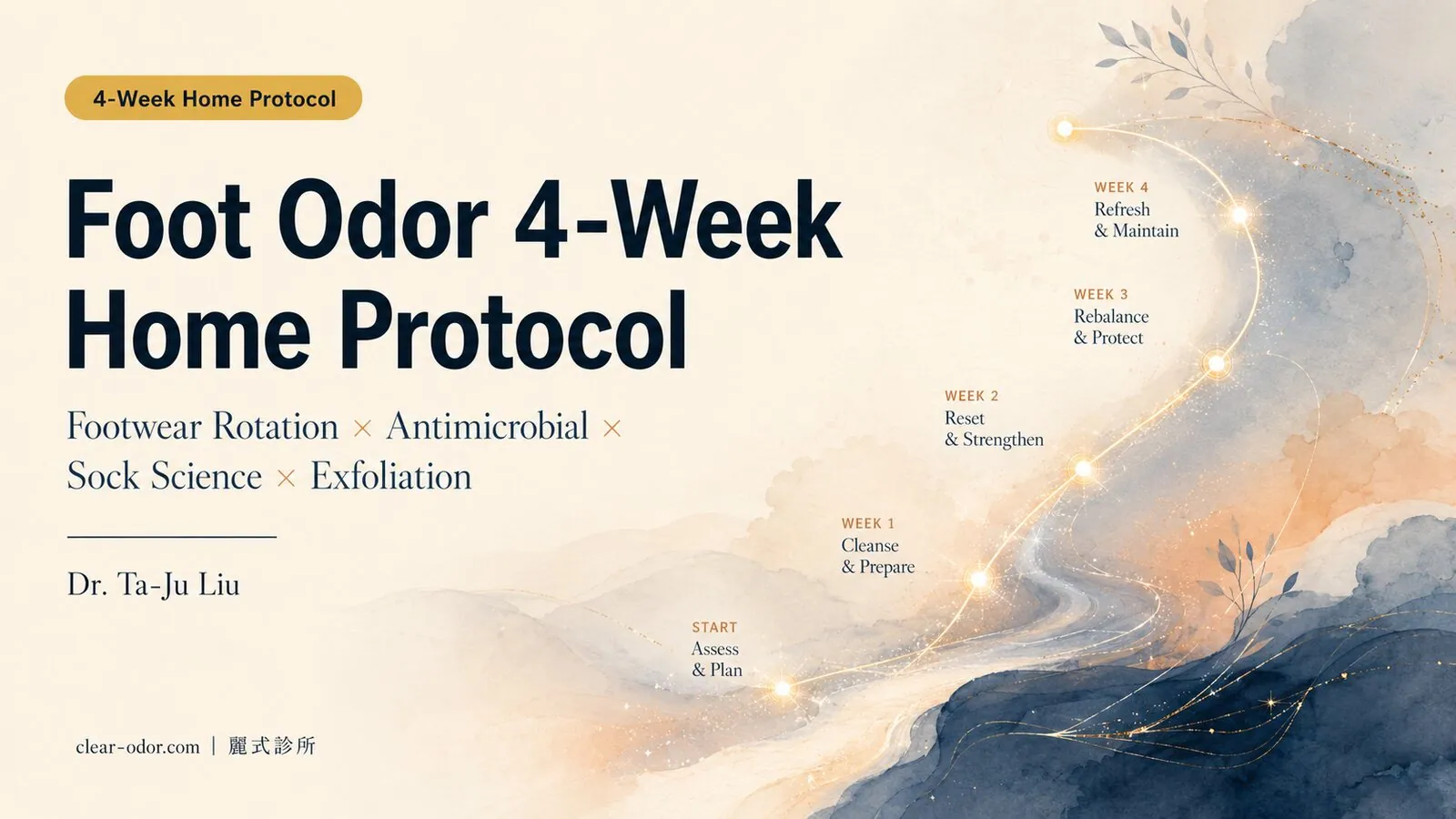
How do you run the 4-week home protocol for foot odor?
Most foot odor can start with a 4-week systematic home protocol: footwear rotation and ventilation, antibacterial care and sweat control, socks and exfoliation, antifungal care if needed, and logging odor and sweat at weeks 0/2/4 — use a measurable flow to watch improvement, then decide whether medical intervention is needed.
Before escalating to medical intervention, most foot odor cases can first try a 4-week systematic home protocol and observe the degree of improvement. Record at Week 0 / 2 / 4:
- Odor intensity self-rating (0-10)
- Accompanying symptoms (peeling, fissures, itching, erythema, vesicles)
- Sweat level (in-shoe dampness, sock-change frequency)
- Trigger contexts (exercise / stress / closed shoes / weather)
Week 0: Baseline recording + environmental inventory
- List all currently used shoes, materials, and purchase dates
- List sock materials (cotton / wool / silver ion / functional fiber)
- Take photos of the feet (especially interdigital web spaces, soles, heels)
- Self-rate odor intensity and record which times of the week are most intense
Week 1: Five things to start with
01. Footwear rotation + ventilation
- Rotate among at least 2-3 pairs of shoes, allowing each pair to air-dry for 24-48 hours after wear (shade-drying, not direct sun)
- Prefer breathable uppers (leather, mesh); avoid prolonged wear of closed synthetic materials
- For closed-shoe work environments: switch to sandals at lunch break for 30+ minutes of ventilation
- Take shoes off immediately after exercise — do not stay in damp shoes for 1-2 hours
02. Antimicrobial foot spray / powder
Every morning when feet are dry:
- Aluminum chloride class (20% aluminum chloride hexahydrate): strong sweat reduction, often used for sweat-dominant cases
- Isopropyl alcohol + antimicrobial compound foot sprays: for daily use
- Antimicrobial foot powders (containing talc + antimicrobial agents): combined moisture absorption and antimicrobial action
2-3 times per week:
- Tea tree oil foot soak (10 minutes / 38°C): antimicrobial and antifungal support
- Avoid over-degreasing (daily soaking can disrupt the skin barrier)
03. Moisture-wicking socks
- Wool / Merino / silver ion / functional fiber: both absorb and release moisture
- Avoid 100% cotton socks — cotton absorbs but does not release, leaving feet soaking in their own sweat
- Change socks daily, immediately after exercise
- Keep 1-2 spare pairs at the office / gym
04. Foot exfoliation and moisturizing
- Gentle exfoliation 1-2 times per week: a foot file or 5-10% urea cream to reduce dead skin that feeds bacteria
- Apply moisturizer to dry areas (avoid heavy oily lotions that clog)
- For fissures, use a 10-20% urea repair cream
05. Tinea pedis screening
If peeling, fissures, or interdigital itching is present — co-existing tinea pedis is possible. Even without itch, the "hyperkeratotic type" remains a possibility.
- OTC antifungal creams (terbinafine 1% / clotrimazole 1%): use for 2-4 weeks (follow product instructions); do not stop after just a few days
- Application area: extend 2 cm beyond visible lesions (tinea pedis has "satellite lesions")
- No improvement → see a clinician: persistent symptoms at 4 weeks → integrated assessment for prescription-strength treatment or comorbidities
Week 2: Run environmental disinfection in parallel
A common driver of recurrent cases is that "the shoe itself is the source of infection" — after 4 weeks of personal skin treatment, residual bacteria in shoes re-infect the feet.
Footwear disinfection:
- UV-C shoe sterilizer: 30 minutes daily
- Alcohol spray (70% IPA): spray inside shoes 1-2 times per week, air-dry naturally
- Antimicrobial spray (quaternary ammonium / silver ion): once per week
- Severe infection: consider retiring the oldest 1-2 pairs (when affordable)
Household environment:
- Bathroom slippers used by one person only, not shared
- Wear sandals in public wet areas (gyms / pools)
- If household members have tinea pedis, treat in parallel (otherwise cross-infection persists)
Week 3: Adjusting lifestyle factors
- Reduce: spicy food, alcohol (can amplify sweating), excessive caffeine
- Weight management: more weight on the feet → more sweat
- Stress: sympathetic activation amplifies systemic sweating
Week 4: Assessment + next-step decision
| Degree of improvement | Next step |
|---|---|
| ≥ 70% improvement | Maintain current protocol, settle into a steady rhythm (see Section 9) |
| 30-70% improvement | Fine-tune antimicrobial agents, confirm presence or absence of tinea pedis, observe another 2 weeks |
| < 30% improvement | Book Integrated Clinic assessment; consider Tier 1 prescription intervention |
| No improvement + severe peeling / fissures / erythema | See a clinician immediately; possible severe tinea pedis or bacterial infection |
After home care doesn't work, what are the medical intervention tiers?
Medical intervention starts only after 4 weeks of home care show no change, on a "minimum necessary strength, re-evaluate at follow-up" principle: Tier 1 prescription antifungal/antiperspirant, Tier 2 plantar Botox for sweating, Tier 3 stubborn or combined issues — stepping up one tier at a time, not maxing out from the start.
When the 4-week home protocol shows no improvement, escalate to medical intervention. The principle is 'minimum necessary intensity, scheduled reassessment'.
Tier 1: Prescription-strength antimicrobial / antifungal
| Intervention | Indication | Usage |
|---|---|---|
| Erythromycin gel | Bacteria-dominant, susceptible strains | Twice daily, 4 weeks |
| Prescription terbinafine 1% cream | Fungus-dominant, OTC failure | Twice daily, 4 weeks |
| 20% aluminum chloride solution | Hyperhidrosis amplification | Apply at bedtime on dry feet, wash off the next morning |
| Topical antibiotic + corticosteroid | Co-existing bacteria + acute inflammation | Short course of 1-2 weeks |
Expected timeline: noticeable change at 2-4 weeks, stable state at 6-8 weeks. If no improvement at 8 weeks → escalate to Tier 2.
Tier 2: Hyperhidrosis management
For patients whose primary driver is hyperhidrosis amplification rather than fungal or bacterial dominance:
- Plantar Botox injection: blocks nerve signaling to eccrine glands, markedly reducing sweat output, with effects lasting about 6 months
- Injection detail: one injection per ~1 cm² on the sole, approximately 30-40 injections per foot depending on area
- Same technique used for palmar / axillary injection: this clinic has long-standing experience
- Pain management: the sole is among the most sensitive areas of skin on the body; ice packs and topical anesthesia are used as needed
The details of Botox injection (dosing, pain management options, comparison with palmar / axillary injection) are explained in person at consultation. Fee and duration are individualized in consultation.
Tier 3: Advanced assessment and treatment
When Tier 1 + 2 show no improvement after 8 weeks or recurrence persists:
- Microbiome testing (flora analysis): quantification of Brevibacterium, Staphylococcus, and other species
- Biofilm assessment: refractory bacteria may form biofilm, requiring specialized handling
- Oral antifungals for refractory tinea pedis: itraconazole (1-week pulse therapy) or fluconazole (once weekly), with liver function monitoring
- Rare differential diagnoses: diabetes, immunosuppressed states, uncommon dermatoses (pitted keratolysis)
Why does footwear rotation + antimicrobial care + treating athlete's foot together beat chasing one more spray?
Because foot odor is a multi-layer problem and a single intervention only fixes one layer — swapping sprays without addressing residual bacteria in shoes, athlete's foot, or callus lets the smell return fast; doing shoe disinfection, antibacterial, and antifungal together breaks the "skin ⇄ shoe" re-contamination cycle.
This is one of the most frequently asked questions in clinic. Short answer: foot odor is a multi-layer problem; single-point intervention can only improve one layer.
Three core reasons
1. The three layers reinforce each other
If you only apply an antimicrobial spray but keep wearing the same damp shoes — the antimicrobial agent is used up within 12-24 hours while shoes continuously supply bacteria and moisture → you return to baseline in 2-3 days.
If you only rotate shoes but do not address the skin flora — the skin flora will rebuild the same microbiome inside the new shoes.
If you only apply antifungal cream but do not change socks or disinfect shoes — tinea pedis will be repeatedly re-infected by residual fungus inside the shoes.
Only by intervening at all three layers simultaneously is improvement sustainable.
2. Footwear is an underestimated core factor
Many people spend money on various foot sprays and prescription medications but never disinfect their shoes. That is like cleaning a room and then sitting back down on the same bacteria-laden chair — treating the symptom but not the root.
Recognizing footwear as a source of infection is the key insight for managing recurrent foot odor.
3. Tinea pedis is often overlooked
30-40% of recurrent foot odor has a fungal component, but most patients lack classic "itching" — they assume "no itch means no athlete's foot".
In reality, "hyperkeratotic" tinea pedis often presents as heel and lateral foot dry scaling, treated for years as "dry skin". Integrated assessment includes this in screening.
In other words
The solution to foot odor is not in "finding the strongest spray" — it is in simultaneously activating intervention across multiple layers:
- Layer 1 (environment): footwear rotation + disinfection + ventilation
- Layer 2 (bacteria): antimicrobial spray + sock adjustment
- Layer 3 (fungus): screening + antifungal when needed
The value of integration lies here — not in more expensive tools, but in applying the right tool at the right layer.
"I think my feet smell strong, but no one else notices" — what's going on?
This may be Olfactory Reference Syndrome (OlRS): a small group strongly feel their feet smell, yet objectively family and friends in the same room notice nothing and exams find no source — here hunting for an "even stronger foot spray or treatment" won't help; what's needed is a different kind of evaluation and support.
A small number of patients report: "I think my feet smell strong, but my family and friends say they smell nothing even in the same room when I take my shoes off" — this falls into the gray zone of Olfactory Reference Syndrome (ORS / OlRS).
Why this needs special handling
Directly labeling this as "psychogenic, all in your head" causes two harms:
- Real physiological microbiome imbalance is overlooked (strong subjective experience with mild objective findings is possible)
- Patients who feel labeled find it harder to seek help
The Integrated Clinic's pathway:
Step 1 — Objective assessment to rule out physiological factors
- Visual examination of skin condition (peeling, fissures, erythema)
- In-shoe / in-sock culture when needed
- Third-party olfactory assessment (family member + medical staff in double-blind confirmation)
Step 2 — If objective indicators are normal but subjective anxiety persists
- Do not conclude "psychogenic"; instead explain "physiological assessment is normal, subjective anxiety may have other origins"
- Recommend a complementary psychosomatic or psychiatric assessment (especially when social avoidance or compulsive checking behaviors co-exist)
- ORS is classified within the OCD spectrum in DSM-5, with dedicated treatment approaches (CBT, SSRI)
Step 3 — Regardless of result, provide the home protocol
Even when objective findings are normal, the 4-week home protocol has minimal side effects and may improve subjective experience — more helpful than outright refusing treatment.
When should you see the integrated clinic instead of trying another foot spray?
When 4 weeks of home care show no improvement, when there's recurrent athlete's foot or skin redness and peeling, when sweating is heavy enough to affect daily life, or when you're unsure which type you are — it's time to book an integrated assessment rather than trying one foot spray after another.
Any one of the following → book an integrated assessment instead of trying another new spray:
- Less than 30% improvement after the 4-week systematic home protocol
- Significant peeling, fissures, or interdigital itching (suspected tinea pedis co-existence)
- Recurrent — recurrence 2+ times per year, primary driver needs clarification
- Sweating heavy enough to require 2-3 sock changes per day (hyperhidrosis intervention candidate)
- Concurrent axillary / scalp / other site odor requiring integrated handling
- Strong subjective odor not detected by people around you (OlRS assessment needed)
Integrated Clinic initial consultation flow:
- History-taking (10-15 min): odor history, family history, footwear habits, activity level, inventory of current products
- Objective examination (10 min): visual foot examination (peeling, fissures, erythema, vesicles), interdigital evaluation, tinea pedis screening
- Odor assessment (5 min): clinician-side olfactory evaluation, with a third-party companion as needed
- Integrated protocol design (5-10 min): personalized Tier 0-3 pathway based on assessment
After it improves, how do you maintain across 3/6/12 months without relapse?
Foot odor is about "stable maintenance," not "one-time cure": after improvement, keep the most effective footwear rotation, antibacterial care, and exfoliation as routine, re-evaluate at 3 months, fine-tune at 6, and confirm stability at 12 — a maintenance rhythm prevents relapse better than a one-off sprint.
Integrated odor management is "stable maintenance" rather than "one-time elimination". Suggested long-term rhythm:
3-month milestone
- Self-rate odor intensity: compare to baseline
- Assess prescription medication frequency: can it be stepped down?
- Footwear status: anything to retire or replenish?
- Review lifestyle factors: have diet, exercise, and stress drifted back to old habits?
6-month milestone
- Seasonal adjustment: summer sweating requires more frequent shoe rotation; winter closed shoes need ventilation
- Reassess whether odor at other sites has emerged (integrated perspective)
- For Botox injection patients: 6-month duration assessment, decision on re-injection
12-month milestone
- Annual review: which months worsened, and connection with life events
- Long-term maintenance tuning: can it move into a "minimum maintenance" mode?
- Overall health assessment: changes in weight, blood glucose, chronic disease medications
Individual outcomes vary — some patients can maintain with home protocol alone after 6 months, while others need 1-2 Botox top-ups per year. The point is to build a "body signal → assessment → adjustment" feedback loop, rather than chase the unrealistic goal of "never having any odor again".
FAQ — 12 Most Frequently Asked Questions in Clinic
Q1. Can foot odor be "cured"?
We do not use absolute terms like "cure" — eccrine glands and the microbiome are dynamically regulated; the goal is "lowering it to a level that no longer bothers you or those around you, and stably maintaining that". Most people see significant reduction in 4-12 weeks under a systematic protocol, but ongoing maintenance is needed (footwear rotation, antimicrobial care, sock material). Individual outcomes vary.
Q2. I wash my feet daily but they still smell — am I doing it wrong?
Common reasons: (1) no footwear rotation — same pair worn back-to-back without drying; (2) 100% cotton socks — absorb but do not release; (3) unrecognized co-existing tinea pedis — peeling and interdigital itching are signals; (4) hyperhidrosis amplification — home care alone is insufficient. Run the 4-week home protocol and then reassess.
Q3. How effective is plantar Botox injection?
Botox injection blocks nerve signaling to the eccrine glands on the soles, markedly reducing sweat output, with effects lasting about 6 months. Injection sites are spaced about 1 cm² apart, approximately 30-40 injections per foot depending on area. This clinic also handles axillary and palmar hyperhidrosis, with mature technique. Fee, duration, and individual suitability are explained in person at consultation.
Q4. My tinea pedis keeps recurring — what now?
Common reasons for recurrent tinea pedis: (1) insufficient treatment course (OTC often used for 1-2 weeks, actually requires 4); (2) untreated co-infection in footwear; (3) untreated tinea pedis in family / household members; (4) immune status (diabetes, HIV, immunosuppression). Integrated assessment screens each in turn and refers for internal medicine workup as needed.
Q5. Is it suitable for children / adolescents?
Suitable for adolescents (middle school and up, especially active and sweating heavily on the feet). Pediatric foot odor is usually a hygiene + footwear issue — start with education and observation. If tinea pedis is suspected, parents can bring the child in for assessment.
Q6. Is plantar Botox painful?
The sole is among the most sensitive skin areas on the body, and Botox injection is genuinely painful — Dr. Liu's long-developed gentle nerve-block technique substantially reduces pain (same technique used for palmar / axillary injection). Details, including pain management options, are explained in person at consultation.
Q7. Can I use ordinary axillary body odor surgery to treat foot odor?
Not suitable. The soles are dominated by eccrine glands (not apocrine glands), with extreme density and intimate adjacency to sensory nerves — surgical excision risks far outweigh benefits. Axillary body odor surgery targets apocrine glands, which differ in origin from foot tissues. The Integrated Clinic does not advocate applying underarm surgery to the feet — that is using the right tool to solve the wrong problem.
Q8. Why does my colleague's foot odor seem worse than mine, yet he doesn't do anything about it?
Subjective and external perception of odor often diverge. Possible reasons: (1) olfactory adaptation (you cannot smell your own odor); (2) cultural / personal tolerance; (3) workplace ventilation; (4) he is actually bothered too, just not talking about it. What matters for you is that if you want to address it, it is worth addressing — other people's choices do not change your decision.
Q9. What is the difference between an antimicrobial spray and an antiperspirant?
Different mechanisms:
- Antimicrobial spray: kills or inhibits bacteria, reducing metabolic byproducts (targets Layer 2)
- Antiperspirant (containing aluminum chloride): reduces sweat secretion volume (targets Layer 1)
The two can be used together without conflict. Heavy cases usually need a combination: antiperspirant (morning) + antimicrobial spray (before going out).
Q10. After getting Botox injection, can I stop rotating shoes and socks?
You still need to maintain those habits. Botox lowers sweat output but does not affect flora or in-shoe environment — if you keep wearing the same unrotated old shoes and cotton socks, residual sweat will still be metabolized by bacteria. Botox lowers "the main irritation source" but does not repair the entire system. Long-term management still requires multi-layer effort.
Q11. I think my feet smell strong but my family says they don't — what now?
This may fall into the gray zone of Olfactory Reference Syndrome (OlRS). This clinic does not jump to a psychogenic label — we first run objective assessment (visual examination, in-shoe / in-sock culture when needed) to rule out physiological factors. If the full set of objective indicators is normal but subjective anxiety persists, we recommend a complementary psychosomatic assessment.
Q12. What does the Integrated Triage assessment look like?
The initial consultation is booked via LINE for an "Odor Map initial consultation", handled integratedly at the in-person visit: (1) detailed history of foot odor and lifestyle; (2) objective examination (visual, tinea pedis screening, culture when needed); (3) prioritization of primary and secondary drivers; (4) personalized Tier 0-3 protocol; (5) reassessment at 4-8 weeks. Fee and duration are individualized in consultation based on your situation.
Related Reading
- Botox for Sweaty Feet: How It Works, Duration & Pain
- Foot Odor: A 4-Week Home Protocol for Shoes, Socks & Skin
- Hyperhidrosis Guide: Types, Severity, Treatments & ETS
- Scalp Odor After Washing? The Microbiome & How to Manage
- Foot Odor Integrated Assessment
- Hyperhidrosis & Compensatory Sweating
A Closing Note
Foot odor is the most systematically tractable among the five major odor sites — home management + microbiome assessment + Botox or antifungal when needed offers a clear pathway. The value of integration is that you no longer have to try one new spray after another — you use the right method, the right tools, at the right layer.
The core stance of the Integrated Odor Clinic is: odor is a signal, not a defect. It tells you something is out of balance between your body and the microbes — perhaps from footwear, sock material, activity level, tinea pedis, or several factors combined. Understanding that signal matters more than masking it.