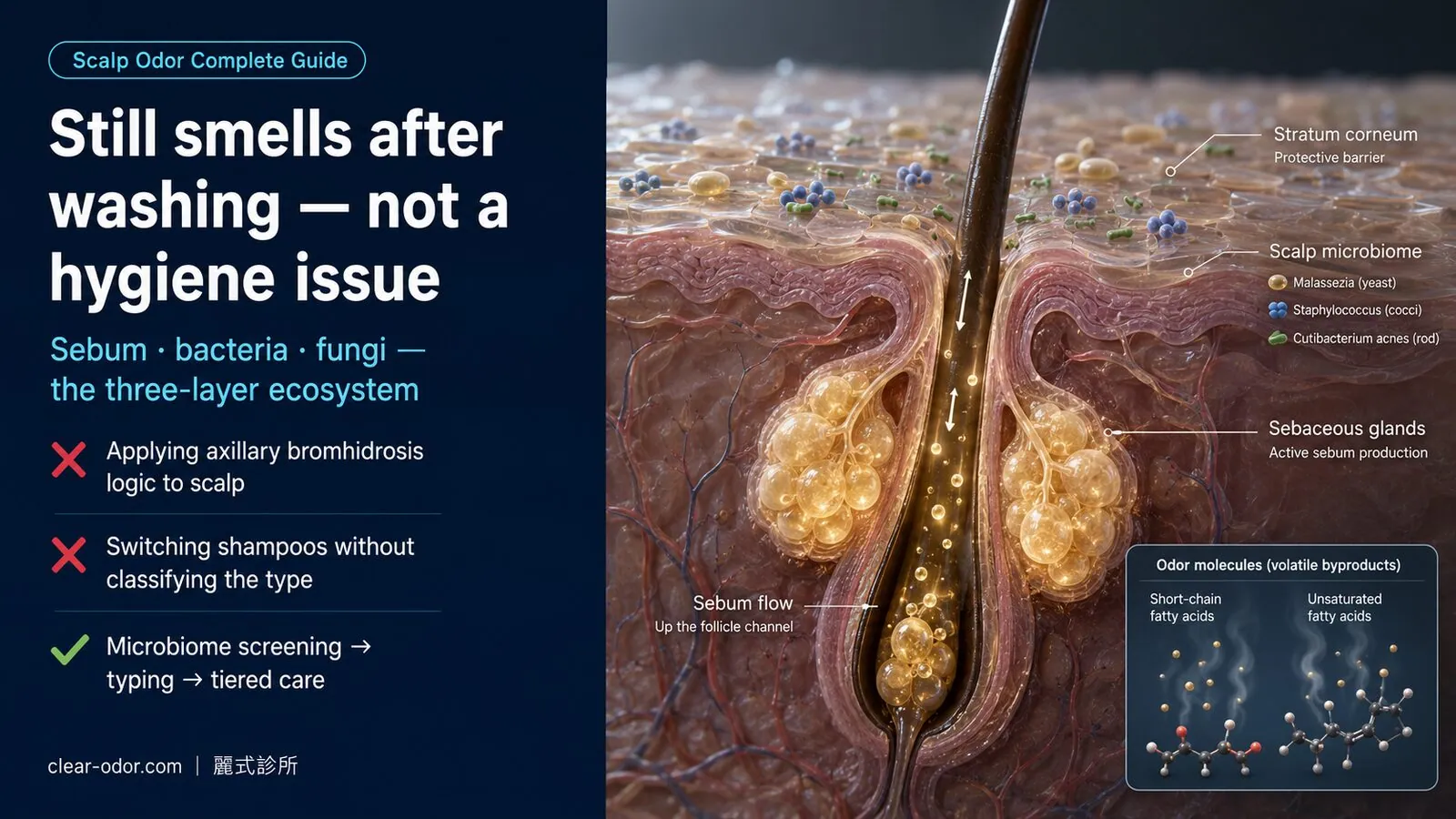
Scalp odor differs fundamentally from underarm or intimate-area "apocrine gland" odor — the scalp has very few apocrine glands. The dominant cause is the extremely high density of sebaceous glands (300-900 per cm²), whose triglyceride secretions are metabolized by surface bacteria (Staphylococcus, Cutibacterium) and fungi (Malassezia restricta / globosa) into short-chain and unsaturated fatty acids. Liu's Integrated Odor Clinic offers a stepped "home protocol → medical intervention → advanced assessment" approach to identify root causes and progressively reduce odor.
3 Layers
Microbiome Analysis
4 Weeks
Home Protocol Window
5 Sites
Odor Map Integration
20+
Years Clinical Experience
Table of Contents
Why Does My Scalp Still Smell After Washing?
Scalp malodor is common in dermatology practice but often underestimated. Its mechanism differs from underarm or areola bromhidrosis — those are driven by apocrine glands, whereas the scalp has almost none. The dominant driver is microbial imbalance on a scalp that produces large volumes of sebum.
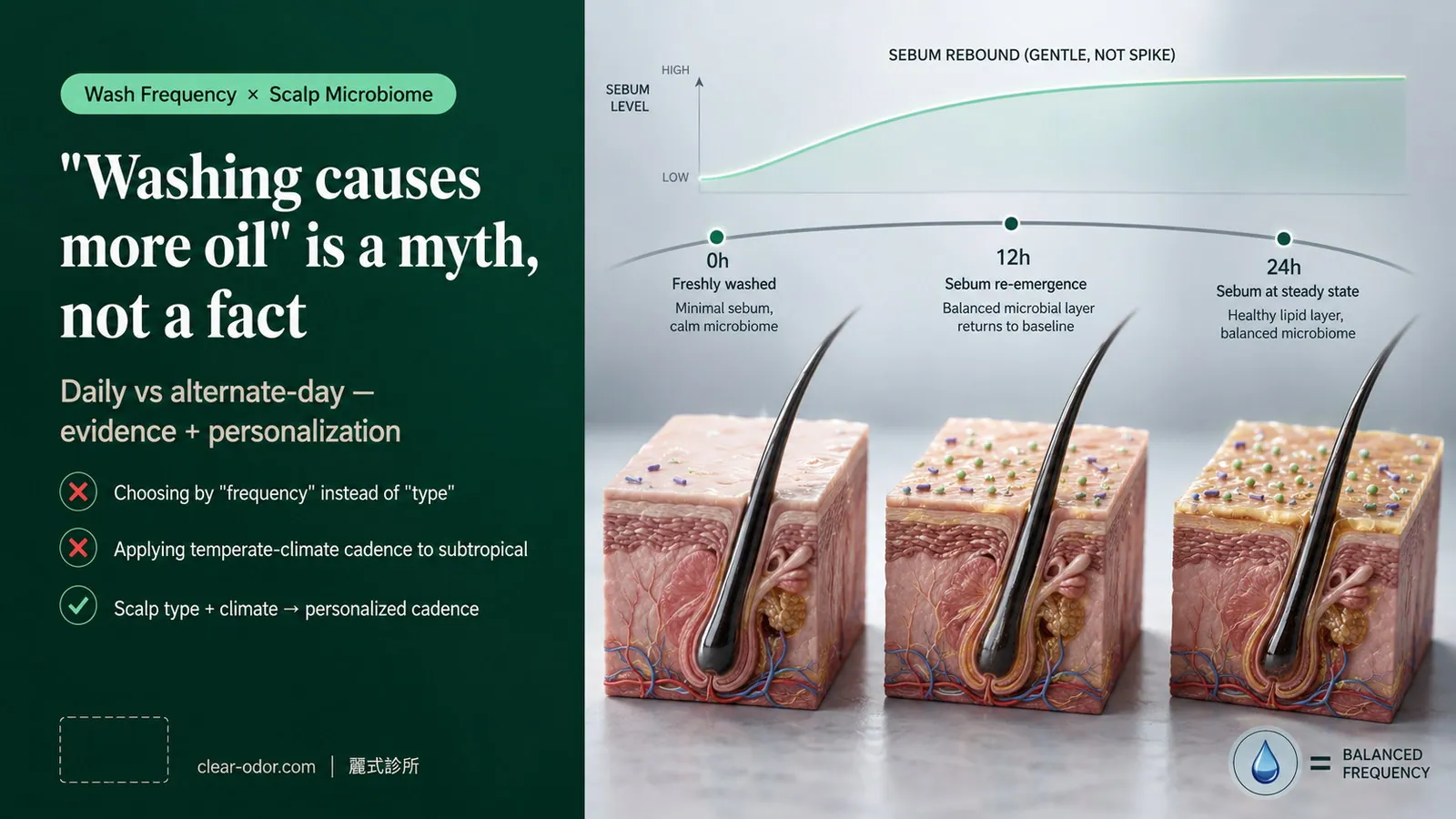
Sebum production typically rebounds within 2-6 hours of washing. When sebum triglycerides are broken down by bacterial lipases into short-chain fatty acids (propionic, butyric), and Malassezia fungi produce unsaturated fatty acids (e.g., oleic acid), the result is a sour/oily smell — usually most noticeable during exercise, stress, hat-wearing, or when the scalp gets warm and humid.
Why "integrated assessment" rather than just switching shampoo
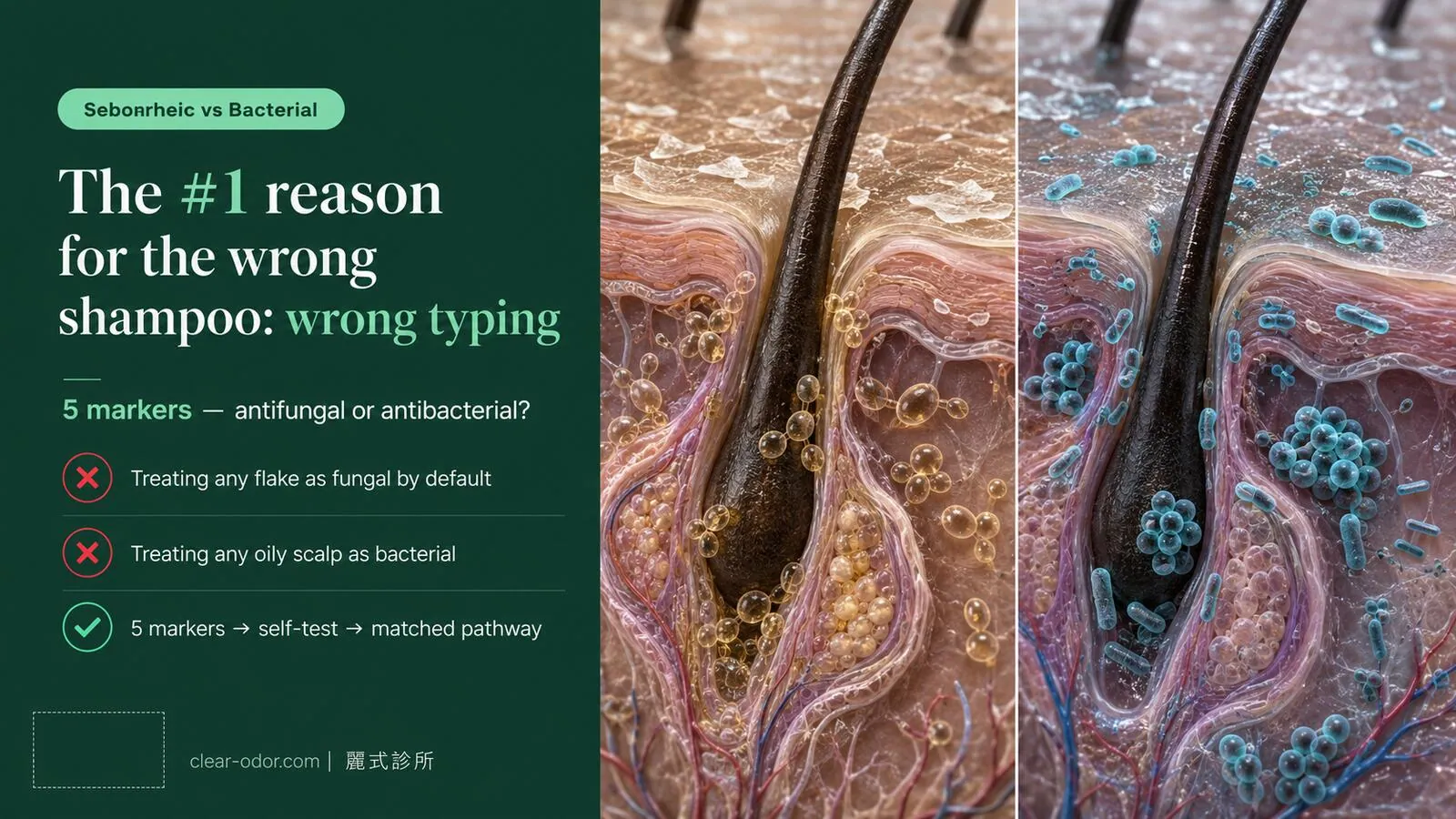
Switching shampoo alone often misses: (1) whether the odor is from sebum metabolism, Malassezia overgrowth, or seborrheic dermatitis; (2) amplifiers like diet, hormones, and stress; (3) the gap between perceived vs. observed odor (a small subset falls into olfactory reference territory). Integrated assessment unpacks each layer.
Sebum × Bacteria × Fungi
Three-Layer Scalp Microbiome Analysis
Our integrated clinic evaluates the scalp in three layers — which layer is imbalanced determines the next step: adjust hygiene cadence, add antifungal medication, or run advanced microbiome testing.
Layer 1: Sebaceous Glands
Scalp sebaceous gland density (300-900/cm²) is second only to the T-zone. Regulated by androgens, diet, and stress. Sebum itself is odorless, but it feeds the bacterial and fungal communities.
Layer 2: Bacterial Flora
Resident bacteria like Staphylococcus epidermidis and Cutibacterium acnes lipolyze sebum triglycerides into short-chain fatty acids — the primary source of the "sour" smell.
Layer 3: Malassezia Fungi
Lipid-dependent yeasts (particularly M. restricta, M. globosa) metabolize sebum into unsaturated fatty acids, closely linked to seborrheic dermatitis, dandruff, and a distinctive oily-rancid odor.
Clinical Reading
Odor + dandruff + erythema + itching → Layer 3 (Malassezia / seborrheic) is dominant. Odor + greasy sheen + folliculitis → Layers 1+2 (sebum + bacteria). Odor without visible skin changes that others don't notice → olfactory reference assessment may be appropriate.
Start with these 5 actions
4-Week Home Protocol
Before medical intervention, most scalp odor cases benefit from 4 weeks of systematic home care. Track odor intensity (self-rated 0-10) and accompanying symptoms (flakes, itch, oiliness) at weeks 0, 2, and 4.
Personalize Wash Frequency
Oily scalp: wash daily (avoid over-stripping that triggers rebound oiliness). Dry/neutral: every 2-3 days. Water temperature 38-40°C — hot water amplifies sebum production.
Let antifungal shampoo dwell 3-5 minutes before rinsing. Product residue (styling, conditioner) is a commonly overlooked odor source — rinse with water first, then shampoo twice.
Long-duration hats/helmets, unwashed sweat on scalp, shared towels and pillowcases, high-alcohol styling products (barrier damage). Change pillowcases weekly.
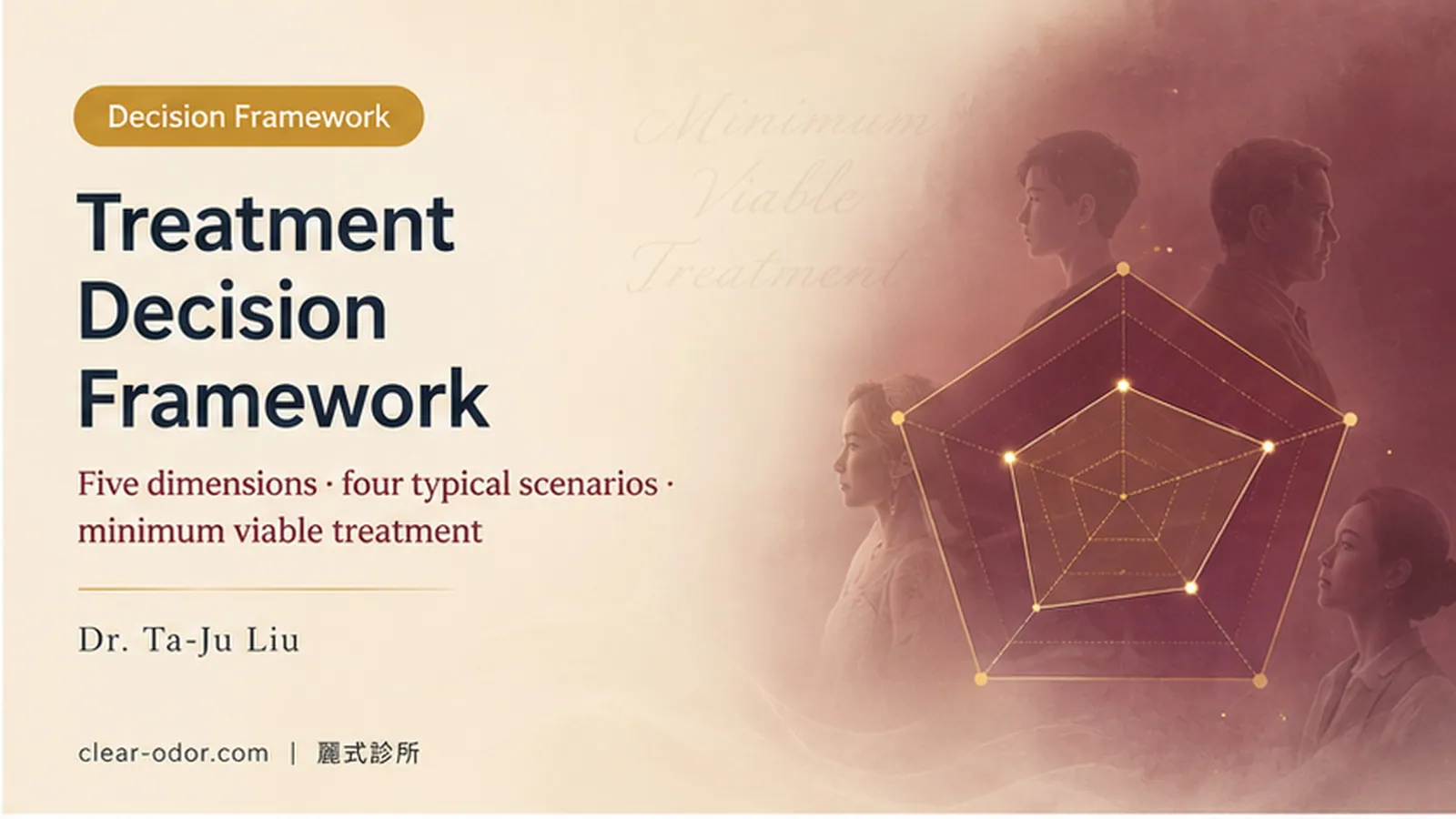
Tier 1 → Tier 2 → Tier 3
Medical Intervention Ladder (when 4-week home protocol fails)
Our integrated clinic intervenes in three tiers based on severity and microbiome assessment. The principle is "lowest necessary intensity, regular reassessment."
8 weeks of Tier 1+2 with no improvement, or recurrent relapse
* All medical interventions are individualized based on clinical assessment; results may vary. This clinic does NOT advocate applying apocrine gland surgery to scalp odor — literature support is extremely limited. Such discussion is reserved for the rare case of imaging or biopsy confirming aberrant apocrine distribution.
When to See the Integrated Odor Clinic
If any of the following apply, book an integrated assessment rather than trying yet another shampoo:
< 30% improvement after 4 weeks of systematic home protocol
Accompanying hair loss, scalp erythema, visible dandruff, or itching
Odor affects social, work, intimate life, or self-esteem
You perceive strong odor but close contacts don't (olfactory reference assessment may be appropriate)
Odor at multiple body sites (underarms, intimate, feet) needing integrated handling
The dedicated 30-45 min Odor Map Initial Consultation launches in Phase 2. For now, please book a general dermatology consultation.
About the Integrated Odor Clinic
Dr. Ta-Ju Liu
Dr. Ta-Ju Liu
Lead Physician, Clear Odor Integrated Odor Clinic
20 years of clinical experience in odor and sweat gland disorders
Founder of Liu's Integrated Odor Clinic (scalp / oral / body / intimate / metabolic / OlRS)
10,000+ apocrine gland procedures across axillary, areola, and perineal sites
Recent focus: multi-site integrated odor assessment and microbiome analysis
"Odor is rarely about one site — it's a signal from the body's interaction with its microbiome. Integrated assessment finds the root cause better than another shampoo bottle."
FAQ
Q1.Is scalp odor an extension of underarm "apocrine bromhidrosis"?
Rarely. Apocrine glands are sparse on the scalp (mostly clustered behind the ears). The vast majority of scalp odor is the product of sebaceous glands, bacteria, and Malassezia — not the underarm-type bromhidrosis. A small subset with prominent post-auricular apocrine activity may notice localized odor, but the overall mechanism differs from the oily-rancid scalp smell.
Q2.Can I just have apocrine surgery applied to my scalp?
Not recommended. International medical literature provides extremely limited support, and the scalp has rich blood supply with dense hair follicles — surgical removal of sebaceous glands carries high risk (including permanent alopecia) relative to benefit. This clinic does not apply axillary/areolar/perineal apocrine surgery to the scalp, except in the rare cases of imaging or biopsy-confirmed aberrant apocrine distribution.
Q3.I use anti-dandruff shampoo but the smell persists — am I doing it wrong?
Possible reasons: (1) Active ingredient concentration too low (OTC is typically 0.5-1%; prescription Ketoconazole is 2%); (2) Insufficient dwell time (recommend 3-5 min); (3) The odor source isn't Malassezia but residue or other bacteria; (4) Co-existing seborrheic dermatitis needs short-course topical therapy. If 4 weeks of home protocol fails, come for reassessment.
Q4.Does diet really affect scalp odor?
Indirectly, yes. High-fat, refined sugar, and alcohol amplify sebum production, feeding bacteria and fungi. Omega-3 and zinc deficiency may affect sebum composition. Severe dehydration concentrates sweat and sebum. Diet adjustment is usually adjunctive rather than primary, with effects emerging over 4-8 weeks.
Q5.Is scalp odor linked to stress?
Yes. Cortisol (the stress hormone) amplifies androgen-driven sebum secretion, and stress itself alters apocrine activity (e.g., post-auricular). Many people notice scalp odor worsening during high-stress periods, before exams, or with sleep deprivation — this is a real physiological mechanism, not a psychological illusion.
Q6.I think I smell strongly, but family says I don't — what now?
This falls into the gray zone of "olfactory reference disorder" (ORS) — where self-perceived intensity diverges sharply from objective measurement. Our clinic does not jump to a psychogenic diagnosis. We run objective microbiome and sebum assessment first to rule out physiological causes; if all objective measures are normal but subjective concern persists, we recommend psychosomatic co-assessment (Phase 4 of our integrated workflow will formalize this).
Q7.Can scalp odor be "cured"?
We avoid absolute language like "cured." Sebaceous glands and microbiome are dynamic — the goal is "reduce odor to a level neither you nor those around you find concerning, and maintain it." Most patients see significant reduction in 4-12 weeks under a systematic plan, but maintenance (wash cadence, antifungal rotation) is ongoing. Results may vary.
Q8.When will the Odor Map Initial Consultation launch?
Planned for Phase 2 (June-July 2026): a dedicated 30-45 minute integrated intake covering scalp, oral, body, intimate, metabolic, and OlRS — six-site systematic assessment with optional microbiome testing. For now, please book a general dermatology consultation.
The medical information provided on this page is for reference only and cannot replace individual face-to-face diagnosis, advice, or treatment from a physician. All medical procedures carry risks. Individual constitution and post-operative recovery vary from person to person. Please discuss any treatment plan with your attending physician before making decisions.