The Odor Map: Find the Source, Not Just Mask the Smell
6 Body Sites × Mechanism DifferencesComplete Integrated Odor Clinic Framework
Body odor is rarely a single-site problem. Underarm, scalp, oral, intimate, foot, and systemic-metabolic — six distinct sources, each with its own mechanism. The same person often has multiple sources that amplify each other. The Liu Integrated Odor Clinic uses the "Odor Map" as a cross-site assessment framework: identify primary cause, amplifiers, and psychological layer first, then deliver a personalized path — rather than the single-point "switch shampoo" or "redo surgery" approach.
Why use an "Odor Map" framework?
- Single-point treatment is often hijacked by the most obvious station, missing secondary sources. Most odor-treatment failures aren't because the surgery was bad — they're because the primary source was misidentified.
- The 6 sites have radically different mechanisms (apocrine vs. sebaceous vs. microbiome vs. metabolic). Applying the same logic to all of them doesn't work.
- OlRS gray zones must be identified before "treating the physiological cause" — otherwise, after handling every physiological factor, subjective perception remains unchanged.
- Integrated assessment + personalized path is cheaper, safer, and more effective than "do another surgery."
Map of 6 Odor Sources
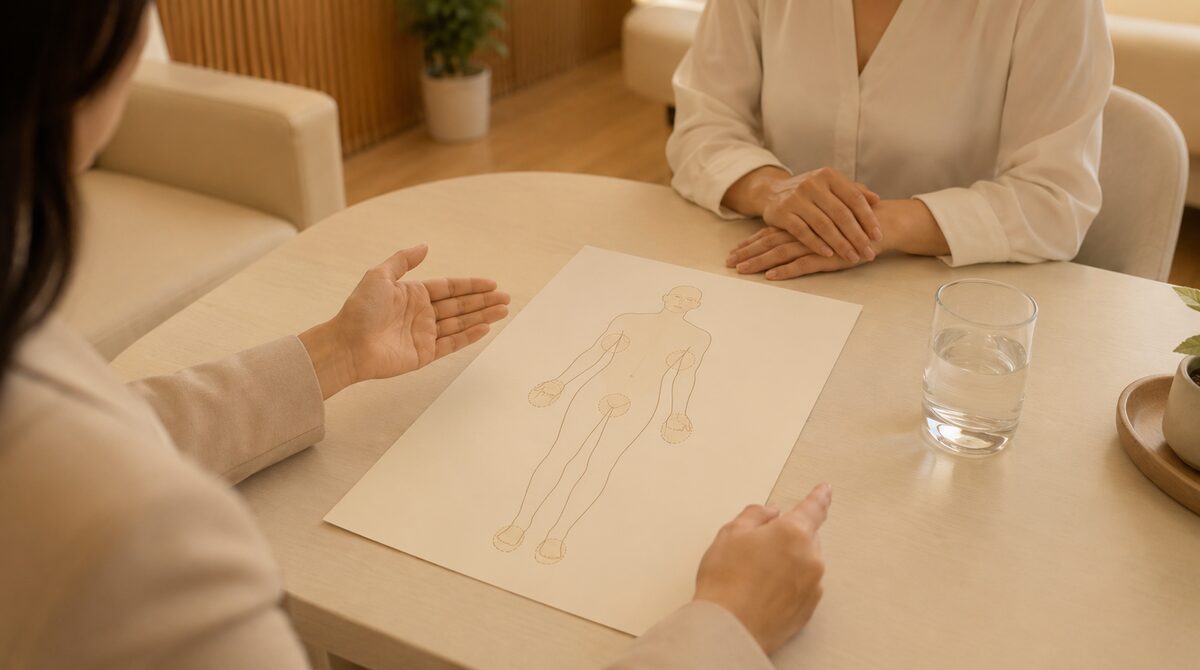
The Odor Map organizes odor sources into six body sites. Each has distinct mechanisms, amplifiers, and optimal interventions. The first step of integrated assessment is localization — which is your primary station? Is there a secondary station?

Body (Underarm / Areola / Hyperhidrosis)
Axillary bromhidrosis, areola odor, and hyperhidrosis dominate. Mechanism: apocrine secretions metabolized by surface bacteria.

Scalp Odor
Different from apocrine mechanism. High sebaceous density (300-900/cm²) + Malassezia + resident bacteria — microbiome imbalance.

Oral / Halitosis
Tongue coating, periodontal, tonsil stones, post-nasal drip, GI reflux — multi-source; triage and refer to dental/ENT/GI as needed.

Intimate Odor
Perineal apocrine (suso-wakiga) and vaginal/vulvar microbiome odor are two separate paths; differentiation guides treatment.

Foot Odor
Dense eccrine glands + occlusive footwear → combined bacterial (Brevibacterium, Staph) and fungal (tinea pedis) action.

Systemic / Metabolic
TMAU (fish-odor syndrome), diabetic ketoacidosis, hepatic/renal disease, rare metabolic disorders — identification and referral are the clinic's core value.
Odor Map Initial Consultation Flow
The initial consultation is not "glance at symptoms and write a prescription." It is a structured workflow that unpacks your odor composition. Each step has a defined output — avoiding trial-and-error treatment.
Symptom Map Localization
Site-by-site assessment across all 6 stations: self-rated odor intensity (0-10), amplifiers (exercise / stress / menstrual cycle / diet), accompanying skin changes. Establishes your "primary + secondary station" initial localization.
Objective Examination & Microbiome Assessment
Examinations tailored to your primary station: iodine-starch test (sweat), sebum and microbial sampling, oral/sinus ENT evaluation or referral, KOH microscopy for tinea pedis — extending to blood chemistry if metabolic causes are suspected.
OlRS Olfactory Reference Brief Screener
Identifies the gray zone where self-perception is strong but objective findings are normal. The 5-item brief screener is a trigger signal for further evaluation — not a diagnostic tool. Higher scores prompt suggestion for psychosomatic co-assessment.
Personalized Treatment Path
Based on primary + secondary + OlRS, define the next step: surgery, 4-week home protocol, dental/ENT/GI referral, or internal-medicine workup. Principle: lowest necessary intensity, scheduled reassessment.
Why isn't there a fixed consultation fee / duration?
Initial consultation fees and duration are case-by-case — disclosed on LINE based on your described condition. Odor composition varies enormously between individuals; multi-source cases need far more evaluation time than single-source. Fixing a price would limit the time we can give to those who need more depth. Fees and time are individualized when you book via LINE.
Olfactory Reference Syndrome (OlRS) Brief Screener
A small subset experiences strong subjective odor without any objective physiological cause — and people around them don't notice. This can fall into the gray zone of "Olfactory Reference Syndrome (OlRS)." It is not "you're imagining things"; it's "your perceptual system diverges from objective measurement," and it needs a different management path.
- Q1I frequently worry my smell affects others, even when family or close friends say they don't notice it.
- Q2I spend more than 1 hour daily on cleaning, checking, or thinking about odor.
- Q3I avoid social, work, school, or intimate situations because of odor concerns.
- Q4Even when medical exams are normal (dermatology, dental, ENT), I still strongly believe I have an odor.
- Q5This concern has persisted more than 6 months and clearly impacts daily life.
* 3+ "yes" responses — please bring this up during your Odor Map initial consultation; we will combine it with psychosomatic co-assessment. This brief screener is not a diagnostic tool; formal diagnosis requires psychiatry or psychosomatic specialty. The Liu clinic's role is to first rule out physiological causes (avoiding premature psychogenic labeling), then integrate next steps.
Frequently Asked Questions
Q1.What's the fee and duration for the Odor Map initial consultation?
Q2.Do I have to do the full 6-site evaluation?
Q3.I've already had sweat-gland surgery elsewhere — can I still come?
Q4.Does a high OlRS score mean I must see a psychiatrist?
Q5.Can the Odor Map be completed online?
Q6.Is the Odor Map suitable for children or teens?
Dr. Ta-Ju Liu
Lead Physician, Clear Odor Integrated Odor Clinic
20 years of clinical experience in odor and sweat-gland disorders. 10,000+ apocrine procedures across axillary/areola/perineal sites. Recent focus: multi-site integrated assessment and microbiome analysis.
Where does your map start?
Build your odor map first, then decide the next step. Book the "Odor Map Initial Consultation" on LINE — assessed personally by Dr. Liu.
Book Odor Map ConsultationConservative care not enough?
If your source turns out apocrine or sweat-related, surgical evaluation is here
The site's source-locating and online consultation flow stay as they are; the options below are a further step for surgically-treatable sources — Dr. Ta-Ju Liu's surgical pages.
By age / cause axis
Only started after midlife — and will not wash off?
Aging odor × halitosis × systemic-metabolic — sort the source and the right specialist in the Midlife & Aging Odor guide
Can't locate the source?
You can smell it — but where is it coming from?
A 6-site self-check table, when to see a doctor, and in-clinic source-locating assessment — the Odor Source Finder guide
Want to talk it through first?
Message our clinic team in your own language — messages are auto-translated.
LIUSMED International Patient Services
Start a consultationReal staff usually reply within 2 hours during business hours. A trained AI assistant answers basic questions right away, and you can ask for a person at any time. Available in 19 languages: just write in your own language and we will reply in it. Your conversation is saved, so you can pick up where you left off.
Telegram
Message us on Telegram
Scan to start
Chat with our clinic team — real staff reply, auto-translated in real time.
Opens in a new tabLINE
Add us on LINE
Scan to add
Our international LINE — real staff reply, messages auto-translated.
Opens in a new tab⚕️ Medical Disclaimer
The medical information provided on this page is for reference only and cannot replace individual face-to-face diagnosis, advice, or treatment from a physician. All medical procedures carry risks. Individual constitution and post-operative recovery vary from person to person. Please discuss any treatment plan with your attending physician before making decisions.