
Systemic / Metabolic Odor: Recognize Red Flags, Rule Out Disease, Refer Correctly
Red-flag recognition of distinctive odor typesScreening + referral — not primary treatment of systemic disease
When odor doesn't come from a single site (underarm, scalp, oral, foot) but seems to emanate from the whole body or carries a distinctive type (sweet-fruity, ammonia, persistent fishy), the source may be metabolic or organ-system. Our role here is clear — not to treat these systemic diseases, but to recognize red flags, first rule out local sources, then refer you to the right specialty (metabolic / genetics / hepatology / nephrology / emergency). Getting the direction right matters far more than repeated deodorizing.
⚠️ Emergency signs: sweet-fruity breath + excessive thirst/urination + rapid breathing + altered consciousness may indicate diabetic ketoacidosis (DKA). Go to the ER immediately; do not wait for an appointment.
Why systemic odor needs "assessment + referral," not local deodorizing
 Why systemic odor needs "assessment + referral," not local deodorizing
- Local deodorizing (antiperspirant, mouthwash, antibacterial) usually fails for metabolic odor — because the source is not on the skin or in the mouth, but circulating in blood and released via sweat, breath, and urine.
- Distinctive odor types often map to specific conditions: sweet-fruity (ketones), ammonia/urine (kidney), musty or sweet-rotten (liver), persistent fishy (trimethylamine metabolism) — signals to be recognized, not masked.
- Most systemic odors are uncommon, but a distinctive type plus systemic symptoms calls for internal-medicine workup — not something dermatology or dentistry can solve alone.
- Our value is identification + exclusion + referral: confirm a local source was not missed, then route you by odor type and symptoms to the specialty that can actually diagnose and treat.
Common Systemic / Metabolic Odors × Assessment & Referral Path
 Common Systemic / Metabolic Odors × Assessment & Referral Path
Below are clinical scenarios linked to "whole-body odor." Note: most odor still comes from local sources; systemic cases are relatively uncommon — but a distinctive type is a red flag not to ignore. We rule out local sources first, then refer by odor type and symptoms.

Trimethylaminuria (TMAU, fish-odor syndrome)
→ Metabolic / GeneticsOdor Type
Persistent fishy odor (sweat, breath, urine)
Mechanism
Inherited or acquired impairment in trimethylamine (TMA) metabolism; the FMO3 enzyme cannot fully oxidize fishy-smelling TMA into odorless TMAO, so TMA is released via sweat, breath, and urine.
Our Role / Action
Odor history + dietary links (choline, lecithin, seafood) assessment; refer for urine TMA/TMAO ratio testing and genetic evaluation as needed; dietary modification is the mainstay of management.

Diabetic Ketoacidosis (DKA)
→ Emergency / Endocrinology (urgent)Odor Type
Sweet-fruity / acetone breath
Mechanism
With severe insulin deficiency the body burns fat, producing large amounts of ketones (acetone exhaled in breath) — a life-threatening emergency.
Our Role / Action
If sweet-fruity breath comes with excessive thirst and urination, nausea/vomiting, rapid breathing, or altered consciousness — this is a medical emergency. Go to the ER directly; do not wait for an appointment.

Fetor hepaticus (liver breath)
→ Hepatology / GIOdor Type
Musty / sweet-rotten breath
Mechanism
In severe liver impairment, sulfur compounds (e.g., dimethyl sulfide) the liver cannot metabolize are exhaled — seen in advanced liver disease.
Our Role / Action
Assess for jaundice, abdominal distension, fatigue, altered consciousness; refer to hepatology/GI for liver function and imaging.
Uremic fetor
→ NephrologyOdor Type
Ammonia / urine-like (breath, skin)
Mechanism
In severe kidney decline, nitrogenous wastes like urea accumulate; salivary urea is broken down to ammonia — released via breath and skin.
Our Role / Action
Assess for edema, change in urine output, fatigue, poor appetite; refer to nephrology for renal function testing.

Medication / supplement-related odor
→ Original prescriberOdor Type
Varies by compound (garlic, sulfur, etc.)
Mechanism
Metabolites of some drugs and supplements (sulfur compounds, certain antibiotics, high-dose vitamins) are released via sweat or breath — reversible.
Our Role / Action
Review the recent medication and supplement list; discuss adjustment with the prescribing physician — do not stop medication on your own.
* This clinic does not treat the systemic diseases themselves; our role is "recognize red flags + rule out local sources + refer to the right specialty." Diabetic ketoacidosis (DKA) is a medical emergency — go to the ER if its signs appear.
When to Get a Systemic / Metabolic Odor Assessment
 When to Get a Systemic / Metabolic Odor Assessment
If any of the following apply, an integrated assessment helps clarify direction first; but if emergency signs appear (see below), go to the ER directly:
- A distinctive odor type — sweet-fruity, ammonia/urine, persistent fishy, musty
- Local deodorizing (antiperspirant, oral care, antibacterial) completely fails, and odor seems to "emanate from the whole body"
- Odor with systemic symptoms: rapid weight loss, jaundice, excessive thirst/urination, edema, unusual fatigue
- Relevant family history (e.g., relatives with fishy-odor issues) or long-term medications/supplements
- Multiple body sites involved, needing integrated interpretation rather than separate specialty visits
Systemic/metabolic odor assessment is performed during the in-person Odor Map initial consultation. Book on LINE; fee and duration are individualized based on your described condition.
Frequently Asked Questions
 Frequently Asked Questions
Q1.Does Clear Odor Clinic treat diabetes, liver, or kidney disease?
Q2.My breath is sweet-fruity — is it diabetes?
Q3.Can trimethylaminuria (fish-odor syndrome) be cured?
Q4.What does a systemic odor assessment involve?
Q5.Why not just see internal medicine directly?
Q6.I'm sure I smell odd, but tests are normal and others don't notice — what now?

Dr. Ta-Ju Liu
Lead Physician, Clear Odor Integrated Odor Clinic
"Systemic odor is uncommon, but a distinctive type is the body's signal. Our job is not to mask it, but to recognize it, rule out local factors, and hand you to the right specialty — getting the direction right is what prevents delay."

Identify the direction first, then choose the specialty
Distinctive odor types should not be masked. Book the Odor Map initial consultation on LINE for integrated interpretation and a referral plan.
Book Odor Map ConsultationCan't use LINE? Leave us your contact details
Replies within 1 hour during business hours — we only use this info to respond
Self-check inconclusive?
Let a clinician map it across all six sites
6 sites × mechanism differences × a 4-stage initial-consult flow — the Odor Map framework, where a clinician locates the primary source and plans a personalized path
Learn More About Systemic Odor

Whole-Body Metabolic Odor: TMAU, Diabetes & Liver Signals
Systemic metabolic odor is a distinct category of body odor — its source is not the apocrine glands on the skin's surface, but a breakdown in the body's metabolic pathways. The "fish smell" of TMAU, the "fruity breath" of diabetic ketoacidosis, the musty-sweet odor of hepatic failure, the ammonia smell of chronic kidney disease — these are internal medicine red flags, not conditions that skin surgery can resolve. Dr. Ta-Ju Liu outlines the identifying features of 5 major metabolic odor categories, a comparison table, a red-flag referral checklist, and the core role of the Integrated Odor Clinic: Screening and referral — not primary management.

Not Bromhidrosis but Whole Body Smells? Where to Start
Your underarms don't smell and your hygiene is fine, yet the odor seems to come from inside the body and is everywhere — what to suspect then is not the apocrine glands but the rarer systemic (metabolic) body odor. The real problem is: which doctor, which tests, and in what order? Many people keep putting it off because they don't know where to start. Dr. Ta-Ju Liu offers a clear diagnostic pathway: first work out whether the odor is local or whole-body, start with basic history and tests, learn what each specialty checks and which tests are common, and understand the screening-and-referral role of the integrated odor clinic — turning 'I don't know how to investigate this' into 'I know my next step.'
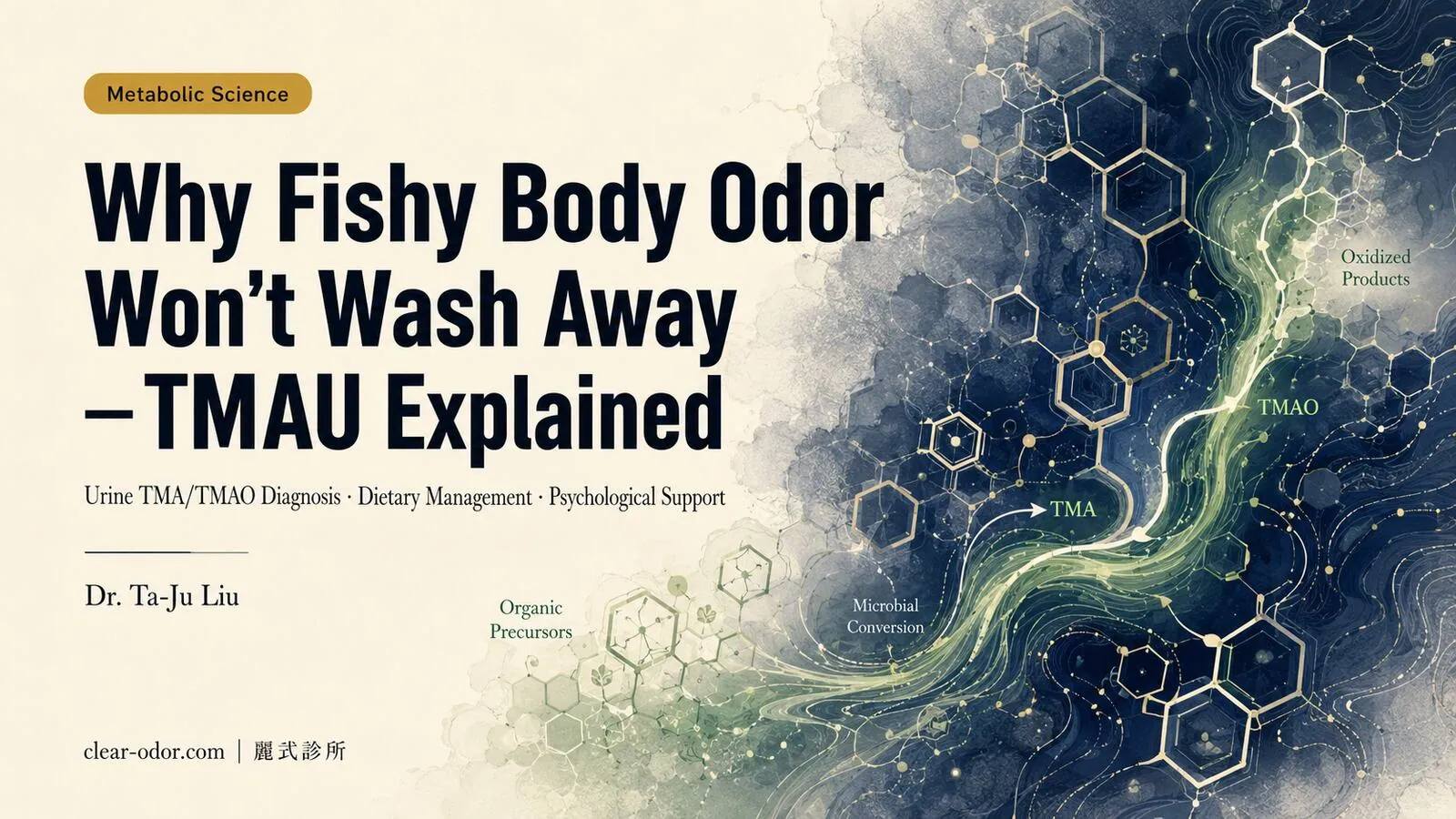
TMAU (Fish Odor Syndrome): FMO3 Genes, Diagnosis & Diet
TMAU (trimethylaminuria, fish odor syndrome) is a metabolic disorder in which FMO3 enzyme deficiency prevents the conversion of trimethylamine (TMA) to odorless TMAO — producing a persistent fishy body odor that bears no relationship to hygiene habits. Diagnosis relies on urine TMA/TMAO ratio and FMO3 genotyping, not apocrine-gland assessment. Drawing on OMIM #602079 and Cashman & Zhang 2006, Dr. Ta-Ju Liu explains the metabolic pathway, four dietary precursor categories to restrict (choline, lecithin, direct TMA sources, L-carnitine), adjunct treatment options, and the chronically underestimated psychological health dimension. The article also defines the Integrated Odor Clinic's role in TMAU: providing initial screening clues and a referral pathway to metabolism or genetics — not primary disease management.

Fruity Breath & Diabetic Ketoacidosis: Spotting DKA Early
Breath that smells fruity or like acetone (nail polish remover) is one of the most characteristic odor clues of diabetic ketoacidosis (DKA) — a Tier 1 metabolic emergency that can become life-threatening within hours. Drawing on ADA Standards of Care 2024 and StatPearls DKA, Dr. Ta-Ju Liu explains the acetone pathway (insulin deficiency → fat mobilization → ketone volatilization), the three-element DKA triad (hyperglycemia + ketonemia + metabolic acidosis), and how to distinguish fruity breath from TMAU's fishy odor or uremia's ammonia smell. The central message: when DKA is suspected, the thought of booking a clinic appointment should give way to 'go directly to the ER' — the Integrated Odor Clinic's role is screening and education, not acute DKA management.
By age / cause axis
Only started after midlife — and will not wash off?
Aging odor × halitosis × systemic-metabolic — sort the source and the right specialist in the Midlife & Aging Odor guide
⚕️ Medical Disclaimer
The medical information provided on this page is for reference only and cannot replace individual face-to-face diagnosis, advice, or treatment from a physician. All medical procedures carry risks. Individual constitution and post-operative recovery vary from person to person. Please discuss any treatment plan with your attending physician before making decisions.