Why Wash Frequency Is the Linchpin of Scalp Odor
The first question in an Integrated Odor Clinic evaluation usually isn't "What shampoo are you using?" — it's "How often do you wash?" Because wash frequency sets the stability of the scalp microbiome more fundamentally than any shampoo ingredient ever will.
Plenty of patients will spend a month's salary trying premium shampoos, yet never stop to ask themselves whether they're simply washing too little, too much, or at the wrong times. This article walks through what dermatology literature says about how wash frequency interacts with the scalp microbiome, sebum production, and Malassezia overgrowth — and turns it into a personalized decision framework you can actually use.
Individual results may vary — what follows is a clinical reading framework, not a substitute for individual evaluation.
What happens to your scalp microbiome in the 24 hours after a wash?
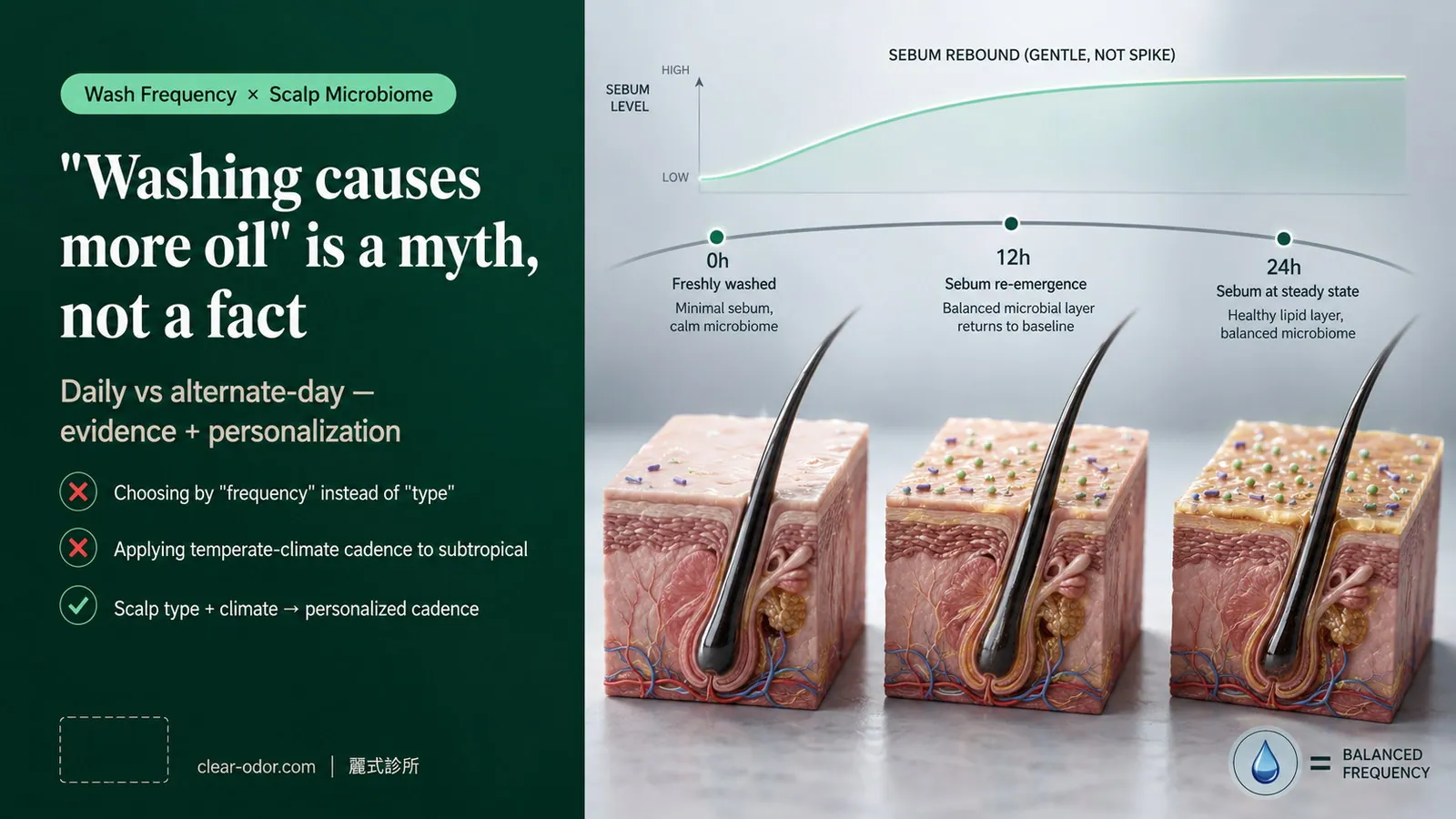
Right after washing, sebum and microbial load are at their lowest; over the next 24 hours sebum refills and microbes (especially Malassezia) regrow — odor usually becomes noticeable late in that refill window. Understanding this 24-hour arc is why "how often you wash" matters more than "which shampoo."
At the moment of washing (hour 0)
Surfactants (the detergent in shampoo) remove:
- Surface sebum (partially — they can't reach the deeper sebaceous glands)
- Surface bacteria and fungi (partially — the follicle interior is preserved)
- Loose corneocytes and flakes
What they do not remove: the deeper sebaceous glands, the follicular microbiome, or the structural lipids embedded in the skin barrier.
2 to 6 hours later
Sebaceous glands begin refilling the surface with sebum. For oily scalps this happens faster (visible shine in 2–3 hours); for dry scalps it can take 8–10 hours. This is the key reason a faintly rancid smell can show up just a few hours after washing — once sebum is back on the surface, bacteria and Malassezia have plenty of substrate to work with again.
12 to 24 hours later
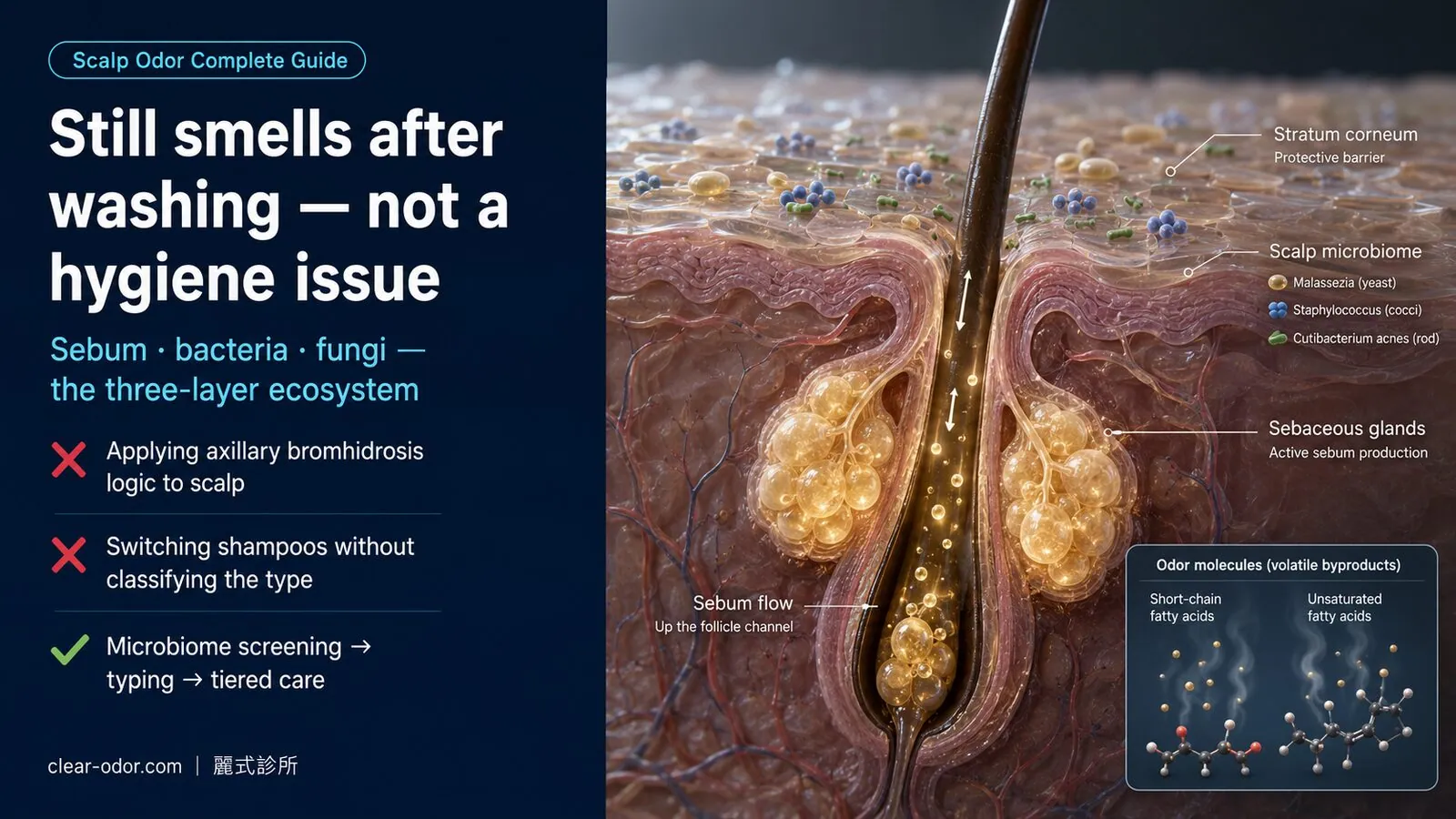
The microbiome gradually returns to pre-wash composition. On a healthy scalp in a clean environment this is normal physiology. On a scalp with Malassezia overgrowth or a disrupted bacterial community, the same process amplifies odor-producing metabolites — short-chain fatty acids and unsaturated fatty acids.
The takeaway
Washing isn't a permanent reset; it's a periodic one. Reset too rarely and the imbalance amplifies. Reset too aggressively and you damage the barrier, which creates its own imbalance. The goal is finding your personal equilibrium point.
Daily vs every-other-day washing — what does the evidence actually say?
The most direct study available (Asian populations, no specific scalp pathology) found overall satisfaction peaked at 5–6 washes per week, with no objective damage to hair even at daily washing, and no support for the "washing makes it oilier" myth. But that study measured hair and scalp condition, not odor — and sebum output and climate still call for individualizing.
The most direct evidence available
The most direct study on wash frequency is Punyani 2021 (Skin Appendage Disord 7(3):183-193, PMID 34055906), which combined an epidemiological survey with a controlled wash-frequency study in Asian populations without any specific scalp pathology.
- Epidemiological arm: overall satisfaction with hair and scalp condition peaked at 5–6 washes per week, consistent across objective and subjective endpoints.
- Controlled arm: a daily wash regimen beat once-weekly cleansing on every endpoint, and no objective detrimental effects to hair were observed at that level of cleansing.
- The authors' own conclusion: concerns about "overcleaning" were unfounded, both objectively and subjectively.
Two limits to state up front: (1) the author list includes Procter & Gamble employees — a shampoo manufacturer; (2) the study measured hair and scalp condition and satisfaction, not odor — odor is a different endpoint and does not carry over automatically.
Within those limits, here is how I put it in clinic:
- There is no single number that fits everyone, but "washing too often makes the scalp oilier" was not supported in that study.
- For a dry or sensitive scalp, the risk comes mainly from surfactant strength, not from frequency itself.
- Hot, humid climates (such as Taiwan in summer) amplify both sebum output and microbiome imbalance — that is a clinical observation, not a finding of the study above.
Oily scalps: daily vs every-other-day, side by side
| Metric | Daily wash | Every-other-day wash |
|---|---|---|
| Surface sebum control | Better | Returns by midday on day two |
| Odor control | Better | Noticeable odor by afternoon of day two |
| Bacterial load | Lower | Clear rebound on day two |
| Malassezia load | Slightly lower (with an antifungal shampoo) | Moderate |
| Barrier impact | No meaningful effect with a mild shampoo | Slightly better (more recovery time) |
| Hair shaft dryness | Modest (with a gentle formula) | Minimal |
For an oily scalp with scalp odor: the evidence supports daily washing as a starting point, paired with a mild shampoo and rotation of active ingredients.
Is it true that the more you wash, the oilier your scalp gets?
It's a myth — sebaceous output is governed mainly by hormones and genetics, not by a reflex to "replace" the surface oil you washed off. The sense of "getting oilier" is usually a misperception, or irritation from how you wash (water too hot, cleanser too harsh), not glands compensating.
"The more I wash, the more my sebaceous glands produce to compensate" is one of the most common patient worries. Its origins are mostly:
- Cosmetic marketing copy from the 1970s–80s
- Anecdotal misattribution ("my scalp feels oilier" may actually reflect seasonal change, stress, or hormonal shifts)
- The real "sebum refills a few hours after washing" phenomenon, misread as "the more I wash, the oilier I get"
What the clinical data actually shows
- Sebaceous gland output is driven primarily by androgens, cortisol, and genetics. Glands do not double their output to "make up for" what was washed away.
- Dermatology literature generally shows that when oily-scalp subjects switch from every-other-day to daily washing, sebum production rates show no significant change at 4 weeks.
- The true "rebound" runs in the opposite direction: harsh degreasing shampoos (high-concentration SLS, aggressive strip formulas) damage the barrier, and sebum output shifts transiently during the barrier-repair window.
The takeaway
The "the more I wash, the oilier I get" fear is usually misplaced. What you actually want to avoid is harsh degreasing shampoos, not the act of washing itself. With a gentle surfactant (SLS-free or SLES-based formulations), even daily washing won't compromise the barrier.
So what are the real risks of washing too often?
"Rebound oiliness" may be a myth, but over-frequent, overly aggressive cleansing does carry real risks: stripping the lipid film and barrier, irritation, and washing away beneficial microbes that keep the flora balanced — the goal isn't "wash less," it's "wash gently and enough, but not to excess."
The "rebound oiliness" idea may be a myth, but over-frequent aggressive cleansing does carry real risks:
- Barrier disruption: loss of epidermal ceramides leaves the scalp more sensitive, itchier, and more prone to flaking.
- The opposite imbalance in the microbiome: microbial diversity drops, and the surviving species tend to be the ones most tolerant of detergent — sometimes amplifying odor rather than reducing it.
- Dry, brittle hair shafts: more of a problem for longer hair.
How to avoid it
- Pick a gentle shampoo: avoid high-concentration SLS/SLES; choose SLS-free or amino-acid–based surfactants.
- Keep the water temperature moderate: 38–40 °C. Hot water both ramps up sebaceous activity and accelerates barrier damage.
- Keep wash time under 5 minutes: active ingredients need contact time, but friction time does not need to be long.
- "Over-washing" really means more than once a day — twice-daily washing is rarely necessary.
How often should oily, normal, and dry scalps each be washed?
There's no single answer: oily scalps and hot, humid settings usually need daily or near-daily washing, normal scalps can go every other day, and dry scalps can stretch the interval with a gentle cleanser — use "shine by midday / odor by evening" as your adjustment cue rather than fixing a single frequency.
Oily scalp (visible shine by midday)
- Frequency: once daily
- Shampoo: gentle cleansing base + Zinc Pyrithione or Piroctone Olamine
- If odor or flaking is present: rotate in Ketoconazole 1% two to three times per week
- Do not drop back to every-other-day in hopes of "reducing oil production" — this almost always makes odor worse.
Normal / combination scalp
- Frequency: every 1–2 days, with an extra wash on days with exercise or heavy sweating
- Shampoo: a gentle daily formula, plus an antifungal shampoo once or twice a week as prevention
- Adjust seasonally: lean toward daily in summer, every-other-day in winter
Dry scalp (prone to flaking and itching)
- Frequency: every 2–3 days; avoid daily washing
- Shampoo: hydration-focused formulas (panthenol, ceramide, plant oils)
- If odor is present: first rule out dry-type seborrheic activity — Malassezia can still overgrow on a dry scalp. An antifungal is still needed, but choose a gentler one (Zinc Pyrithione rather than Selenium Sulfide).
- Water temperature: slightly cooler (37–38 °C) to avoid further degreasing
How should you adjust wash strategy in a hot, humid subtropical climate?
Most English-language dermatology is based on temperate climates and doesn't fully apply to hot, humid Taiwan — high heat and humidity speed up sebum oxidation and bacterial growth, so odor appears earlier, meaning subtropical readers often need to wash more frequently than the literature suggests.
A lot of English-language dermatology literature is built on temperate-climate populations and doesn't translate cleanly to the hot, humid reality of Taiwan:
- Summer sebum production typically increases noticeably (high temperature + humidity).
- Scalp microbial growth accelerates (humidity favors both Malassezia and bacteria).
- Helmet wearing and scooter commuting create extra warm, enclosed environments on the scalp.
- Air-conditioning vs outdoor temperature swings amplify sebaceous activity.
Practical adjustments for readers in Taiwan / subtropical climates
- Summer: people who normally wash every other day may need to switch to daily; wash within 2 hours after exercise.
- Winter: watch for heater-driven dryness; lower frequency and add moisture support as needed.
- Scooter commuters: air out or rotate helmet liners monthly; wash promptly after exercise or commuting.
- After the gym: don't push the wash to the next day — sweat plus sebum, mixed for 12 hours, is exactly the window where odor amplifies.
Personalized Decision Tree
- What is my scalp type?
- Oily → Daily wash, gentle cleansing + active ingredients
- Normal → Every 1–2 days, adjusted for activity
- Dry → Every 2–3 days, avoid aggressive degreasing
- Do I have scalp odor or dandruff?
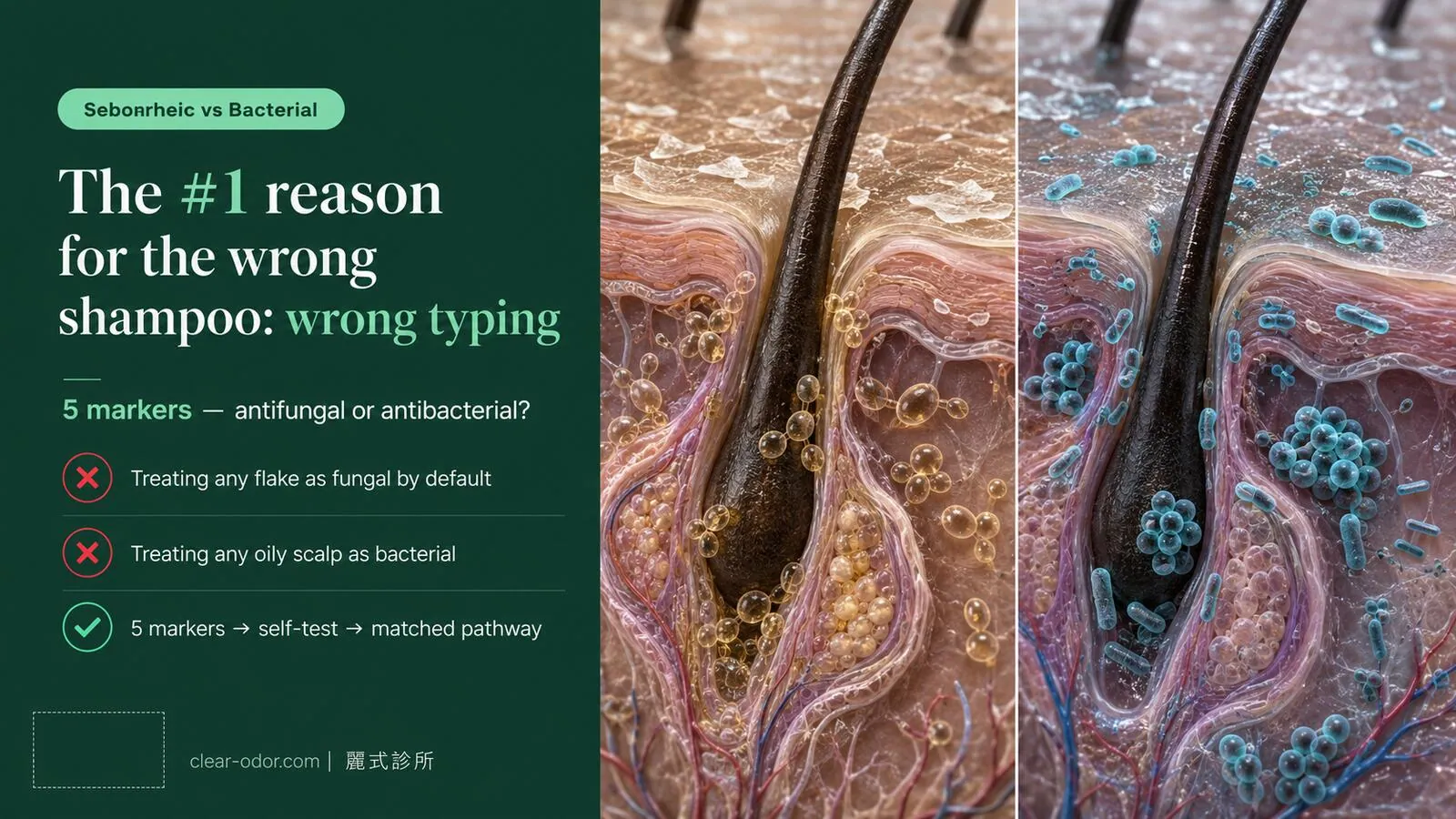
- Yes — with rancid smell / flakes / redness → Add Ketoconazole 1% two to three times per week
- Yes — sour/oily smell, shine, no flaking → Add Zinc Pyrithione with daily washing
- No → Maintain current frequency; no active ingredients needed
- Am I in Taiwan / Southeast Asia?
- Yes, and it's summer → Push frequency one step above what literature recommends
- Yes, but it's winter → Focus on hydration; avoid over-washing
- Do I wear a helmet or hat for long stretches?
- Yes → Always wash at the end of the day; don't push it to tomorrow
- After exercise, do I usually:
- Wash immediately → Keep doing this
- Wait until I'm home or the next day → Switch to immediate washing to cut odor amplification
FAQ
Q1. Is it really true that daily washing won't make my scalp oilier?
Correct. "Rebound seborrhea" lacks clinical evidence — sebaceous output is driven primarily by androgens, cortisol, and genetics, not by a compensatory "make up for what was washed off" response. Dermatology literature generally shows that switching from every-other-day to daily washing produces no significant change in sebum output at 4 weeks. The thing to avoid is harsh degreasing shampoos, not the act of washing.
Q2. Then why do some people say "I wash daily and my scalp is even oilier"?
A few possibilities: (1) a harsh degreasing shampoo damaged the barrier, causing transient sebum shifts during the repair window; (2) seasonal change misattributed to wash frequency; (3) stress or hormonal fluctuations; (4) the gap between subjective perception and objective measurement — people are unusually sensitive to perceived oiliness on their own scalp.
Q3. Can an oily scalp be washed twice a day?
Usually not necessary, and barrier repair may not keep up. In extreme cases — heavy oiliness plus a helmet plus summer — twice-daily washing can work short-term, but the formula needs to be even gentler (avoid strong detergents). Long-term, once daily plus personalized rotation is still the right answer.
Q4. Morning wash vs evening wash — which is better?
From a sebum-and-microbiome standpoint there's no meaningful difference — sebum is produced during sleep too. Evening wash advantages: removes a day's worth of sweat, dirt, and styling products before bed; nothing transferred to the pillow. Morning wash advantages: leaves the scalp feeling fresh on the way out the door. If both are equally convenient, evening washing has a slight edge.
Q5. If I wash every other day, can I just rinse with water on the in-between day?
You can, but the effect is limited — water can't emulsify sebum or remove lipid-soluble residues. For normal or dry scalps it can serve as light "in-between maintenance"; for oily scalps it's usually not enough. As a compromise, you can also try coWash (cleansing with conditioner) to cut shampoo frequency while still getting some surfactant action.
Q6. What happens if I don't wash after exercising?
Short term: odor and microbiome imbalance amplify for 12–24 hours. Long term: a habitual "sweat plus sebum, left uncleansed" pattern can drive seborrheic dermatitis or bacterial folliculitis. Aim to wash within 2 hours of exercise when possible.
Q7. Can I use an antifungal shampoo every day?
You can, but rotation works better. Continuous daily Ketoconazole use beyond 4 weeks has reports of reduced sensitivity, and over-suppressing Malassezia can let other microbial species take advantage of the open ecological niche. A reasonable pattern: antifungal shampoo two to three times per week, gentle or antibacterial shampoo on the other days.
Q8. How do I tell whether my current wash frequency is right?
Two signals: (1) Odor self-check: if there's still no noticeable odor 8–12 hours after washing, your frequency and formula are roughly on target. (2) Barrier status: no redness, itching, or sensitivity means you're not over-cleansing. If odor shows up earlier than that, raise the frequency; if you're seeing barrier issues, lower the frequency or switch to a gentler formula.