Why This Distinction Matters So Much
A line we hear in clinic almost every week: "I've already tried three anti-dandruff shampoos and none of them worked — do I need to see a doctor?"
The first response is usually a question back: "How do you know it's a flake problem and not a bacterial problem?"
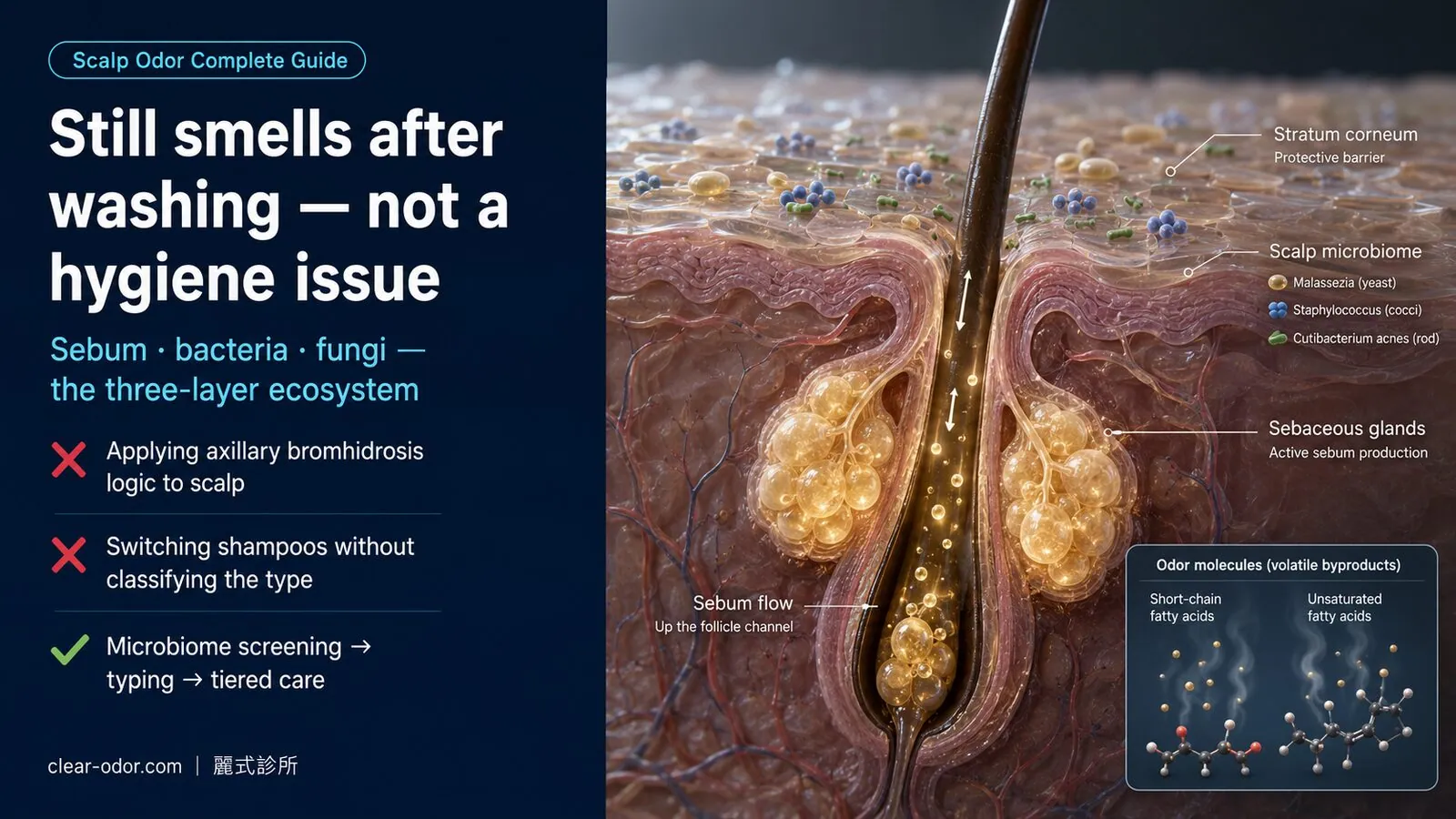
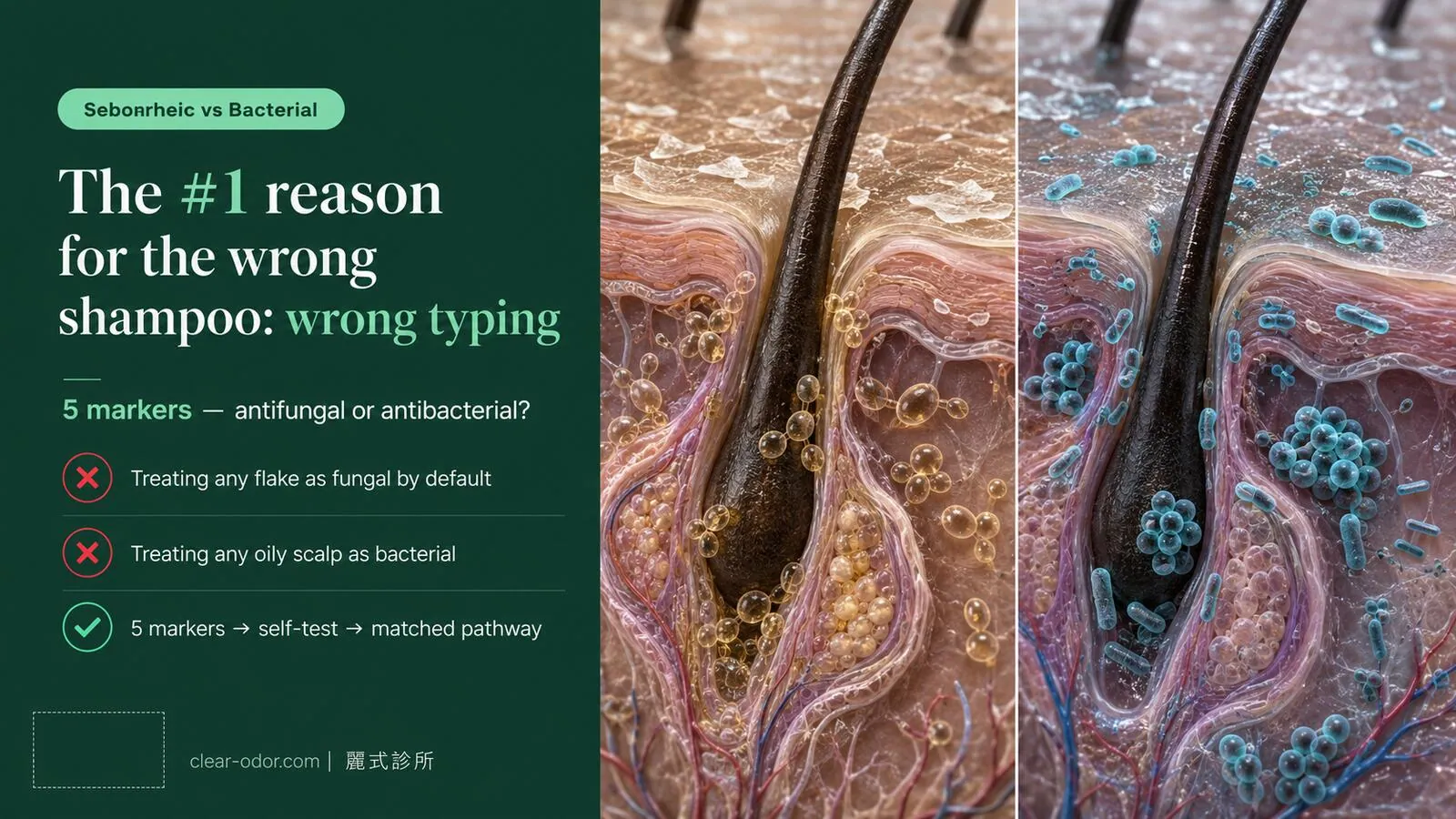
The two main drivers of scalp odor — Malassezia overgrowth (seborrheic dermatitis type) and bacterial dysbiosis (bacteria-dominant type) — call for completely different active ingredients:
- Malassezia-dominant → needs an antifungal: Ketoconazole, Selenium Sulfide, Ciclopirox
- Bacteria-dominant → needs an antibacterial: Zinc Pyrithione, Piroctone Olamine, Triclosan (the last one is rarely used now)
Choosing the wrong ingredient is like "taking cold medicine for stomach pain" — you may get some non-specific effect (washing alone reduces oil), but it doesn't actually solve the problem. This article gives you 5 indicators that let you make a 30-second first read.
Individual results may vary — what's offered here is a reading framework; the final assessment still depends on your individual situation.
How do seborrheic and bacterial scalp odor differ mechanistically?
Seborrheic odor comes from Malassezia yeast breaking sebum into rancid-smelling free fatty acids; bacterial odor comes from skin bacteria breaking down sweat and keratin into a sour, stale smell. Different sources — which is why anti-dandruff shampoo often does nothing for the bacterial type, and why sorting them out first matters.
Seborrheic Type (Malassezia-Driven)
Mechanism: Malassezia (especially M. restricta and M. globosa) is a lipophilic (oil-loving) yeast that lives on sebum. When it overgrows, it secretes lipases that convert saturated fatty acids in sebum into unsaturated fatty acids (such as oleic acid). These metabolites:
- Irritate the scalp → redness, itch, flaking (this is "seborrheic dermatitis")
- Give off a distinctive rancid-oil plus musty smell
Typical combination: rancid oil smell + dandruff (yellow oily flakes) + redness + itch. Often spreads to the eyebrows, sides of the nose, and behind the ears.
Bacteria-Dominant Type
Mechanism: Resident scalp bacteria (Staphylococcus epidermidis, Cutibacterium acnes) use lipases to break the triglycerides in sebum into free fatty acids. Among these, short-chain fatty acids (propionic acid, butyric acid, isovaleric acid) are the main source of the "sour smell."
When washing frequency is too low, the scalp is hot and stuffy, or the microbiome is out of balance, these short-chain fatty acids accumulate and the sour note becomes obvious.
Typical combination: sour smell (like sour sweat) + obvious oily shine + no obvious dandruff (or only trace amounts) + usually no itch.
How can you quickly tell which type you have?
Compare five indicators: oily dandruff or not, a rancid smell vs a stale sweaty one, itch or no itch, whether anti-dandruff shampoo works, and whether it flares after sweating — seborrheic skews oily-flakes + itch + anti-dandruff-responsive, bacterial skews sour-musty + sweat-linked.
| # | Indicator | Seborrheic (Malassezia) | Bacteria-Dominant |
|---|---|---|---|
| 1 | Odor character | Rancid oil, musty | Sour (sour-sweat note) |
| 2 | Dandruff | Obvious, yellowish, oily | None or trace |
| 3 | Redness & itch | Common; may extend to brows/nose/behind ears | Usually absent |
| 4 | Seasonal pattern | Worse in winter (dry skin + indoor heating) | Worse in summer (sweat + heat) |
| 5 | Response to antifungal shampoo | Clear improvement in 1–2 weeks | Limited improvement |
How to Use This Table
- 3+ indicators point to seborrheic → start with OTC Ketoconazole 1% (e.g. Nizoral), 2–3 times a week, leave on for 5 minutes
- 3+ indicators point to bacteria-dominant → start with Zinc Pyrithione 1–2% (e.g. classic Head & Shoulders), daily wash
- Indicators split across both sides → you fall into the mixed type (see Section 5)
A 5-minute self-check: how do you make a first call at the bathroom mirror?
Before washing, smell your roots and pillow, look for oily flakes and redness on the scalp, recall how anti-dandruff shampoo worked, and note whether the odor tracks sweating — in a few minutes you can triage yourself to seborrheic, bacterial, or mixed and decide the next step.
A quick assessment you can run in front of the bathroom mirror:
Step 1: 6 hours after washing, lightly touch the crown and the occipital area, then smell your fingers.
- Rancid / musty → leans seborrheic
- Sour → leans bacterial
Step 2: Bow your head, tap the scalp gently, look at the flakes that land on dark clothing:
- Yellow oily flakes → seborrheic
- Small white dry flakes → not necessarily seborrheic; could just be dry scalp
- No flakes → leans bacterial
Step 3: Look in the mirror at the scalp, eyebrows, sides of the nose, behind the ears:
- Multiple areas red → seborrheic (a shared expression across sebum-rich zones)
- Only scalp shine, other areas normal → leans bacterial or just excess sebum production
Step 4: Think back on how often you itch:
- Intermittent itch through the day, worse with heat or stress → seborrheic
- Not very itchy but you notice the smell → leans bacterial
Step 5: Try a one-week trial of Ketoconazole 1% (every other day, leave on 5 minutes):
- Smell, flakes, and itch noticeably reduced → confirms seborrheic
- Limited improvement → reassess; possibly bacteria-dominant or mixed
How should each type — seborrheic and bacterial — be managed?
Seborrheic is managed mainly with antifungals (e.g. ketoconazole anti-dandruff washes) plus oil control; bacterial with antibacterial cleansing, adjusted wash frequency, and sweat management. Mixed type needs both at once — go the wrong way (only anti-dandruff when it's bacterial) and nothing seems to work.
Seborrheic Path
Tier 0 (at home):
- Antifungal shampoo rotation: Ketoconazole 1% (OTC) → Selenium Sulfide 1% → Zinc Pyrithione 2% (secondary; has some antifungal effect too)
- Contact time: 5 minutes (anything under 3 minutes won't work)
- Frequency: 2–3 antifungal washes per week, with a mild shampoo in between
- Duration: at least 4 weeks before judging response
Tier 1 (clinic prescription):
- Prescription-strength Ketoconazole 2% (OTC is only 1%)
- For Ketoconazole allergy or resistance, switch to Ciclopirox 1%
Tier 2 (acute flare with redness and itch):
- Short-course topical steroid (Hydrocortisone 1%) once or twice daily, no longer than 2 weeks
- Topical Calcineurin inhibitors (Tacrolimus, Pimecrolimus) suit sensitive skin
Tier 3 (resistant or repeatedly relapsing):
- Short-course oral antifungal (Fluconazole, Itraconazole) with liver function monitoring
- Microbiome testing to confirm other fungal or mixed bacterial infection
Bacteria-Dominant Path
Tier 0 (at home):
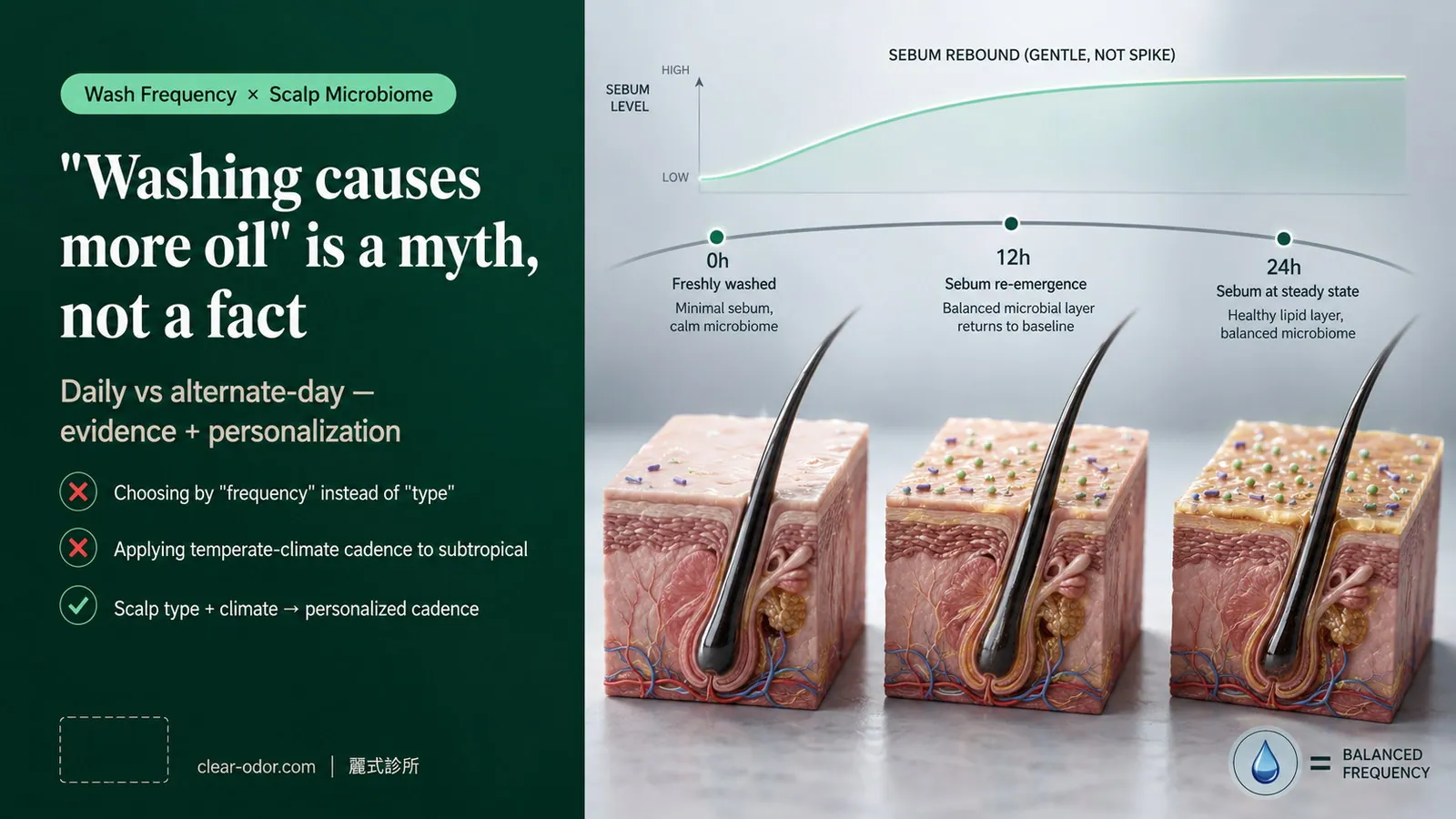
- Wash more often: daily for an oily scalp (don't try to "wash less to make oil less" — sebum tends to rebound)
- Main ingredient: Zinc Pyrithione 1–2%, Piroctone Olamine (the latter is gentler)
- Double cleanse: first pass removes styling product and sweat; second pass leaves the antibacterial active in contact for 2–3 minutes
- Adjuncts: change pillowcase weekly, keep towels personal, avoid sharing combs
Tier 1 (clinic evaluation):
- Rule out folliculitis (advanced bacterial infection: red bumps, pustules; may need a short course of antibiotics)
- Evaluate endocrine factors driving excess sebum (PCOS, androgen imbalance)
Tier 2–3:
- Laser / light therapy to modulate sebaceous gland activity
- Rare differential diagnoses (e.g. metabolic odor conditions)
Why do so many people have a seborrheic + bacterial "mixed" type?
Because oil and humid heat grow both Malassezia and bacteria at once: in clinic, pure seborrheic and pure bacterial are each about 30%, leaving roughly 40% mixed — which is why a single anti-dandruff or antibacterial product often only half-fixes it.
From clinic experience: pure seborrheic and pure bacterial each account for roughly 30%, and the remaining 40% are mixed type — Malassezia overgrowth and bacterial dysbiosis happening together. Why?
- Sebum feeds both: when sebum production is high, both Malassezia and bacteria proliferate
- Malassezia metabolites change scalp pH → which in turn shifts the bacterial balance
- Long-term use of a single ingredient suppresses one side while letting the other expand (classic case: long-term Ketoconazole alone keeps Malassezia down but bacteria climb up)
How to Handle the Mixed Type
Rotation strategy (most important):
- Mon / Wed / Fri: Ketoconazole 2% (antifungal)
- Tue / Thu / Sat: Zinc Pyrithione 2% (antibacterial + partial antifungal)
- Sun: mild shampoo (give the scalp barrier a break)
Plus the three foundations: diet (lower sugar and oil), sleep, and stress management.
Mistakes to avoid:
- Using the same shampoo exclusively for more than 4 weeks (no matter how well it works)
- Stacking two antifungal ingredients in the same wash (no added effect, more irritation)
- Setting an unrealistic goal of "never smelling anything ever again"
When should you see a doctor instead of trying yet another shampoo?
If after 4 weeks of a home routine you still have persistent odor, scalp redness or oozing, noticeable hair loss, or odor affecting your social life, it's time for an integrated evaluation — endlessly switching shampoos without typing it is often treating a bacterial case as if it were seborrheic.
If after 4 weeks of home strategy any of the following applies → book an integrated evaluation:
- Improvement < 30%
- Odor accompanied by hair loss, folliculitis, or obvious redness and swelling
- Already rotated through 3+ OTC ingredients with no improvement
- You perceive the odor as strong but others don't (Olfactory Reference Syndrome, ORS, gray zone)
- Odor in other body areas at the same time, needing integrated assessment (underarms, intimate area, feet)
The integrated evaluation includes: trichoscopy of the scalp, sebum sampling for microbiome analysis if needed, and a personalized plan built on the findings.
FAQ
Q1. I used Nizoral but the smell is still there — does that mean it's not seborrheic?
Not necessarily. Possibilities: (1) you're not seborrheic but bacteria-dominant, in which case Ketoconazole 1% does little; (2) you are seborrheic but the concentration isn't enough (OTC 1% may not be enough for moderate-to-severe cases; you may need prescription 2%); (3) contact time was too short (< 3 minutes); (4) you're mixed type and need a rotation strategy.
Q2. What's the difference between anti-dandruff shampoo and anti-odor shampoo?
Anti-dandruff shampoos are designed mainly to "reduce flakes" and usually contain antifungal ingredients (targeting Malassezia); anti-odor shampoos lean toward "antibacterial + sebum control" and often contain Zinc Pyrithione, Piroctone Olamine, tea tree oil, and similar. Seborrheic patients usually do better with anti-dandruff; bacteria-dominant patients usually do better with anti-odor.
Q3. Can I use both shampoos at the same time?
Yes, but rotation rather than stacking is the sensible way. Stacking two antifungal ingredients in the same wash doesn't increase effect — it increases irritation. Rotation (e.g. Mon/Wed/Fri Ketoconazole, Tue/Thu/Sat Zinc Pyrithione) covers both imbalances and lowers the risk of resistance.
Q4. Why does seborrheic scalp spread to the eyebrows and the sides of the nose?
Because those areas are also sebum-rich zones, and Malassezia lives there too. When Malassezia overgrows, it shows up across all sebum-rich zones at once — eyebrow flaking, redness around the nose, dry itch behind the ears, oily scalp flakes — this is the "distribution signature" of seborrheic dermatitis.
Q5. Selenium Sulfide makes my hair very dry — what should I do?
Selenium Sulfide is a strong antifungal but it strips the sebum barrier. It suits short intensive use (e.g. twice a week for 4 weeks in an acute flare), then switch to gentler Zinc Pyrithione for maintenance. If you need to use it long term, follow each wash with a ceramide- or panthenol-based scalp soothing mist to help rebuild the barrier.
Q6. Why is OTC shampoo cheaper than prescription — does that mean it's less effective?
The main differences between OTC and prescription are active concentration and the vehicle system: OTC Ketoconazole is 1%; prescription is 2%; the vehicle (surfactants, penetration enhancers) affects how efficiently the active reaches the scalp. For mild cases OTC is usually enough; for moderate-to-severe or repeatedly relapsing cases, prescription-strength is more efficient. OTC isn't "lower quality" — it's strength matched to a different severity.
Q7. The shampoo worked, but a few months later the odor came back. Why?
That's the normal behavior of the scalp microbiome — it's a dynamic balance, not a "treat once, immune for life" situation. Common reasons for relapse: (1) stopping the active shampoo too quickly after improvement (bacteria and Malassezia rebalance); (2) seasonal change (winter heating amplifies seborrheic; summer heat amplifies bacterial); (3) higher life stress or worse sleep. Maintenance strategy: even when symptoms are gone, keep rotating in an antifungal or antibacterial shampoo 1–2 times a week, rather than stopping completely.
Q8. Isn't "mixed type" just "use both"?
If you only "use both" you can actually make things worse — stacking two antifungal ingredients in the same wash doesn't increase effect, only irritation. The key for the mixed type is rotation across the time axis (different days, different ingredients, lower resistance risk), plus addressing the three amplifying factors: diet, stress, and sleep. The Integrated Odor Clinic will help you design a personalized rotation frequency.