Why You Need a "Treatment Decision Framework"
You've reached the last article in this series — by now you may have read the Bromhidrosis Guide: Causes, Diagnosis, Treatment & Recovery, the Hyperhidrosis Guide: Types, Severity, Treatments & ETS, the Sweat Gland Surgery: Curettage vs Laser vs miraDry vs ETS, the Apocrine Glands Explained: Anatomy, Function & Body Odor, and the Sweat Gland Surgery Recovery: Day 0-180 in 4 Phases.
But after those 5 pillars, the pain of choosing may have gotten worse — not better — because you now see the trade-offs clearly. Every treatment has a reasonable case for it, and every treatment has its own cost.
Three recurring kinds of stuck-ness in clinic each week:
- "I've read all those articles, but I still don't know which one fits me."
- "Out there I've been pushed toward miraDry, pushed toward surgery — how do I judge who's right?"
- "My friend had surgery and was thrilled; my cousin had surgery and regretted it — why does the same surgery give different results?"
The answer to all these isn't "which treatment is best." It's "for your situation, which combination of trade-offs your 5-year-future self will most thank you for."
This guide consolidates 20 years of the judgment logic I use most in clinic. By the end you should be able to answer:
- What are the weights of your 5 decision dimensions (severity, timeline, budget, surgical tolerance, comorbidities)?
- Which of the 4 typical patient scenarios is closest to you, with their full decision pathways?
- Why is the "Minimum Viable Treatment" principle more useful as a reference than the "most powerful solution"?
- When should you re-examine your choice (on entering adulthood, after major weight change, after key life events)?
- What information should you bring to the consultation, and what questions should you ask?
- How do you recognize the signals that mean "this warrants a second opinion"?
This isn't about making the decision for the surgeon — it's about helping you walk into the consultation with your own thinking already organized, so the discussion can stay focused.
Multi-site odor? If you have odor in more than one area, see the Odor Map for site-by-site triage first to identify the primary source before diving into this guide.
What 5 dimensions do you weigh when making a treatment decision?
Every treatment decision is a multi-dimensional trade-off — there's no "wins on everything" option, only the one that fits the dimensions you care about; 95% of clinical considerations fall into five: severity, how thoroughly it works, invasiveness and recovery, risks and side effects, and impact on daily life — get clear on your own weighting before looking at options.
Any treatment decision is a multi-dimensional trade-off — there's no "fully winning" option, only the one that "aligns with the dimensions you care about most." The 5 dimensions below cover roughly 95% of clinical decision considerations.
Dimension 1: Severity
The most basic dimension — where does your problem sit on the clinical spectrum?
Bromhidrosis severity (simplified 5-level self-assessment):
- Grade 0–1: You can't smell it yourself; others occasionally notice at close range
- Grade 2: Detectable with arms hanging down; intensified during exercise or stress
- Grade 3: Detectable from 1 meter away in normal conditions (the surgical threshold for most patients)
- Grade 4: Detectable from 3 meters away, clearly affecting social life (active treatment strongly advised)
Hyperhidrosis severity (4-grade HDSS):
- 1: No impact on daily life at all
- 2: Tolerable; occasionally bothersome
- 3: Still tolerable, but frequently interferes with daily activities (the threshold at which most people seek treatment)
- 4: Intolerable; significantly affects work and social life (active treatment)
You can use the Hyperhidrosis Severity Self-Check: 5 Quick Questions to locate yourself.
How severity shapes the choice:
| Severity | Reasonable options | Less reasonable |
|---|---|---|
| Mild (1–2) | Antiperspirants, hygiene, occasional Botox | Surgery (poor return on investment) |
| Moderate (3) | Botox, miraDry, laser, consider surgery | ETS (asymmetric risk) |
| Severe (4) | Surgery-led, miraDry to consider, ETS where necessary | Antiperspirants alone (can't keep up) |
Dimension 2: Timeline
"How quickly do you need this solved" is the dimension most often overlooked — and one of the most decisive.
| Your timeline | Reasonable options | Less reasonable |
|---|---|---|
| Within 4–6 weeks (wedding, interview, on camera) | Botox (kicks in 1–2 weeks) | Surgery (still swollen with palpable lumps at 1 month) |
| Within 2–3 months (important trip, new job) | miraDry / surgery (1-month recovery) | Slowly titrating antiperspirants |
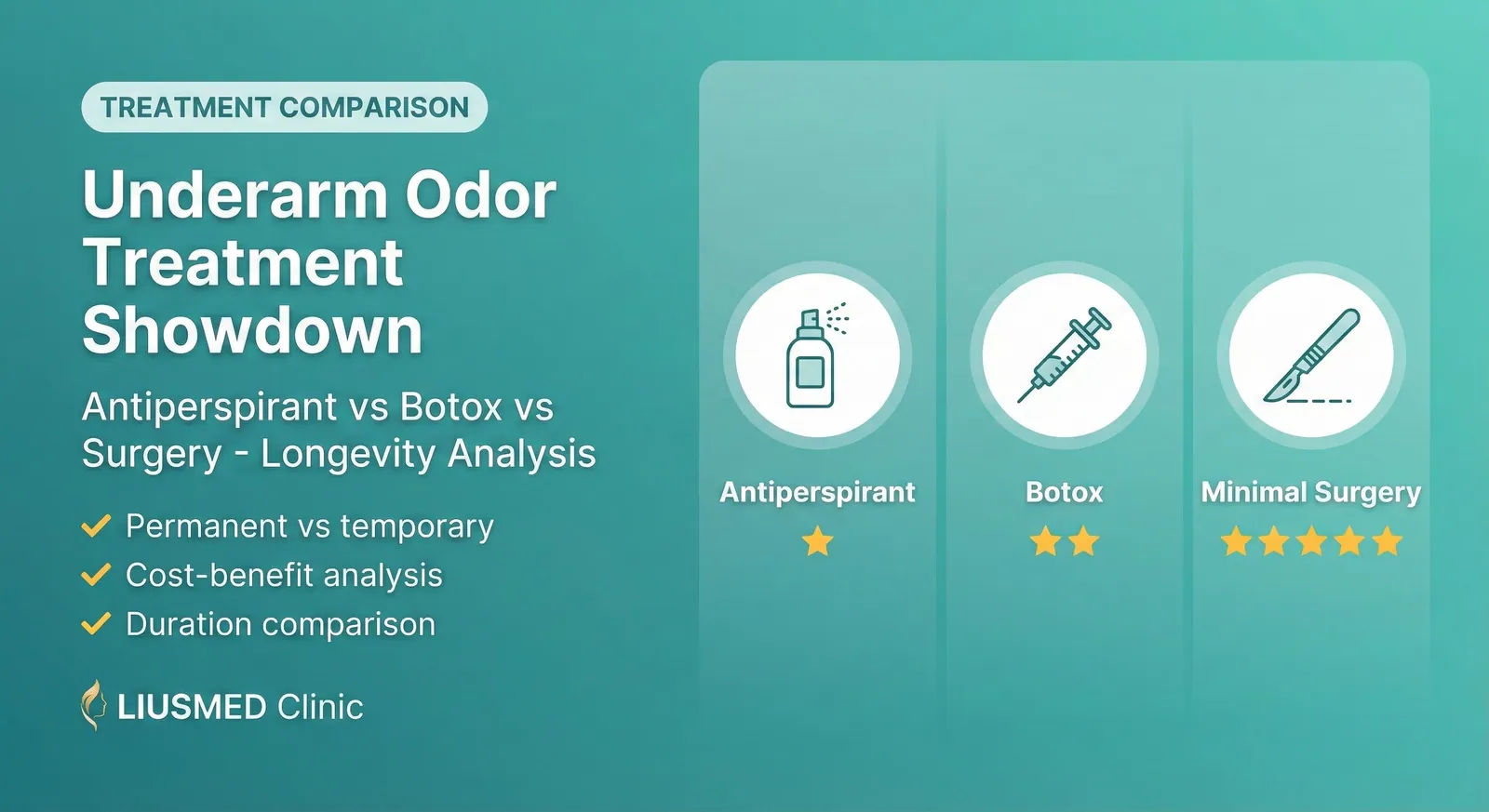
| 6+ months out, looking for a long-term answer | Direct-visualization rotational curettage | Repeated Botox (high 5-year cumulative cost) |
| No time pressure, want to test the waters | Step ladder: antiperspirants → Botox → surgery | Jumping straight to surgery (without fully trying earlier steps) |
Clinical viewpoint: Timeline is often underestimated. I've had 30-year-olds say "I want to do it, so let's just do it" and book surgery, only to remember a month later that they have a major presentation in 6 weeks — and the firm-lump sensation plus visible appearance distract them so much that the presentation suffers. Ask yourself "where do I need to be at 6 weeks / 3 months / 6 months from now," then work backward to the right treatment timing.
Dimension 3: Budget
Not just "single-session cost" — look at "cumulative cost ÷ years of sustained effect."
Relative cost positioning (Taiwan market, individual figures vary by case):
| Treatment | Per-session band | Typical frequency | 5-year cumulative band (relative to antiperspirants baseline) |
|---|---|---|---|
| Antiperspirants | Low monthly | Ongoing | Low (baseline 1×) |
| Botox (both axillae) | Mid per-session | Every 4–6 months | Very high (≈ 10× baseline due to repeat frequency) |
| Iontophoresis (palmar) | Mid-high one-time (machine) | One-time + maintenance | Mid (≈ 4–5× baseline) |
| miraDry | Mid-high per-session | 1–2 sessions | Mid (≈ 2–5× baseline if single session) |
| Laser sweat-gland ablation | Mid-high one-time | 1 session (occasional touch-up) | Mid (≈ 2–4× baseline) |
| Direct-visualization rotational curettage | High one-time | 1 session | Mid-high (≈ 3–4× baseline, fully decisive) |
| ETS | Mid-high one-time (incl. hospitalization) | 1 session | Mid-high (excluding compensatory management) |
Budget logic (positioned by relative investment depth):
- Low long-term investment capacity: Antiperspirants → Botox bridge (but cumulative cost climbs quickly because Botox repeats every 4–6 months)
- Mid one-time investment: miraDry or laser (single decisive session, no recurring fee)
- Mid-high one-time investment: Direct-visualization rotational curettage (highest decisiveness for moderate-to-severe cases)
- Want to stage the investment: Try miraDry first; supplement or convert to surgery if insufficient
Specific figures vary by clinic, treatment area, severity, and combined modalities — Dr. Liu explains the case-specific plan at the initial consultation. For the cost-component breakdown logic, see Bromhidrosis Surgery Cost in Taiwan: How to Compare Clinics.
Dimension 4: Surgical Tolerance
This is the combined "psychological + physiological" dimension — your degree of acceptance toward "going under a blade."
4 self-assessment questions:
- How did past surgical experiences go? Smooth, or traumatic?
- How acceptable is a 4–7 mm incision scar to you?
- Can you schedule 3–5 days of rest at home (while the compression dressing is on), plus keeping the underarms dry and limiting arm movement until suture removal on Day 14?
- Are you mentally prepared for "firm-lump sensation persisting for 3 months" post-op?
High surgical tolerance: Wide range of options; decide based on severity and timeline
Moderate surgical tolerance: Lean toward miraDry or laser (semi-invasive or non-invasive)
Low surgical tolerance: Long-term management with antiperspirants + Botox; miraDry is the ceiling
Dimension 5: Comorbidities
Easily overlooked but important — other medical conditions affect the treatment pathways available to you.
Comorbidities that need special consideration:
- Diabetes: Slower wound healing, slightly higher infection risk — surgery isn't off the table, but blood sugar must be well-controlled
- Bleeding disorders / on anticoagulants: Discuss a pre-op holding plan with your prescribing physician
- Hidradenitis suppurativa (HS): Cannot be treated as bromhidrosis surgery — needs a dermatology diagnosis first
- History of breast surgery / axillary radiation: Anatomical planes may be altered, requires individualized assessment
- Keloid-prone: Surgery is feasible but requires aggressive scar care
- Severe anxiety or panic disorder: Pre-op psychological preparation must be more thorough; may affect post-op perception
- Hyperhidrosis combined with severe generalized anxiety: Address the anxiety first; surgery isn't necessarily the first step
- Skin allergies / contact dermatitis: The antiperspirant pathway may be limited
See the "apocrine disease spectrum" section in the Apocrine Glands Explained: Anatomy, Function & Body Odor.
Assembling Your Personal Weights Across the 5 Dimensions
This exercise is simple — give each dimension a score from 1 to 5 (5 for the most important, 1 for "doesn't matter to me"):
- Dimension 1 Severity: [ ] / 5
- Dimension 2 Timeline: [ ] / 5
- Dimension 3 Budget: [ ] / 5
- Dimension 4 Surgical Tolerance: [ ] / 5
- Dimension 5 Comorbidities: [ ] / 5
The 1–2 dimensions you scored highest are the considerations you should give priority to during the decision. The 4 scenarios that follow show how these weights determine treatment pathways.
Four typical scenarios — how should each one choose?
Four of the most common scenarios show the full decision logic: mild-to-moderate wanting to stay conservative, severe wanting a one-and-done fix, those wary of recovery time or anesthesia burden, and those whose real driver is sweating rather than odor — pick the one closest to you and walk its trade-offs.
The 4 scenarios below are the most common archetypes I've seen across 20 years in clinic — pick the one closest to you and walk through the full decision logic.
Scenario A: The 17-Year-Old Being Bullied at School
Chief complaint: Severe axillary bromhidrosis; mocked by classmates; afraid to raise a hand in class; starting to refuse school
5-dimension weights:
- Severity: 4 (Grade 3–4 bromhidrosis)
- Timeline: 4 (wants improvement within the school term)
- Budget: 2 (parents are paying but willing to invest)
- Surgical tolerance: 3 (teenagers adapt physically well, but the psychological reaction to "going under a blade" can be tense)
- Comorbidities: 1 (otherwise healthy)
Typical decision pathway:
- Rule out disease first: Visit dermatology or plastic surgery to confirm apocrine-type bromhidrosis — not hidradenitis suppurativa
- Bridging strategy: Daily antiperspirants + counseling (the psychological impact of school bullying is at least as serious as the odor itself)
- If 6 months in, daily life is still seriously affected, and both parents and teenager consent:
- Surgery is possible from age 9, and any child 9 or older can be a candidate — what matters is the child's cooperation and readiness, assessed in clinic; a 17-year-old is well within range
- No need to wait for development to finish: apocrine glands that have been cleared don't grow back, so being young is not a reason to delay; anesthesia is local anesthesia plus gentle pain-relief anesthesia
- Surgical choice: Direct-visualization rotational curettage as first choice (most reliable outcome); miraDry can be considered when "absolutely no scarring" is a hard constraint the parents insist on
- Post-op: Watch the pace of social re-entry; psychological reconstruction needs as much attention as physical recovery — if not more
Why not ETS / laser / Botox?
- ETS: Asymmetric compensatory-sweating risk for an adolescent
- Laser: Less thorough clearance than direct visualization
- Botox: Wears off in 4–6 months; long-term cumulative cost is heavy on parents
See When Can Children Have Odor Surgery? A Parent's Guide and the Child Teased for Body Odor at School? A 5-Step Parent Guide.
Scenario B: The 32-Year-Old Bride 6 Months from Her Wedding
Chief complaint: Moderate axillary bromhidrosis + moderate hyperhidrosis; manageable with antiperspirants day-to-day; but 6 months from now she'll be in a wedding dress, under stage lighting, hugging and posing for photos for 6–8 hours — absolutely no sweat marks or odor allowed
5-dimension weights:
- Severity: 3
- Timeline: 5 (must be solved within 6 months, and absolutely no post-op residue on wedding day)
- Budget: 4
- Surgical tolerance: 3 (dislikes "uncertainty")
- Comorbidities: 1
Typical decision pathway:
- The 6-months-out decision window:
- Option A: Direct-visualization rotational curettage 4–5 months before the wedding — by the wedding the firmness has softened, there's no visible interference, and the effect is complete. First choice.
- Option B: miraDry 4–5 months before the wedding — no incision, no compression period, no swelling or scarring. But clearance thoroughness is slightly lower; may need a Botox top-up 1 month later
- Option C: Botox 2 months before the wedding — reliably effective, no surgical aftermath to worry about, but the issue returns and needs to be re-handled 5 years out
- If surgical tolerance is high + budget allows: Option A is the most complete solution — the wedding-day effect persists for years afterward
- If worried about post-op appearance risk: Option B + Botox top-up is more conservative
- If budget is limited and the goal is just "the wedding day": Option C is a reasonable short-term solution
Matching the dress:
- Option A: Finish all scar care 4 weeks before the wedding; sleeveless gowns are fine, but practice wide-angle arm motion in advance
- Option B: No visible interference; any dress style works
- Option C: No visible interference at all
Why not ETS?
- For moderate hyperhidrosis controllable with antiperspirants, the compensatory-sweating risk of ETS is entirely not worth it (asymmetric risk)
Scenario C: The 45-Year-Old Man with Combined Bromhidrosis and Hyperhidrosis
Chief complaint: Grade 3 axillary bromhidrosis + HDSS 3 hyperhidrosis. In work settings (sales presentations, client meetings) he routinely tries to hide sweat marks, avoid getting too close, and his social anxiety has been mounting. Has tried antiperspirants and Botox (expensive and the 4-month cycle gets old), wants a one-and-done, long-term solution
5-dimension weights:
- Severity: 3.5
- Timeline: 3 (no specific deadline, but the sooner the better)
- Budget: 3 (a larger one-time investment is fine; what's not fine is endless repeat accumulation)
- Surgical tolerance: 4
- Comorbidities: 2 (a middle-aged man may have mild hypertension, pre-diabetes)
Typical decision pathway:
- Comorbidity assessment: Blood sugar, blood pressure, coagulation panel — if well-controlled, surgery is on
- Surgical choice:
- First choice: Direct-visualization rotational curettage — clears both apocrine and eccrine glands simultaneously, treating odor and hyperhidrosis in one go
- Not miraDry: Limited deep apocrine-gland clearance thoroughness; grade 3 bromhidrosis may need 2 sessions
- Not ETS: ETS is for palmar sweating; this patient's chief complaint is axillary, not palmar
- Not Botox: Already tried; cumulative cost exceeds surgery
- Schedule planning:
- Rest at home until the compression dressing comes off (Day 3–5 post-op); after that, return to work is possible. If you'd rather take the full 14 days until suture removal, book the leave in advance
- Avoid major meetings within the first post-op month (appearance is still changing)
- Expectation management:
- Final outcome evaluated 6 months post-op
- Expected odor improvement: 85–95%; sweating improvement: 60–80%
- Any residue can still be managed daily with antiperspirants
Why this is the most common "direct-visualization rotational curettage as first choice" scenario:
- The three-in-one value (odor + sweat + single procedure) maxes out for this patient
- Moderate-to-severe severity, with a reasonable 5-year cumulative investment
- High surgical tolerance, comorbidities controllable
Scenario D: The 22-Year-Old Post-ETS with Compensatory Sweating
Chief complaint: ETS at age 18 for severe palmar hyperhidrosis. Palms are dry now, but the back, abdomen, and thighs sweat profusely — clothing is soaked through, social distress is worse than the original palmar problem. Asking whether it can be "reversed" or "patched."
5-dimension weights:
- Severity: 4 (severe compensatory sweating)
- Timeline: 3
- Budget: 3
- Surgical tolerance: 3 (has prior surgical experience)
- Comorbidities: 2
Typical decision pathway:
- Honest explanation of limits:
- There is currently no reliable way to restore the sympathetic nerve cut by ETS
- The range and severity of compensatory sweating vary by person and are hard to eliminate completely
- No single method can "reverse" it
- Reasonable reduction strategies:
- Local Botox: Effective for reducing volume in concentrated compensatory zones (back, abdomen), but needs to be repeated every 4–6 months
- miraDry: If compensation is concentrated in a treatable region (residual axillary or other local site), apocrine clearance can reduce volume
- Anticholinergics (e.g., glycopyrrolate): Can reduce sweating systemically, but side effects (dry mouth, visual disturbance) need weighing
- Iontophoresis: Effective for palmar/plantar compensation (rare)
- Psychological support:
- Connect with compensatory-sweating peer communities, patient mutual-support groups
- Some patients need counseling to process anxiety and regret
- Important reminders:
- Don't seek "another chest cavity surgery" — in most cases it's either ineffective or makes things worse
- Choose cautiously among clinics offering "ETS reversal surgery" — international literature evidence is limited; most patients see only modest improvement
See Hyperhidrosis vs Compensatory Sweating: Before ETS Surgery.
Clinical viewpoint: The hardest part of Scenario D isn't the physiology — it's the emotional weight of "I made the wrong choice." That's the part that's harder than treatment to address. Our stance is: at the time you chose, with the information you had, the decision was reasonable. Today's goal isn't to "blame the past" but to "start reducing the load from today onward." Acceptance at the psychological level is just as important as volume reduction at the physiological level.
Why does the "minimum viable treatment" beat "the most powerful solution"?
Because "most powerful" isn't the same as "best for you" — the option that delivers the improvement you want with the least invasiveness and the smallest risk-and-recovery burden is usually the better value; push conservative options to their ceiling first and step up only if needed, rather than picking the most aggressive from the start.
Many clinics' consultation logic is "the most powerful solution" — pick the most thorough, fastest, most once-and-done option. It sounds reasonable, but it's actually a problem.
Defining the "Minimum Viable Treatment"
Minimum Viable Treatment: The least invasive option capable of taking you from "intolerable" to "acceptable."
Keyword: viable — it actually solves the problem, not just masks it
Keyword: minimum — among the viable options, the one with the lowest invasiveness
Why It Beats "Most Powerful"
- Irreversibility risk: The more invasive the treatment, the more irreversible. Climbing up from low invasiveness leaves a retreat path
- Personal change: Body status, lifestyle, work, family all change — preserving room to adjust beats "set it and forget it"
- Learning your own response: Trying a lighter option first teaches you "how much reduction makes you happy" — most people discover they need less reduction than they thought
- Avoiding overtreatment: "Theoretically the most thorough" isn't necessarily "what you actually need"
A Step-Ladder Example
For someone with Grade 3 bromhidrosis, applying the Minimum Viable Treatment principle:
- Step 1: Antiperspirants + hygiene management (try for 3 months)
- If improved to "acceptable": Stop here, reassess periodically
- If still unacceptable → Step 2
- Step 2: Botox (try for 6 months)
- If 4–6 months of effect is satisfying and cumulative cost is bearable → Maintain
- If insufficient / don't want to repeat → Step 3
- Step 3: miraDry or laser sweat-gland ablation (evaluate at 6 months)
- If "acceptable" → Stop, consider maintenance
- If meaningful residue remains → Step 4
- Step 4: Direct-visualization rotational curettage (long-term solution)
The point isn't "you must walk all 4 steps" — it's "stop when you're satisfied."
The Danger of the "Most Powerful" Myth
Common patient pitfalls:
- "I'm at the doctor anyway, might as well go straight to the most thorough option" → Skips the ladder, picks overtreatment
- "I'll end up doing surgery later anyway, might as well do it now" → Not necessarily true
- "Friends say that clinic is amazing — just give me the strongest thing" → Need to evaluate your own situation
- "I'm afraid of pain, want it solved in one go, pick the strongest to avoid repeats" → Logic partially holds, but the risk is asymmetric
But "Minimum Invasiveness" Isn't "Try the Cheapest First"
The key word is "viable" — if your severity is Grade 4, the starting point shouldn't be antiperspirants — that isn't viable for you.
The starting point should be the least invasive option that actually has a chance of helping at your severity:
- Grade 1–2 → Start with antiperspirants
- Grade 2–3 → Starting point may be Botox or miraDry
- Grade 3–4 → Starting point may be miraDry or surgery directly
- Grade 4 or post-ETS compensatory → Starting point is an individualized plan after professional assessment
When should you go back and re-examine your choice?
A treatment decision isn't for life — life stages shift the weights: someone once wary of recovery time may later have more of it, someone who chose conservative may worsen, or odor may naturally fade after menopause; when your circumstances or symptoms change, it's worth re-ranking your priorities.
Treatment decisions aren't one-time — life stages shift the weights.
1. Moving from Adolescence into Adulthood
- Decisions made in adolescence may warrant re-examination in adulthood
- Adolescent bridging strategies (antiperspirants, Botox) may become "not enough anymore" after maturity
- You can re-evaluate at any point — surgery is possible from age 9, so there's no need to wait for adulthood; what matters is whether severity still affects daily life
2. After Major Weight Change
- Substantial weight loss or gain alters apocrine and sweat-gland distribution and the subcutaneous fat layer
- Post-surgery patients: After weight loss, "axillary residue feels more prominent" — the fat pad is thinner and previously inconspicuous residual glands become relatively visible
- After weight gain, if the surgical area is no longer tightly apposed to skin, some people perceive intensified recurrence
- Recommendation: If you've gained or lost more than 10 kg, evaluate whether to reassess treatment
3. Pregnancy, Lactation, Menopause
- Pregnancy: Dramatic hormonal shifts; individual variation in apocrine activity
- Lactation: Peri-areolar apocrine and Montgomery gland activity increases (normal physiology)
- Post-menopause: Female estrogen decline; apocrine activity naturally attenuates — some women find "no need to treat anymore" at this stage
- Recommendation: Reassess 6–12 months after major hormonal changes
4. Major Life Events
- Marriage, childbirth, new job, study abroad, retirement — all may shift "what you require of your own appearance and social presentation"
- Past-acceptable "residue" may become unacceptable in a new context
- Past-unacceptable "post-op recovery" may become "now I have the time" in retirement
5. Changes in Mental State
- Anxiety, depression, and OCD all amplify the perception of body odor
- Psychotherapy can sometimes bring "treatment goals" back into a reasonable range
- Over-treatment often stems from psychological amplification — before treating the physical problem, assess whether the psychological dimension also needs support
6. The 5-Year Reassessment Criteria
If you've already been treated, satisfaction evaluation:
- 80–95% improvement + no social impact: Success, no further action needed
- 60–80% improvement + occasionally bothered: Acceptable, minor top-ups can be considered
- 40–60% improvement + still significantly bothered: Discuss a secondary touch-up or strategy change with your surgeon
- < 40% improvement: Discuss possible causes with your surgeon (incomplete clearance? residual site? assessment-method issue?)
How do you prepare for a consultation and bring the right questions?
A good consultation is more than half decided by the questions you bring: instead of "I want surgery, how do I do it," walk in with "roughly where's my severity, what are my options, and what are their trade-offs" — that lets the doctor give individualized advice rather than being pulled down a single track.
A good consultation is more than half determined the moment you walk in. If you walk in saying "I want surgery, how much," the conversation will steer toward pricing. If you walk in saying "I want to understand my severity, 3 options, and the trade-offs of each," the conversation will focus on your judgment.
5 Things to Prepare Before You Walk In
- Medical history summary:
- When did you first notice bromhidrosis / hyperhidrosis?
- Family history (do parents / siblings have similar issues?)
- Treatments you've tried (which antiperspirants, how many Botox sessions, other?)
- Current medications (including supplements)
- Severity self-assessment:
- 1–5 severity self-rating for bromhidrosis
- HDSS 1–4 self-rating for hyperhidrosis (Hyperhidrosis Severity Self-Check: 5 Quick Questions)
- Specific scenarios affecting your life (work, social, exercise, intimate relationships)
- Expected treatment goals:
- What level of improvement are you hoping for?
- Which dimension matters most (severity reduction, timeline, budget, scarring, workplace)?
- What trade-offs are you not willing to accept?
- Timeline needs:
- Any important deadlines (wedding, presentation, going abroad)?
- How many days of leave can you take?
- How soon do you need to feel "subjective improvement"?
- Budget range:
- Acceptable single-session cost range
- 5-year total investment ceiling
- Whether you accept repeating treatments (Botox, long-term antiperspirants)
8 Questions to Ask During the Consultation
You don't have to ask all 8, but they help you judge the quality of the consultation:
- "Given my severity, what options would you recommend?" (A good physician will offer 2–3 options, not just one)
- "What are the trade-offs of each option?" (See whether the physician is honest about downsides)
- "How do the 5-year cumulative costs compare?" (Tests whether the clinic is willing to do the long-term math)
- "What's the success rate and failure risk of the surgery or procedure?" (Honest numbers vs vague promises)
- "What does post-op follow-up include? What's the policy for a touch-up within the first year if needed?"
- "Scar care (if applicable) timeline and materials?"
- "Anesthesia method? What happens if I have an allergy or intolerance?"
- "Can I take this consultation home and think about it for 1–2 weeks before deciding?" (Be wary of any clinic that pressures you on time)
Red-Flag Signals — When to Seek a Second Opinion
- The consultation pushes only one option, refuses to discuss others
- Promises of a "100% cure" or a guarantee it will never come back (every surgery carries individual variation; no one can promise that before the operation)
- Quotes clearly above the local market upper range with no itemization
- No complete palpation assessment of apocrine distribution
- No discussion of post-op recovery details and risks
- Time pressure tactics ("deposit today gets a discount")
- Refuses to let you take materials home to evaluate
Why a Second Opinion Is Reasonable
Sweat-gland treatment is self-pay medicine, and the choice is the patient's — a second opinion is reasonable:
- Visit 2–3 clinics for consultation, compare the quality of the conversation
- If a clinic has multiple physicians, you can request to see a different one
- Spending an afternoon on two independent consultations is completely worth it compared to a downstream treatment investment of much larger scale
See "When to Get a Second Opinion" in the Sweat Gland Surgery: Curettage vs Laser vs miraDry vs ETS.
How should you read this pillar series together?
The recommended order: start with the apocrine-gland guide to grasp the mechanism, then the bromhidrosis and hyperhidrosis complete guides for the full picture, then the sweat-gland surgery comparison and post-op handbook for options and recovery, and finally come back to this framework to integrate it all into your own decision.
This series has 6 pillars; the recommended reading order:
- Apocrine Glands Explained: Anatomy, Function & Body Odor — understand "the nature of your own problem"
- Bromhidrosis Guide: Causes, Diagnosis, Treatment & Recovery or Hyperhidrosis Guide: Types, Severity, Treatments & ETS — understand your chief complaint
- Sweat Gland Surgery: Curettage vs Laser vs miraDry vs ETS — understand the treatment options
- This Treatment Decision Framework — integrate the previous 3 steps into your personal decision
- Sweat Gland Surgery Recovery: Day 0-180 in 4 Phases — if you've decided on the surgical pathway
What Each Pillar Does
| Pillar | Role | When to read |
|---|---|---|
| P4 Apocrine Glands | Foundation: knowledge and mindset | First — understand yourself |
| P1 Bromhidrosis Complete Guide | Disease-specific deep-dive | Chief complaint is odor |
| P2 Hyperhidrosis Complete Guide | Disease-specific deep-dive | Chief complaint is sweating |
| P3 Sweat Gland Surgery Comparison | Treatment options compared | At the stage where surgery is being considered |
| P6 Treatment Decision Framework | Integration layer — this article | Ready to make the final decision |
| P5 Postoperative Recovery Manual | Post-op operations manual | Already decided on surgery |
What the Integration Layer Means
P6 is the "decision hub" of this series — the first 5 pillars supplied "facts and options"; this one provides "how to choose."
After reading the full series, you should be able to:
- Describe in your own words your severity, timeline, budget, surgical tolerance, and comorbidities
- Identify the typical scenario most like you (A/B/C/D or a hybrid)
- Apply the "Minimum Viable Treatment" principle to narrow down to 2–3 candidate paths
- Walk into the consultation with the 8 questions in hand
- Tell the difference between one-way sales and real consultation
Frequently Asked Questions
Q1: What if I can't decide the weights on the 5 dimensions myself?
Work backward from "the one thing that hurts the most." Ask yourself: "If I could only solve one thing, what would it be?" — the answer usually surfaces your highest-weighted dimension. For example:
- "I want to avoid embarrassment on my wedding day" → Timeline weight 5
- "I want to stop worrying about this for the next 5 years" → Severity weight 5, budget secondary
- "I want no scars" → Surgical tolerance weight 5
- "I have a tight long-term budget" → Budget weight 5
Start from this "worst pain" and the other dimensions naturally sort themselves out.
Q2: I don't look like any of the 4 typical scenarios — what then?
The 4 scenarios are typical templates — most people are hybrids. For example "A + B" (a teenager with a specific deadline) or "C + pre-D" (a middle-aged man starting to worry about post-ETS compensatory risk). Typical scenarios are templates for finding "decision logic," not boxes to force yourself into. Apply your own weights to the 5 dimensions, then cross-reference the closest scenario's decision logic.
Q3: "Minimum Viable Treatment" sounds conservative — won't it waste time?
A fair question. For mild-to-moderate patients, the Minimum Viable approach does spend some time trying lighter options. But for severe patients (Grade 4 bromhidrosis, HDSS 4 hyperhidrosis), the "Minimum Viable" starting point is surgery directly — so it isn't wasting time; the starting point matches your severity. The waste is in picking the wrong starting point — trying antiperspirants for 3 months on Grade 4 bromhidrosis really is wasteful; jumping straight to surgery for Grade 2 bromhidrosis is overtreatment.
Q4: The surgeon recommends surgery but I want to try Botox first — what are the consequences?
Usually no consequences. Botox doesn't affect later surgery — in fact you get to "experience what reduced sweating actually feels like," which makes your goal-setting more concrete. Exceptions: When your severity and timeline are particularly unfavorable (e.g., a major event 6 weeks out + Grade 4 bromhidrosis + you've never tried Botox), going directly to surgery or miraDry is more reliable than Botox.
Q5: My scenario looks like C (middle-aged man), but my budget only allows miraDry — is that feasible?
Yes. The "first choice" for Scenario C is direct-visualization rotational curettage, but miraDry can still deliver 60–80% improvement for moderate bromhidrosis — so if budget is a hard constraint, miraDry is reasonable, with the expectation that two sessions may be needed and the effect is slightly lower than surgery. Remember the Minimum Viable Treatment principle — miraDry is viable for your situation.
Q6: If I get a second opinion and the two clinics give opposite advice, what do I do?
A common dilemma. Three principles:
- Look at "why," not just "what": A surgeon who can explain the trade-off logic is usually more reliable
- Look at fit with "your weights": If scarring is what you care most about, and Clinic A recommends surgery while Clinic B recommends miraDry, Clinic B is closer to your weights
- Look at "long-term follow-up commitments": A clinic willing to promise necessary touch-ups within the first year with a concrete follow-up plan is usually more responsible
If you still can't decide, a third opinion is also reasonable.
Q7: I've decided on surgery, but my family opposes — what should I do?
A common non-medical issue. Suggestions:
- Bring your family along to the consultation — they can hear the trade-off explanation directly from the surgeon, which is more credible than your relay
- Prepare a concrete explanation of "why now" — specific scenarios affecting daily life, your severity self-rating, the bridging strategies you've tried
- Understand your family's concerns: Usually "afraid you'll suffer" / "afraid it costs too much" / "worried about complications" — these are reasonable concerns that deserve responses
- Don't force the issue: Forcing a decision through against opposition affects post-op support, which affects recovery quality
Q8: Could "Minimum Viable Treatment" make me pick wrongly in the name of "saving"?
It won't — provided you accurately estimate your own severity and situation. Picking antiperspirants for Grade 4 bromhidrosis is "estimating the viable starting point wrong" — not a "Minimum Viable" problem. The essence of "Minimum Viable" is "try the lightest option that actually matches your severity" — not "try the cheapest." If your starting point genuinely is surgery, then "Minimum Viable" is surgery.
Q9: If at 5 years out my treatment evaluation shows 50% improvement, is that success or failure?
Judge by subjective experience + degree of life impact:
- From completely unable to work → occasionally bothered (Grade 4 → 2): Success, even though the number is 50%
- From mild social discomfort → still mild social discomfort (Grade 2 → 1): Failure, the number is 50% but the problem isn't solved
- From Grade 3 → 1.5 (still perceptible but no life impact): Partial success, minor top-up can be considered
The number itself isn't the standard — the change in quality of life is.
Q10: When should I give up on treatment entirely?
Two situations:
- After multiple treatments, you're still severely distressed and the psychological impact exceeds the physiological problem — needs to pivot toward psychotherapy (including differential for olfactory reference syndrome, OlRS)
- Comorbidities or systemic status make further treatment too risky — e.g., end-stage cancer patients have other treatment priorities
In both cases, acceptance and management replacing "looking for the next treatment" is a reasonable choice.
Q11: I'm a post-ETS compensatory sweating patient (Scenario D), and psychologically it's hard to accept. What can I do?
A reasonable reaction. Three suggestions:
- Join patient communities: Taiwan and international groups exist for post-ETS compensatory patients — "someone gets it" is itself a form of support
- Counseling: To process the emotion of "choice regret" and avoid getting stuck ruminating
- Reduction management as the goal: Change the goal from "back to pre-ETS" to "a little better today than yesterday" — this is viable; the former isn't
See Hyperhidrosis vs Compensatory Sweating: Before ETS Surgery.
Q12: Does this framework really apply to everyone?
The framework can't cover every situation — it covers about 95% of common scenarios. A handful of exceptions:
- Rare diseases (hidradenitis suppurativa, Fox-Fordyce disease, chromhidrosis): Need specialist diagnosis; this framework doesn't apply
- Olfactory reference syndrome (OlRS): Subjectively intense perceived body odor with no significant objective findings — psychiatry involvement needed
- Trans-related care: Hormone therapy affects apocrine activity; treatment pathways need individualized planning
- Concurrent planning with other major cosmetic surgery: Surgical sequencing and recovery need integrated consideration
For these situations, bring them to the consultation directly — don't try to force them into a generic framework.
Related Reading
- Apocrine Glands Explained: Anatomy, Function & Body Odor
- Bromhidrosis Guide: Causes, Diagnosis, Treatment & Recovery
- Hyperhidrosis Guide: Types, Severity, Treatments & ETS
- Sweat Gland Surgery: Curettage vs Laser vs miraDry vs ETS
- Sweat Gland Surgery Recovery: Day 0-180 in 4 Phases
- Bad Breath Brushing Won't Fix? 5 Sources & Which Doctor
- Foot Odor Won't Wash Off? Causes & a 4-Week Home Protocol
- Whole-Body Metabolic Odor: TMAU, Diabetes & Liver Signals
- Body Odor or Bad Breath: Which Doctor Should You See?
- Axillary Bromhidrosis
- Hyperhidrosis & Compensatory Sweating
- Palmar Hyperhidrosis
- Areola Bromhidrosis
- Perineal Bromhidrosis
- Oral / Halitosis Integrated Triage
- Foot Odor Integrated Assessment
- Systemic / Metabolic Odor Screening
- Midlife Body Odor & Aging Odor Guide
Conclusion: Treat This Framework as a Decision Support Tool, Not the Standard Answer
A sweat-gland treatment decision shouldn't be made unilaterally by the surgeon, and it shouldn't be made by an online article either — it should be the convergence, in the consultation room, of "your already-organized thinking" and "the surgeon's professional judgment."
The purpose of this decision framework is to give you:
- A weighting tool across 5 dimensions
- Decision-logic templates from 4 typical scenarios
- The judgment principle of "Minimum Viable Treatment"
- A question list for the consultation
- Trigger points to re-examine a decision
After reading the entire 6-pillar series, you should be able to:
- Describe your own severity and situation
- List 2–3 candidate options with their trade-offs
- Ask the right questions during the consultation
- Reassess at 5 years out based on current circumstances
- Recognize an inappropriate consultation when you encounter one
If you'd like Dr. Liu to personally assess your individual situation, discuss the specific weighting of the 5 dimensions, and walk through your candidate plans, you can request a consultation. Dr. Ta-Ju Liu has 20 years of focused experience in odor and sweat treatment and over 10,000 cases, and values a consultation style of "letting the patient leave with information, then return with a decision" — to help you make a choice your 5-year-future self will be glad you made.
This article provides patient education and decision-framework guidance; individual outcomes vary. The decision matrix, typical scenarios, and "Minimum Viable Treatment" principle outlined here are clinical-experience-derived judgment tools and do not replace in-person evaluation. Actual treatment choice depends on integrated assessment of individual severity, comorbidities, anatomical status, and life situation, and must be decided after an in-person consultation with Dr. Ta-Ju Liu. This article does not constitute safety claims for any specific treatment pathway; all treatment options carry their own indications, limitations, and possible risks.