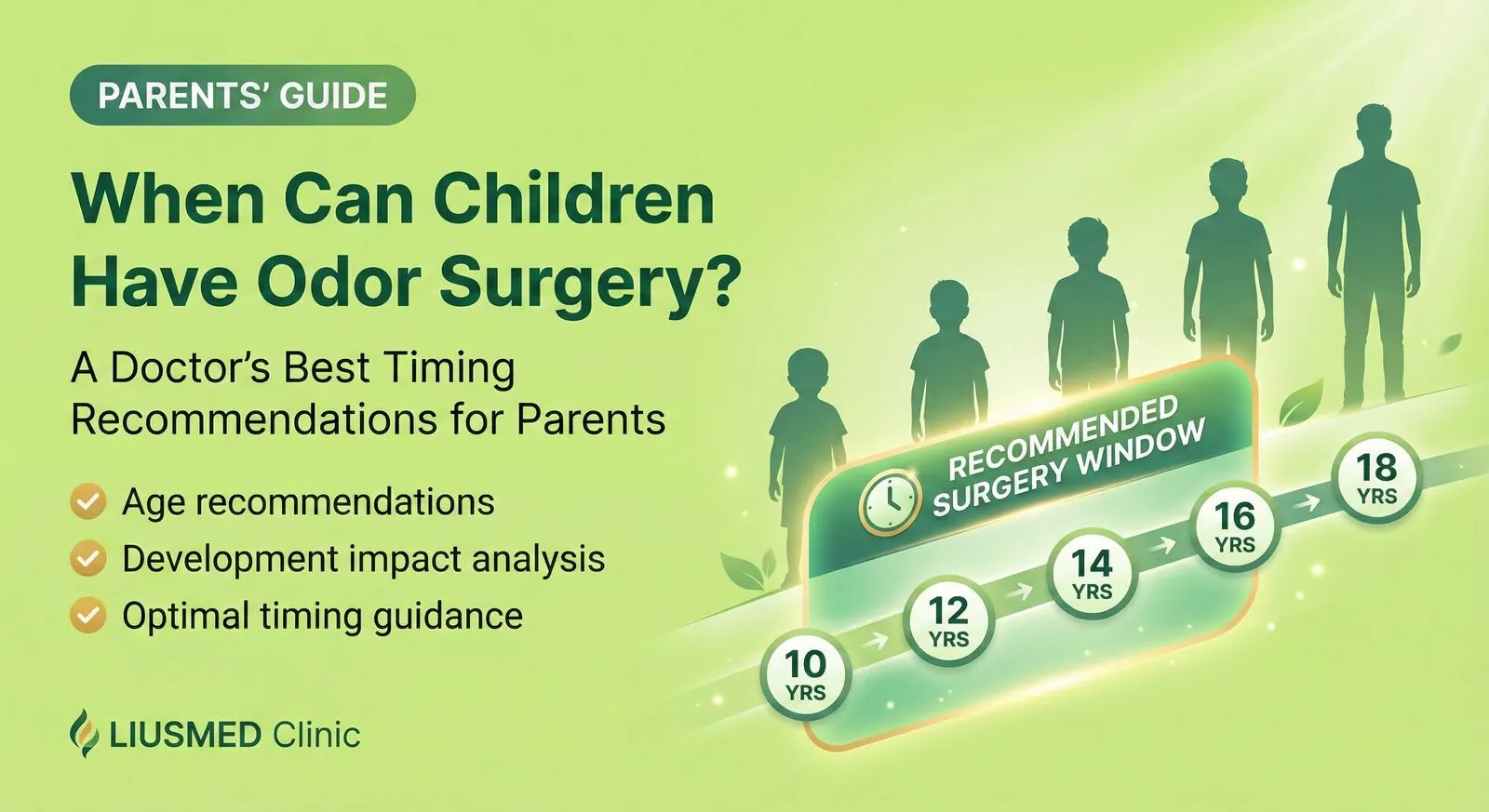
Parents almost always ask "how young can he have the surgery?"
It isn't the question that matters most.
Whether a child is old enough to operate takes a few minutes to establish in clinic. The hard part — the part that belongs to the family, not to me — is whether it should be done now at all, and if the answer is "not yet," how to get through the next year or two.
This isn't a timing chart. It's a decision map for parents: who to see, when I would operate, when I would tell you to wait, and what to do with the waiting.
Looking for adult bromhidrosis information? This is a decision guide for parents of children. For the causes, diagnosis, and treatment options in adults, see The complete bromhidrosis guide; to go straight to the surgery itself, see axillary bromhidrosis surgery.
Which specialty treats bromhidrosis in children?
Start with a dermatologist, for children and adults alike. The odor comes from the apocrine glands in the underarm, which puts diagnosis in dermatology; if surgery comes up, either a dermatologist or a plastic surgeon can discuss it. A pediatrician is a fine first stop, but will usually refer you on. If your child also sweats heavily, that can be looked at in the same visit.
Very young children take a different route. If adult-type body odor shows up before a girl turns 8 or a boy turns 9, paediatric endocrinology counts that as early adrenal activation, and a paediatric endocrinologist should see the child first to rule out early puberty (Voutilainen 2015, PMID 24923732; Novello 2018, PMID 29323690). Breast development, enlarging testes or a sudden growth spurt alongside the odor make that visit more pressing. How to tell the difference is covered in Body Odor in Young Children: Bromhidrosis or Early Puberty?
The question I get more often is a different one: "How do I prove to the doctor that he really does smell?"
You don't. Families dealing with bromhidrosis already know — you have lived with it for months or years, and you are more certain than anyone else in the room. The visit is not about re-judging the smell. It is about:
- confirming the source is apocrine (not clothing, oral, dietary, or something else)
- understanding where your child is developmentally
- hearing what your child says about it
In twenty years of treating bromhidrosis I have almost never relied on smelling a patient to assess them. A child should not have to stand in front of a strange adult and be checked for whether he stinks. That examination itself does damage.
You can make a first judgment at home. Apocrine odor sits in the underarms, lingers after the sweat has dried, and comes back a few hours after a shower. A faint smell after sport doesn't count. If someone in the family has bromhidrosis, or your child has wet earwax, the odds go up; the genetics are covered in Is Bromhidrosis Genetic? Inheritance & When to Check Kids.
If you are not yet sure the odor is bromhidrosis, or you want the full "which specialty" map across every odor source, see Body odor or bad breath: which doctor should you see?.
Will a child outgrow it? When does it settle?
Constitutional (apocrine-type) bromhidrosis does not usually fade with age. It settles in after puberty.
| Stage | Apocrine glands and odor |
|---|---|
| Early childhood | Glands not yet switched on by hormones; usually no adult-type odor |
| Adrenal activation | The adrenal glands typically start producing androgen precursors at around 5-8, and a few children develop adult odor at this point (Voutilainen 2015, PMID 24923732) |
| Adult-type odor before 8 (girls) or 9 (boys) | Counts as early; see a paediatric endocrinologist first (Voutilainen 2015, PMID 24923732; Novello 2018, PMID 29323690) |
| Puberty | Glands activate; odor becomes noticeable and still fluctuates |
| After puberty | Odor settles |
So when does it end? There is no age at which it switches itself off. Once constitutional bromhidrosis appears, it usually carries on into adulthood. You will read online that it fades in old age. Even where that happens, it is decades away, and a child can't wait that long.
So "he'll grow out of it" is usually false. But the reverse is equally false: "it won't go away on its own" does not mean "he needs surgery now." There is a great deal of room between those two statements.
When I tell parents not to operate yet
This is what the article is really for.
Parents who come in have usually already made peace with the idea of surgery. So the thing I do most often is apply the brakes. These are the cases where I say wait:
1. The parent wants it; the child doesn't
If the child is passive, reluctant, or has clearly been talked into the visit, I send the family home.
Bromhidrosis surgery is not urgent. Six months or a year costs nothing. But an unwilling child still has to do the wound care, the compression dressing and the activity restrictions himself — and if he didn't want this, none of it gets done properly. Worse, he will file "there is something wrong with my body" together with "the adults decided for me," and remember them as one thing.
2. The odor hasn't settled; development is still running
Around puberty the odor is still moving. Strong one month, faint the next, and at that stage it is hard to judge how severe it really is or whether it justifies an operation.
Age itself doesn't drive recurrence. Apocrine glands that have been cleared out don't grow back; whether odor returns depends on how thoroughly they were removed. I wait for other reasons. Once the odor settles, the child can tell me how much it actually bothers him. The compression and dressing changes after surgery need his cooperation. And he needs time to be ready for the operation itself.
If a child is in that phase and the odor comes and goes, I usually suggest we watch it for a while.
3. Confounding factors haven't been ruled out
Some "bromhidrosis" isn't only bromhidrosis, or isn't bromhidrosis at all. Residue in clothing, oral sources, diet, skin flora, even stress sweating all get filed by parents under one heading. Clear those first and the odor sometimes drops below the threshold where surgery is worth considering.
This is one reason I am deliberately conservative with children under 12, and assess each one individually.
4. The child's pain is coming from somewhere else
Sometimes a child is excluded or nicknamed at school, the parents attribute it to the odor, and surgery looks like the fix. But bullying doesn't stop when the smell does — surgery can remove an odor, not a label that has already stuck. In that case I would deal with the school first. Surgery can wait.
(Related: Nicknamed at school over body odor? 5 steps for parents)
When it is worth discussing
The other side of the same coin. These are the cases I take seriously:
- The child wants it solved. This is the single most important one. He asks, he raises it, he is willing — then there is something to talk about.
- The odor has stabilized and clearly affects daily life. Not "the parents notice a smell," but the child avoiding things — not raising his hand, not standing close to people, refusing short sleeves in summer.
- Conservative measures have been tried and fall short. Antiperspirants, frequent changes of clothing — and it still isn't controlled.
- He can cooperate. Lie still for a while, accept a local anaesthetic injection, say when something hurts.
Age is not the threshold; cooperation is. The youngest child we have treated was 9 — because that particular child was ready, not because 9 is a standard.
We have performed pediatric bromhidrosis surgery for more than fifteen years and are one of the few teams in Taiwan with a sustained focus on it. The clearance standard is the same for children as for adults; thinner skin in children does not mean a lower standard. In our clinic's follow-up, children whose glands were fully cleared have had no reported recurrence after going through puberty. Pubertal hormone changes do not regrow apocrine glands that have already been removed.
Will surgery affect his development?
Clinically, no. Underarm bromhidrosis surgery works on apocrine glands lying between the dermis and the upper subcutaneous layer. It does not touch the hormonal system, the lymphatic system, or physical growth. This is the question parents ask most, and the one most easily frightened by rumours online. You can set it aside.
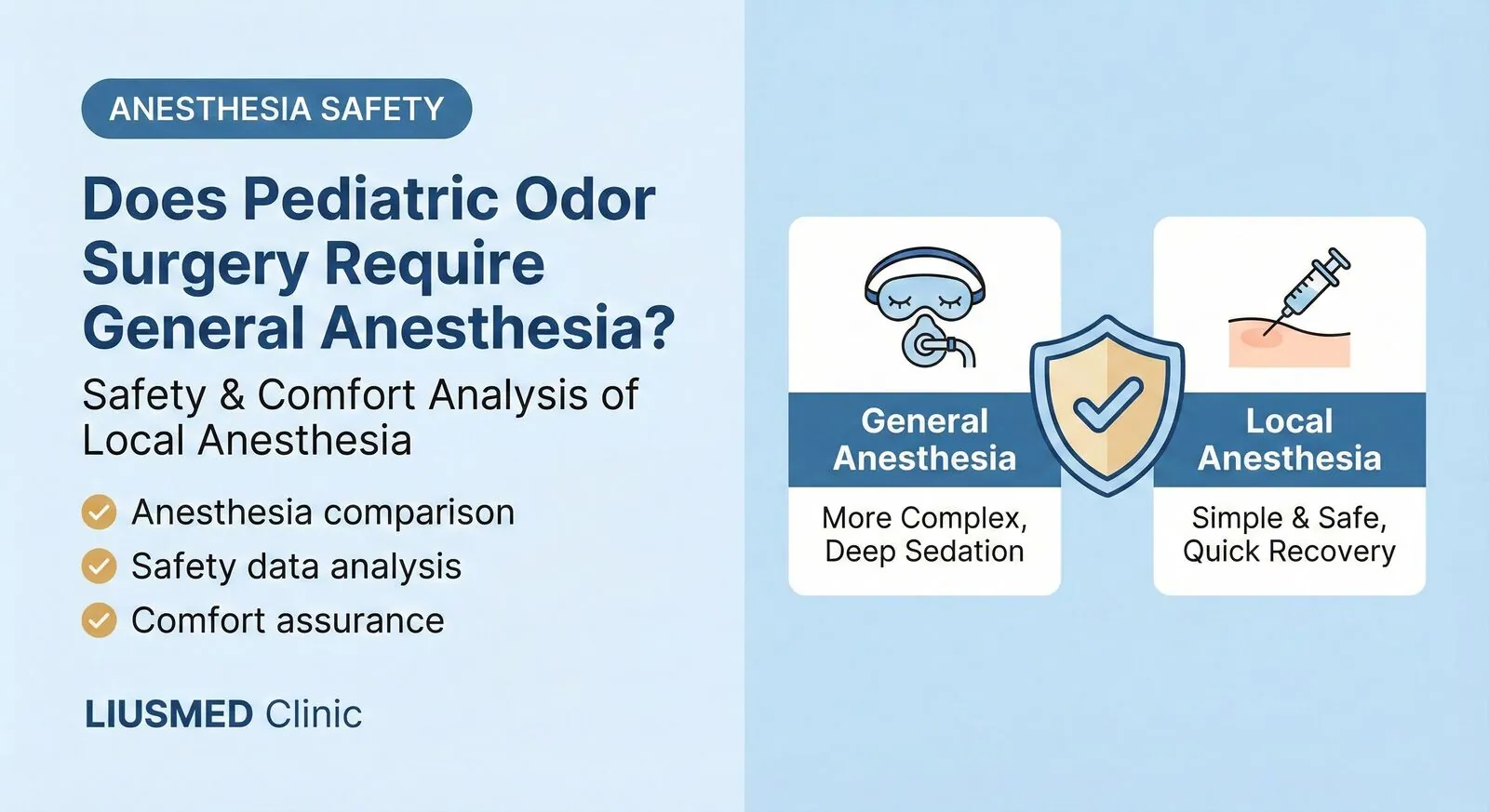
On anaesthesia, this clinic uses gentle pain-relief anaesthesia — not general anaesthesia; the child can talk with the surgeon throughout. See Does pediatric bromhidrosis surgery need general anaesthesia?
If you decide to wait, what does the waiting look like?
"Not operating yet" is not the same as "doing nothing." What happens in this period often matters more to the child than the surgery does.
What can be controlled
| Method | Age | Effect |
|---|---|---|
| Antiperspirant (mild formulation) | Any | Temporary control |
| Frequent changes of clothing; staying dry | Any | Less odor build-up |
| Botulinum toxin injection | Case by case | Reduces sweating; temporary, needs repeating |
Children can use antiperspirant. Pick a fragrance-free, gentle formula and apply it to a clean, completely dry underarm; it works better that way than on skin that is already sweating. Stop if it causes redness, itching or stinging. It holds sweat and odor down for a while and they return when you stop, so treat it as a tool for the waiting period. It doesn't change the constitution.
The part that matters more: how you talk to him
- Normalize it. Tell him this is constitutional — not that he is dirty, not that it is his fault. Say it out loud. Don't assume he already knows.
- Don't over-monitor. Asking "do you smell today?" every morning is a daily reminder that he is defective.
- Tell him it can be dealt with. "This can be solved later" and "you'll have to put up with it" are not the same sentence.
- Listen to him about school. What you need to know is his situation, not his smell.
Parent FAQ
Q1: Which specialty should I take my child to?
A1: Start with a dermatologist; for surgery, a dermatologist or plastic surgeon. If adult-type body odor appears before 8 in a girl or 9 in a boy, see a paediatric endocrinologist first (PMID 24923732, PMID 29323690). You will not be asked to "prove" the odor; you already know.
Q2: My child is 11 and already has body odor. Can he have surgery?
A2: We can assess it, but under 12 I am more conservative and look at each child individually. At 11 the odor is usually still changing, which makes severity hard to judge. I look first at whether the child wants this, whether the odor has stabilized, and whether confounders have been excluded. Those answers matter far more than his age.
Q3: When does bromhidrosis start, and when does it end?
A3: Most children first notice it around puberty. Adrenal activation typically begins at around 5-8, so a few have adult odor earlier (PMID 24923732). As for an end, there is no age at which it switches itself off; constitutional bromhidrosis usually carries on into adulthood. If it does fade in old age for some people, that is decades away.
Q4: My child is mocked at school. Can we operate early?
A4: Psychological pressure is a real consideration, but first separate the causes: is the suffering coming from the odor, or from a label that has already attached? If it is the latter, surgery won't help. Come in and talk — we bring the school situation into the discussion before deciding.
Q5: How is the cost of pediatric bromhidrosis surgery worked out?
A5: It depends on surgical scope, follow-up and other case-specific factors, so we don't quote a fixed price. For the structural factors behind the cost, see How is bromhidrosis surgery priced in Taiwan?. The figure for your child's case is discussed in clinic or on our chat line.
Q6: If we wait, are we holding him back?
A6: No. Bromhidrosis surgery has no expiry date; a year's delay does not make the result worse. What does hold a child back is spending that year with nobody talking to him properly about it.
Q7: My child has underarm odor. What should I do first?
A7: Don't rush into a decision about surgery. First, check whether it is bromhidrosis: odor that lingers after sweat dries and comes back hours after a shower points to apocrine glands. Second, check the age: before 8 in a girl or 9 in a boy, see a paediatric endocrinologist first; after that, a dermatologist (PMID 24923732, PMID 29323690). Meanwhile, use antiperspirant and frequent changes of clothes at home, and ask your child whether it actually bothers him.
Three things for parents
- Ask your child whether he wants it before you ask a doctor whether it is possible. Reverse that order and every later step jams.
- "It won't go away on its own" does not mean "operate now." There is a lot of road in between.
- How you speak to him during the waiting will shape how he sees himself long after the surgery is forgotten.
Further reading
- Children's Odor Surgery Without General Anesthesia
- Child Teased for Body Odor at School? A 5-Step Parent Guide
- Is Bromhidrosis Genetic? Inheritance & When to Check Kids
- Bromhidrosis Surgery Cost in Taiwan: How to Compare Clinics
- Children & adolescent bromhidrosis
Already decided, and want to know how the surgery itself works? This article is about whether to operate. The procedure, clearance thoroughness and post-op wound care are covered on our surgical site → Pediatric bromhidrosis surgery
About Clear Odor Clinic
Dr. Ta-Ju Liu
- Position: Director, Clear Odor Clinic
- Focus: Minimally invasive odor and sweat surgery (underarm, areolar, perineal), hyperhidrosis
- Credentials:
- 20+ years dedicated to odor treatment
- 10,000+ cases; no recurrence reported in clinical follow-up
- Board-certified dermatologist (Taiwan)
- Philosophy: "With children, the hard part isn't the surgery — it's deciding whether to do it. I work that through with the parents and the child, including the times when I think it shouldn't be done yet."