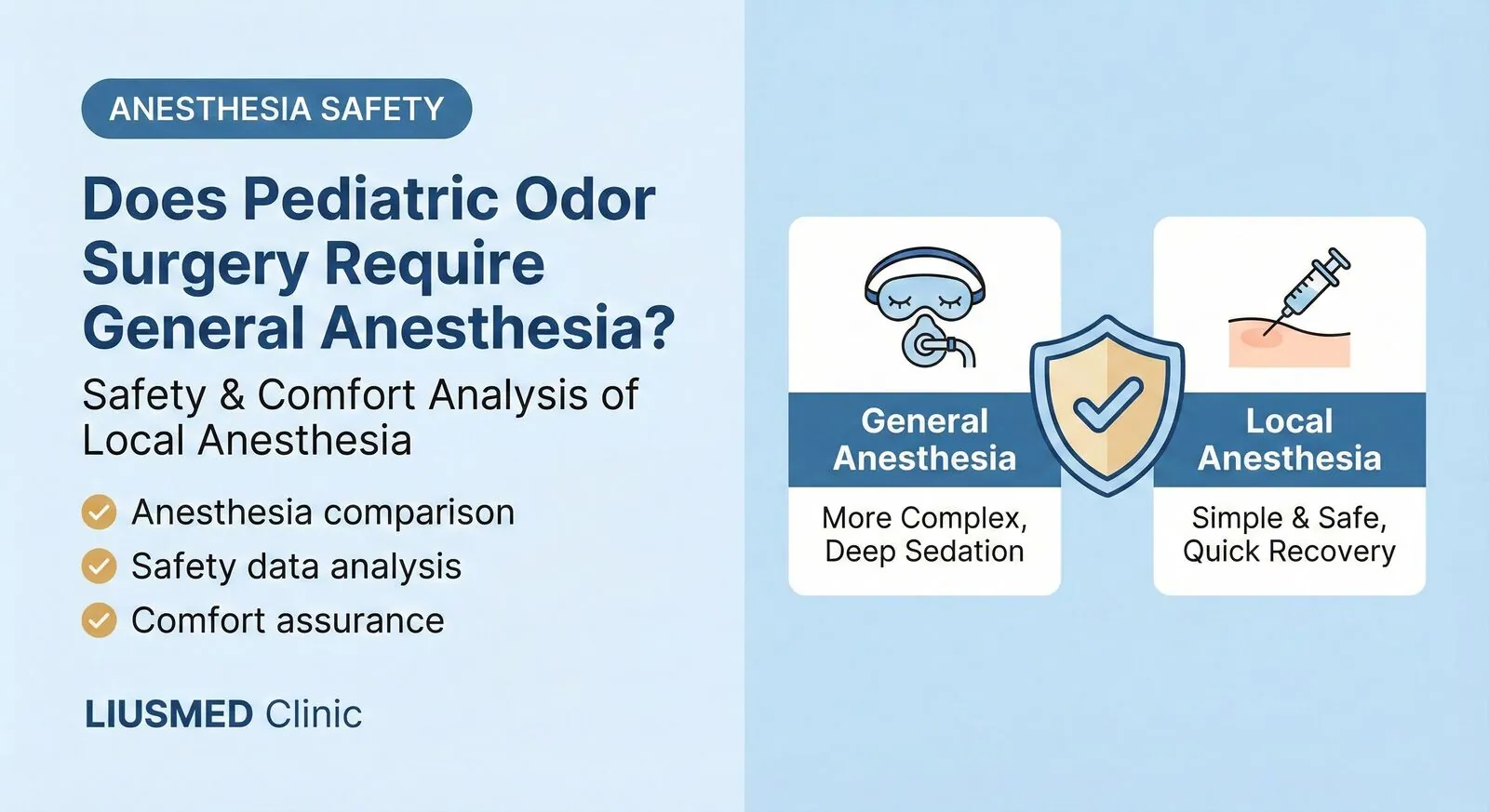
We Use Gentle Pain-Relief Anesthesia, Not General Anesthesia
For pediatric body odor minimal-incision surgery, our clinic uses gentle pain-relief anesthesia across the board: we do not use general anesthesia, and we don't rely on local anesthesia alone either. On top of numbing the underarm with local anesthesia, we add gentle pain-relief anesthesia, so the child stays relaxed throughout and the discomfort felt during surgery is kept to a minimum.
The child needs no intubation as with general anesthesia and recovers quickly; throughout the procedure staff can interact with the child and adjust at any time. The core of this approach is to balance safety and comfort at the same time—without putting the child through the extra burden of general anesthesia, and without making them tough out the whole procedure on local anesthesia alone.
The Difference Between Three Anesthesia Approaches
Parents most often ask, "Will general anesthesia be needed?" Let's lay out the three approaches clearly:
| Approach | What it is | Our practice |
|---|---|---|
| General anesthesia | Fully asleep, no awareness, often needs intubation or breathing support | ❌ Not used |
| Local anesthesia alone | Numbs only the surgical site; the child has to get through the procedure unaided and may feel anxious or uncomfortable | △ Not used on its own |
| Gentle pain-relief anesthesia (our practice) | Local anesthesia + gentle pain-relief anesthesia; child relaxed, discomfort greatly reduced | ✅ Used across the board |
💡 Clear Odor Medical Team's View: "We don't put the child through the extra burden of general anesthesia, but we also don't just give local anesthesia and have the child tough it out. On top of local anesthesia at the underarm, we add gentle pain-relief anesthesia—the child is relaxed, and the discomfort during surgery is kept to a minimum. That is how we balance safety and comfort."
Why Gentle Pain-Relief Anesthesia Balances Safety and Comfort
Safer Than General Anesthesia
| Advantage | Explanation |
|---|---|
| Avoids the general-anesthesia burden | No intubation or breathing support needed |
| Cardiovascular stability | Lighter medication, minimal impact on heart and blood pressure |
| No deep post-op drowsiness | None of the longer cognitive after-effects of general anesthesia |
| Rapid recovery | Shorter observation time; back to activity sooner |
More Comfortable Than Local Anesthesia Alone
| Advantage | Explanation |
|---|---|
| Less anxiety and discomfort | Gentle pain-relief anesthesia keeps the child relaxed, rather than tense and toughing out the whole surgery |
| Smoother numbing | Even the underarm local injection feels milder to the child |
| Steadier procedure | A relaxed, still child means a smoother, more stable surgery |
Gentle Pain-Relief Anesthesia vs General Anesthesia
| Comparison | Gentle Pain-Relief Anesthesia (our practice) | General Anesthesia |
|---|---|---|
| Interaction during surgery | Relaxed; staff can talk to and reassure the child anytime | Completely asleep, no interaction |
| Breathing support | No intubation or breathing support needed | May need assistance/intubation |
| Pain control | Underarm local anesthesia + gentle pain-relief anesthesia | General anesthetic agents |
| Surgery time | About 1.5–2 hours (not counting post-op observation) | About 1–1.5 hours |
| Post-op recovery | Fast recovery, short observation | Needs 2–4 hours observation |
| Risk level | Low | Low (but higher than gentle pain-relief anesthesia) |
💡 In one line: general anesthesia means "the whole person is asleep"; gentle pain-relief anesthesia means "the child is relaxed, staff can interact anytime, and discomfort at the surgical site is greatly reduced." For a short body odor minimal-incision procedure, the latter is already enough to balance safety and comfort.
How We Arrange It by Age
Our clinic performs pediatric body odor surgery with gentle pain-relief anesthesia across the board, so there is no need to escalate to general anesthesia just because a child can't fully cooperate. Age and maturity still affect pre-op preparation and how we communicate:
| Age | Cooperation Level | Key Considerations |
|---|---|---|
| 9 years and older | Varies from child to child | Surgery is possible from age 9; gentle pain-relief anesthesia + local anesthesia, with the child's cooperation and readiness assessed before surgery |
| Younger or more anxious children | Need a bit more preparation | The same gentle pain-relief anesthesia + local anesthesia, with more thorough pre-op explanation and reassurance |
What We Assess Before Surgery
Beyond age, the doctor also evaluates the child's:
| Assessment Item | Good | Needs More Communication |
|---|---|---|
| Psychological maturity | Can understand the purpose of surgery | Excessive fear or anxiety |
| Past medical experience | Previous injections/blood draws were fine | Extreme needle phobia |
| Communication ability | Can express discomfort | Cannot communicate clearly |
| Staying still | Can lie still for about 1.5–2 hours | Cannot stay still |
The Gentle Pain-Relief Anesthesia Process
Surgery Day Timeline
| Step | Time |
|---|---|
| Check-in | 10min |
| Pre-op prep | 10min |
| Topical numbing | 15-20min |
| Gentle pain-relief anesthesia | a few min |
| Local anesthesia | 5min |
| Surgery | About 1.5–2 hours |
| Observation | 15-30min |
| Go home | Leave |
Detailed Step Explanation
Step 1: Topical Numbing (Reduces Injection Discomfort)
| Item | Description |
|---|---|
| Cream name | EMLA or similar anesthetic cream |
| Application area | Underarm where injections will be |
| Wait time | 15-20 minutes |
| Effect | Skin surface numb, reduces needle sensation |
Step 2: Gentle Pain-Relief Anesthesia (Helps the Child Relax)
| Item | Description |
|---|---|
| Method | Gentle pain-relief anesthesia is added on top of local anesthesia (not general anesthesia) |
| Purpose | Helps the child relax and reduces discomfort and anxiety during surgery |
| State | The child is relaxed and can interact with staff in real time |
| Monitoring | Vital signs monitored throughout |
Step 3: Local Anesthesia Injection
| Item | Description |
|---|---|
| Medication | Lidocaine + tumescent solution |
| Injection method | Very fine needle, multiple points |
| Sensation | With topical numbing plus gentle pain-relief anesthesia, the sensation is kept very low |
| Duration | About 2-3 hours |
Step 4: Surgery Proceeds
| Item | Description |
|---|---|
| Sensation | Greatly reduced discomfort |
| May feel | Light tugging, pressing (low discomfort) |
| Time | About 1.5–2 hours (both sides, not counting post-op observation) |
How to Help Children Complete Surgery Comfortably
Pre-Surgery Psychological Preparation
| Suggestion | Description |
|---|---|
| Advance notice | Let the child know what's happening, no surprises |
| Positive framing | "After this, there won't be any smell" |
| Simulate the situation | Practice lying flat, raising arms |
| Answer questions | Address the child's questions to reduce fear |
Comfort Measures During Surgery
| Measure | Description |
|---|---|
| Gentle pain-relief anesthesia | The core measure: keeps the child relaxed and reduces discomfort |
| Parent accompaniment | Can stay beside (depending on clinic policy) |
| Music/headphones | Play the child's favorite music |
| Ongoing reassurance | Nurses interact with and reassure the child |
How We Keep Discomfort to a Minimum
To make the whole process more comfortable, our approach combines:
- Pre-applied numbing cream: Skin is numbed first
- Gentle pain-relief anesthesia: Keeps the child relaxed and reduces discomfort during surgery
- Very fine needles, slow injection: Reduces the sensation of the local injection
- Continuous reassurance and company: Nurses guide, parent stays nearby
- Continuous monitoring: Safety comes first
💡 Dr. Liu's Experience: "We've treated many teenagers. The point is not to put the child through the burden of general anesthesia, while still letting them complete the surgery in a relaxed state. With good communication beforehand and gentle pain-relief anesthesia, most children get through it smoothly."
Safety and Monitoring
Medication and Monitoring
| Item | Description |
|---|---|
| Pre-op evaluation | Confirm no anesthesia contraindications |
| Dosage calculation | Precisely calculated by body weight |
| Vital sign monitoring | Continuous throughout |
| Emergency preparation | Complete emergency equipment and medications |
| Professional team | Well-trained medical staff |
Local Anesthesia Safety
| Risk Type | Incidence | Description |
|---|---|---|
| Local allergic reaction | < 0.1% | Rash, mild swelling |
| Systemic allergy | Extremely rare | Emergency equipment on standby |
| Temporary numbness | Common | Resolves in 2-3 hours |
| Bruising | Occasionally | Resolves in 1-2 weeks |
Frequently Asked Questions
Q1: Will the surgery hurt?
A1: After the topical numbing cream, the gentle pain-relief anesthesia keeps the child relaxed, and the underarm local anesthesia keeps the surgical site numb. The child may feel "something happening" (tugging, pressing), but discomfort is kept very low.
Q2: My child says they're very afraid of needles—what can we do?
A2: These measures can help:
- Thorough pre-op communication so the child understands the process
- Topical numbing cream to reduce needle sensation
- Gentle pain-relief anesthesia to help the child settle and relax
- A parent nearby and music to distract
Q3: So are there any of the concerns associated with general anesthesia (such as effects on brain development)?
A3: Our pediatric body odor surgery does not use general anesthesia, so the concerns specific to general anesthesia do not apply. Gentle pain-relief anesthesia uses lighter medication and recovery is fast, and staff can monitor and interact with the child in real time during the procedure—making it a high-safety approach.
Q4: How long until the anesthesia wears off after surgery?
A4: The underarm local anesthesia lasts about 2-3 hours. After it wears off, there may be mild soreness, which pain medication can control. The gentle pain-relief anesthesia also wears off gradually during the observation period; staff confirm the child has recovered and is stable before arranging to go home.
Q5: Can a parent come in during surgery?
A5: Depending on clinic policy, in most cases one parent may accompany. A parent's presence is very calming for the child. Please confirm with the clinic in advance.
Q6: Does gentle pain-relief anesthesia require fasting?
A6: Yes. Because gentle pain-relief anesthesia is used, fasting is required before surgery; how long to fast and how to plan the day's meals will be explained individually when you book—please follow our pre-op instructions.
Surgery Day Recommendations
Pre-Op Preparation
| Item | Suggestion |
|---|---|
| Eating | Fasting required; follow our pre-op instructions |
| Clothing | Loose button-front top |
| Mood | Adequate sleep, stay relaxed |
| Bring | Headphones, tablet (for music) |
Accompanying Parent Notes
| Item | Description |
|---|---|
| Role | Calm the child, distract attention |
| Position | Usually near the child's head |
| Don't | Interfere with medical staff operations |
| Prepare | Topics the child enjoys talking about |
Conclusion
| Question | Answer |
|---|---|
| Does pediatric odor surgery need general anesthesia? | ❌ Our clinic does not use general anesthesia |
| Is it pure local anesthesia, then? | ❌ Local anesthesia + gentle pain-relief anesthesia |
| What is our standard practice? | ✅ Gentle pain-relief anesthesia, balancing safety and comfort |
| Will the child be in pain? | ❌ Discomfort is kept very low |
| What state is the child in during surgery? | ✅ Relaxed; staff can interact and adjust anytime |
Clear Odor Specialist Perspective
Pediatric bromhidrosis is clinically a different problem from the adult version. At Clear Odor we see a high volume of adolescent odor and hyperhidrosis cases, and Dr. Liu evaluates not only whether surgery is feasible but whether the child's cooperation and readiness are in place right now — a conversation only a single-condition clinic has the time to have fully with parents.
Surgery is possible from age 9, and any child 9 or older can be a candidate. What we look at is the child's cooperation and readiness, alongside skin microbiome, sleep, diet, and psychosocial confounders, before deciding on timing together with parents. For school bullying, social withdrawal, and related comorbidities we engage parents directly — this is the kind of time investment a specialist clinic can afford and that general medical facilities struggle to provide.
Full Treatment Information → · Book a Specialist Consultation →
Related Reading
- Child Bromhidrosis: Which Doctor, and When Not to Operate
- Child Teased for Body Odor at School? A 5-Step Parent Guide
- Is Bromhidrosis Genetic? Inheritance & When to Check Kids
- Pediatric Bromhidrosis
- Sweat Gland Surgery Recovery: Day 0-180 in 4 Phases
About the Author
Dr. Ta-Ju Liu
- Current Position: Director, Clear Odor Clinic
- Specialties: Odor and hyperhidrosis minimal-incision surgery (underarm, areola, perineal bromhidrosis), hyperhidrosis treatment
- Experience:
- 20+ years of specialist experience in odor treatment
- Over 10,000 cases performed, with no recurrence reported on clinical follow-up
- Board-certified dermatologist (Taiwan)
- Philosophy: "For children, surgery is a big deal. We make every effort to ensure the process is comfortable and safe, so both child and parents can feel at ease."