Why You Need a Full Comparison of Sweat-Gland Surgery Options
Every week in clinic, I (Dr. Ta-Ju Liu) hear variations of the same three questions:
- "One clinic pushed miraDry, another said surgery is better. What's the actual difference?"
- "Is laser more 'advanced'?"
- "My palmar sweating is severe — can't we just cut the nerve and be done with it?"
These questions share a common misconception: that the surgical options sit on a single "early-to-advanced" timeline.
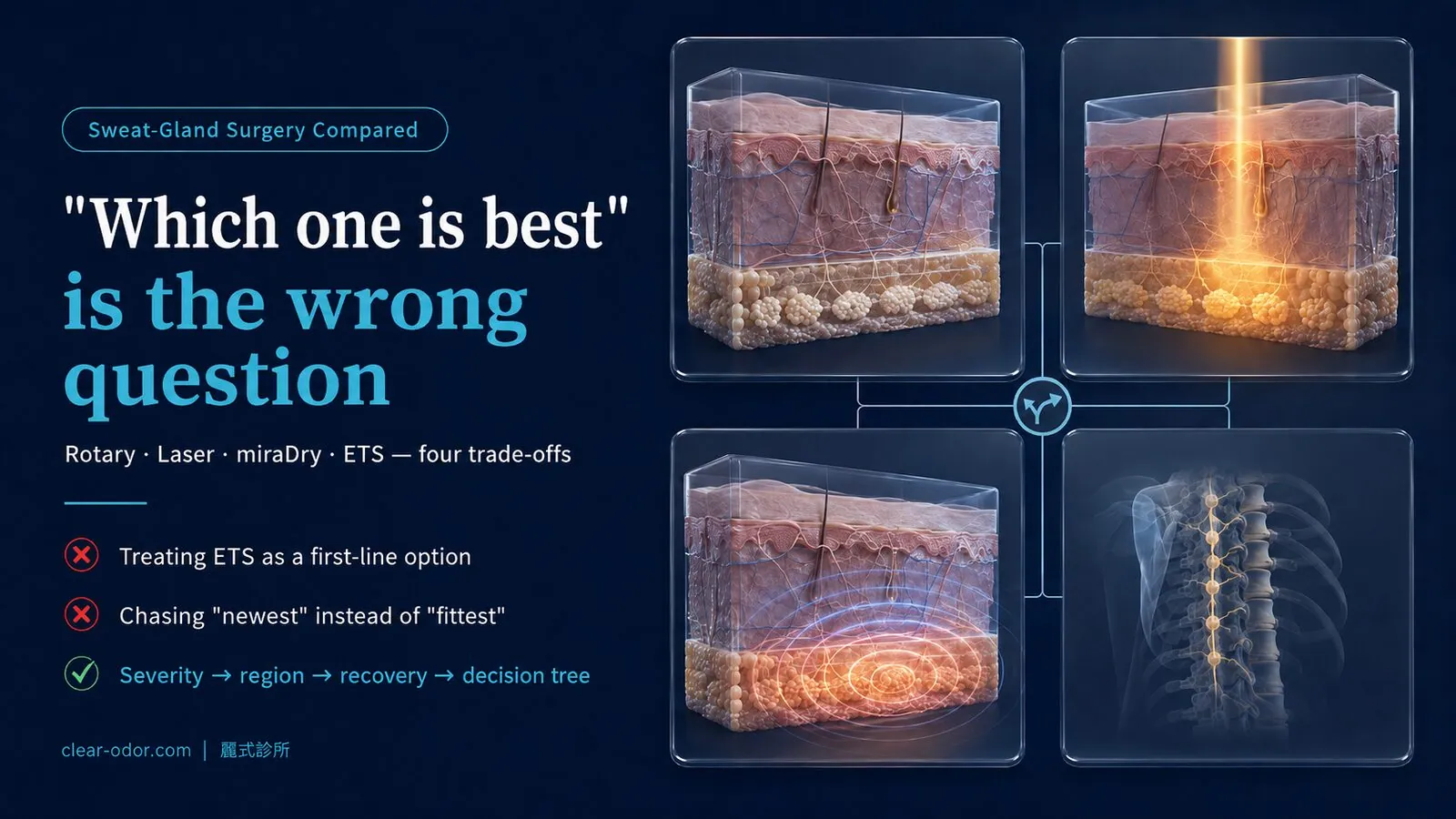
They don't. The 4 mainstream paths — minimally invasive rotational curettage, laser sweat-gland ablation, miraDry microwave thermolysis, and ETS thoracic sympathectomy — are fundamentally different tools with different mechanisms, different ideal patients, and different trade-offs. Lined up as a progression, you'll end up choosing badly.
This guide consolidates the comparison questions I get most often after 20 years in odor and sweat surgery, into a framework you can read before the consultation. By the end, you should be able to answer:
- What does each path actually do, and which glands does it target?
- Why do we put direct-visualization rotational curettage first and ETS last?
- Which severity ranges map to which option?
- How do 3-, 5-, and 10-year cumulative costs compare?
- If one treatment doesn't fully work, what are the recovery paths?
Individual results vary. This guide gives you the decision framework, not a diagnosis — the final treatment choice still requires an in-person evaluation.
Multi-site odor? If you have odor in more than one area, see the Odor Map for site-by-site triage first to identify the primary source before diving into this guide.
What are the 4 main surgical and device options for odor and sweating?
Four main routes: minimally invasive direct-visualization rotational curettage (directly clears apocrine glands), laser sweat-gland ablation, miraDry microwave, and ETS sympathectomy — the first three target the glands, ETS targets the nerve, with different mechanisms and uses, so meet each before lining them up.
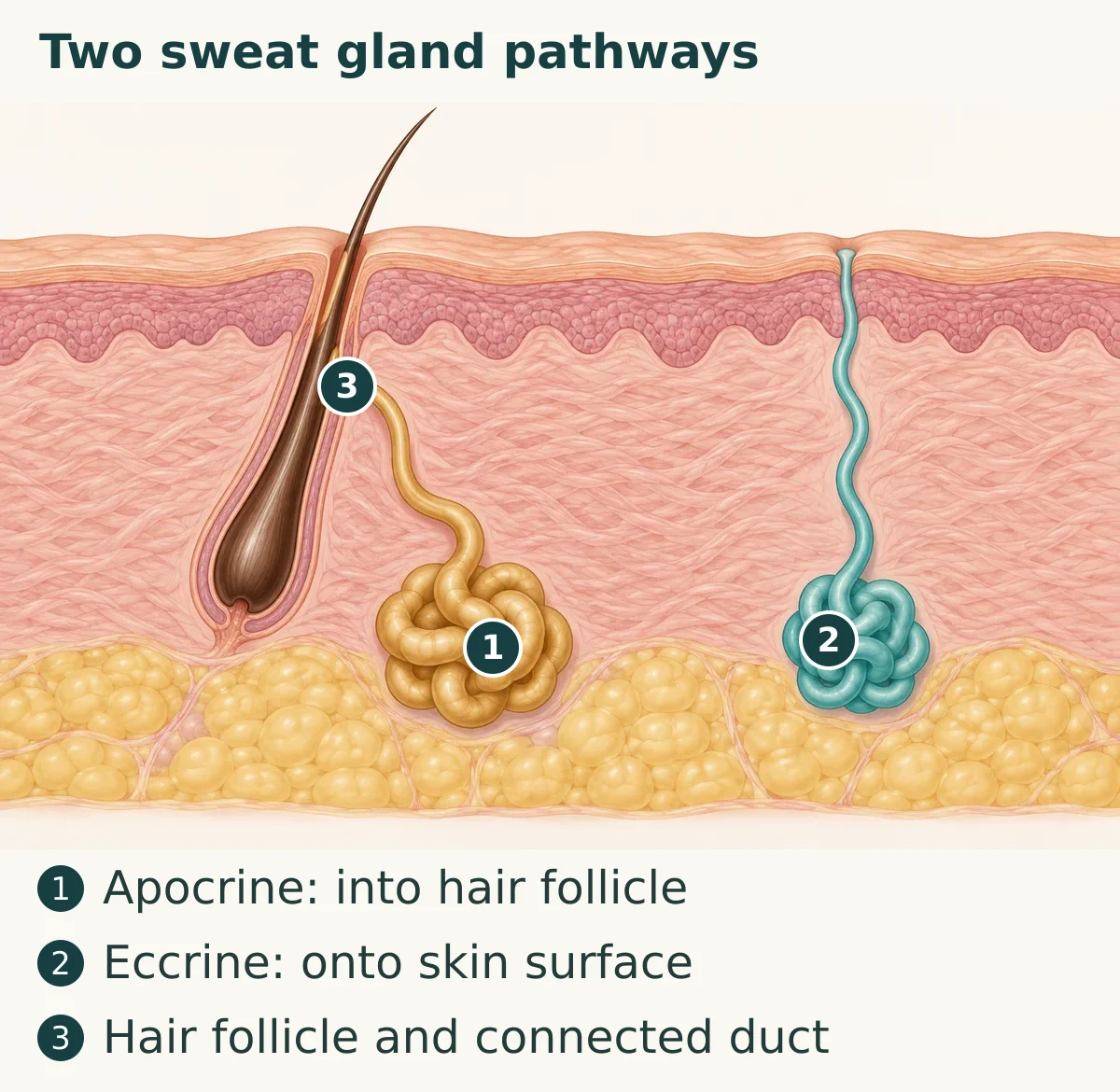
Each option in one paragraph before we line them up.
a. Rotational Curettage (Minimally Invasive, Direct Visualization)
- Mechanism: A 4–7 mm incision in the underarm, through which a rotating curette is introduced. The surgeon mechanically removes apocrine glands and most eccrine glands under direct visualization of the deep dermis.
- Primary target: Apocrine glands (odor) + eccrine glands (sweat) + partial follicular structures — addresses "odor, sweat, hair" in one operation.
- Ideal candidates: Moderate-to-severe bromhidrosis (odor-severity grade 3–4), bromhidrosis with axillary hyperhidrosis, patients prioritizing single-procedure long-term stability.
- Distinguishing feature: The surgeon's eyes are on the tissue throughout — clearance can be verified in real time.
- Service page: Axillary Bromhidrosis Surgery
b. Laser Sweat-Gland Ablation
- Mechanism: A fiber laser enters through a 2–3 mm incision under the skin. Thermal energy destroys sweat glands. Semi-invasive — incision exists but smaller than curettage; clearance is thermal, not mechanical-visual.
- Primary target: Axillary sweat glands and some apocrine glands. Depth and thoroughness depend on wavelength, power, and operator experience.
- Ideal candidates: Mild-to-moderate bromhidrosis, patients wanting a smaller incision than curettage and accepting that thoroughness may not match direct-vision surgery.
- Distinguishing feature: Smaller incision, less post-op pain, but no direct view of which glands were actually destroyed.
- Deeper comparison: Rotational Curettage vs Laser for Odor: Which Lasts Longer?
c. miraDry Microwave Thermolysis (Non-Invasive)
- Mechanism: A handpiece on the underarm skin emits microwave energy that heats the dermis/subcutaneous fat junction. No skin incision.
- Primary target: Eccrine sweat glands primarily; some effect on apocrine glands but limited by microwave penetration depth.
- Ideal candidates: Sweat-dominant complaints with mild odor, patients who can't accept any scar, patients who can accept 1–2 treatment sessions.
- Distinguishing feature: No incision, no surgical scar — but session count and deep-gland coverage are the constraints.
- Deeper comparison: Bromhidrosis Surgery vs miraDry: A 6-Point Comparison
d. ETS — Endoscopic Thoracic Sympathectomy
- Mechanism: Under general anesthesia and thoracoscopy, the sympathetic nerve ganglia controlling palmar sweating are cut or removed. This is chest cavity surgery under general anesthesia — categorically different from the three "local gland-targeting" paths above.
- Primary target: Nerve signals, not sweat glands themselves. Sweating in the supplied region stops once signaling is interrupted.
- Ideal candidates: Severe palmar hyperhidrosis (HDSS 3–4), other treatments inadequate, patient has fully understood compensatory sweating risk.
- Distinguishing feature: Rapid and dramatic effect on palmar sweat — but with a known, common, and typically irreversible compensatory sweating side effect.
- Deeper context: Hyperhidrosis vs Compensatory Sweating: Before ETS Surgery
- Managing compensation after ETS: Minimal-Cut Surgery page: compensatory sweating after ETS
How do the 4 options compare? Start with a 7-dimension table
Compare across seven dimensions at once: how thoroughly it clears, whether it targets odor or sweat, invasiveness and recovery, scarring, reversibility, durability, and which severity it suits — none wins on every dimension, so the point is which fits your needs best.
| Dimension | Rotational Curettage | Laser Ablation | miraDry | ETS |
|---|---|---|---|---|
| What it removes | Apocrine + eccrine + follicles | Eccrine + some apocrine | Eccrine primarily | Sympathetic nerve |
| Direct visualization | ✅ Yes | ❌ Thermal, blind | ❌ Surface, blind | Endoscopic nerve transection |
| Incision | 4–7 mm | 2–3 mm | None | 5–10 mm × 2 chest-wall ports |
| Anesthesia | Local | Local | Local (with surface cooling) | General |
| Typical session count | 1 | 1–2 | Usually 1–2 | 1 |
| Recovery period | Compression dressing 3–5 days; sutures out Day 14 | 3–5 days | No incision; weeks of swelling | 1–2 weeks |
| Primary residual risk | Temporary numbness, rare recurrence | Limited thoroughness | Odor residual; possible top-up | Compensatory sweating, hard to reverse |
This table is the entry point to the comparison. Each dimension expands in the sections below, especially the clinical logic of "what to choose when."
Why is direct-visualization rotational curettage our primary procedure?
Because "you can only clear safely and thoroughly what you can see" — rotational curettage clears apocrine glands under direct view, with a high clearance rate while preserving skin blood supply and sensation; it's a choice grounded in 20 years of clinical experience, not chasing what's newest.
Rotational curettage is the primary technique we offer for axillary bromhidrosis and combined bromhidrosis-hyperhidrosis. This isn't because it's the "newest" option — it's the result of 20 years of clinical accumulation and a commitment to a single principle: "if you can't see it, you can't safely treat it."
Direct vs Blind: The Difference Is Controllability
Both laser and miraDry are blind thermal modalities — they rely on heat acting on tissue, with no real-time visualization of which glands are actually destroyed. In theory, if the parameters are correct, the target is reached. In practice:
- Skin thickness, subcutaneous fat distribution, and apocrine gland depth vary between patients
- Heat penetration is affected by epidermal thickness and blood flow — actual clearance depth has variance
- The operator can't see tissue response, can't adjust mid-procedure
Rotational curettage works differently: the surgeon sees, the hand controls. Through a 4–7 mm incision, the deep dermis, fat-tissue interfaces, and neurovascular landmarks are directly visualized — clearance is verified as you go. That's why direct-visualization controllability is higher. Not because of fancier technology, but because a human is in the loop.
The Three-in-One Clinical Value
For patients with combined bromhidrosis and hyperhidrosis (clinically the most common combination, per Bromhidrosis Guide: Causes, Diagnosis, Treatment & Recovery), one rotational curettage session addresses:
- Apocrine gland clearance → odor improvement
- Eccrine gland reduction → sweat improvement
- Partial follicular removal → reduced underarm hair
The other 3 paths can't address all three in one operation. For patients with multiple concerns, this is a meaningful difference.
But Rotational Curettage Isn't for Everyone
I have to be honest: direct-visualization curettage isn't a panacea. There's an incision of about 4 mm, a compression dressing for the first 3–5 days, sutures that stay in until Day 14, and 1–2 months of palpable nodularity. For some patients, these costs are not acceptable. If your main complaint is mild sweating and any scar is unacceptable, miraDry is the better choice. That's why the next section talks about when miraDry wins.
In what situations is miraDry actually the better choice?
miraDry isn't a lesser option — for people who want no incision at all, can accept that more than one session may be needed, and are mainly bothered by sweating, the non-invasive microwave fits better; its role is "right for certain situations," not inferior to surgery.
We don't describe miraDry as a "lesser option" — that's unfair to patients. The truth is: for certain situations, miraDry fits the patient's needs better than surgery.
miraDry Fits Better When:
- The main complaint is sweat or wetness, with odor secondary or absent
- Any incision scar is absolutely off the table (occupational or personal preference)
- You can't schedule 3–5 days of rest at home plus keeping the underarms dry until suture removal on Day 14
- There's strong hesitation about surgery itself; the patient wants a non-invasive trial first
- 1–2 treatment sessions are acceptable, and the patient understands odor thoroughness may not match direct-vision surgery
miraDry Fits Less Well When:
- The main complaint is moderate-to-severe odor (odor-severity grade 3–4) — deep apocrine glands are limited by microwave penetration
- The patient wants single-session long-term resolution — 2 sessions are often needed
- Bromhidrosis combined with significant hyperhidrosis — direct surgery is more efficient for both
- Apocrine glands are deep or widely distributed (often the case with strong family history)
Clinical view: For patients wanting miraDry, I recommend an in-person palpation of apocrine distribution first — if glands are concentrated and superficial, miraDry results will approach surgery. If distribution is deep or extensive, we'll revisit. That's safer than choosing based on online reviews.
What is the role of laser sweat-gland ablation?
Laser ablation sits between rotational curettage and miraDry: a smaller wound than curettage, a bit more clearing power than miraDry, with an in-between recovery; it's less used in Taiwan, but it's an option for those wanting a compromise between invasiveness and thoroughness.
Laser sweat-gland ablation is less common in Taiwan than rotational curettage or miraDry, but it has a specific niche.
Quick Mechanism
A fiber laser (typically Nd:YAG or diode) enters through a 2–3 mm incision and thermally destroys sweat glands. Semi-invasive — smaller wound than rotational curettage, one more incision than miraDry.
Fits Better When:
- Mild-to-moderate bromhidrosis (grade 2–3)
- Patient wants a smaller wound than rotational curettage while wanting more thoroughness than miraDry
- Patient is comfortable with thermal-based treatment
Limitations:
- No direct visualization of clearance — same fundamental issue as miraDry
- Wide variation across laser wavelengths and energy settings; operator experience matters significantly
- For severe cases (grade 4+), thoroughness typically falls short of direct surgery
- Pricing in Taiwan is similar to rotational curettage; the value proposition isn't always obvious
Clinical view: Laser ablation is a mainstream option in some countries (e.g., parts of Europe) but less common in Taiwan. When patients want "slightly less wound than rotational curettage" plus "more thoroughness than miraDry," laser is a middle option — but understand it's a compromise, not the strongest answer in any single dimension.
Why do we place ETS as the "last resort"?
Not because the technique is flawed, but because of its side-effect profile: ETS cuts the sympathetic nerve and works fast and clearly, but compensatory sweating is common and irreversible; so in our pathway, ETS is the last resort, considered only after other options are exhausted.
ETS was once the dominant option for severe palmar hyperhidrosis, with rapid and definitive results. In our clinical pathway, ETS is the last resort — not because the technique is flawed, but because its side-effect structure is unusual.
Compensatory Sweating: Known, Common, Irreversible
After ETS cuts the sympathetic nerve to palmar regions, the body — still needing to thermoregulate — compensates by sweating in other areas. Common compensation zones are the trunk, back, abdomen, and thighs.
Key properties:
- Not a rare complication — incidence varies in literature but is not occasional
- Severity is hard to predict pre-operatively — there's no way to promise "you won't have it"
- Typically irreversible — once the sympathetic nerve is cut, there is no reliable way to restore it
Full discussion: Hyperhidrosis vs Compensatory Sweating: Before ETS Surgery.
Why ETS Is Last in Our Pathway
Our logic is simple: address the gland before the nerve.
- Sweat-gland problems should be addressed at the gland — Botox, iontophoresis, miraDry, local surgery don't touch the nerve
- Nerve tissue is "don't touch unless necessary" — once cut, there's no path back
- Most palmar sweating patients can achieve satisfactory improvement via non-sympathectomy paths
ETS is on the table only when:
- Severe palmar hyperhidrosis (HDSS 4), affecting work or daily life
- Non-surgical paths have been tried (antiperspirants, iontophoresis, Botox) and were inadequate
- Patient has fully understood compensatory sweating risk and accepts the trade-off
- No suitable local-surgery alternative exists
Non-sympathectomy palmar options are covered in Sweaty Palms Without Surgery: Iontophoresis, Topicals, or Botox? and Iontophoresis for Sweaty Palms: Devices, Frequency, Results.
Over 3, 5, and 10 years, which is actually more cost-effective?
"Cost-effective" shouldn't be judged by sticker price alone — look at "cumulative cost ÷ years of lasting effect"; durable, low-recurrence options often work out better over years than seemingly cheap ones that need repeating, so compare across 3, 5, and 10 years rather than just today's price.
"Which is more cost-effective" should never be answered by sticker price alone — it should be cumulative cost ÷ years of sustained effect. The table below is a general reference range (actual pricing varies by clinic and individual case):
| Path | Per-session band | Sessions usually needed | Primary recurrence driver | 3-yr cumulative | 5-yr cumulative | 10-yr cumulative |
|---|---|---|---|---|---|---|
| Rotational Curettage | High one-time | 1 (rare touch-up) | Major weight change, constitutional residual | Same as single | Same | Same |
| Laser Ablation | Mid-high one-time | 1–2 | Thoroughness limits | Same or +1 session | Possible +1 session | Possible +1 session |
| miraDry | Mid-high per-session | 1–2 | Deep apocrine residual | Possible 2 sessions accumulated | Same | Some 2–3 yr odor regression top-up |
| ETS | Mid-high one-time (incl. hospitalization, anesthesia) | 1 | Compensatory sweating (not recurrence) | Same | Same | Same, but compensatory needs long-term management |
| Botox (reference) | Mid per side per session | Every 4–6 months | Nerve signaling restoration | ≈ 3–5× single surgery | ≈ 5–8× single surgery | ≈ 10–15× single surgery |
Actual case-specific figures vary by clinic, severity, area, and combined modalities. Dr. Liu will explain the appropriate plan in detail at your initial consultation.
What This Table Reveals
- Single surgery looks expensive, but amortized over 5–10 years it's usually more economical — especially against repeated Botox.
- miraDry's per-session price is lower, but the 2-session reality narrows the gap.
- ETS's "cost" isn't just the surgery fee — significant compensatory sweating can incur long-term management costs (topical antiperspirants, Botox, psychological adjustment).
- Botox's cumulative cost is often underestimated — many patients think "let me try it first," but the 5-year total can exceed surgery.
See Bromhidrosis Surgery Cost in Taiwan: How to Compare Clinics for the full cost-structure analysis.
By severity, how should you choose which procedure?
Map options to the odor (5-level severity) and sweat (HDSS) scales: mild-to-moderate may start with non-invasive or local measures, moderate-to-severe odor leans to direct-visualization curettage, and sweat-dominant cases may consider miraDry — locate your severity and main complaint first, then match the procedure.
Mapped to the 5-level odor-severity scale and the HDSS hyperhidrosis scale, the simplified logic looks like:
Primary complaint is odor (bromhidrosis)
- Grade 1–2: Try antiperspirants and hygiene improvements first; no surgery needed
- Grade 2–3: Botox bridge → observe progression; miraDry is reasonable if mild
- Grade 3: Rotational curettage first-line; miraDry as an alternative if scar avoidance is critical (understanding it may need 2 sessions)
- Grade 4: Rotational curettage — conservative treatment is inadequate, and miraDry has limits on deep apocrine glands
Primary complaint is sweating (no odor)
- HDSS 1–2: Antiperspirants, iontophoresis
- HDSS 2–3: Botox (4–6 months effective); miraDry reasonable for axilla
- HDSS 3–4: Axilla → miraDry or rotational curettage; palms → Iontophoresis for Sweaty Palms: Devices, Frequency, Results plus Botox (see the Minimal-Cut Surgery page on palm sweating Botox)
- HDSS 4 with other paths failed: Then consider ETS (with full understanding of compensatory risk)
Combined bromhidrosis + hyperhidrosis
- Any grade: Rotational curettage addresses both in one operation — most efficient path
Not Sure Which Grade You're At?
Try the Hyperhidrosis Severity Self-Check: 5 Quick Questions first, then decide whether to schedule a consultation.
If a previous treatment didn't fully work, can it still be fixed?
Mostly yes, but it raises the difficulty — scarring or tissue adhesion from a prior treatment makes re-treatment more complex; so rather than forcing the same approach again, it's better to assess the current tissue state and choose the most suitable salvage route.
A common consultation question: "I had X treatment and the result wasn't what I wanted — can I still get surgery?" The answer is usually yes, but operational difficulty increases.
Had miraDry, Now Want Rotational Curettage
Possible. miraDry's thermal effect can blur the fat-dermis interface, requiring more careful intra-operative judgment of clearance depth. Wait at least 6 months for tissue to stabilize before re-evaluation.
Had Laser Ablation, Now Want Rotational Curettage
Same general rule. Laser thermal effects are similar to miraDry's tissue impact; subcutaneous status and residual gland distribution need assessment.
Had Rotational Curettage, Want to Add miraDry
Less common but feasible. If post-curettage residual sweating persists (rare), miraDry can be added to reduce superficial sweat glands as a supplement.
Had ETS, Now Have Compensatory Sweating
This is the hardest scenario. Compensatory sweating occurs in nerve-supplied regions that weren't transected — it can't be "fixed" by cutting more nerve. The approach is symptom management: antiperspirants, localized Botox, behavioral adjustment. If compensation is axillary, miraDry or curettage can reduce local sweat glands — but this only mitigates partial discomfort and cannot restore the pre-ETS state.
6 Months Post-Curettage, Odor Still Present
A second-pass touch-up can be evaluated. Most clinics (ours included) offer a touch-up plan for residual cases within the first year. Feasibility requires in-person re-assessment.
When should you get a second opinion?
When you're pushed straight to the most powerful option, when a clinic offers only a single technique, or when you still have doubts about the diagnosis and options — a second opinion is reasonable; the choice is yours, and another professional perspective helps match the plan to your situation.
Sweat-gland surgery is self-pay and patient-elected — seeking a second opinion is entirely reasonable. Especially consider it when:
- You're being pushed toward ETS for moderate palmar sweating — non-sympathectomy options should have been fully tried first
- You're told "you must do X" with no alternative paths discussed — good consultations present 2–3 options with their trade-offs
- A single-session quote clearly exceeds the local market upper range without itemization — you should know what's included (surgical fee, anesthesia, follow-up, touch-up)
- You're promised a "100% cure" or a guarantee it will never come back — every surgery carries individual variation, and no one can promise that before the operation
- No comprehensive pre-op assessment was performed before scheduling — a proper workflow includes palpation, severity grading, family history, post-op expectation discussion
Our position: patients should arrive at consultation with information, not anxiety. If this guide convinces you to compare a few more clinics, that's exactly what it's supposed to do.
Frequently Asked Questions
Q1: Is there really a "most advanced" sweat-gland surgery?
No. The 4 options are different mechanisms, not stages on a single evolutionary timeline. miraDry isn't "next-gen rotational curettage" — it was designed from the start as a non-invasive microwave device. ETS isn't "upgraded Botox" — its target is fundamentally different (nerve vs gland). "Most advanced" is usually marketing language. Clinically, what matters is "most appropriate for your specific problem."
Q2: Why is direct-visualization rotational curettage your primary procedure, not miraDry or laser?
Three reasons: (1) direct-visualization controllability is higher; (2) it addresses apocrine glands, eccrine glands, and follicles simultaneously — most efficient for the common combined-complaint patient; (3) 15 years of clinical follow-up with low recurrence rates. This doesn't mean miraDry and laser are "bad" — for certain situations (sweat-dominant complaint, scar-averse patients) they're the better choice.
Q3: Does miraDry really leave no scar?
The incision part is true — miraDry has no skin incision, no sutures, no surgical scar. But the underarm has weeks of swelling and palpable nodularity after treatment, with rare temporary numbness. "No scar" is true; "no post-treatment effects" is not.
Q4: If ETS has compensatory sweating risk, why is it still performed?
Because for severe palmar hyperhidrosis (HDSS 4), ETS achieves a result other treatments can't — when palmar sweat severely impacts work (common in doctors, chefs, teachers, engineers) and other treatments have been tried, ETS remains a reasonable option. The key is "informed trade-off," not "should this surgery exist." See Hyperhidrosis vs Compensatory Sweating: Before ETS Surgery.
Q5: I've been using Botox for a while — can I jump directly to surgery?
Yes. Botox doesn't affect later surgery, and you have an advantage: you've already experienced what "reduced sweating" or "dry underarm" feels like, so you can describe your post-surgery goal more concretely. The best time to evaluate surgery is when your current Botox effect has worn off and you've returned to baseline.
Q6: Will the rotational curettage scar truly fade?
Not "vanish completely," but it fades enough that most people have to look hard to find it. The 4–7 mm incision sits in the natural underarm crease; in 3–6 months, scars typically transition to a fine line near skin tone. Keloid-prone patients need specific evaluation — we'll provide scar care guidance based on your skin type pre-op.
Q7: I have both bromhidrosis and palmar sweating — do I need to treat both?
Not necessarily. Underarm bromhidrosis surgery and palmar sweat treatment are separate procedures, typically handled separately. Underarm rotational curettage addresses both bromhidrosis and axillary hyperhidrosis at once; palmar treatment prioritizes non-surgical paths (iontophoresis, gentle Botox), and ETS is considered only for severe cases with other treatments failed.
Q8: Does the fee include post-op follow-up?
Practices vary — a good clinic should include at least 6 months of follow-up visits, wound care guidance, and touch-up coverage within the first year. The quote should specify what's included, not just a single total. If unclear, ask directly.
Q9: What's the difference between miraDry and miraDry Plus?
miraDry is a registered trademark; generations differ mainly in energy delivery and comfort design (cooling system upgrades). For patients, outcome differences come more from operator experience and patient selection than from device generation. When consulting, focus on: the operator's total miraDry treatment count, average sessions per patient, and follow-up strategy.
Q10: Is laser sweat-gland ablation "newer" technology?
"New" and "appropriate" are separate things. Fiber laser has been used in aesthetics for over 10 years — it's not a novel modality. New doesn't mean better; mature doesn't mean obsolete. Direct-visualization curettage has equally been mature for 20+ years. Judge by: for your severity and main complaint, which approach has the strongest clinical evidence and practitioner experience.
Q11: Can I try miraDry first and have surgery later if it doesn't work?
Yes, but understand two things: (1) miraDry leaves some tissue change — 6 months should pass before considering rotational curettage afterward; (2) you'll have paid for two procedures — if you knew upfront you were grade 3–4, going directly to surgery may have been simpler. The "miraDry first, surgery later" strategy fits patients who genuinely aren't sure about surgery and want to test the non-invasive option.
Q12: How do I tell if a surgeon is qualified?
Practical indicators: (1) The consultation offers 2–3 options with trade-offs rather than pushing one; (2) comprehensive palpation assessment of apocrine distribution and family history is performed; (3) the quote itemizes services and clarifies follow-up and touch-up inclusion; (4) limitations and possible risks are stated honestly, not just benefits; (5) you're given time to think without pressure. A second opinion is worth the cost — medical decisions are irreversible, and spending an afternoon on two or three consultations is well-spent time.
Closing: "Appropriate" Beats "Best"
Sweat-gland surgery has no "best choice" — only the choice closest to your specific problem.
- Rotational Curettage: Direct-visualization, three-in-one, single-session orientation — first-line for moderate-to-severe bromhidrosis and combined bromhidrosis-hyperhidrosis
- Laser Ablation: Semi-invasive middle ground — for mild-to-moderate cases wanting smaller incision than curettage
- miraDry: Non-invasive, no scar — for sweat-dominant complaints, absolute scar avoidance, patients accepting 1–2 sessions
- ETS: Nerve transection, last resort — severe palmar hyperhidrosis after other paths failed, with full understanding of compensatory sweating risk
The goal of this guide isn't to choose for you — it's to ensure you walk into a consultation able to ask the right questions with the surgeon, knowing what you're actually comparing and why.
If you'd like Dr. Liu to personally evaluate apocrine distribution, sweat gland activity, family history, and lifestyle constraints before you decide, request a consultation. Dr. Ta-Ju Liu has 20 years of focused experience in odor and sweat surgery and over 10,000 cases.
Related Reading
- Rotational Curettage vs Laser for Odor: Which Lasts Longer?
- Bromhidrosis Surgery vs miraDry: A 6-Point Comparison
- Hyperhidrosis vs Compensatory Sweating: Before ETS Surgery
- Bromhidrosis Guide: Causes, Diagnosis, Treatment & Recovery
- Hyperhidrosis Guide: Types, Severity, Treatments & ETS
- Axillary Bromhidrosis
- Hyperhidrosis & Compensatory Sweating
- Palmar Hyperhidrosis