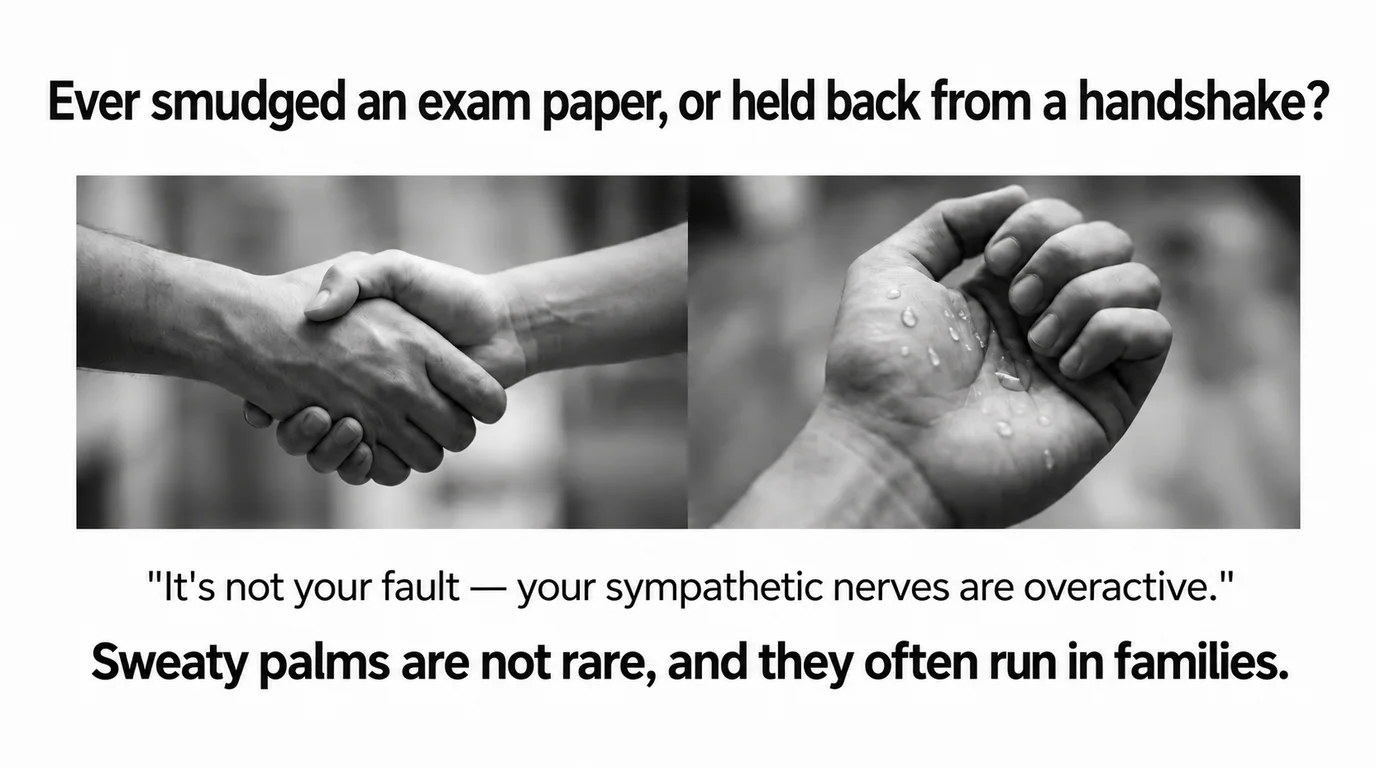
Do your exam papers always end up wrinkled from sweat? Do your fingers slip on piano keys while practicing? Do you hesitate to shake hands at important social occasions because of your cold, wet palms?
If you relate to these situations, remember: It's not because you're too nervous, and it's not your fault.
Primary Hyperhidrosis affects approximately 5% of Taiwan's population, and when including hereditary factors, the rate rises to 13%. This is a physiological condition caused by "overactive" sympathetic nerves. In the past, many patients chose surgery to stop sweating, only to experience more troublesome side effects. The good news is that with medical advances, we now have options that don't require surgery.
This article takes a physician's perspective on three commonly used non-surgical options for sweaty palms, including where each one actually stands with regulators.
Why Are More People Choosing "Non-Surgical" Options? Understanding Compensatory Sweating
Before introducing new technologies, we must discuss the dilemma of traditional surgery (Endoscopic Thoracic Sympathectomy, ETS).
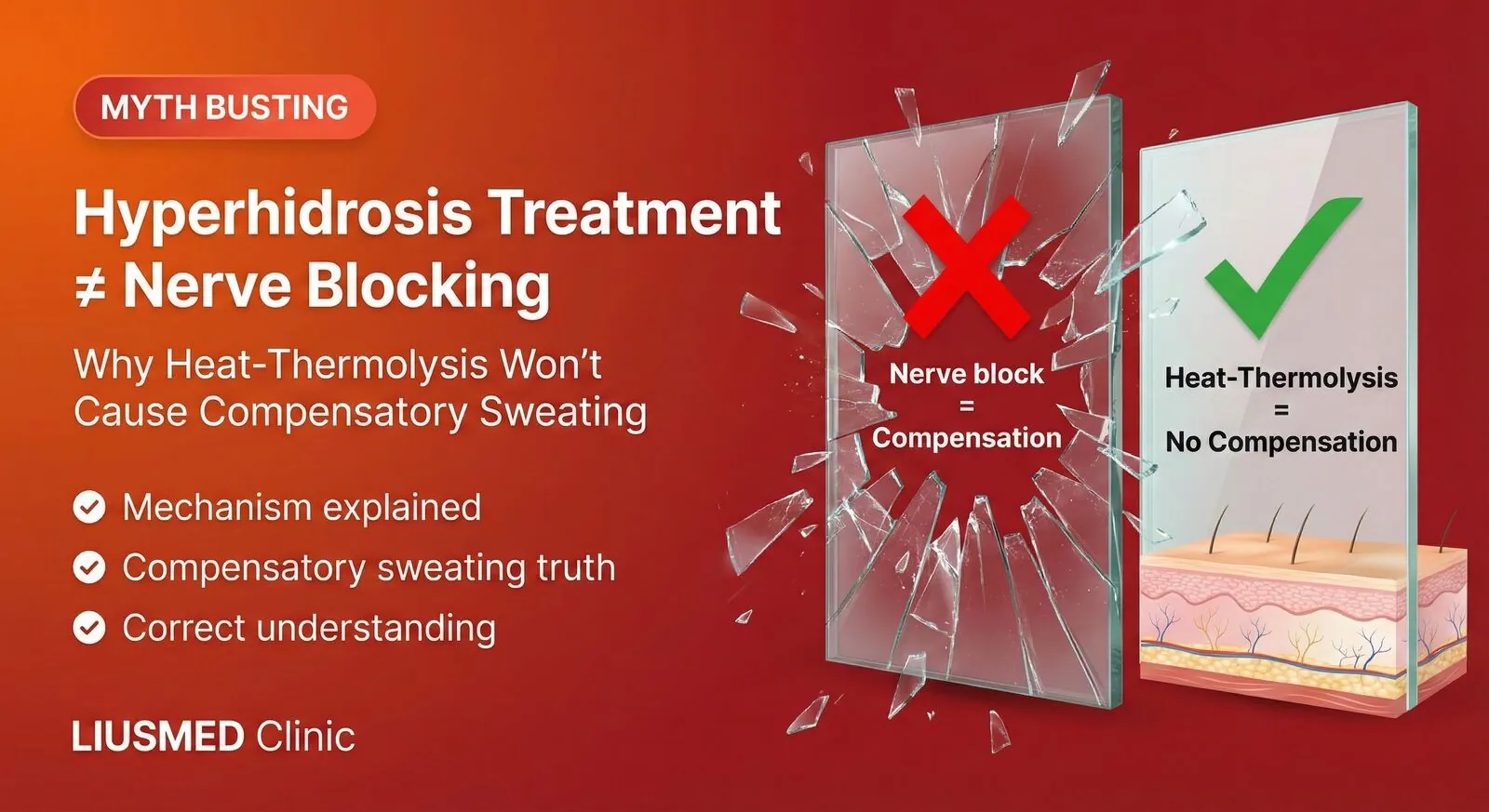
While surgery can provide long-lasting reduction of palm sweating, the greatest risk is "Compensatory Sweating". Simply put, your body's total sweat volume remains the same. When the palm's outlet is blocked, sweat may transfer to the back, chest, or soles of the feet, sometimes causing even more profuse sweating. This "irreversible" side effect has led many patients to experience decreased quality of life after surgery.
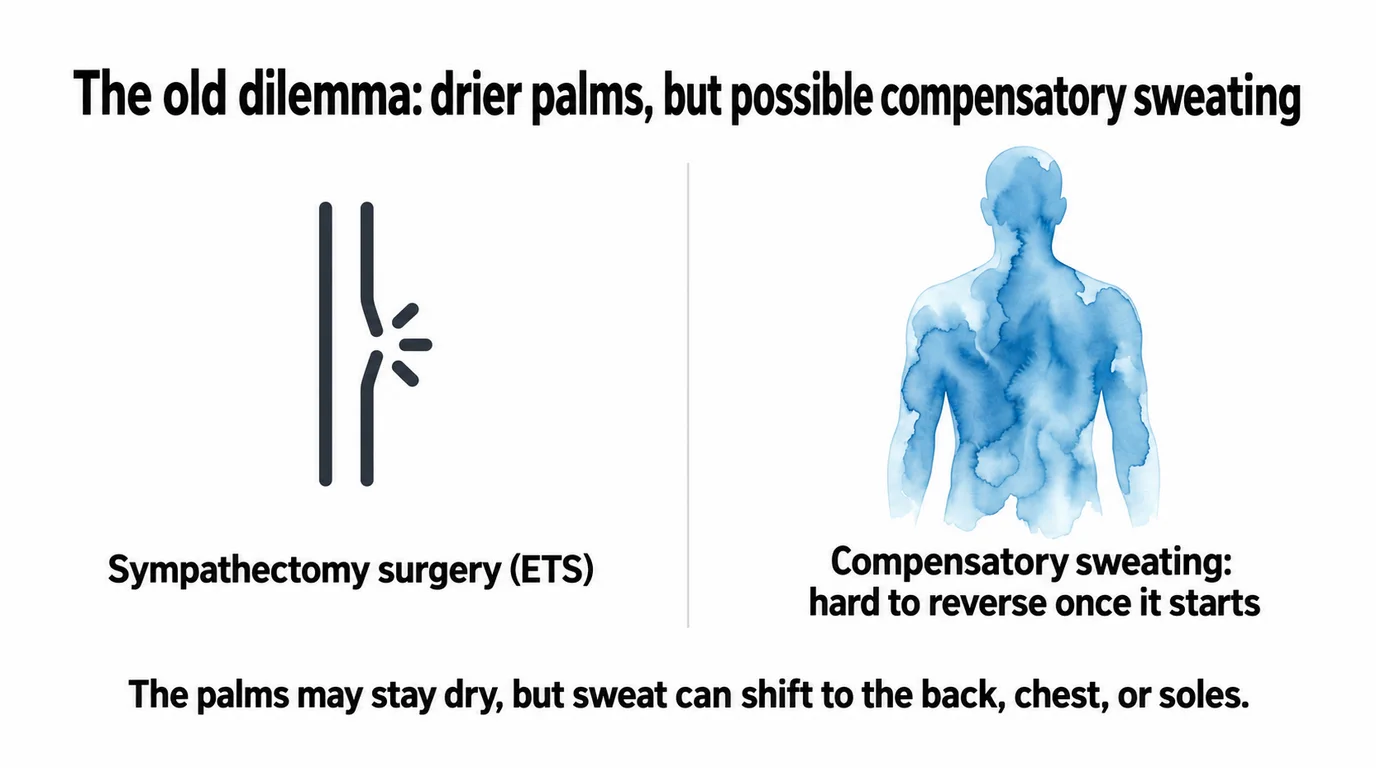
Therefore, treatment guidelines have shifted from "destructive cutting" to "functional suppression" in recent years.

2025 Top Three Trends in Hyperhidrosis Treatment: Safe, Gentle, Non-Surgical
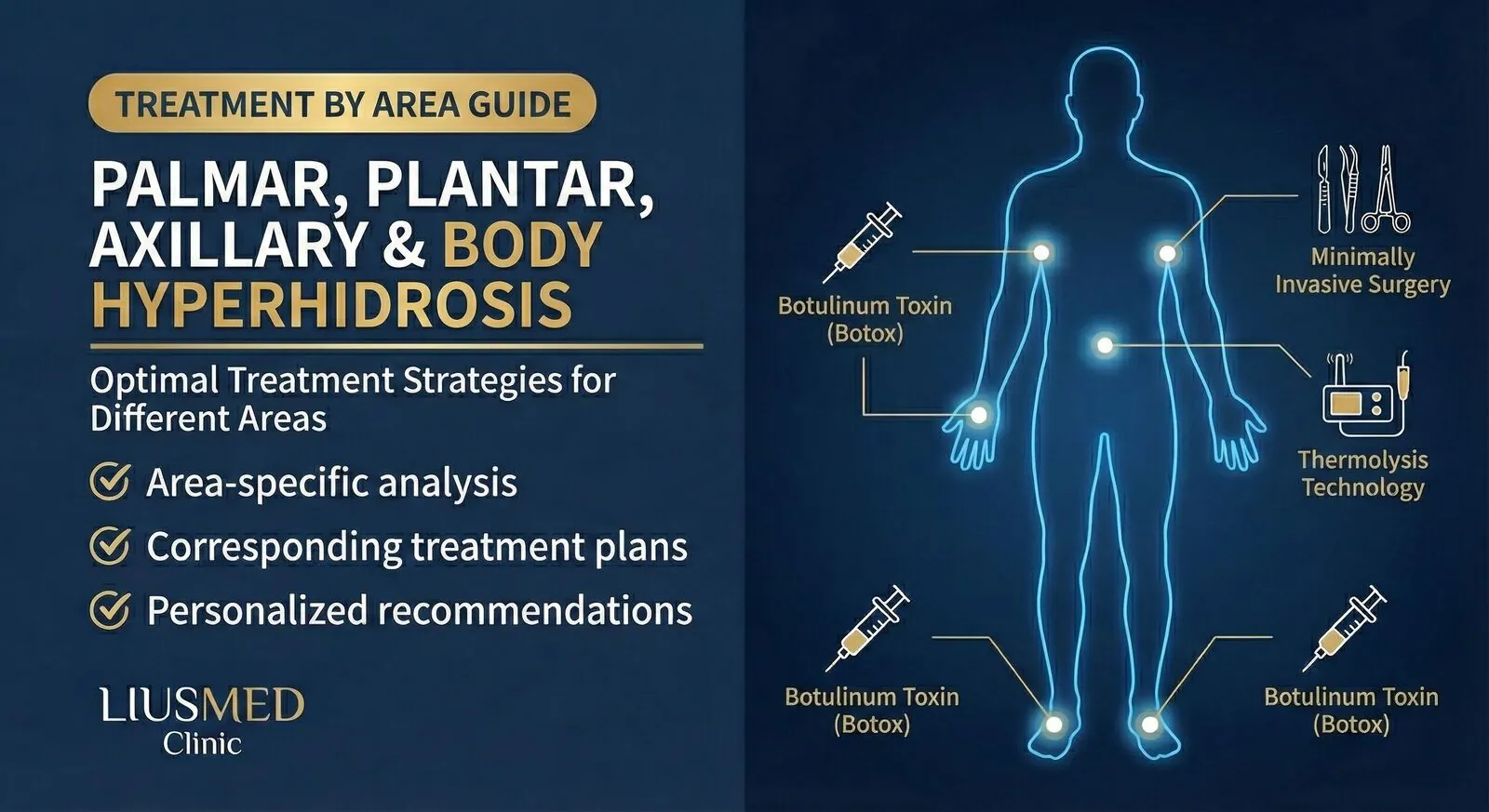
For patients with mild, moderate, or severe hyperhidrosis, three non-surgical therapies are in common clinical use and have a reasonable evidence base:
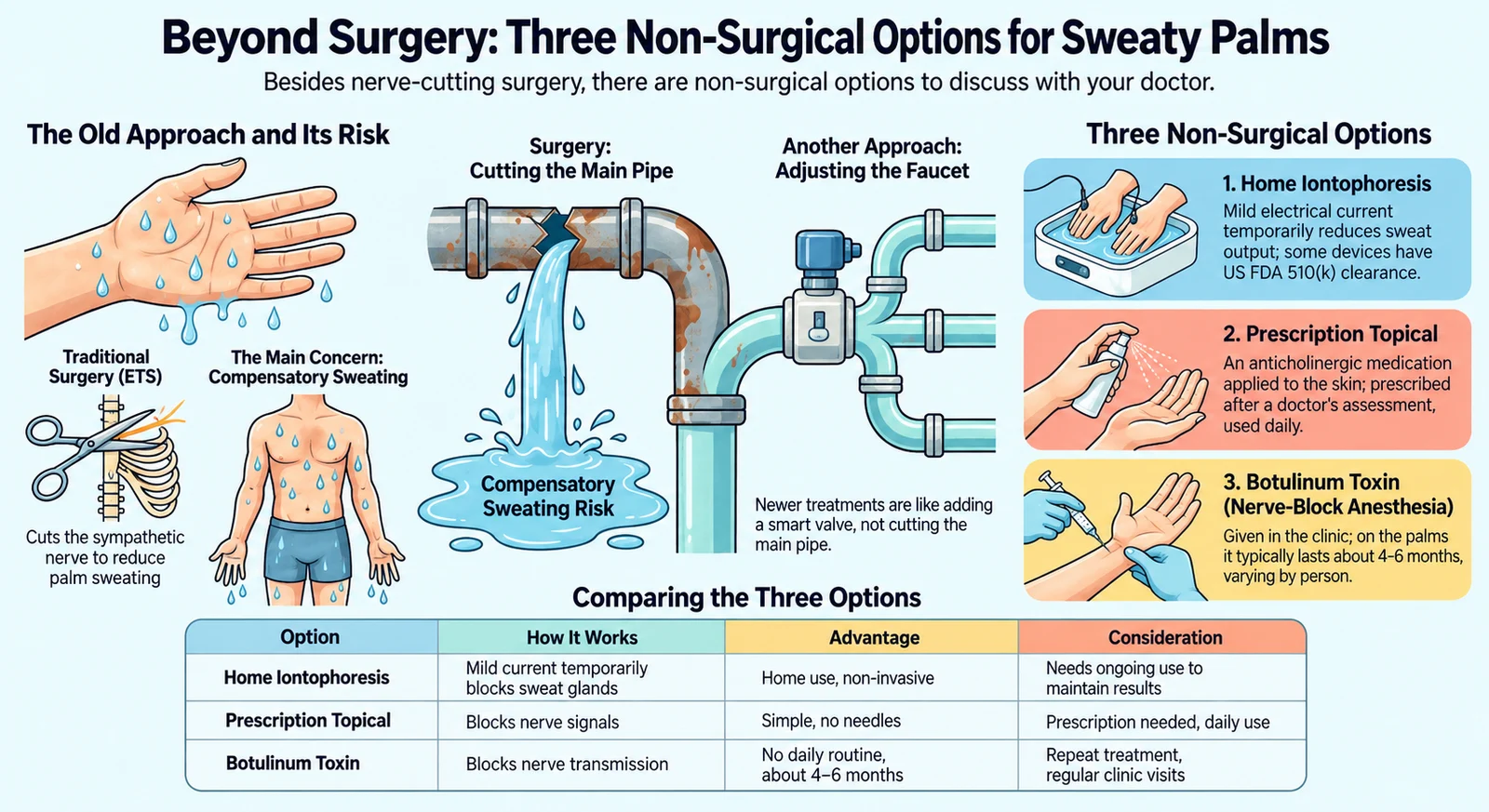
1. Home Technology: Smart Iontophoresis Devices
Iontophoresis devices designed for home use are now available, and some models have received US FDA 510(k) clearance. A 510(k) clearance means the FDA found the device substantially equivalent to one already legally on the market; it is a different pathway from the "approval" given to new drugs. Ask your doctor to help you check the model and the areas it is intended for.
Treatment Principle: Uses "pulsed electrical iontophoresis" technology. Through a mild electrical current, it temporarily blocks sweat gland secretion channels, preventing sweat from being released.
What Home Devices Offer:
- Home Convenience: Designed for home use, so patients can operate it themselves after purchase (while watching TV or reading), saving frequent clinic visits.
- Safety Design: Most models are battery-operated (no power cord), with current limiters and safety circuits that lower the risk of skin irritation or burns (follow the instructions for use).
- Applicability: Age range and treatment areas depend on each model's labeling; many can be used for both palm and foot sweating.
Doctor's Note: Ideal for students or office workers who don't want medication or injections and prefer to control their treatment schedule.
2. Topical Solution: New Prescription Medications (Qbrexza)
For patients who don't want to use devices, new prescription topical medications offer another option. Dermatologists commonly prescribe products like "Qbrexza".
Treatment Principle: The main ingredient is anticholinergic medication. After penetrating the skin, it acts at the nerve-sweat gland junction, blocking neurotransmitters (acetylcholine) so sweat glands "don't receive the secretion signal."
Usage: Very simple - just apply the medicated cloth or solution to your palms before bed (about 5 strokes), let it dry, sleep, and wash it off the next morning.
Important Notes:
- This is a prescription medication - cannot be purchased online without a prescription. Requires doctor evaluation to rule out contraindications like glaucoma.
- Requires daily or every-other-day continued use; sweating will gradually return after stopping medication.
- In the US, Qbrexza's FDA-approved indication is primary underarm (axillary) hyperhidrosis; using it on the palms is off-label, so your doctor needs to judge whether it suits you.
3. Enhanced Comfort: Botox Injections Under Nerve-Block Anesthesia
Botox treatment for palm sweating has been around for years with significant results (on the palms, typically about 4–6 months, varying from person to person), but the biggest drawback was "extreme pain." Palms have dense nerve distribution, and traditional injections often left patients trembling in pain.
How the anesthesia works: Sensation in the palm comes mainly from three nerves: the median nerve, the ulnar nerve, and the superficial branch of the radial nerve. Before the injections, these three nerves are blocked near the wrist (nerve block), combined with gentle pain-relief anesthesia (not general anesthesia), which considerably reduces the discomfort of the injections. You stay awake and can talk with the doctor throughout.
Want the details on anesthesia and injection for palm Botox? How the nerve block is done, the injection steps, and aftercare are explained in full on the Minimal Cut Surgery page → Visit the surgical page to learn about palm Botox
Advantages: Works fairly quickly (most people notice clearly drier palms within about a week); on the palms one treatment typically lasts about 4–6 months, varying from person to person; no daily medication or device routine needed.
Doctor's Note: Ideal for patients with sufficient budget who seek high efficiency, or need noticeably drier hands for specific important occasions (weddings, concerts).
Comparison Chart: Which Treatment Is Right for Me?
To help you make a clearer choice, we've prepared the following comparison table:
| Treatment | Mechanism | Advantages | Drawbacks/Considerations | Suitable For |
|---|---|---|---|---|
| Home Iontophoresis | Electrical pulse blocking | Home use, non-invasive, needle-free, some models FDA 510(k)-cleared, no nerve cutting involved | Initially requires frequent use, device purchase needed | Students, busy professionals, long-term maintenance |
| Topical Medication (Qbrexza) | Anticholinergic drugs | Simple to use, no injections, portable | Prescription required, daily use needed, possible dry mouth side effects | Those afraid of pain or devices |
| Botox Injection (Nerve-Block Anesthesia) | Nerve signal blocking | Works fairly quickly, no daily routine, about 4–6 months on the palms (varies) | Higher cost, consumable treatment, requires professional anesthesia techniques | Those seeking quick results with sufficient budget |
| Traditional Surgery (ETS) | Sympathetic nerve severing | Long-Lasting sweat stopping | High risk of compensatory sweating (to back/feet), irreversible | Severe cases where non-surgical methods failed |
Doctor's Analogy
If you're still hesitating, think of hyperhidrosis as a "faucet that won't close properly":
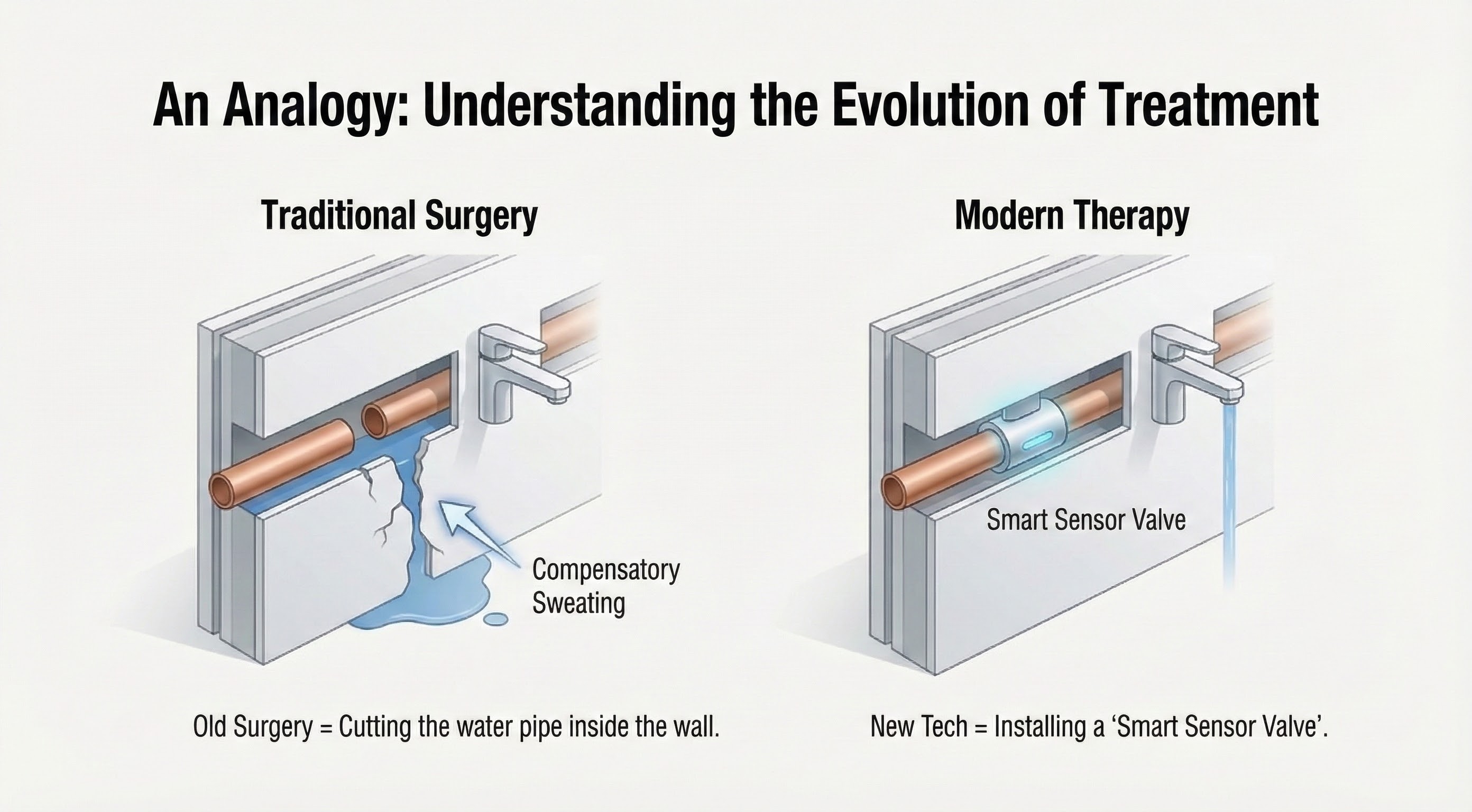
Traditional Surgery (ETS)
It's like directly cutting the pipe buried in the wall. Water no longer flows from the faucet, but with nowhere for the water pressure to release, it may seep through other cracks in the wall (back, soles), causing new water damage (compensatory sweating).
New Technology (Iontophoresis/Topical/Botox)
It's like installing a "smart sensor valve" or "temporary plug" on the faucet. We precisely control water output without destroying the internal pipe structure. Although regular maintenance is needed (continued treatment), the body's original plumbing remains intact - a safer choice that better aligns with modern medical ethics.
Frequently Asked Questions
Will sweaty palms go away on their own, and do they need treatment?
Primary palmar hyperhidrosis is a constitution of overactive sympathetic nerves, and it usually doesn't subside on its own. Whether to treat it depends on how much it disrupts your daily life and social interactions, not on how severe the condition looks.
Does sweaty palms always require surgery?
Not necessarily. ETS sympathetic-nerve surgery carries irreversible risks such as compensatory sweating, and for many people it is often not the best choice. You can first consider non-surgical options such as iontophoresis, topical medication, or Botox.
How long does Botox for sweaty palms last, and is the injection very painful?
On the palms the effect typically lasts about 4–6 months, varying from person to person; it then wears off and needs periodic re-injection, so it's a consumable treatment. Before injecting, the median nerve, ulnar nerve, and superficial branch of the radial nerve are blocked, combined with gentle pain-relief anesthesia (not general anesthesia), which considerably reduces discomfort during the injections; how it feels still varies from person to person.
How long does iontophoresis take to work, and how often is it done?
It needs fairly frequent use at first, and once it takes effect you switch to maintenance sessions at longer intervals — more like long-term regulation than a one-time course. The actual frequency is adjusted by the doctor according to how much you sweat.
Which specialty should I see for sweaty palms, and can teenagers or children be treated?
You can start with a dermatology evaluation. Some treatments, such as iontophoresis, are also suitable for adolescents; for younger children, the doctor needs to assess each case individually before deciding on the method and timing.
Do topical antiperspirant medications have side effects, and will sweating return if I stop?
Topical anticholinergic medications are prescription-only and can cause side effects such as dry mouth; they aren't suitable for patients with glaucoma. After stopping, sweating gradually returns, so continued use is needed to maintain the effect.
Related Reading
- Iontophoresis for Sweaty Palms: Devices, Frequency, Results
- Why Palms Sweat: Primary vs Secondary & a Severity Check
- Hyperhidrosis vs Compensatory Sweating: Before ETS Surgery
- Palmar Hyperhidrosis
- Hyperhidrosis & Compensatory Sweating
Conclusion: Reclaim Your Dry, Confident Hands Starting with Evaluation
While hyperhidrosis isn't a critical illness, its impact on psychology and social interactions shouldn't be underestimated. With home iontophoresis and new topical medications becoming more widely available, most people no longer have to start with a painful choice between "wet hands" and "compensatory sweating."
We recommend seeking professional dermatologist assistance to develop a customized combination treatment plan based on your sweating severity (mild, moderate, severe) and lifestyle.
Say goodbye to sweaty hands - you deserve a more comfortable life!
Related Reading
- Iontophoresis for Sweaty Palms: Devices, Frequency, Results
- Why Palms Sweat: Primary vs Secondary & a Severity Check
- Hyperhidrosis vs Compensatory Sweating: Before ETS Surgery
- Palmar Hyperhidrosis
- Hyperhidrosis & Compensatory Sweating
Clear Odor Specialist Perspective
Non-surgical treatment of palmar hyperhidrosis is often oversimplified at general clinics as either "get Botox" or "do ETS". But there is a full ladder of options between those two extremes — iontophoresis, oral anticholinergics, sweat-gland thermolysis, lifestyle-context adjustments. As a clinic dedicated to hyperhidrosis, Clear Odor ranks these for each patient by efficacy, durability, side-effect profile, and lifestyle compatibility.
The compensatory-sweating risk of ETS (endoscopic thoracic sympathectomy) is one of the topics we spend the most consultation time on. At Clear Odor we treat the judgment of "you should NOT have this surgery" as equally important as "this is the right surgery for you" — and that is an essential protection a specialist clinic provides.
Full Treatment Information → · Book a Specialist Consultation →
Related Reading
- Iontophoresis for Sweaty Palms: Devices, Frequency, Results
- Why Palms Sweat: Primary vs Secondary & a Severity Check
- Hyperhidrosis vs Compensatory Sweating: Before ETS Surgery
- Palmar Hyperhidrosis
- Hyperhidrosis & Compensatory Sweating
Disclaimer: This article is for informational purposes only. Medical treatments vary by individual. Please consult a professional physician for specific treatment plans.