Why Iontophoresis Is the First-Line Non-Surgical Treatment
The first question almost every patient with sweaty palms asks is: "Without surgery, is there actually a way to stop the sweat?"
The answer is yes — and iontophoresis is currently the non-surgical option with the strongest evidence behind it. Its place on the treatment ladder is clear: when topical antiperspirants (aluminium chloride preparations) are not enough, but you are not yet ready to consider Hyperhidrosis vs Compensatory Sweating: Before ETS Surgery, iontophoresis is the middle step most worth trying first.
Its appeal comes down to three things: no incision, no general anaesthesia, and no compensatory sweating. For patients who fear surgery, or who are still deciding, iontophoresis offers a low-risk starting point.
Key point: Iontophoresis is not "a weaker substitute for surgery." It is a distinct, legitimate stage on the treatment ladder that works for most palm-type patients. Working through conservative treatment first is simply the standard order for managing hyperhidrosis.
How Iontophoresis Works: How Electrified Water Stops the Hand From Sweating
Many patients hesitate the moment they hear "electrical current," but the principle is quite gentle.
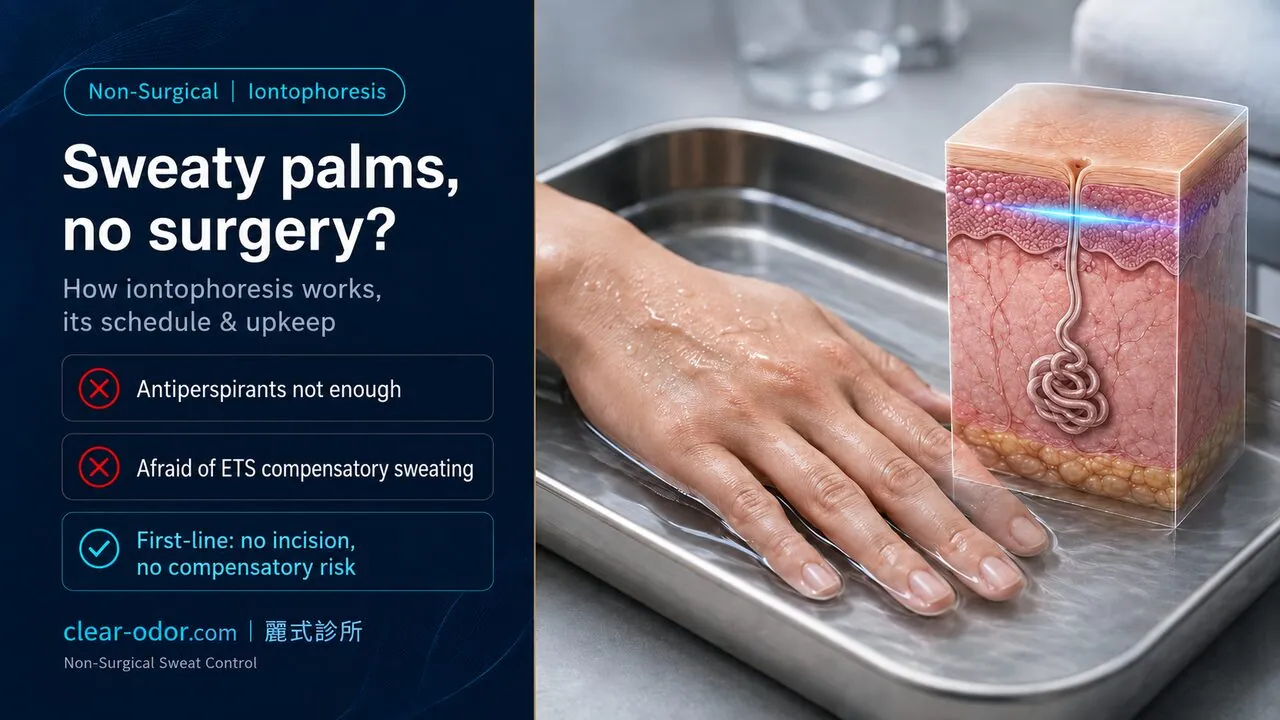
In iontophoresis, the palms (or soles) are placed flat in a tray of ordinary tap water, and the device passes a low-intensity direct current through it (clinically often around 15–20 milliamps). As the current travels through the water and skin, it acts on the outlet of the sweat glands — specifically the ducts of the eccrine sweat glands.
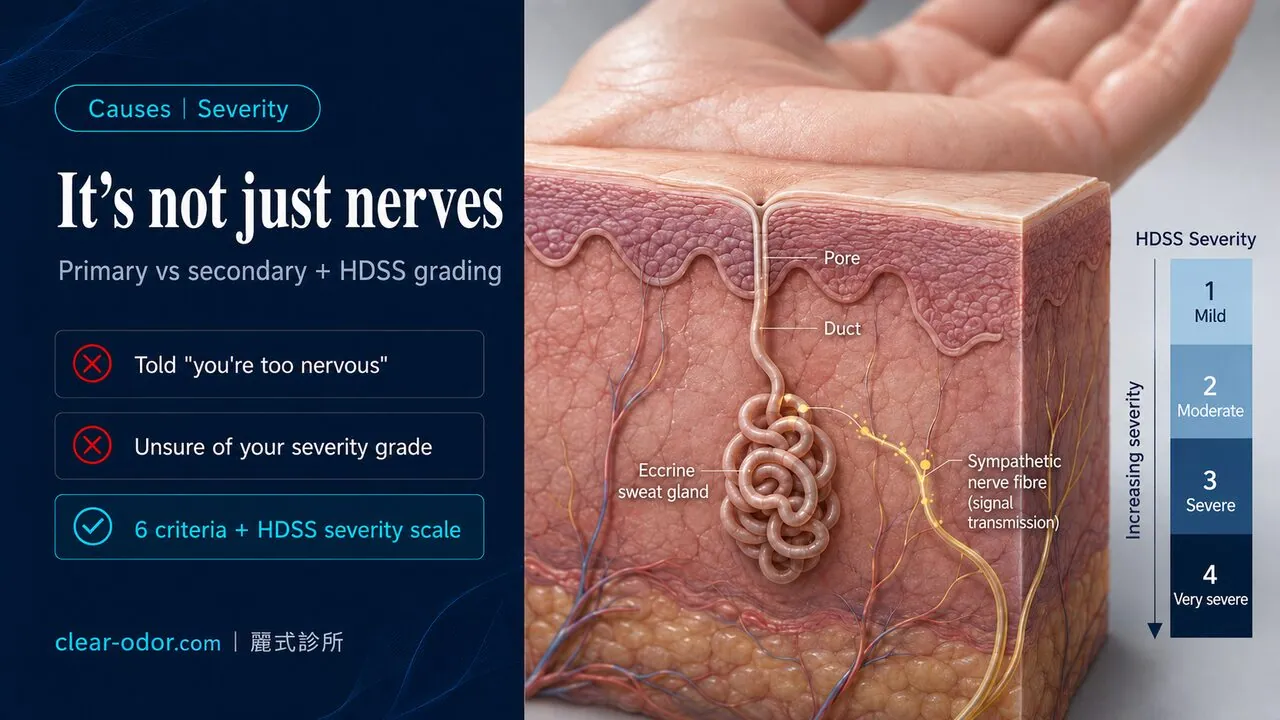
One common misconception needs clearing up: palm sweat comes from eccrine glands, not the apocrine glands that cause body odor. This is exactly why the logic of treating sweaty palms is completely different from underarm bromhidrosis surgery — the former addresses sweat volume, the latter addresses the odor-producing glands.
The exact mechanism of iontophoresis is not yet fully settled in the medical literature. The leading explanation is that the current produces a temporary functional block or microscopic keratin plugging at the most superficial outlet of the sweat duct, so sweat cannot escape for a period of time. Because this is a functional rather than a destructive change, the effect fades over time and requires regular maintenance — more on that below.
Clinic Devices vs Home Iontophoresis Machines: How to Choose
Iontophoresis can be done in a clinic or with a home device. Both use the same principle; the differences lie in current parameters, flexibility and cost. What people search for as an “iontophoresis machine” or a “sweaty hands machine” is usually this kind of home iontophoresis device.
| Comparison | Clinic device | Home iontophoresis machine |
|---|---|---|
| Current strength | Higher, adjustable by medical staff | Limited by safety regulations, usually gentler |
| Loading-phase efficiency | Reaches dryness faster | Slower, needs more frequent use |
| Per-session cost | Per-treatment fee | One-time purchase, amortised over time |
| Flexibility | Tied to clinic hours | Used at home around your own schedule |
| Professional supervision | Staff adjust parameters, manage skin reactions | You judge your own skin response |
| Best for | Those wanting fast results and a professional assessment | Confirmed patients willing to self-maintain long-term |
A common practical combination is to complete the loading phase in the clinic, confirm that your body responds, then switch to a home device for maintenance. This gives you fast entry into dryness while keeping long-term cost and convenience under control.
Key point: Before buying a home device, have a doctor assess you first and complete one round of clinic loading. Confirming that "your sweat responds to iontophoresis" before investing in a machine means you won't buy equipment only to discover you belong to the small group of poor responders.
Treatment Frequency: Loading Phase and Maintenance Phase
Iontophoresis treatment has two phases. Understanding both keeps your expectations accurate.
Loading phase (getting the hands dry)
- Frequency: more intensive at first — clinically often 2–3 times per week, with some protocols more frequent
- Session length: about 20–30 minutes each (palms and soles can be done separately)
- Sessions needed: most patients notice clear dryness after about 6–10 sessions, roughly 2–4 weeks after starting
Maintenance phase (keeping the dryness)
Once a satisfactory level of dryness is reached, you enter the maintenance phase. Because iontophoresis is a functional, reversible change, once you stop entirely, the sweating usually returns gradually over days to weeks. Maintenance frequency varies by person — commonly once every 1–3 weeks, adjusted to how quickly your sweat rebounds.
This is the point about iontophoresis that must be stated honestly: it is a treatment that requires ongoing upkeep, not a one-time cure. Whether you benefit long-term depends on whether you are willing to make it a habit, as routine as brushing your teeth.
How Effective Is It, and How Long Do Results Last?
Based on clinical experience and the literature, iontophoresis has a high success rate for primary palmar and plantar hyperhidrosis — most patients who complete the loading phase regularly reach a level of dryness acceptable for daily life. However, there are three limits that must be stated honestly:
- Individual variation is large. A minority of patients respond poorly; this relates to how the sweat glands respond to current, and cannot be predicted with full certainty in advance.
- The effect is not permanent. It rebounds once you stop; the maintenance phase cannot be skipped.
- It works less well for the underarms. Iontophoresis suits palms and soles, which can be submerged; Sweating by Area: Palms, Underarms & Feet Treatment, being hard to immerse, usually needs a different approach.
If you are not yet sure how severe your sweating is or whether you need treatment, you can first take the Hyperhidrosis Severity Self-Check: 5 Quick Questions, then decide whether to manage it through lifestyle measures or seek a clinic assessment for iontophoresis.
Who Is Suitable — and Who Should Not Do It (Contraindications)
Suitable candidates:
- Primary palmar/plantar hyperhidrosis with insufficient response to topical antiperspirants
- Patients who want to try a non-surgical, non-drug approach first
- Patients willing to follow the loading phase and long-term maintenance
Contraindications or situations needing special assessment:
| Situation | Reason |
|---|---|
| Cardiac pacemaker or implanted electronic device | Current may interfere with the device |
| Metal implant in the treatment area | Current distribution may be abnormal |
| Pregnancy | Limited safety data; best avoided |
| History of epilepsy or seizures | Requires individual assessment by a doctor |
| Open wounds or severe dermatitis in the treatment area | Current concentrates and may cause irritation or burns |
Key point: "Do not do iontophoresis if you have a cardiac pacemaker" is the single most important contraindication and must never be overlooked. Before buying a home device, be sure you and your family members have none of the situations above, and confirm with a doctor.
A further reminder: sweaty hands can also be a sign of secondary hyperhidrosis (for example, thyroid or endocrine problems). If your sweating appeared only recently, or comes with generalised or night-time sweating, identify the cause first rather than jumping straight to iontophoresis. Distinguishing the cause is covered in detail in the next article.
Side Effects and Discomfort of Iontophoresis
Iontophoresis is overall very safe, and side effects are mostly mild and reversible:
- Dry, flaking skin: the most common — apply moisturiser diligently after treatment
- Localised redness, mild itching: usually settles within a few hours
- Small blisters: occasionally seen with stronger current or more sensitive skin; resolved by adjusting parameters
- Tingling during current flow: a normal sensation; those uneasy with the feeling of electricity need a short adjustment period
Serious burns are rare and usually relate to poor technique (for example, an unnoticed wound on the hand, or turning a home device's current too high yourself). This is exactly why the first round of treatment is best done under professional supervision — medical staff can adjust the parameters in real time according to your skin response.
When Iontophoresis Doesn't Work Well, What Are the Options
If results are still unsatisfactory after a regular loading phase, it does not mean hyperhidrosis is unsolvable — it simply means moving to the next rung of the treatment ladder:
- Adding an anticholinergic medication to the water: for those who respond poorly to plain tap water, a doctor may assess adding a low concentration of anticholinergic medication to enhance the effect
- Botulinum toxin injection: injecting botulinum toxin into the palms can temporarily block the nerve signals to the sweat glands, with effects lasting several months
- Newer topical prescription drugs: recent topical anticholinergic creams offer another non-invasive option
A full comparison of these options is covered in the Sweaty Palms: 3 FDA-Approved Non-Surgical Treatments. ETS sympathectomy surgery is usually kept as the last consideration, because it carries an irreversible risk of compensatory sweating — be sure to read Hyperhidrosis vs Compensatory Sweating: Before ETS Surgery before deciding.
Frequently Asked Questions
Q1: Does iontophoresis hurt?
It does not hurt, but you will feel a mild tingling in the palms while the current flows. Most people get used to it after a few sessions. If it feels clearly uncomfortable, ask the medical staff to lower the current.
Q2: How many sessions until it works?
Most patients begin to feel clear dryness after about 6–10 sessions, roughly 2–4 weeks after starting. But this is only the result of the "loading phase" — maintenance is still needed afterwards.
Q3: Can I just buy a home device and do it myself?
You can, but it is best to have a doctor assess you first and complete one round of clinic loading — confirming that your sweat responds to iontophoresis and that you have no contraindications — before switching to a home device for long-term maintenance.
Q4: Will the sweat come straight back after I stop?
Not "straight back," but it will gradually rebound, usually over days to weeks. This is exactly why the maintenance phase cannot be skipped.
Q5: Will iontophoresis cause compensatory sweating like ETS surgery?
No. Compensatory sweating is a side effect of ETS cutting the sympathetic nerve. Iontophoresis acts only on the superficial outlet of the sweat duct, not on the nerve, so there is no compensatory sweating issue.
Q6: Can children do iontophoresis?
Yes, but a doctor must assess age, cooperation and skin condition. For children and adolescents, sweating should be managed in person by a doctor according to the individual's developmental stage.
Related Reading
- Sweaty Palms Without Surgery: Iontophoresis, Topicals, or Botox?
- Sweating by Area: Palms, Underarms & Feet Treatment
- Why Palms Sweat: Primary vs Secondary & a Severity Check
- Palmar Hyperhidrosis
- Hyperhidrosis & Compensatory Sweating
Conclusion
Iontophoresis is the stage most worth seriously trying for sweaty-palm patients after antiperspirants and before surgery. Its advantages are no incision, no general anaesthesia, and no risk of compensatory sweating; its trade-off is that it requires ongoing maintenance — this is its nature, not a flaw, and the key is setting expectations correctly.
The best practical path is: have a doctor assess you to rule out contraindications and secondary causes → complete the loading phase in the clinic to confirm a response → switch to a home device for long-term maintenance → move to the next rung of the treatment ladder if the effect is insufficient.
Dr. Ta-Ju Liu has 20 years of experience in odor and sweat treatment and offers complete assessment and iontophoresis planning for palmar hyperhidrosis. If sweaty palms are affecting you and you want to know whether iontophoresis suits you, you are welcome to book a consultation for an in-person assessment of your sweat severity and the most appropriate treatment stage. For the full range of options, see the palmar hyperhidrosis specialist service.
Related Reading
- Sweaty Palms Without Surgery: Iontophoresis, Topicals, or Botox?
- Sweating by Area: Palms, Underarms & Feet Treatment
- Why Palms Sweat: Primary vs Secondary & a Severity Check
- Palmar Hyperhidrosis
- Hyperhidrosis & Compensatory Sweating
This article is for health education. Individual results may vary. The suitability, treatment frequency and contraindications of iontophoresis must be confirmed after an in-person assessment by Dr. Ta-Ju Liu.