Why compare bromhidrosis surgery and MiraDry at all
Patients often ask: "Doctor, now that there's a non-invasive option like MiraDry, why would anyone still have surgery?" Behind that question is a common misconception — that the two are "a basic version and a premium version of the same thing."
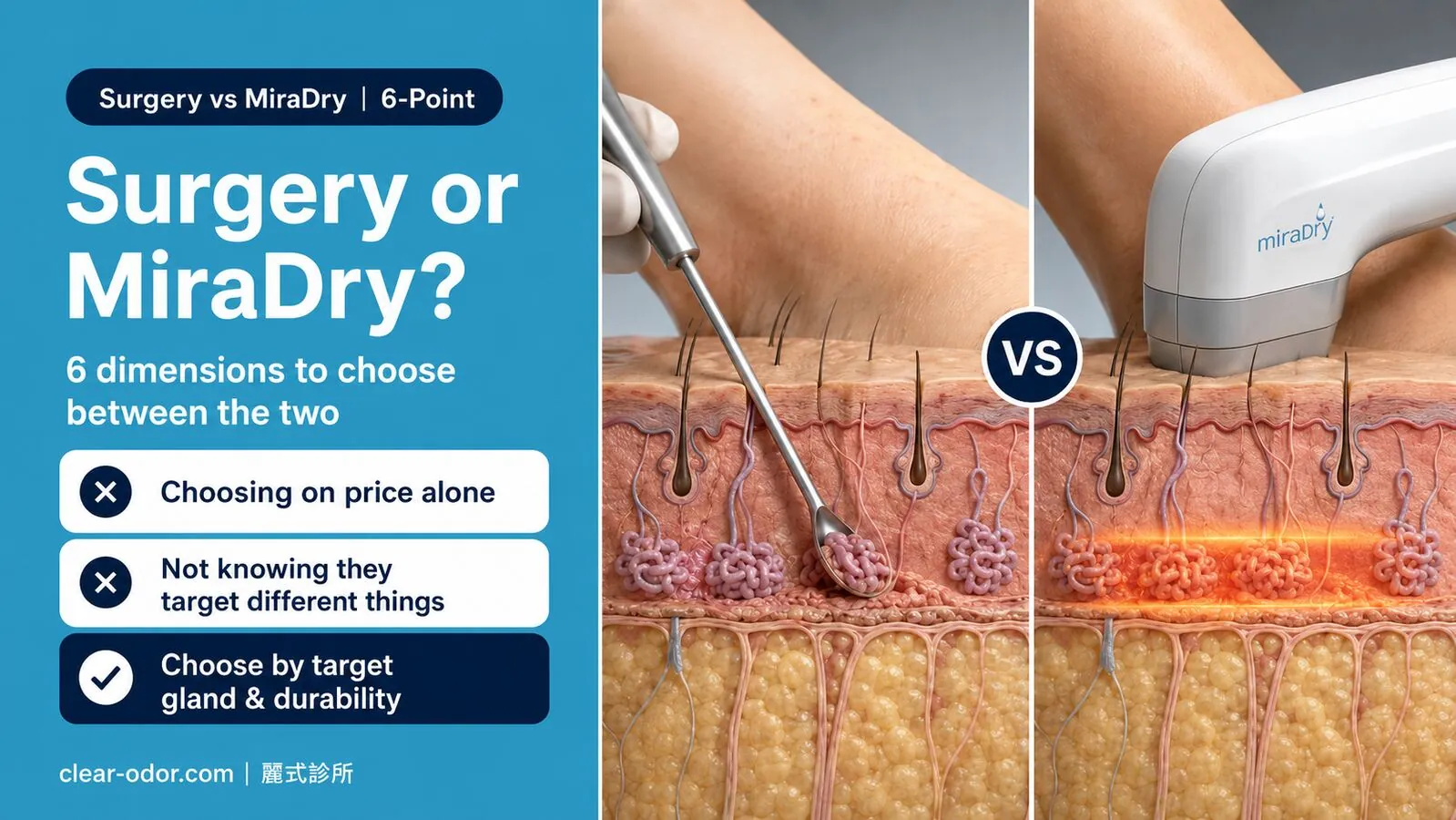
In reality, minimally invasive rotational curettage and MiraDry are two completely different treatment routes: one is invasive clearance under direct vision, the other is non-invasive microwave thermal energy. Understanding the difference is how you tell which one fits your concern. This article compares them across 6 dimensions on a factual basis — it won't decide for you, but it will make the trade-offs clear.
See the 6 dimensions at a glance
| Dimension | Rotational curettage surgery | MiraDry microwave |
|---|---|---|
| Mechanism | 4mm incision, mechanical removal of apocrine glands under direct vision (invasive) | Surface microwave heating that disables sweat glands (non-invasive, no incision) |
| Main target | Apocrine glands + sweat glands + hair follicles (three effects in one) | Mainly sweat glands; odor improvement limited by heat-penetration depth |
| Result orientation | One procedure, oriented toward a stable long-term result | Usually 1–2 sessions |
| Recovery | 7 days of compression dressing, no strenuous exercise for 2 weeks | No wound; underarm swelling and firmness for several weeks |
| Scarring | A roughly 4mm small scar | No incision, no scar |
| Cost & sessions | Higher per procedure, most complete in one | Lower per session, but may need 2 sessions |
Each dimension is unpacked below.
Dimension 1: Mechanism — invasive direct-vision clearance vs non-invasive microwave
The core of rotational curettage surgery is "clearance under direct vision." Through a roughly 4mm incision, the doctor directly sees the deep dermis–subcutaneous junction where the apocrine glands sit, then removes them region by region with a rotating curette head. The whole process is eyes watching, hand controlling, so the degree of clearance can be confirmed in real time.
The core of MiraDry is "surface microwave thermal energy." The device sits against the skin surface of the underarm and delivers microwave energy that heats the dermis–subcutaneous-fat junction, disabling sweat-gland structures, while surface cooling reduces discomfort in the top layer. Its biggest advantage is that the skin is never cut.
Key point: Neither is "right or wrong." The difference is whether clearance is confirmed under direct vision. MiraDry's heat field is set by parameters and operator experience, working from the surface; rotational curettage opens the area up and clears while watching.
Dimension 2: Target tissue — clearing "odor, sweat, hair" in one vs "mainly sweat"
This is the most easily overlooked yet most important difference.
The odor of bromhidrosis comes from the apocrine glands; ordinary "sweat dampness" comes mainly from the eccrine glands (the glands behind everyday sweating).
- Rotational curettage surgery removes the apocrine glands directly and clears the adjacent sweat glands and hair follicles at the same time, so it can improve odor, excessive sweating, and underarm hair together — the so-called "three effects in one."
- MiraDry's microwave heat acts on the eccrine glands (sweating) fairly directly, with a clear effect; it also acts on the deeper apocrine glands (odor), but its thoroughness is limited by heat-penetration depth — deeper or more widely distributed apocrine glands may not all be cleared in one go.
Key point: If your main complaint is "too much sweat," MiraDry addresses sweating directly; if it is "strong odor," the odor source sits in the deeper apocrine glands, where direct-vision clearance is more controllable. If you're unsure whether your problem is sweat or odor, first read Hyperhidrosis vs Compensatory Sweating: Before ETS Surgery.
Dimension 3: Result orientation — done in one vs multiple sessions
Rotational curettage surgery completes apocrine-gland clearance in a single procedure in most cases. Because it is performed under direct vision, the doctor can check for remnants while clearing; in-clinic follow-up over more than 15 years reports no recurrence (per clinic records; individual results may vary).
Because MiraDry is non-invasive and the energy per session has an upper limit, 1–2 sessions are routinely advised to bring sweat volume down to a satisfactory range; where odor improvement is the goal, some cases may need additional treatment. The manufacturer states that sweat glands do not regenerate once thermally destroyed, so durability for "sweating" is reasonable; but for "odor," if apocrine glands remain, the smell may partly return.
Dimension 4: Recovery and impact on daily life
| Item | Rotational curettage surgery | MiraDry |
|---|---|---|
| Wound | 4mm incision, sutured or taped closed | No wound |
| Compression dressing | About 7 days | Not needed |
| Swelling / firmness | Bruising 7–14 days; firmness several weeks to 1–2 months | Swelling and firmness for several weeks |
| Temporary numbness | At the site, resolves within weeks | Short-term numbness in some people |
| Return to office work | Most people in 1–2 days | Usually the next day |
| Strenuous exercise | Resumed gradually after 2 weeks | After a few days |
Overall, MiraDry is faster for "getting back to daily life" because there is no incision; but both involve a few weeks of swelling and firmness. If your work or life makes a 7-day compression window hard to arrange, this difference is worth weighing.
Dimension 5: Scarring and appearance
This is MiraDry's strongest selling point: no incision at all, and therefore no surgical scar.
The incision for rotational curettage surgery is about 4mm, usually placed within the natural fold of the armpit; for most people the scar gradually fades over 3–6 months into a fine line close to skin tone. But how a scar turns out depends greatly on individual constitution — a keloid-prone constitution and how well the wound is cared for both affect the final appearance.
If "absolutely no scar in the underarm" is a hard requirement for you, MiraDry has a clear advantage on this point. But note: scarring and "thoroughness of clearance" are trade-offs on two different dimensions — don't decide on the single criterion of scarring.
Dimension 6: Cost and number of sessions
- Rotational curettage surgery: a higher per-procedure cost, reflecting the density of direct-vision manual skill and the operating time; but most cases are complete in one.
- MiraDry: usually a lower per-session cost than surgery, but if 2 sessions are needed, the total cost gap narrows.
Suggestion: When comparing cost, factor in the likely number of sessions and whether a touch-up may be needed later, not just the single sticker price. Actual cost varies with the underarm area, severity, and treatment plan; an in-person consultation gives a personalised quote. For the durability and cost of the three mainstream odor routes (antiperspirants, Botox, surgery), see Underarm Odor: Antiperspirant vs Botox vs Surgery.
How to choose — a reference for who suits what
Neither has a one-size-fits-all advantage; the difference is what matters most to you:
Rotational curettage surgery may suit you if:
- Your main complaint is "strong odor" and you want the apocrine glands cleared thoroughly in one go
- You want to improve odor, sweating, and underarm hair at the same time
- You have a clear family history with widely distributed apocrine glands
- You value a long-term follow-up record of low recurrence
MiraDry may suit you if:
- Your main complaint is "sweating and dampness," with relatively mild odor
- You are wary of surgery and prefer a non-invasive option
- You want absolutely no incision scar in the underarm
- You can accept possibly needing 2 sessions and a later touch-up if required
If what you really want to compare is "two surgical techniques" rather than "surgery vs MiraDry," see Rotational Curettage vs Laser for Odor: Which Lasts Longer?.
Frequently Asked Questions (FAQ)
Will I still need surgery after MiraDry?
Not necessarily. If your main complaint is sweating and MiraDry brings the sweat volume down to a range you're happy with, surgery isn't needed. But if your main complaint is odor and the smell is still noticeable after treatment, apocrine glands may remain, and rotational curettage can then be considered to reinforce clearance. Whether further treatment is needed is for the doctor to judge after examination.
Does MiraDry work for odor, or only for sweating?
MiraDry's effect on sweating (eccrine glands) is fairly direct and clear; it also acts on bromhidrosis (apocrine glands), but its thoroughness is limited by microwave heat-penetration depth — deeper or more widely distributed apocrine glands may not be fully cleared in one go. If odor is your main concern, an in-person assessment of the depth and extent of the apocrine glands is advisable before deciding.
Will the 4mm surgical scar be very obvious?
Any skin incision leaves a scar. The rotational-curettage incision is about 4mm and is usually hidden in the natural fold of the armpit; for most people it fades over 3–6 months into a fine line close to skin tone. How a scar turns out depends greatly on individual constitution (such as a keloid-prone constitution) and wound care; the pre-operative assessment gives care advice tailored to your skin.
I've already had MiraDry — can I still have rotational curettage surgery?
It can be assessed. If apocrine-gland activity remains after MiraDry, rotational curettage is a common route to reinforce clearance. However, the earlier thermal effect can make tissue planes less distinct, which increases the difficulty of the procedure; the doctor needs to examine the skin and tissue in person to judge suitability and the expected degree of clearance.
How do I know which one suits me better?
The key is to first sort out whether your main complaint is "odor" or "sweat volume," and how much you can accept regarding an incision scar, days of recovery, and the number of sessions. At the consultation the doctor will assess apocrine-gland distribution by palpation, ask about family history and lifestyle needs, and then help you decide. You can book a consultation for a personal assessment by Dr. Ta-Ju Liu.
Related Reading
- Sweat Gland Surgery: Curettage vs Laser vs miraDry vs ETS
- Rotational Curettage vs Laser for Odor: Which Lasts Longer?
- Underarm Odor: Antiperspirant vs Botox vs Surgery
- Hyperhidrosis vs Compensatory Sweating: Before ETS Surgery
- Axillary Bromhidrosis
- Hyperhidrosis & Compensatory Sweating
Conclusion
Bromhidrosis surgery and MiraDry are not "premium vs basic" — they are two routes with different mechanisms:
- Minimally invasive rotational curettage: invasive direct-vision clearance; odor, sweat, and hair in one; oriented toward completion in a single procedure; a 4mm scar; a long-term follow-up record of low recurrence.
- MiraDry: non-invasive microwave thermal energy; mainly for sweating; no scar; faster recovery; often 1–2 sessions.
The choice isn't "which is better" but "which fits your priorities." If you're weighing the two and want a doctor to assess your apocrine-gland distribution and family history first, see the odor and sweat treatment overview or book a consultation. Dr. Ta-Ju Liu has focused on axillary bromhidrosis for 20 years with over 10,000 cases and can help you clarify the route that fits.
Related Reading
- Sweat Gland Surgery: Curettage vs Laser vs miraDry vs ETS
- Rotational Curettage vs Laser for Odor: Which Lasts Longer?
- Underarm Odor: Antiperspirant vs Botox vs Surgery
- Hyperhidrosis vs Compensatory Sweating: Before ETS Surgery
- Axillary Bromhidrosis
- Hyperhidrosis & Compensatory Sweating
- "No Surgery, Done in One Visit": What Non-Incisional Odor Treatments Can and Cannot Do
This article is health education; individual results may vary. The actual treatment and its suitability require an in-person assessment by Dr. Ta-Ju Liu. MiraDry is a registered trademark of its manufacturer; this article compares treatment mechanisms for educational purposes only.