Why Is a 4-Week Foot Odor Home Protocol Worth Doing Formally?
The most common thing I hear in clinic: "I've already tried so many things — switched between 3 different foot sprays, bought silver-ion socks, had foot exfoliation done — but nothing lasts."
The problem usually isn't "what you did" but rather not doing them simultaneously, not sustaining for 4 weeks, and not quantifying the result. Foot odor is a multi-layered problem (sweat glands, bacteria, fungi, shoe environment). A single-point intervention can only improve one layer — and it takes 2-3 weeks to see the full effect.
Over 20 years of clinical experience: 80% of patients show meaningful improvement when they use the right methods, pair the right ingredients, and persist for 4 weeks. The remaining 20% are typically:
- Hyperhidrosis amplifying the problem (consider Tier 2 Botox)
- Comorbid tinea pedis going unnoticed (need Tier 1 prescription antifungal)
- Repeated footwear contamination source (household cross-infection)
How do you distinguish "solvable at home" from "needs medical intervention"? The 4-week systematic protocol is the triage tool for exactly this question.
This article gives you a complete 4-week SOP — weekly priorities, product comparison tables, self-assessment record format, decision tree. Read it and start executing today.
Which 5 actions does the 4-week protocol run at the same time?
The core is launching five dimensions at once: cleaning and drying, antibacterial care, footwear rotation and ventilation, sock and material choice, and exfoliation — foot odor rarely yields to a single trick, so you run all five together and use 4 weeks of measured comparison against baseline to see which one matters most for you.
The core of foot odor home management is launching 5 dimensions simultaneously:
- 01. Footwear rotation + ventilation → Address environment (Layer 1)
- 02. Antimicrobial spray / powder → Address bacteria (Layer 2)
- 03. Moisture-wicking socks → Address interface (bridges Layer 1/2)
- 04. Exfoliation + moisturizing → Address substrate (bridges Layer 2)
- 05. Tinea pedis screening → Address fungi (Layer 3)
Doing only 1-2 items usually yields 30-50% improvement. Doing all 5 is what gives you a shot at 70-80%.
What do you do in Week 0? Record your baseline and inventory your environment
In Week 0, don't rush to treat — establish a baseline: record current odor intensity, when it flares, and how much you sweat, and take stock of your shoes and socks; with a measurable starting point, you can compare improvement objectively after 4 weeks instead of going by feel.
Task Checklist
Footwear inventory:
- List every pair of shoes you currently rotate (including slippers, indoor shoes, sneakers, dress shoes)
- Record the material of each pair (leather / synthetic leather / mesh / rubber) and purchase date
- Mark your top 2-3 "most-worn" pairs
- Take photos of the interior condition (insole wear, lining)
Sock inventory:
- List the materials (100% cotton / blends / performance / silver-ion / wool)
- Mark the "most-worn" styles
- Record how often you change socks per week (once daily? extra change after exercise?)
Foot condition:
- Take photos: sole, heel, web spaces, sides, top (5 shots)
- Observation items: peeling, cracking, erythema, vesicles, thickening, pigment changes
- Toenails: any discoloration, thickening, deformation (clues for onychomycosis / nail fungus)
Odor self-assessment:
- 0-10 score (0 = none, 10 = intolerable to yourself)
- Which times of day are strongest (morning when taking shoes off? evening? post-exercise?)
- Trigger contexts (exercise, stress, specific shoes, specific seasons)
Record all of the above in a fixed notebook / spreadsheet — you'll be comparing against it every week.
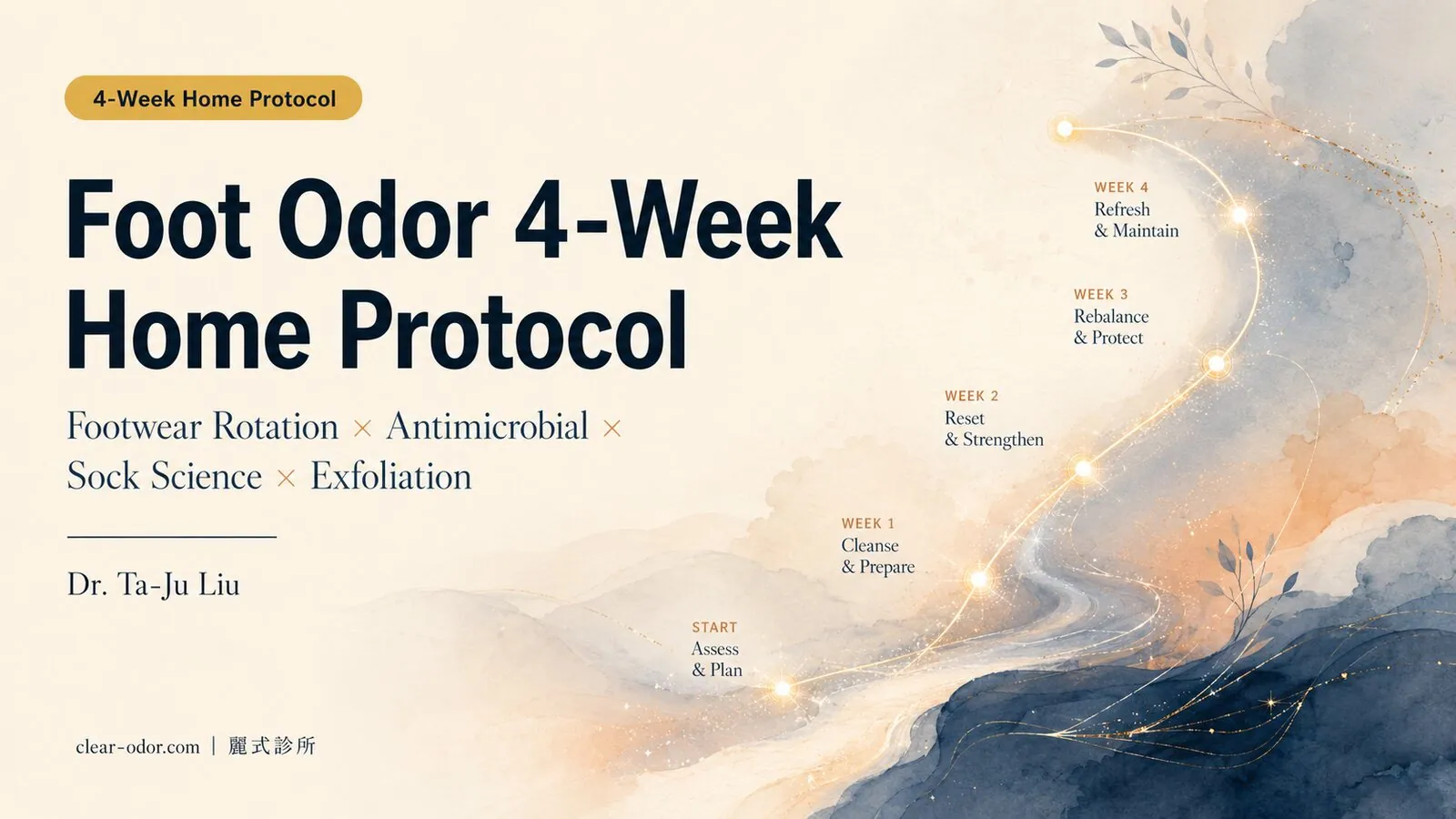
What do you do in Week 1? Launch all 5 actions
Week 1 brings all five actions online: rotate shoes daily so they dry fully, clean and control sweat with antibacterial care, choose moisture-wicking socks, and exfoliate regularly — this week is about building the habits, aiming for consistent execution rather than doing everything at maximum intensity.
01. Footwear Rotation + Ventilation
Rules:
- Rotate at least 2-3 pairs (ideally 3)
- After wearing, air-dry in the shade for 24-48 hours — let interior moisture fully evaporate
- Avoid direct sunlight — accelerates material aging and hardening
- Use desiccants in humid conditions or remove the insole and air-dry separately
For those who must wear closed shoes at work:
- During lunch, switch to slippers and ventilate for 30+ minutes
- Keep a pair of slippers in your drawer
- Don't stay in shoes for 1-2 hours after exercise — take them off immediately, wipe feet, change socks
Shoe material priority:
- Real leather + breathable upper (most breathable)
- Mesh sneakers (breathable + moisture-releasing)
- Synthetic leather + ventilation holes (medium)
- Fully synthetic closed (worst, only for short periods)
02. Antimicrobial Foot Spray / Powder
Each morning when feet are dry, use one of the following:
| Type | Ingredient | Suited For |
|---|---|---|
| Aluminum chloride | Aluminum chloride hexahydrate 20% | Sweat-dominant cases, high potency |
| IPA + antimicrobial combo | 70% IPA + antimicrobial agent | Daily use |
| Antimicrobial foot powder | Talc + antimicrobial ingredients (e.g. zinc, silver) | Moisture-absorbing + antimicrobial dual action |
| Silver-ion spray | Ag+ formulation | Mild, suitable for long-term use |
2-3 times per week:
- Tea tree oil foot soak: 10 min / 38°C — antimicrobial + antifungal adjunct
- Diluted white vinegar foot soak (1:3 dilution): lowers pH, suppresses bacteria
- Avoid daily soaking — disrupts the skin barrier
03. Moisture-Wicking Socks
Selection:
- Yes — Wool / Merino: naturally antimicrobial, absorbs and releases moisture
- Yes — Silver-ion socks: strongly antimicrobial, good for exercise
- Yes — Performance fibers (CoolMax, Drymax, etc.): strong wicking
- No — 100% cotton socks: absorbs but doesn't release, feet soak in sweat
- No — Fully synthetic (100% nylon): not breathable
Use:
- Change socks daily
- Change immediately after exercise
- Keep 1-2 spare pairs at office / gym
- Bring a spare pair on rainy or humid days
04. Foot Exfoliation and Moisturizing
Exfoliate 1-2 times per week:
- Foot scrub: mechanical removal of dead skin
- 5-10% urea cream: chemical softening + exfoliation
- Heel file: physical removal of thickened keratin (don't cut — it will damage skin)
Dead skin is the core substrate bacteria feed on — especially on the heel and sides where keratin is thick. Less substrate = lower rate of bacterial growth.
Moisturizing:
- Apply moisturizer to dry areas (avoid overly oily lotions that occlude)
- For cracks, use urea 10-20% repair cream
- Keep the web spaces dry (skip the web spaces when moisturizing — damp web spaces feed fungi)
05. Tinea Pedis Screening
5 signals — meeting any one warrants considering tinea pedis:
- Peeling in the web spaces: especially between the 3rd-4th and 4th-5th toes (most common sites)
- Dry, flaking heels: often mistaken for "dry skin" (hyperkeratotic type tinea pedis)
- Small vesicles on the sides of the foot: clustered vesicles (vesicular type tinea pedis)
- Large-area peeling on the sole: sheets of white flakes
- Toenail discoloration / thickening / deformation: onychomycosis (same family)
If ≥ 1 signal is present:
- OTC antifungal cream: terbinafine 1% or clotrimazole 1%
- Application area: extend 2 cm beyond the visible lesion border (tinea pedis has satellite lesions)
- Continue for at least 2-4 weeks — follow product instructions, don't stop just because symptoms disappear
- No improvement (still symptomatic at 4 weeks) → see a physician for prescription-grade evaluation
Why does Week 2 add shoe disinfection in parallel?
Because the core unaddressed issue in recurrent foot odor is often that "the shoe itself is the source" — you spend 4 weeks healing the skin, and the bacteria left inside the shoe reinfect you; so Week 2 runs shoe disinfection in parallel, otherwise skin and shoes keep re-contaminating each other.
A core unaddressed issue in many recurrent foot odor cases is that the footwear itself is the source of infection — after 4 weeks of treating your skin, residual microbes inside the shoes will re-infect you.
Footwear Disinfection Options
| Tool | Mechanism | Frequency |
|---|---|---|
| UVC sterilizer | UVC kills bacteria and fungi | 30 min daily |
| 70% isopropyl alcohol spray | Bactericidal, fast-evaporating | 1-2 times per week |
| Quaternary ammonium antimicrobial spray | Sustained antimicrobial action | 1 time per week |
| Desiccants | Lowers humidity | Keep in continuously |
| Freezer treatment | Low-temperature sterilization | 1 time per month (seal shoes in a thick ziplock bag, freezer for 24 hours) |
Environmental Disinfection
- Bathroom slippers: one person, one pair, no sharing
- Wear slippers in public wet areas (gym, swimming pool, etc.)
- Household members with tinea pedis should be treated concurrently (otherwise cross-infection)
- Carpets / floor mats: sun-dry often, vacuum regularly
- Towels: personal use only, wash bath towels in hot water 1-2 times per week
Severe Infection Scenarios
Consider retiring the oldest 1-2 pairs of shoes — especially:
- Sneakers worn for 2+ years (lining cannot be thoroughly disinfected)
- Odor persists even after disinfection
- Visible wear / deformation
Before using new shoes, treat them once with UVC or antimicrobial spray.
Which lifestyle factors do you adjust in Week 3?
Week 3 tackles the lifestyle factors that amplify foot odor: cut foods that increase sweat and odor, check stress and sleep, and adjust habits of heat, prolonged standing, or long wear — these aren't the root cause, but they discount the prior two weeks' effort, so addressing them keeps you from stalling.
Dietary Adjustment
- Reduce: spicy food (short-term amplification of systemic sweating), alcohol (raises body temperature and sweat volume), excess caffeine
- Reduce: sulfur-containing foods (cabbage, onion, garlic) in the short term (note: no need for long-term avoidance)
- Increase: fluids (1.5-2 L per day, distributed evenly)
Weight and Exercise
- Weight management: more weight = more foot pressure = more sweat. Every 5 kg loss meaningfully reduces hyperhidrosis
- Change shoes and socks immediately after exercise: don't keep wet shoes and socks on for 1-2 hours
- Exercise regularly but avoid excessive closed-shoe activity: rotate sneaker styles
Stress Management
Sympathetic nervous system activation amplifies systemic sweat secretion. Chronic high-stress individuals will see foot sweat increase noticeably.
- 10-15 minutes of daily stress-reduction activity (meditation, deep breathing, walking)
- 7+ hours of sleep
- Keep a spare pair of socks at the office during high-stress periods
How do you evaluate in Week 4 and decide the next step?
Week 4 repeats the Week 0 objective recording and compares to baseline: ≥ 70% improvement means you enter stable maintenance; limited improvement suggests the main driver may be more than bacteria (such as hyperhidrosis, fungus, or thick skin), and it's time to see a doctor for further evaluation.
Repeat the Week 0 Objective Recording
- Odor intensity self-assessment (0-10)
- 5 foot photos (same lighting, same angle)
- Shoe interior humidity self-assessment
- Sock change frequency
Compare Against Baseline, Calculate Improvement Magnitude
| Improvement | Next Step |
|---|---|
| ≥ 70% | Maintain current protocol, enter stable maintenance rhythm (see Section 8) |
| 30-70% | Fine-tune 1-2 items (e.g. switch to a stronger antimicrobial spray, intensify tinea pedis treatment), reassess in 2 weeks |
| < 30% | Book an Integrated Triage assessment, consider Tier 1 prescription intervention |
| No improvement / worsening | See a physician immediately — possible severe tinea pedis, bacterial infection, or other condition |
How should you keep the self-assessment record?
Just use one fixed format: each day log perceived odor intensity (1–5), sweat level, the shoes and socks you wore, and which actions you did — the point isn't writing a lot but keeping the columns fixed and comparable, so the trend is obvious at a glance after 4 weeks.
Recommended fixed format for your notebook or phone notes:
Foot Odor Self-Assessment Record (Date: YYYY/MM/DD)
[Odor Intensity]
- Morning when taking shoes off: __ / 10
- After lunch (before ventilation break): __ / 10
- Evening when arriving home: __ / 10
- Post-exercise: __ / 10
- Average: __ / 10
[Shoe Interior Condition]
- Insole humidity (dry / slightly damp / clearly wet): ____
- Shoe interior odor (none / mild / moderate / heavy): ____
[Skin Condition]
- Peeling (none / mild / clear): ____
- Web space itching (none / occasional / clear): ____
- Cracking (none / mild / severe): ____
- Erythema / vesicles: ____
[Today's Execution]
- Shoe rotation: yes / no
- Number of sock changes: __
- Antimicrobial spray: yes / no
- Exfoliation: yes / no (1-2 times per week is enough)
[Trigger Contexts]
- Today's special exercise / stress / diet: ____
[Notes]
____
Recording every 2 days is sufficient — the key is having a baseline to compare against.
After the 4 weeks, how do you keep it from coming back?
After ≥ 70% improvement you enter stable maintenance: keep the most effective actions as routine (footwear rotation, periodic disinfection and exfoliation), lowering the frequency but not stopping entirely; foot odor tends to return once you relax, so a maintenance rhythm matters more than a one-off sprint.
If your Week 4 assessment shows ≥ 70% improvement, enter the "stable maintenance" phase:
Daily
- Footwear rotation (continue)
- Sock change (continue)
- Antimicrobial spray (can shift to every other day depending on how things hold)
Weekly
- 1-2 exfoliations
- 1-2 shoe interior disinfections
- 1 foot inspection (self-check for peeling, itch, erythema)
Monthly
- Assess shoe condition (retire and replace)
- Assess sock wear
- Complete one full self-assessment record (compare against baseline)
Quarterly / Semi-Annually
- Integrated Clinic follow-up (if you have prescription intervention or Botox injection)
- Seasonal adjustment (intensify in summer, watch closed-shoe ventilation in winter)
FAQ — 6 Questions Most Often Asked in Clinic
Q1. Does the 4-week protocol really need to run a full 4 weeks? Can't I do it shorter?
Yes, you need the full 4 weeks. Reasons:
- Antimicrobials: bactericidal effect accumulates over 1-2 weeks
- Tinea pedis: antifungal therapy needs at least 2-4 weeks to show effect
- Footwear disinfection: microbes inside shoes take time to clear
- Skin microbiome rebuilding: typically 3-4 weeks to reach a new equilibrium
Observation periods shorter than 4 weeks easily lead to a false "doesn't work" verdict, which causes people to abandon a path that was actually correct.
Q2. Can I skip some of the items (e.g. not change shoes, just apply cream)?
You can, but the effect will be reduced. Each item skipped reduces the improvement magnitude by roughly 10-20%. If your goal is "lasting improvement," it's recommended to do all 5; if you only want "emergency relief for 1-2 weeks," a subset will do. But at the 4-week evaluation, you can't compare yourself to people doing the full set.
Q3. Can antimicrobial spray, antifungal cream, and antiperspirant be used at the same time?
Yes, they don't conflict, but it's recommended to stagger them in time:
- Morning: antiperspirant (aluminum chloride)
- Before leaving home: antimicrobial spray
- Evening: antifungal cream (if there are tinea pedis signals)
Applying multiple products at the same time reduces absorption / effect.
Q4. I wear sneakers to work every day and can't rotate — what do I do?
Minimum approach:
- Prepare at least 2 pairs of sneakers to rotate
- Take shoes off immediately when you get home, remove insole and air-dry separately
- Stuff the shoes with newspaper / desiccant to absorb moisture
- Use UVC to sterilize the insole
- Spray the shoe interior once per week with 70% isopropyl alcohol
Q5. Do silver-ion socks really work? Are they better than regular performance socks?
The literature supports antimicrobial effect of silver ions, but the potency relates to "silver-ion release rate" — cheap silver-ion socks may be labeled with silver but release very little. Selection:
- Reputable brand + clearly labeled silver-ion socks
- Also look at wash durability (whether antimicrobial effect is retained after repeated washing)
- It's reasonable for them to cost slightly more than ordinary performance socks
But even the best silver-ion socks still need to be combined with footwear rotation for lasting effect.
Q6. After 4 weeks of the protocol I got 50% improvement — does that count as success?
Moderate success. Next steps:
- Evaluate which items you executed most rigorously and which were partial
- Strengthen the under-executed items, observe for another 2 weeks
- If still stuck at 50% → book an Integrated Triage assessment
- May need Tier 1 prescription intervention or Botox (for sweat-dominant cases)
50% improvement means your direction is right but 1-2 factors aren't yet in place — usually unnoticed tinea pedis or hyperhidrosis amplification.
Related Reading
- Foot Odor Won't Wash Off? Causes & a 4-Week Home Protocol
- Botox for Sweaty Feet: How It Works, Duration & Pain
- Scalp Odor After Washing? The Microbiome & How to Manage
- Foot Odor Integrated Assessment
A Closing Note
The 4-week home protocol isn't a slogan that says "if you're not serious enough, things won't improve" — it's a systematic operation with structure, with quantification, with a baseline to compare against. After completing one round, most people can at least answer the key question of whether they fall into "solvable at home" or "needs medical intervention."
If you show < 30% improvement after 4 weeks, please book an Integrated Triage rather than continuing to try new foot sprays — the possibility of multiple coexisting sources or comorbidities needs to be ruled out by objective evaluation.