Why These Myths Deserve a Careful Walkthrough
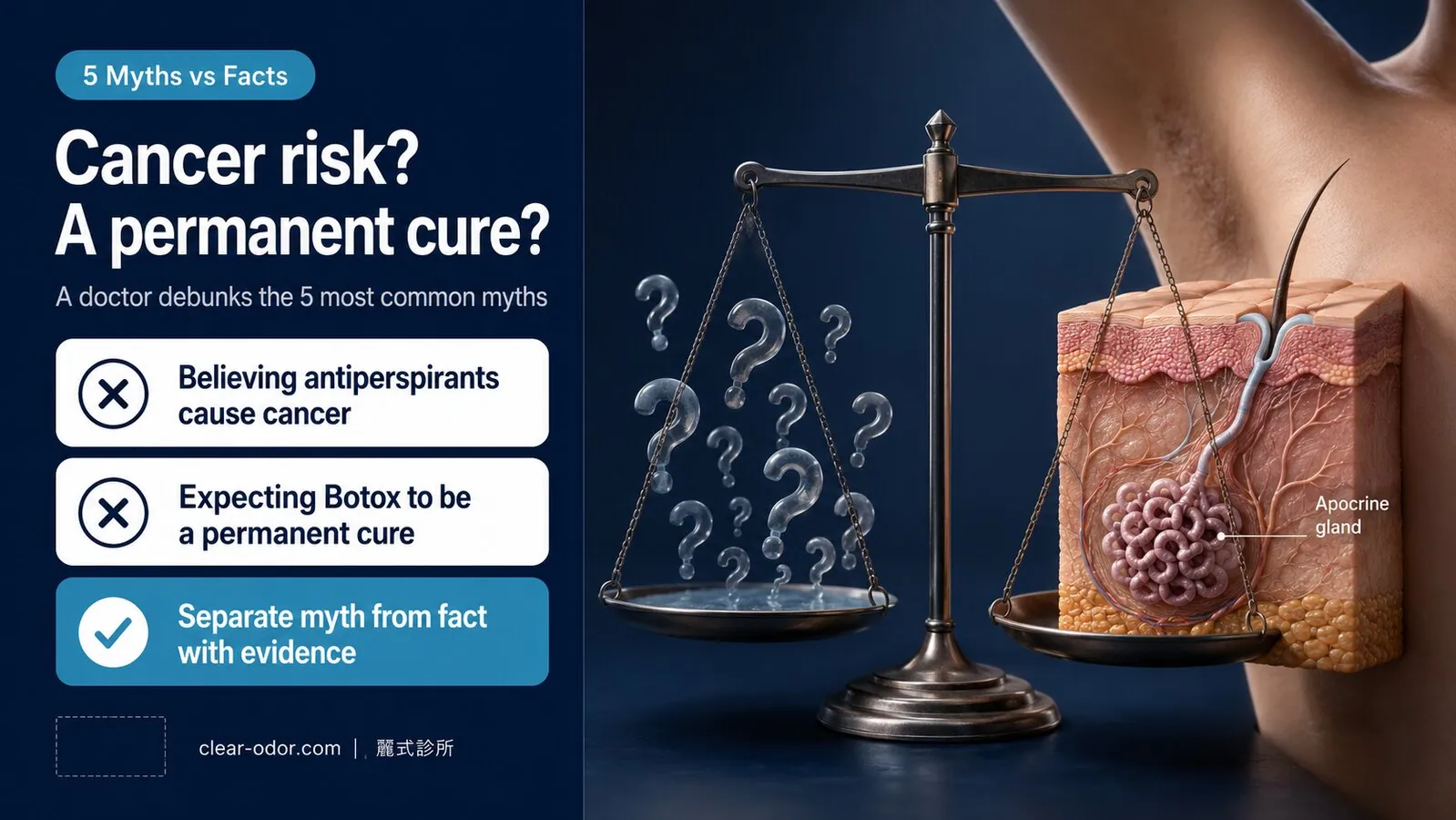
Bromhidrosis and hyperhidrosis are long-standing issues, but online information varies in quality. Statements like "antiperspirants cause cancer," "one Botox shot fixes it," or "wait until your child grows up" mix real evidence with overreach. The result is people who don't know how to choose. This article addresses the 5 most commonly raised myths and contrasts them with current medical consensus.
Myths vs Facts at a Glance
| Myth | Medical fact (short) |
|---|---|
| Heavy antiperspirant use causes cancer | No consistent epidemiological evidence of causation |
| Bromhidrosis surgery causes compensatory sweating elsewhere | "Axillary surgery" and "ETS nerve surgery" are completely different mechanisms; compensation is rare with the former |
| Botox is a permanent cure | Botox only blocks nerve signals to reduce sweat; glands recover in roughly 6 months |
| Areola surgery ruins breastfeeding | Micro-incisions run along skin edge and avoid the lactiferous ducts |
| Just wait until they grow up | Ages 10–16 balance physiology and psychology |
Myth 1: Heavy Antiperspirant Use Causes Cancer
The myth: Many people have heard "antiperspirants contain aluminum salts; long-term use causes breast cancer or Alzheimer's." So they avoid antiperspirants entirely and rely on heavier perfume to mask odor.
The fact: The active ingredient in most antiperspirants is aluminum chlorohydrate or similar aluminum salts, which temporarily block eccrine sweat outlets to reduce sweating. Regarding aluminum salts and breast cancer or Alzheimer's, the American Cancer Society (ACS), the U.S. FDA, and similar bodies have reviewed existing studies and concluded "no consistent epidemiological evidence supports a causal relationship." The controversial small-scale studies are mostly lab or animal models; large-scale human epidemiological work has not reproduced strong correlations.
Clinical guidance:
- Within typical use ranges, antiperspirants are an acceptable everyday measure
- Applying immediately after shaving or to broken skin can cause local irritation, but this is not systemic toxicity
- If you remain concerned, aluminum-free formulations (citric acid zinc-based, etc.) exist, but their sweat-reducing effect is weaker
The real concern is not "aluminum causes cancer" — it's "multiple antiperspirants haven't suppressed your odor." That usually means the target you're treating (eccrine glands) doesn't match the source of your odor (apocrine glands), and a re-evaluation is in order.
Myth 2: Surgery Causes Compensatory Sweating Elsewhere
The myth: "I heard people who get bromhidrosis surgery start sweating heavily on the back, abdomen, and thighs — they call it compensatory sweating, and it's awful."
The fact: This statement conflates two completely different surgeries:
| Comparison | Axillary bromhidrosis surgery | ETS sympathectomy |
|---|---|---|
| Target | Apocrine and eccrine glands under armpit skin | Sympathetic nerve trunk inside the chest cavity |
| Method | Micro-incision, mechanical gland removal | Cutting or cauterizing the nerve |
| Scope | Local to the area treated | Body-wide change in sweat signaling |
| Compensatory sweating | Rare; if any, localized | Literature reports rates above 50% |
The point: The classic "heavy compensatory sweating" picture is almost always a side effect of ETS (sympathectomy), used for palmar hyperhidrosis. Axillary rotational curettage does not touch the sympathetic trunk anatomically, so the typical compensatory pattern is not triggered.
If a testimonial or complaint mentions "widespread compensatory sweating," confirm which surgery the person actually had. Pinning ETS side effects on axillary bromhidrosis surgery is a common mix-up.
Myth 3: Botox Is a Permanent Cure
The myth: "I had Botox for sweating and my underarms are much drier — does that mean my bromhidrosis is cured?"
The fact: Botulinum toxin works by blocking acetylcholine release at nerve endings, which temporarily quiets the eccrine glands receiving the signal. Key points:
- Botox primarily reduces watery sweat (eccrine); its effect on apocrine secretion is limited — its impact on bromhidrosis odor itself varies between individuals
- The effect is temporary: nerve signaling returns in roughly 4–6 months and glands resume secretion
- The glands themselves are not removed: Botox doesn't destroy them — it mutes them for a window
Where it fits:
- Trying a conservative option first to see how much sweat reduction helps your situation
- Short-term control for important events (wedding, exam, presentation)
- Patients unsuited or unwilling to undergo surgery
Where it doesn't:
- Expecting "one shot, lifetime relief"
- Cases where the main issue is apocrine odor rather than sweat volume
"Reducing sweat" and "reducing bromhidrosis odor" are different things. Botox is clearly effective for the former (temporarily); for the latter, results vary by individual odor composition. Definitive removal of apocrine glands still requires the surgical pathway.
Myth 4: Areola Surgery Ruins Breastfeeding
The myth: "There are apocrine glands around the areola too, but I heard surgery cuts the milk ducts and you can't breastfeed afterward."
The fact: Areolar apocrine surgery, anatomically, should not damage the lactiferous duct system. Reasons:
- Lactiferous ducts travel through the deep breast tissue, converging from the glandular parenchyma toward the nipple, opening at the nipple surface
- Apocrine glands sit in the deep dermis to superficial subcutaneous layer of the areola and surrounding skin — a different anatomical layer from the lactiferous ducts
- Micro rotational curettage incisions are typically placed 3–4mm from the areola edge, processing apocrine glands at the skin layer without entering the breast parenchyma
Details to note:
- Incision location and depth are determined per anatomy by the physician; women planning future pregnancies should discuss this fully with the doctor pre-op
- Individual anatomical variation exists; in rare cases part of the duct system could be affected, but this can usually be assessed and avoided in advance
- Any surgery carries general risks (bleeding, infection, scarring, sensory change); areolar surgery additionally requires attention to individual changes in nipple sensitivity
Bottom line: "areolar surgery automatically ruins breastfeeding" is overreach. With appropriate technique selection and an experienced surgeon, lactiferous duct integrity can be preserved. Always inform the doctor of your reproductive plans before surgery.
Myth 5: Just Wait Until Your Child Grows Up
The myth: "It's safer to do bromhidrosis surgery as an adult — my child is only 12 and still developing. Let's wait until 20."
The fact: "Wait until they grow up" sounds conservatively safe, but in practice excessive delay misses the appropriate window. Reasons:
Physiological:
- Skin recovery is strong at ages 10–16; scar reaction tends to be milder
- At this age range apocrine glands are active but their distribution has not fully expanded — both treatment area and recovery are easier than in adults
- With proper preoperative evaluation, anesthetic and surgical tolerance are not significantly different from adults
Psychological:
- Adolescence under prolonged peer comments, avoiding raising hands, avoiding close social contact has real impact on self-image and social development
- The longer treatment is delayed, the more the child adapts via concealment and avoidance — treatment motivation and cooperation actually drop later
- At 18–22, when school transitions, employment, and dating concentrate, the "should be seen" window of adolescence has already passed
A reasonable evaluation window:
- Ages 10–16: balances physiology and psychology; clinically a common appropriate range
- Surgery is usually not advised before age 10 (apocrine glands not fully active; adult intensity hard to predict)
- Surgery after 16 remains possible, but indefinite delay is not recommended
The well-meaning "just wait" advice often overlooks the genuine weight of adolescent social pressure. Whether and when to operate should be assessed by a physician case by case — don't presume "later is automatically safer." Dr. Ta-Ju Liu has spent 20 years on pediatric bromhidrosis evaluation, with over 10,000 cases (adolescent and adult combined), and can help families judge the right timing. Individual results may vary.
FAQ
I use antiperspirant every day — am I accumulating toxicity?
According to studies summarized by mainstream bodies (ACS, FDA), within typical daily use ranges there is no consistent evidence of systemic accumulating toxicity. If you remain concerned, aluminum-free formulations or reduced frequency are options. The more meaningful question is whether antiperspirant's failure to suppress your odor reflects that your odor source is not eccrine.
Will I sweat heavily on my back or buttocks after axillary surgery?
The probability is very low. That story originates from ETS sympathectomy side effects. Axillary rotational curettage does not address the sympathetic trunk and does not trigger the classic widespread compensatory pattern.
How long does Botox last?
Generally 4–6 months, with individual variation. Nerve signaling then recovers and glands resume secretion. Botox suits "short-term control" or "evaluating how much sweat reduction would help your situation" — it isn't designed as a long-term definitive solution.
Will areolar surgery affect future breastfeeding?
With appropriate technique selection by an experienced surgeon, areolar apocrine surgery should not affect lactiferous ducts. Individual anatomical variation exists, so fully discuss reproductive plans with the doctor pre-op so incision location and depth can be customized.
My 11-year-old is being teased at school — do we really wait until 18?
Not necessarily. Ages 10–16 are clinically a common appropriate range, especially when social and emotional impact is already present; the psychological dimension matters more than "wait until grown." Bring your child for evaluation, let the doctor judge timing per individual situation, and decide on surgery from there.
Related Reading
- Bromhidrosis Guide: Causes, Diagnosis, Treatment & Recovery
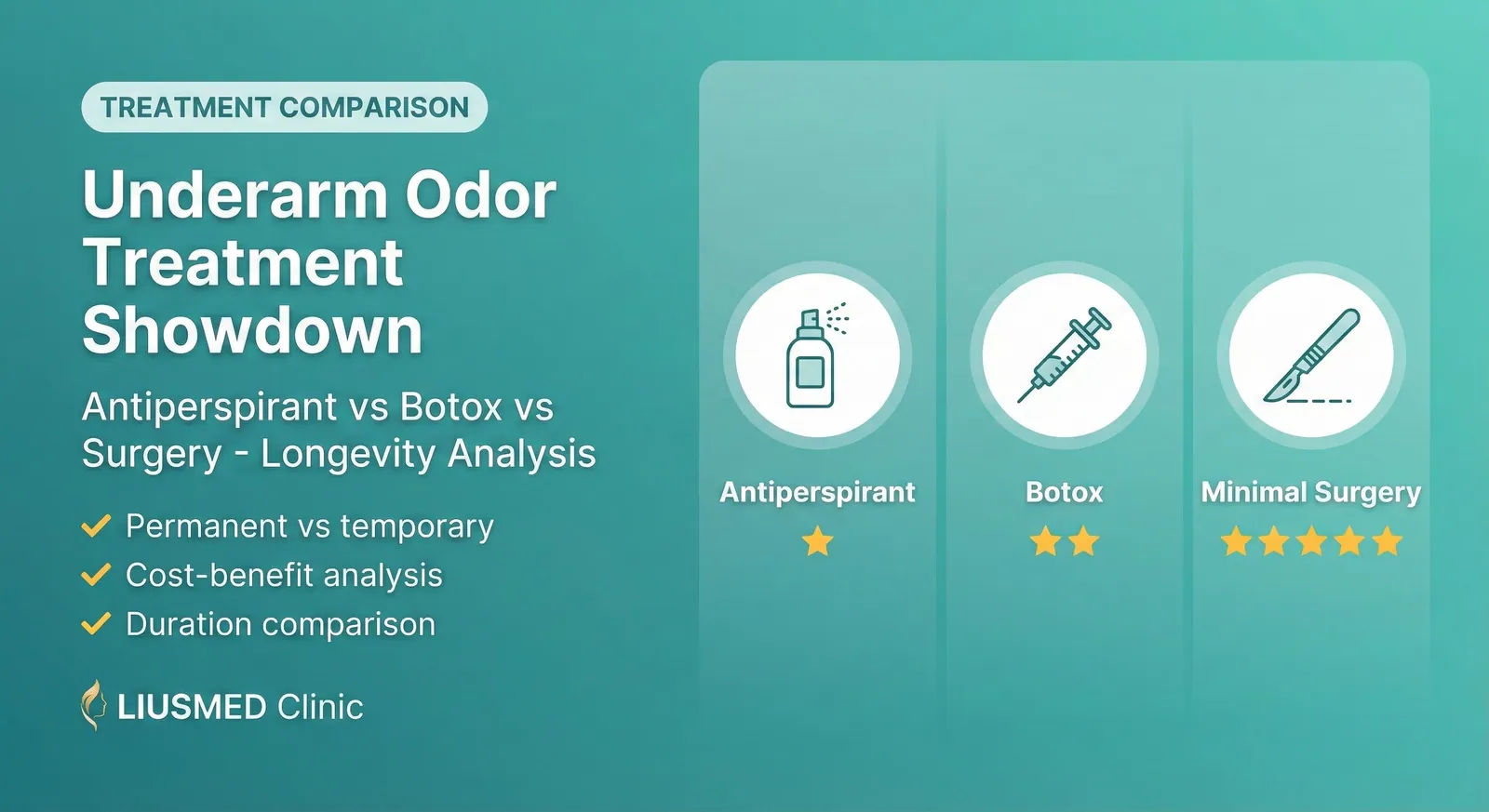
- Underarm Odor: Antiperspirant vs Botox vs Surgery
- Areola Odor Surgery: Will It Affect Breastfeeding?
- Axillary Bromhidrosis
Conclusion
The core problem with these 5 myths isn't "all wrong" — it's "partial fact + overreach":
- Antiperspirant cancer: no consistent epidemiological evidence
- Compensatory sweating: that's the ETS issue, not axillary surgery
- Botox cure: Botox is a temporary sweat reducer, not gland removal
- Areola surgery and breastfeeding: appropriate technique avoids ducts, but pre-op discussion is needed
- Wait until grown: excessive delay misses the 10–16 window
If any of these myths is delaying your decision, an in-person evaluation can clarify your individual situation. Dr. Ta-Ju Liu has dedicated 20 years to axillary bromhidrosis and hyperhidrosis treatment, with over 10,000 cases, and can help separate "internet rumor" from "your specific situation" before designing a sensible path.
Related Reading
- Bromhidrosis Guide: Causes, Diagnosis, Treatment & Recovery
- Underarm Odor: Antiperspirant vs Botox vs Surgery
- Areola Odor Surgery: Will It Affect Breastfeeding?
- Axillary Bromhidrosis
This article is educational. Individual results may vary; actual treatment requires in-person evaluation by Dr. Ta-Ju Liu.