Why You Need to Distinguish These Three
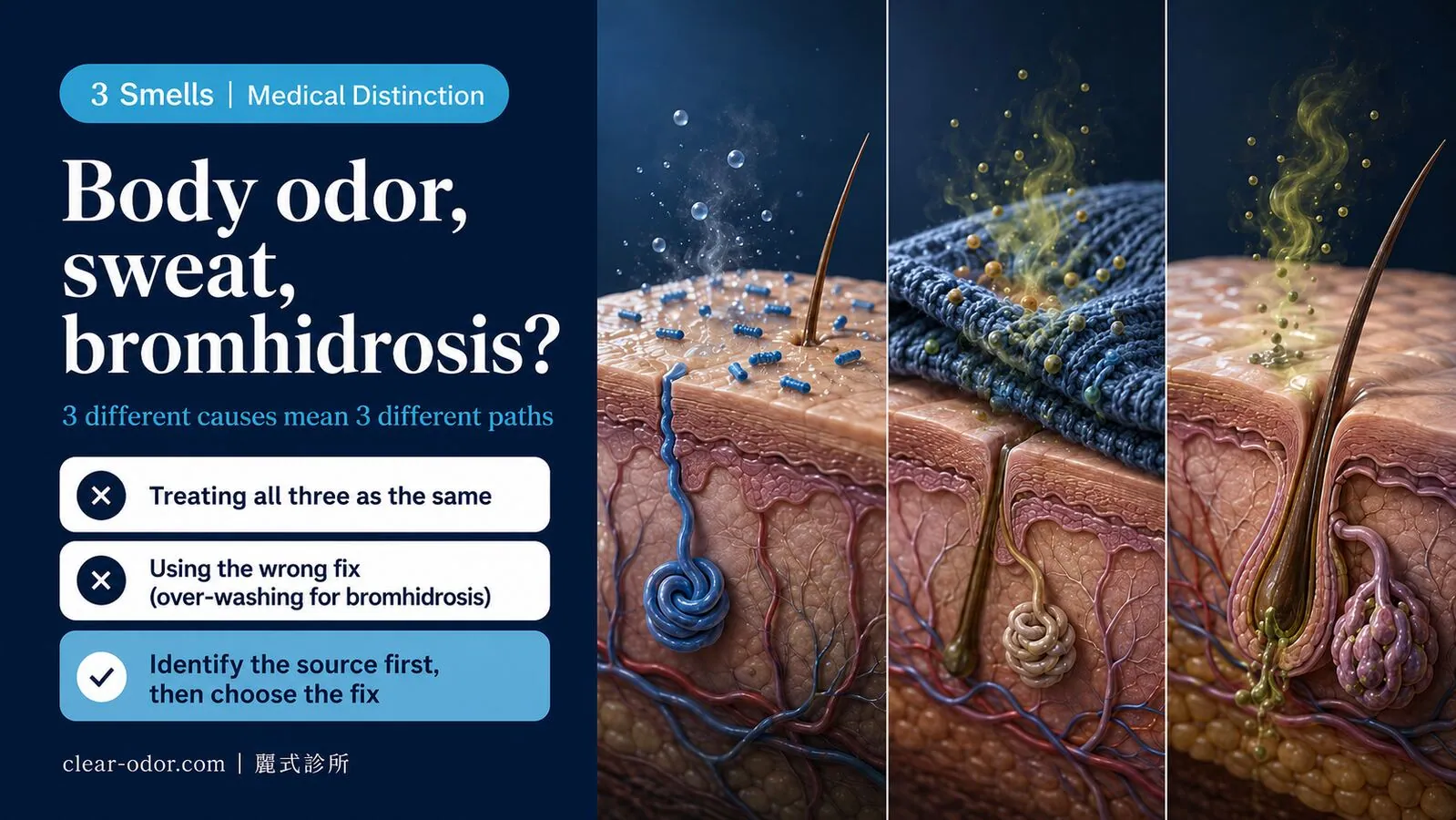
Patients often arrive saying "I have body odor," "I have sweat smell," or "I have bromhidrosis" — but in medicine these refer to three different things. Treating the right smell with the right method is what produces results. This article walks through the sources, identification cues, and treatment paths for all three.
A Single Table to See the Difference
| Item | Body odor | Sweat odor | Bromhidrosis |
|---|---|---|---|
| Main source | Eccrine sweat + skin commensal bacteria | Same, but high volume + heat | Apocrine secretion + bacteria |
| Where it appears | Anywhere on the body | Sweat-prone areas (armpit, feet) | Mainly armpit, areola, perineum |
| Smell character | Faint "human smell" | Sour, stuffy | Distinctive pungent, hard to mask |
| When it appears | Almost everyone has some | After sweating, heat, exercise | Onset at puberty, lifelong |
| Treatment path | Hygiene, breathable clothing | Antiperspirants, frequent changes | Usually requires medical intervention |
In short: body odor and sweat smell are "everyone has some, varies by degree" problems; bromhidrosis is a specific-gland-driven, lifelong problem. Lumping them together causes confusion.
Where Body Odor Comes From
Human skin has two main types of sweat glands: eccrine glands and apocrine glands.
- Eccrine glands are distributed across the entire body. Their sweat is 99% water plus a small amount of salt — essentially odorless on its own.
- But on the skin's surface, eccrine sweat is broken down by skin commensal bacteria, producing short-chain fatty acids and other metabolites — that's the everyday "body odor."
In other words, body odor is the product of "sweat + bacteria." Its intensity depends on: how much you sweat, which bacteria are present, how breathable your clothing is, how often you bathe.
So "strong body odor" usually doesn't mean "your glands are broken" — it means your living conditions make it easier for bacteria to break down sweat. Most people can manage it with regular bathing and breathable fabrics.
What Is Sweat Odor
Sweat odor is essentially a stronger version of body odor. When eccrine glands produce a lot of sweat (exercise, heat, anxiety) and clothing traps that moisture, bacterial metabolite concentration rises and the smell becomes more obvious. Foot odor, post-workout sour sweat smell — most fall in this category.
Sweat odor management focuses on:
- Reduce sweat trapping (breathable fabrics, antiperspirants, regular drying)
- Reduce bacterial load (antibacterial wash, keep dry)
- Change frequency (swap clothing during heavy-sweat periods)
Sweat odor rarely needs surgical intervention. If lifestyle measures aren't improving things, it's worth checking whether bromhidrosis is mixed in.
How Bromhidrosis Differs from the Other Two
Bromhidrosis (medically: axillary bromhidrosis or apocrine osmidrosis) has a fundamentally different smell source from body odor or sweat odor:
- Apocrine glands are a different type of sweat gland, mainly distributed in the armpits, areolae, perineum, and external ear canals.
- Apocrine glands don't secrete watery sweat — they secrete a milky, viscous substance containing proteins and lipids, which is also nearly odorless on its own.
- But this secretion is especially susceptible to breakdown by specific bacteria (Corynebacterium spp.), producing 3-methyl-2-hexenoic acid and similar compounds — the distinctive pungent bromhidrosis smell.
Key differences:
| Dimension | Body/sweat odor | Bromhidrosis |
|---|---|---|
| Which gland | Eccrine | Apocrine |
| Secretion | Water-based sweat | Protein + lipid |
| Bacterial product | Mild fatty acids | Distinctive pungent compounds |
| Distribution | Body-wide possible | Only at apocrine sites |
| Lifelong nature | Depends on lifestyle | Onset at puberty, doesn't disappear on its own |
This is why treating bromhidrosis like body odor usually doesn't work. Antiperspirants and antibacterial soaps target eccrine glands and general bacteria — they have limited effect on the unique apocrine secretion and the breakdown bacteria specific to it.
How to Self-Identify
You can take an initial guess from a few angles:
Likely body odor / sweat odor:
- Smell is faint or absent when not sweating
- Smell drops noticeably after changing into breathable clothes / showering
- Family members don't have the same issue
- No major change around puberty
Likely bromhidrosis:
- Smell is detectable even when not sweating; armpits of clothing show pale yellow stains
- Family member (parent) has the same issue
- Onset became obvious at puberty
- Smell returns within hours of changing clothes / showering
- Multiple antiperspirants and antibacterial sprays have had limited effect
Self-assessment is just a starting point. A real diagnosis requires a doctor to examine secretion characteristics, smell, clothing staining, and other indicators in combination.
How do you self-check your underarms? Three at-home methods
At home you can roughly gauge the strength and type of underarm odor with three methods: ① the "dry test" — shower, dry off, sit still for 10 minutes, then smell; ② the "tissue / gauze test" — press clean tissue or gauze in the underarm for 1–2 minutes, then smell; ③ ask a trusted family member to smell from within 30 cm. The key point: you tend to underestimate your own odor because of olfactory fatigue, so another person — and the "step away then smell again" test — is more reliable.
Method 1 · The dry test (sweat odor or bromhidrosis?): shower, dry the underarm, stay still for 10 minutes, then smell — almost no smell = leans toward sweat odor (only smells when you sweat); still distinct while dry and still = leans toward bromhidrosis (smells even without sweating).
Method 2 · The tissue / gauze test (how strong?): tuck clean tissue or gauze in the underarm, press lightly for 1–2 minutes, take it out and smell — almost no smell = milder; a clear smell, or even a faint yellow stain = more moderate-to-severe (the faint yellow staining is a classic sign of apocrine secretion). Sealing it in a zip bag and smelling a few minutes later helps you bypass the "my nose is already used to it" blind spot.
Method 3 · Have family smell for you (defeating olfactory fatigue): people adapt to their own odor and often can't smell what others can — this is the biggest blind spot of self-checking. Ask a trusted family member to smell from a social distance of about 30 cm and to honestly say "how close do I have to get before I smell it" — only at very close range = milder; noticeable at ordinary social distance (30 cm to 1 m) = more moderate, worth assessing; still noticeable beyond 1 m = more severe, where conservative methods are usually not enough.
Self-checking only points you in a direction; it is not a diagnosis. If two of the three methods point to "moderate-to-severe," or the odor is already affecting your social life and confidence, consider a face-to-face assessment — you can cross-reference the full bromhidrosis self-grading scale and treatment ladder, or simply book an assessment; the consultation is not tied to any procedure.
Treatment Paths for Each
| Smell type | First-line | Advanced |
|---|---|---|
| Body odor | Regular bathing, natural fibers, mild deodorant | Check for combined sweat/bromhidrosis |
| Sweat odor | Antiperspirants, frequent changes, keep dry | Botox (temporary sweat reduction) |
| Bromhidrosis | Antiperspirants / perfumes only mask temporarily | Micro rotational curettage to remove apocrine glands |
Key point: bromhidrosis fundamentally requires removing the apocrine glands — something other methods cannot do. Dr. Ta-Ju Liu's micro rotational curettage technique, refined over 20 years, removes apocrine glands under direct vision through a 4mm incision; complete apocrine gland clearance is the goal, with no recurrence reported in 15 years of clinical follow-up. Individual results may vary.
FAQ
I had no smell before puberty; at 13 it started — is that bromhidrosis?
Very likely. Bromhidrosis emerges at puberty (apocrine glands begin secreting in response to sex hormones). If you also notice pale yellow stains on shirt armpits and family members have similar issues, you can reasonably suspect bromhidrosis tendency. An in-clinic evaluation is recommended.
My smell comes back within an hour after showering — is that normal?
If it's water-sweat-driven body or sweat odor, you should stay clean for several hours after showering. Smell becoming obvious again 1–2 hours after a shower looks more like bromhidrosis — apocrine secretion keeps producing, bacteria keep breaking it down. This usually means you've hit the limit of what lifestyle measures can do, and a medical consultation is worth considering.
I've tried antiperspirants and perfumes but nothing holds — what does that mean?
It probably means you're treating the wrong target. Antiperspirants address eccrine glands; perfumes are surface masking — both have limited effect on bromhidrosis caused by apocrine glands. If multiple brands and strengths have all underperformed, it's worth shifting your thinking from "find a stronger antiperspirant" to "remove the apocrine glands."
Can all three coexist?
Yes. A common real-world pattern is bromhidrosis + sweat odor mixed: apocrine glands generate the base bromhidrosis smell, while heavy eccrine sweating from the same armpit adds sweat odor on top. The most efficient path is typically resolve bromhidrosis first (definitive surgery) → manage residual sweat odor afterward (antiperspirants, clothing).
How can I tell which one my underarm smell is at home?
The most direct way is an in-clinic evaluation. At home, try a "dry test": after showering, dry your underarms with a clean towel, stay still for 10 minutes, then smell. If almost no smell, it leans sweat-odor-dominant; if noticeable smell persists even when dry and still, it leans bromhidrosis-dominant.
Related Reading
- Apocrine Glands Explained: Anatomy, Function & Body Odor
- Bromhidrosis Guide: Causes, Diagnosis, Treatment & Recovery
- How to Tell Three Body Odors Apart: Aging, Bromhidrosis, Sweat
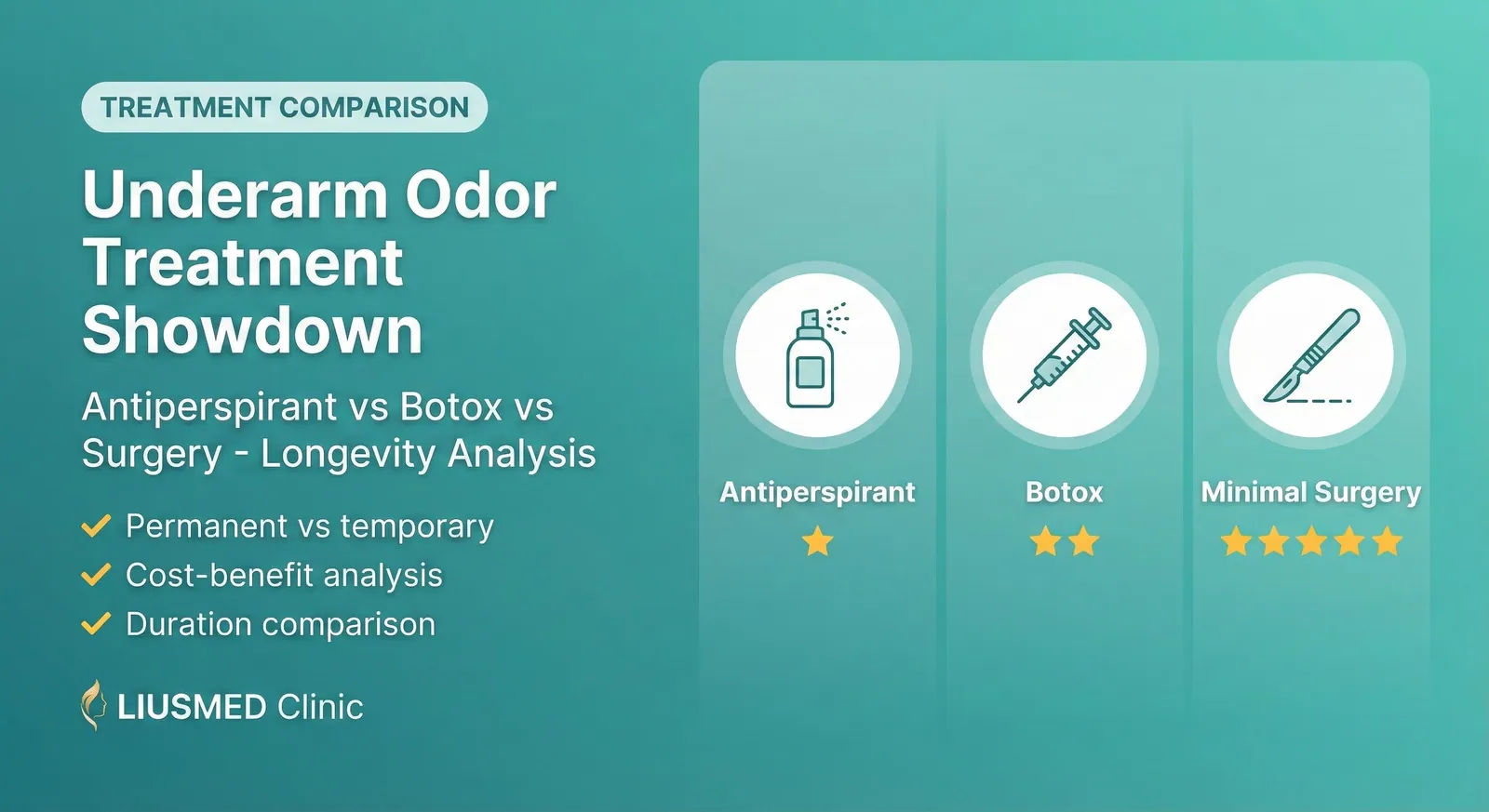
- Underarm Odor: Antiperspirant vs Botox vs Surgery
- Axillary Bromhidrosis
- Midlife Body Odor & Aging Odor Guide
Conclusion
Separating "body odor, sweat smell, and bromhidrosis" is what allows targeted treatment:
- Body odor and sweat odor can usually be managed at the lifestyle level
- Bromhidrosis is a specific-gland-driven lifelong issue; resolving it definitively requires removing the apocrine glands
- All three may coexist; let a doctor identify the dominant smell type before planning the path
If your odor is the kind that returns within hours of showering, runs in the family, or comes with yellow underarm staining, an evaluation may be worthwhile. Dr. Ta-Ju Liu has spent 20 years dedicated to axillary bromhidrosis treatment, with over 10,000 cases — happy to help you clarify the source and your options.
This article is educational. Individual results may vary; actual treatment requires in-person evaluation by Dr. Ta-Ju Liu.