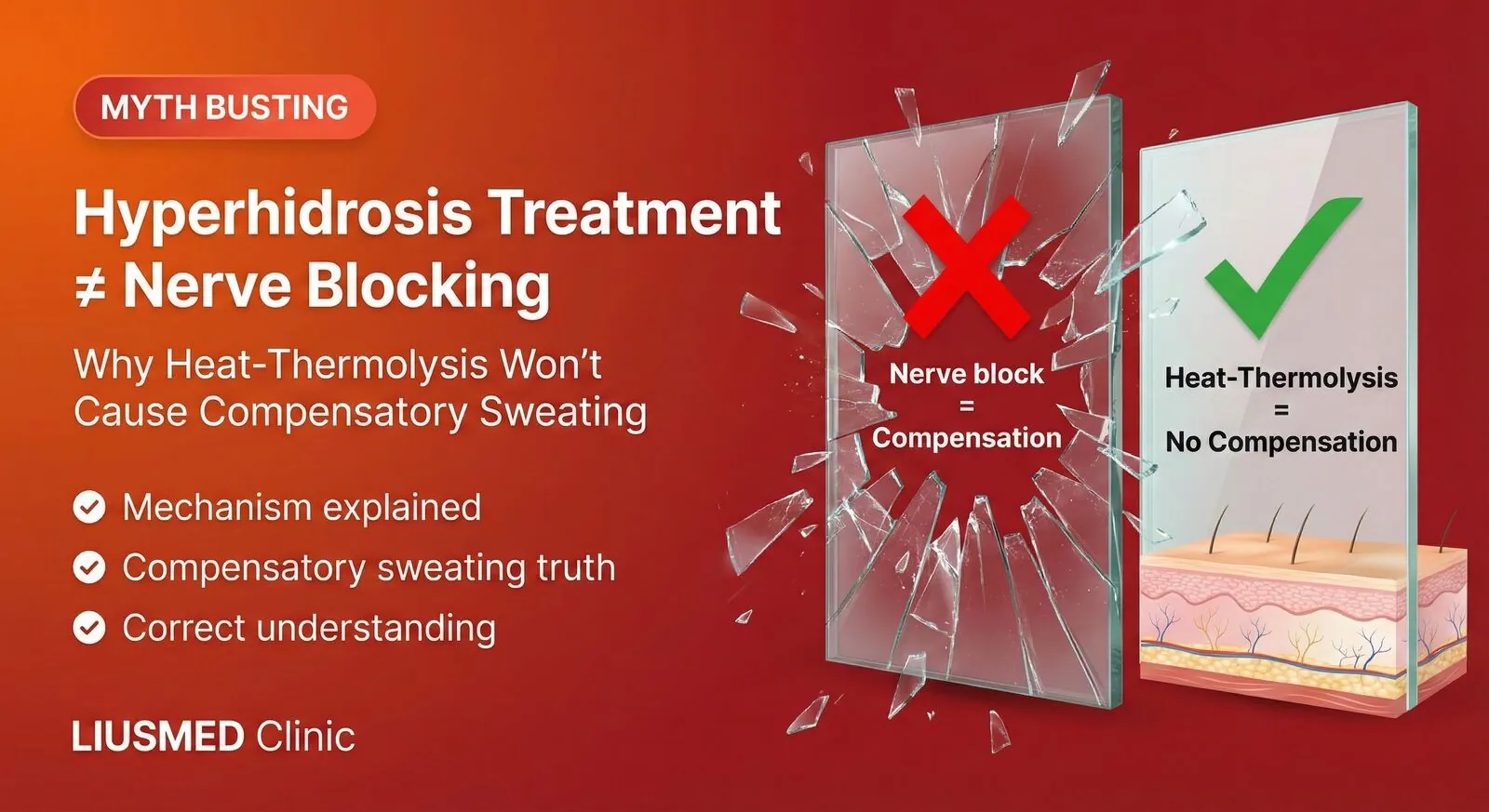
Busting the Biggest Myth: Sweat Gland Thermal Ablation Does NOT Cause Compensatory Sweating
The most common concern patients have when consulting about hyperhidrosis treatment is: "Will surgery cause compensatory sweating?" The answer is: underarm Sweat Gland Thermal Ablation (non-invasive sweat treatment) does NOT cause compensatory sweating because it doesn't touch the nerves at all. This myth stems from confusion between different surgical methods. This article will thoroughly clarify this concept.
Why Does the "Compensatory Sweating" Myth Exist?
It Comes from Sympathetic Nerve Surgery
Compensatory sweating is real, but it only occurs after "sympathetic nerve blocking surgery":
| Surgery Type | Mechanism | Compensatory Sweating Risk |
|---|---|---|
| Endoscopic Thoracic Sympathectomy (ETS) | Cuts or clamps sympathetic nerve ganglia in chest | ⚠️ High (~62%) |
| Sweat Gland Thermal Ablation | Directly destroys sweat glands in skin | ✅ None |
Every compensatory-sweating rate in this article comes from the same source: a meta-analysis of 10 studies and 3,117 patients — overall 62% (95% CI 51–72%), severe 23% (95% CI 12–34%) (PeerJ 2025;13:e19097, PMID 40124609).
The Source of Confusion
Many people hear "hyperhidrosis surgery causes compensation" without distinguishing surgery types:
| Surgery | Treatment Area | Method | Affects Nerves? |
|---|---|---|---|
| ETS Surgery | Palmar/facial sweating | Thoracoscopic nerve cutting | ✅ Yes |
| Sweat Gland Thermal Ablation | Underarm sweating | Thermal energy destroys glands | ❌ No |
💡 Dr. Liu explains: "These are completely different surgeries. Sympathetic nerve blocking treats 'nerves,' thermal ablation treats 'glands.' Only nerve surgery causes compensation—gland ablation doesn't."
What Is Compensatory Sweating?
The Mechanism of Compensatory Sweating
Sympathetic nerves control sweat glands throughout the body. When a nerve segment is cut:
Normal → Brain signals to sweat → Sympathetic nerves transmit → Entire body sweats evenly
After Nerve Cutting → Signal can't reach hands/face → Hands/face stop sweating → Body tries to maintain temperature regulation → Other areas (back, abdomen, thighs) sweat instead → = Compensatory Sweating
Characteristics of Compensatory Sweating
| Characteristic | Description |
|---|---|
| Location | Back, chest, abdomen, thighs |
| Amount | May be more than pre-surgery hand sweating |
| Triggers | Heat, nervousness, exercise |
| Incidence | ~62% after ETS (severe ~23%) |
| Severity | Ranges from mild to severe |
Why Doesn't Sweat Gland Thermal Ablation Cause Compensation?
Completely Different Mechanisms
| Comparison | Sympathetic Nerve Surgery | Sweat Gland Thermal Ablation |
|---|---|---|
| Surgery Location | Inside chest (nerve ganglia) | Underarm skin layer |
| Target | Sympathetic nerves | Sweat/apocrine glands |
| Effect on Nerves | Blocks nerve conduction | No effect |
| Effect on Thermoregulation | Changes sweat distribution | No effect |
| Compensation Risk | High | None |
What Sweat Gland Thermal Ablation Actually Does
- Enter through a needle-sized puncture in the underarm (no incision)
- Deliver heat to the dermis (eccrine glands) and the upper subcutaneous layer just below it (apocrine glands)
- Use thermal energy to destroy sweat/apocrine glands in that area
- No stitches needed for the puncture site
Key Point: Surgery only destroys "glands," not "nerves." Sympathetic nerves remain intact, body's thermoregulation mechanism is unaffected.
⚠️ Critical Distinction: Thermal ablation removes the "sweating equipment," not blocking the "sweating command." So the body doesn't need to and won't compensate through other areas.
Detailed Comparison of Both Surgeries
Surgical Method Comparison
| Item | ETS (Sympathectomy) | Sweat Gland Thermal Ablation |
|---|---|---|
| Anesthesia | General anesthesia | Local anesthesia |
| Incision Location | Through armpit into chest | Needle-sized puncture in underarm (no stitches) |
| Surgical Depth | Deep into chest cavity | Dermis to upper subcutaneous layer |
| Surgery Time | 1-2 hours | 30-40 minutes |
| Hospitalization | Required | Outpatient |
| Recovery Time | 1-2 weeks | 1-2 weeks |
Effect and Risk Comparison
| Item | Sympathetic Nerve Surgery | Sweat Gland Thermal Ablation |
|---|---|---|
| Applicable Areas | Palms, face, underarm | Primarily underarm |
| Effect Duration | Long-Lasting | Long-Lasting |
| Compensatory Sweating | ~62% | None reported (clinic follow-up) |
| Other Complications | More | Fewer |
| Reversibility | Irreversible | — |
Why Do People Still Worry About Compensation?
Information Confusion
Online information often doesn't clearly distinguish between different surgeries:
| Incorrect Statement | Correct Explanation |
|---|---|
| "Hyperhidrosis surgery causes compensation" | Only nerve surgery causes it, thermal ablation doesn't |
| "Other areas will sweat more after surgery" | This is a nerve blocking side effect, unrelated to thermal ablation |
| "Body will find somewhere to compensate" | Thermal ablation doesn't affect thermoregulation, no compensation needed |
Influence of Past Experience
In the 1990s-2000s, sympathetic nerve surgery was the mainstream treatment for hyperhidrosis, and compensatory sweating troubled many patients. This impression persists today, causing current patients to mistakenly think all hyperhidrosis surgeries cause compensation.
Already Have Compensatory Sweating — Can It Still Be Treated?
Yes. Compensatory sweating is no longer a dead end. The cut sympathetic nerve cannot be reconnected, but in the compensatory areas (back, chest, abdomen) the sweat still comes from glands in the skin, and those glands can be treated directly. Based on our clinic records, Sweat Gland Thermal Ablation in post-ETS compensatory areas (beyond the underarm) reduces sweating by about 70% per session. It doesn't touch the nerves, so it doesn't create new compensation.
| Option | Where it acts | Notes |
|---|---|---|
| Sweat Gland Thermal Ablation | Sweat glands in the compensatory area | Needle-sized entry, no stitches; about 70% reduction per session (clinic records); recovery about 1-2 weeks |
| Botox injection | Nerve endings in the compensatory area | Lasts about 3-6 months and needs repeating; large areas need high doses |
| Oral anticholinergic medication | Whole body | Works only while you take it; may cause dry mouth, constipation and other side effects |
| A second ETS | — | Not recommended; ETS is what causes compensation in the first place |
Honestly, there is almost no controlled-trial data on compensatory sweating of the trunk, and most sweat-reduction percentages quoted online come from underarm studies. The location, extent and amount of compensatory sweating differ from person to person, so a doctor should assess it before you decide. See the compensatory sweating treatment page for the procedure and a full comparison.
Clinical Evidence
Clinic Follow-Up Records
Based on our clinic records, after Sweat Gland Thermal Ablation for primary underarm hyperhidrosis, underarm sweating improves by about 80-90%, and our follow-up has recorded no reports of compensatory sweating. These figures come from our own clinical records. There was no control group, and they have not been published in a journal.
| Item | Clinic records |
|---|---|
| Underarm sweating improvement (primary underarm hyperhidrosis, not compensatory) | About 80-90% |
| Sweating reduction in post-ETS compensatory areas (beyond the underarm) | About 70% per session |
| Increased sweating elsewhere after treatment | None reported |
Dr. Liu's Clinical Experience
"In my experience of over 10,000 non-invasive sweat treatments, not a single patient who had underarm thermal ablation developed compensatory sweating. This concern is completely unnecessary for Sweat Gland Thermal Ablation."
Frequently Asked Questions
Q1: Will other areas really not sweat more after thermal ablation?
A1: Correct. Thermal ablation only destroys underarm sweat glands—it doesn't affect the sympathetic nervous system or body's thermoregulation. Sweat glands elsewhere continue working normally and won't "substitute" for the underarm.
Q2: My friend says their back sweats profusely after hyperhidrosis surgery?
A2: Your friend likely had "sympathetic nerve surgery" (ETS, for treating palm or severe facial sweating), not "Sweat Gland Thermal Ablation." These are completely different surgeries—only nerve surgery has compensatory sweating issues.
Q3: If I have both severe palm and underarm sweating, what should I do?
A3: These are different problems requiring separate treatment:
| Area | Recommended Treatment | Compensation Risk |
|---|---|---|
| Palm sweating | Botox/iontophoresis (conservative) | None |
| Palm sweating | ETS surgery (higher risk) | Yes |
| Underarm sweating | Sweat Gland Thermal Ablation | None |
Recommend treating underarm first (no compensation risk); try non-surgical methods for palms first.
Q4: Will I still sweat from my underarms after thermal ablation?
A4: You'll have slight sweating. Sweat Gland Thermal Ablation mainly destroys apocrine glands and some eccrine glands, but the eccrine glands (for temperature regulation) aren't completely removed. Post-surgery, underarms will still have mild normal sweating, but significantly reduced (about 80-90% improvement in underarm sweating, based on our clinic records).
Q5: Is thermal ablation long-lasting?
A5: Yes. Destroyed sweat/apocrine glands don't regenerate—the effect is long-lasting. After adulthood, gland count is fixed; once destroyed, they won't grow back.
Treatment Selection Recommendations
Underarm Hyperhidrosis / Body Odor → Sweat Gland Thermal Ablation (Non-invasive Sweat Treatment)
Advantages:
- ✅ Long-Lasting Effect
- ✅ No compensation risk
- ✅ Local anesthesia, outpatient
- ✅ Quick recovery
Ideal Candidates:
- Excessive underarm sweating
- Underarm odor
- Want long-lasting solution
Palm Sweating → Conservative Treatment First
Recommended Order:
- Topical antiperspirant (aluminum chloride)
- Iontophoresis
- Botox injection
- ETS surgery (last resort, must fully understand compensation risk)
Summary
| Myth | Fact |
|---|---|
| All hyperhidrosis surgeries cause compensation | ❌ Only nerve surgery does |
| Underarm thermal ablation causes compensation | ❌ It doesn't |
| Body will definitely find somewhere to compensate | ❌ Thermal ablation doesn't affect thermoregulation |
| Thermal ablation touches nerves | ❌ Only treats glands |
| Other areas will sweat more after surgery | ❌ Not found in clinical follow-up |
Conclusion: If you want to treat underarm hyperhidrosis or body odor, Sweat Gland Thermal Ablation (non-invasive sweat treatment) is a safe and effective choice—in our experience, you don't need to worry about compensatory sweating.
Related Reading
- Hyperhidrosis Guide: Types, Severity, Treatments & ETS
- Sweating by Area: Palms, Underarms & Feet Treatment
- Hyperhidrosis vs Compensatory Sweating: Before ETS Surgery
- Hyperhidrosis & Compensatory Sweating
Clear Odor Specialist Perspective
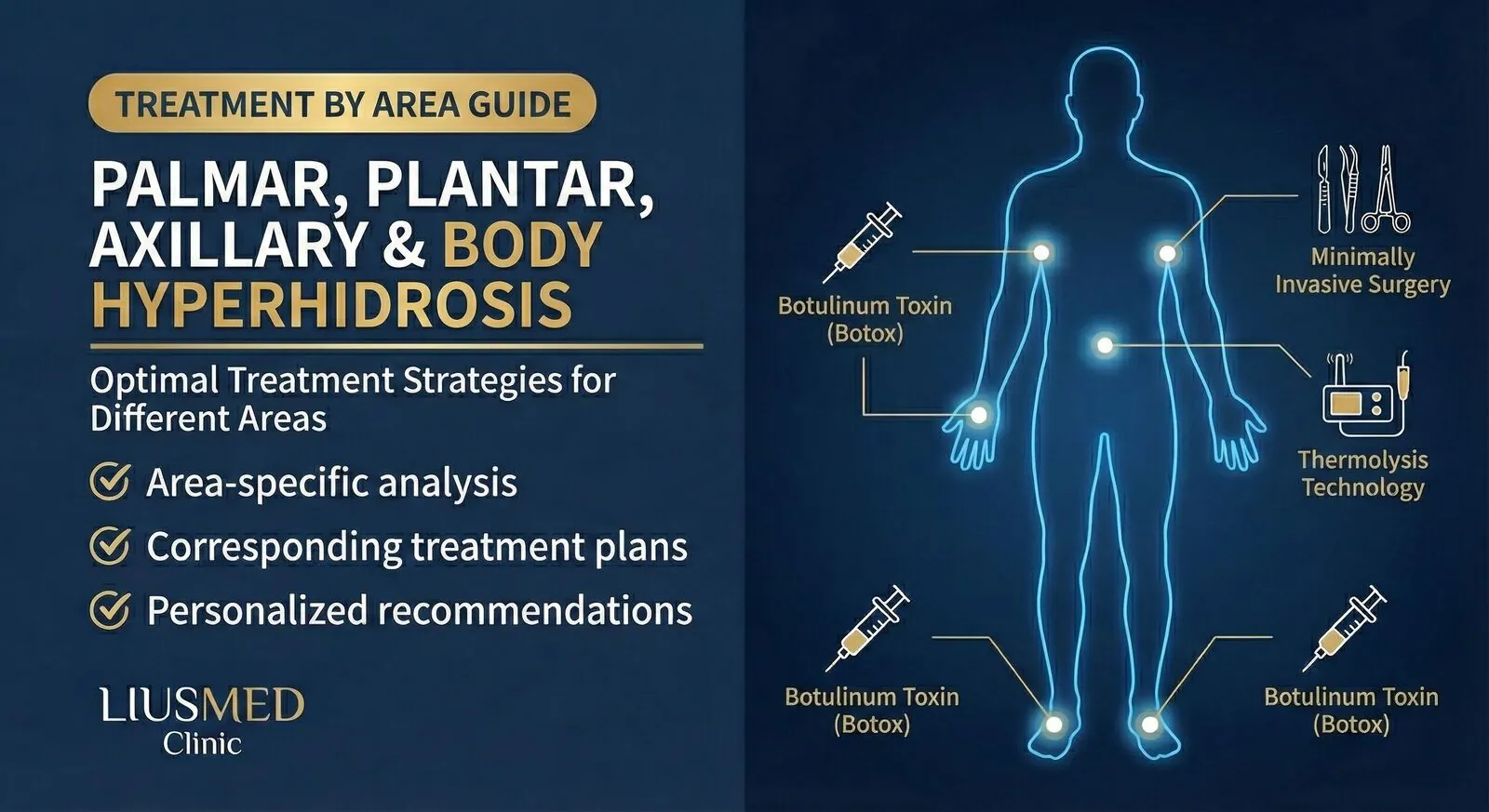
Hyperhidrosis is often conflated with bromhidrosis or anxiety symptoms at general clinics, but at Clear Odor we treat it as a distinct clinical problem. Every patient receives a zone-specific sweat-gland activity assessment (axillary, palmar, plantar, scalp), and the treatment pathway is designed around individual severity and lifestyle — Botox, iontophoresis, sweat-gland thermolysis, or minimally invasive surgery.
We don't push a one-size-fits-all approach. The optimal treatment for hyperhidrosis varies dramatically by body zone, age group, and occupation, and only a clinic that sees hyperhidrosis day in and day out has the case volume to navigate those differences confidently. What Clear Odor offers is not a product — it's a plan tailored to your specific sweating pattern.
Full Treatment Information → · Book a Specialist Consultation →
Conservative care not enough? If sweating is significant and conservative care is not enough, the surgical page explains sweat-gland procedures, evaluated by Dr. Ta-Ju Liu → Visit the surgical page
Related Reading
- Hyperhidrosis Guide: Types, Severity, Treatments & ETS
- Sweating by Area: Palms, Underarms & Feet Treatment
- Hyperhidrosis vs Compensatory Sweating: Before ETS Surgery
- Hyperhidrosis & Compensatory Sweating
About the Author
Dr. Ta-Ju Liu
- Current Position: Director, Clear Odor Clinic
- Specialties: Odor and hyperhidrosis minimal-incision surgery (underarm, areola, perineal bromhidrosis), hyperhidrosis treatment
- Experience:
- 20+ years of specialist experience in odor treatment
- Over 10,000 cases performed, with no recurrence reported on clinical follow-up
- Board-certified dermatologist (Taiwan)
- Philosophy: "Busting myths is a doctor's responsibility. Many patients hesitate due to incorrect information, missing opportunities to improve their quality of life. I hope to help everyone make informed choices through proper education."