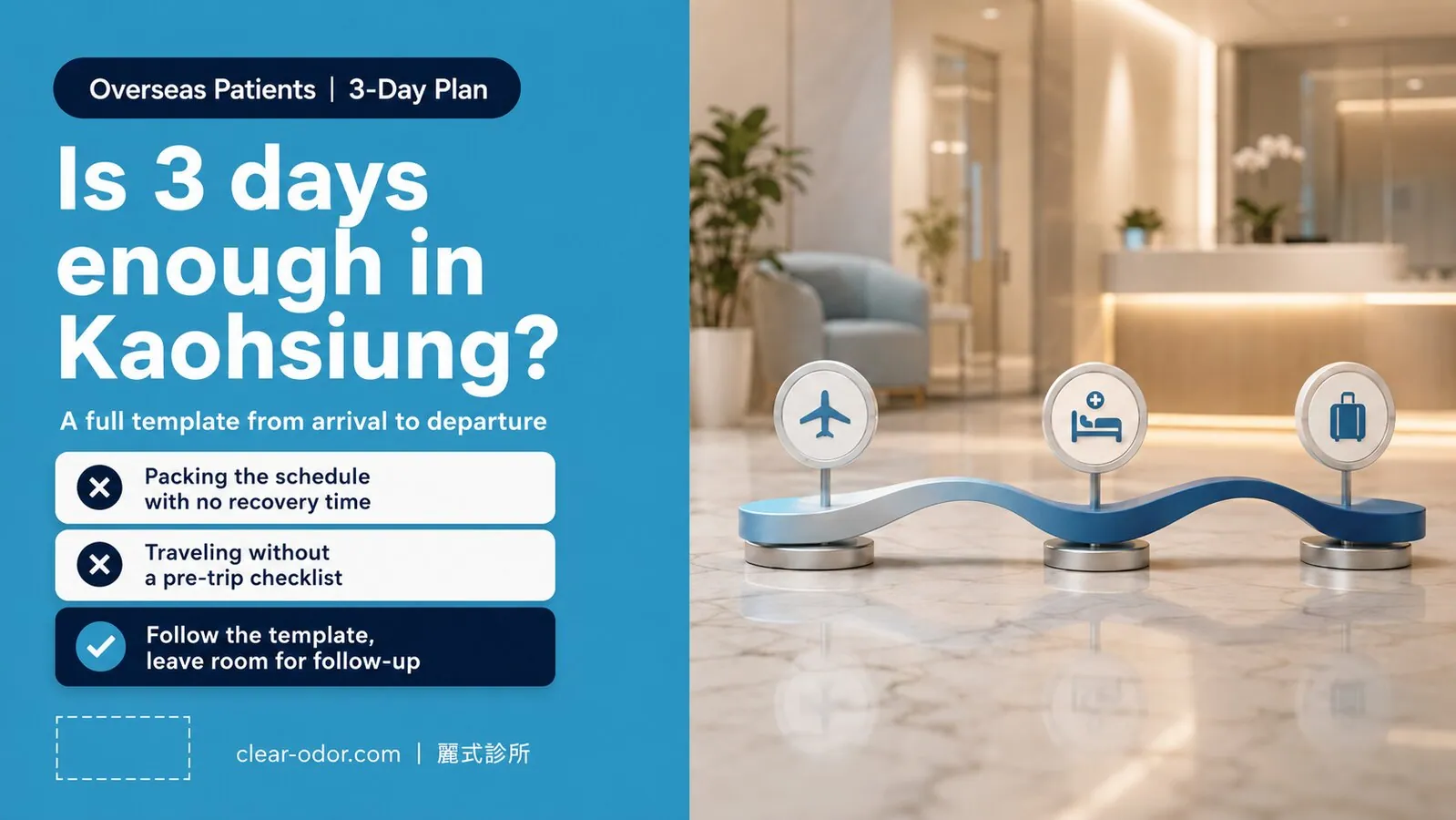
How Long Should You Stay in Kaohsiung for Odor Surgery?
Patients flying in from Hong Kong, Singapore, Japan, Korea, or Malaysia usually ask the same thing first: "How many days do I need?" For rotational curettage, we recommend staying until post-op day 5 and flying home once the gauze is off. The minimum is post-op day 3. If you fly home before stitch removal on day 14, you'll need a special dressing plan (the fee is explained at your consultation).
Dr. Ta-Ju Liu puts it plainly: "If it's rotational curettage, I'd certainly recommend staying until day 5 and going home after the gauze comes off. The minimum is 3 days."
The reason is the gauze. With rotational curettage, the compression is the gauze dressing on your underarm. It comes off at the clinic 3–5 days after surgery, and that ends compression — no compression garment afterward. Until then, resting at your hotel is recommended, and the gauze removal has to be done at the clinic, not at the hotel or the airport. That's why flying home the day after surgery doesn't work.
The sample schedule below assumes surgery the day after you arrive, so you can plan flights, accommodation, and time off.
Schedule at a Glance
Surgery day counts as "post-op day 0"; the next day is post-op day 1, and so on.
| When | What happens | Notes |
|---|---|---|
| Arrival day | Land in Kaohsiung, hotel check-in, afternoon clinic evaluation (~1.5 hrs) | Fasting: no regular or fatty meals 8 hrs, no light solids or dairy 6 hrs, no clear liquids 2 hrs before surgery |
| Surgery day (post-op day 0) | Clinic visit, surgery (~1.5–2 hrs), 1 hr observation, back to hotel | No alcohol; keep the underarms dry |
| Post-op days 1–2 | Rest at the hotel | No sightseeing, no broad arm movement; the clinic schedules any check-ins based on how the wound looks |
| Post-op days 3–5 | Return to the clinic to have the gauze removed and the wound checked | Day 5 recommended; day 3 at the earliest |
| Departure day | Fly home after the gauze is off | Keep arms low; keep the underarms dry |
Recommended vs. minimum stay
| Recommended | Minimum | |
|---|---|---|
| Fly home | After gauze removal on post-op day 5 | After gauze removal on post-op day 3 |
| Time in Kaohsiung (surgery the day after arrival) | About 7 days, 6 nights | About 5 days, 4 nights |
| Best for | Anyone whose schedule allows it; the whole compression period is spent in Kaohsiung | Patients with limited time off |
| Flying home before stitch removal on day 14 | Special dressing plan required (fee explained at your consultation) | Special dressing plan required (fee explained at your consultation) |
The clinic decides the exact day of gauze removal based on the wound. Since it can fall anywhere from post-op day 3 to 5, keep your return flight and hotel booking flexible.
Each stage in detail below.
Arrival Day: Evaluation and Pre-Op Confirmation
Arrive → hotel check-in
Kaohsiung International Airport is about 20–30 minutes from the city center by car. Choose a hotel near the MRT Red Line (Sanduo Shopping District, Formosa Boulevard, Kaohsiung Main Station) for short transit time to the clinic.
Drop off your luggage and head straight to the clinic — no need to spend the whole day resting at the hotel first.
Afternoon clinic evaluation (~1.5 hrs)
Your first clinic visit covers:
- Doctor consultation — Dr. Ta-Ju Liu personally evaluates apocrine gland distribution, family history, lifestyle
- Underarm assessment — skin tension, hair follicle density, presence of co-occurring hyperhidrosis
- Procedure details discussion — confirm the rotational curettage scope, expected outcome, possible recovery discomfort
- Sign consent forms; schedule the next-day surgery slot
- Confirm fasting timing — no regular or fatty meals from 8 hours before surgery, no light solid food or dairy from 6 hours before, and clear liquids such as water until 2 hours before; follow the fasting instructions the clinic sends you
- Confirm gauze removal and suture removal plans — which post-op day the gauze is likely to come off, how to plan your departure, and how the day-14 suture removal will be handled
Dinner and rest
After the evaluation you can have a normal dinner (Kaohsiung has plenty of night markets and restaurants). But regular and fatty meals must stop 8 hours before surgery — for a 9 AM surgery the next day, no meals or late-night snacks after 1 AM; no light solid food or dairy from 6 hours before, and clear liquids such as water are fine until 2 hours before. Follow the exact times in the fasting instructions the clinic sends you.
Get to bed early; avoid alcohol, coffee, energy drinks. Before sleeping, prepare your surgery-day outfit (a loose, button-up top, so you don't have to pull clothing over your head after surgery).
Surgery Day (Post-Op Day 0)
Morning arrival
Arrive at the clinic at the scheduled time, ideally 30 minutes early.
On arrival:
- Reconfirm fasting timing
- Change into surgical gown
- Underarm disinfection, surgical area marking
- Local anesthesia plus gentle pain-relief anesthesia (no general anesthesia needed)
Surgery (~1.5–2 hrs, not counting post-op observation)
Rotational curettage enters through an incision of about 4mm and removes apocrine glands under direct vision; the final wound is about 4–7mm. During the procedure:
- You keep your arms raised
- Each side is treated separately, ~40–45 minutes per side
- You can talk to nursing staff or listen to music
Post-op observation and return to hotel
After surgery:
- 1 hour observation — confirm no bleeding, no dizziness
- Compression gauze dressing — this gauze is the compression; it stays on until it's removed 3–5 days after surgery
- Aftercare guidance — nursing staff explains positioning, hygiene, and medication for your hotel stay
- Receive medication — pain reliever, antibiotics
After returning to the hotel:
- No alcohol; no shower — sponge bathe only and avoid the underarms
- Keep arms naturally lowered; do not raise them or move them broadly
- Sleep on your back; pillows can support your arms
- A hotel with elevators and short walking distances is ideal
Most patients feel underarm tightness and mild pain on the surgery night, manageable with prescribed pain medication.
Post-Op Days 1–2: Rest at the Hotel
Your only job these two days is to rest. Don't plan sightseeing.
- Don't raise your arms high or carry heavy things — avoid pulling on the wound
- Keep the gauze dry: sponge bathe only, no water on the underarms
- Take your medication as prescribed
- The clinic schedules follow-up visits based on how the wound looks; just come in at the agreed time
- If the gauze shows noticeable bleeding, the pain gets worse, or you develop a fever, contact the clinic directly
If a family member is traveling with you, let them handle meals and carrying things these few days. The less you use your arms, the better.
Post-Op Days 3–5: Gauze Removal at the Clinic
Removing the gauze
Return to the clinic at the scheduled time. The doctor checks the wound and removes the gauze. Once the gauze is off, compression is over — no compression garment afterward.
- Recommended: stay until post-op day 5 and fly home after the gauze is off
- Minimum: gauze removal on post-op day 3, the earliest point it can come off
While you wait for gauze removal, keep resting: stay near the hotel and avoid anything that needs a lot of arm movement.
Aftercare sheet
On gauze-removal day you'll receive a 4-language aftercare sheet (zh-TW / en / ja / ko), and you can reconfirm how your day-14 suture removal will be handled.
Departure Day: Flying Home
Once the gauze is off, you can fly home as planned.
- Keep arms lowered, no broad raising (avoid over-stretching the wound)
- Standard airport security is fine (no implants involved with rotational curettage)
- An aisle seat is recommended so bathroom trips don't require reaching; ask cabin crew or a travel companion to lift bags into the overhead bin
- During the flight, gently move your feet and fingers to avoid circulation issues from sitting still
If you have a long-haul flight or other health conditions, talk through your return plans with the doctor before you travel.
Sutures and Showering: What to Know After You're Home
- Suture removal on day 14: most overseas patients are back home by then. Confirm the suture removal arrangement with the clinic before you travel.
- Normal showering: only after the day-14 suture removal and once the clinic confirms the wound has healed (you can send wound photos to the clinic); slower healers may need another 2–3 weeks. Until then, sponge bathe only and keep the underarms dry.
- Going back to work: you can return to work once the gauze is off, as long as you watch your arm movements, look after the wound, and keep it dry.
Pre-Trip Checklist
Essential:
- Passport, flight tickets (keep the return date flexible), immigration form
- Cash: the clinic accepts cash only on site (NT$, US$, HK$ or KRW); credit cards are not accepted
- Loose, button-up tops ×3–4 (a longer stay; no pullovers, nothing tight-fitting)
- Prescription medications (e.g., daily blood pressure or diabetes meds — inform the doctor in advance)
- Personal toiletries
Recommended:
- Large towel (for sponge baths after surgery)
- Charger, power bank
- Translation app or dictionary (the clinic provides 4-language support, but a backup helps)
Not needed:
- Medical dressings (clinic provides)
- Pain meds, antibiotics (clinic prescribes)
Hotel and Dining Recommendations
Hotel selection priorities:
- Close to the clinic (10-min walk or 1–2 MRT stops)
- Has elevators (arm movement is limited after surgery; avoid stairs)
- Private bathroom in the room
- Flexible extensions (gauze removal may fall anywhere from post-op day 3 to 5)
- A convenience store nearby or food delivery available, so you can stay in on rest days
Dining notes:
- Arrival evening: normal dining, but avoid alcohol and very spicy food
- Surgery day: fast before surgery; light meal in the evening
- Rest days: eat normally; delivery or hotel meals keep trips outside to a minimum
Language Support and Follow-Up
In-clinic 4-language support
The clinic offers consultation in zh-TW / en / ja / ko. Overseas patients can:
- Consult before the trip via LINE / Email in their native language
- Use translation support during in-person visits
- Receive a 4-language aftercare sheet
Remote post-op follow-up
Going home doesn't end follow-up. The clinic schedules:
- Day 7 post-op: LINE 1-on-1 review (send wound photos)
- Day 14 post-op: Suture removal — confirm the arrangement with the clinic before you travel; afterward you can send the clinic wound photos, and normal showering starts only once healing is confirmed (keep the underarms dry until then)
- 1 month post-op: photo review of skin flap recovery
- 3 months post-op: another photo review confirming no recurrence signs
- Long-term follow-up: optional revisits at year 1, year 5, year 10 (most overseas patients handle this remotely via photos)
FAQ
Can I shorten the trip and fly home the day after surgery?
No. With rotational curettage, the gauze comes off on post-op day 3 at the earliest, and removal has to happen at the clinic — not at the hotel or the airport. So the minimum is staying until post-op day 3 for gauze removal. If your schedule allows, stay until post-op day 5 and fly home after the gauze is off.
Why stay until day 5 instead of leaving on day 3?
The gauze comes off sometime between post-op days 3 and 5, and the clinic decides the exact day based on the wound. Staying until day 5 means the gauze can come off in Kaohsiung whichever day that turns out to be, and you spend the whole compression period here. Book only through day 3 and your return flight has no room to adjust.
Can a family member come along?
Yes — and you need one. Gentle pain-relief anesthesia is used on surgery day, so please arrange for a friend or family member to take you back, and do not drive or ride a scooter that day. Having someone with you on surgery day helps with luggage and getting back to the hotel (arm motion is restricted post-op), and on rest days they can pick up meals and carry things. It makes the whole trip much smoother. Family members don't enter the surgery room; they can wait in the clinic's waiting area.
Any hotel suggestions on a tight budget?
Kaohsiung business hotels are affordable, with many options along the MRT Red Line (Sanduo, Central Park, Formosa Boulevard). The key isn't star rating — it's "close to the clinic + has elevators." With your arms restricted after surgery, every 5 minutes of walking you save matters. Since the stay is longer, check whether you can extend flexibly.
When can I go back to work?
Arm motion is restricted for at least 2 weeks after rotational curettage — no overhead arm motion, no weight training, no swimming. Rest until the gauze comes off (post-op day 3–5), which for overseas patients is the time spent in Kaohsiung anyway. After that you can go back to work, as long as you watch your arm movements, look after the wound, and keep it dry. Some patients take the full 14 days until suture removal. If your work involves heavy lifting or large arm motion, talk it through with the doctor first.
Sutures come out on day 14 — what if I'm already home?
Confirm the suture removal arrangement with the clinic before you travel, and ask again at your evaluation. Until the sutures are out, sponge bathe only and keep the underarms dry; afterward, send wound photos to the clinic, and start normal showering once healing is confirmed.
What if there's a problem after I return home?
If you notice wound redness, fever, or unusual discharge after returning home, send photos to the clinic via LINE right away — the doctor will assess whether local care or a return visit is needed. Most situations can be guided remotely. For emergencies needing local treatment, the clinic can provide an English medical summary for your local doctor's reference.
Conclusion
For overseas patients coming to Kaohsiung for rotational curettage:
- Recommended: stay until post-op day 5 and fly home after the gauze is off (about 7 days, 6 nights if surgery is the day after arrival)
- Minimum: stay until gauze removal on post-op day 3 (about 5 days, 4 nights)
- Flying home the day after surgery doesn't work
The order is arrival and evaluation → surgery → rest at the hotel on post-op days 1–2 → gauze removal at the clinic on post-op days 3–5 → flight home. Confirm how the day-14 suture removal will be handled before you travel. Pack loose button-up tops, prescription medications, and cash, and keep your return flight and hotel flexible.
If you're planning a trip to Kaohsiung for surgery, Dr. Ta-Ju Liu's team can help arrange the pre-op consultation, confirm a surgery slot, and provide hotel and transit suggestions. With 20 years dedicated to axillary bromhidrosis treatment and over 10,000 cases, the team is happy to help you plan the whole trip.
Related Reading
- Bromhidrosis Surgery Cost in Taiwan: How to Compare Clinics
- How Long Is Underarm Odor Surgery Recovery? Aftercare Guide
- Underarm Odor: Antiperspirant vs Botox vs Surgery
- Axillary Bromhidrosis
- International Patients
This article is educational. Individual results may vary; actual treatment requires in-person evaluation by Dr. Ta-Ju Liu.