"Will what I ate yesterday come out in my sweat today?"
It's one of the most common questions I hear in clinic. The morning after a heavy garlic dinner, a steak, or a few glasses of wine, patients often wonder whether their body is broadcasting last night's meal.
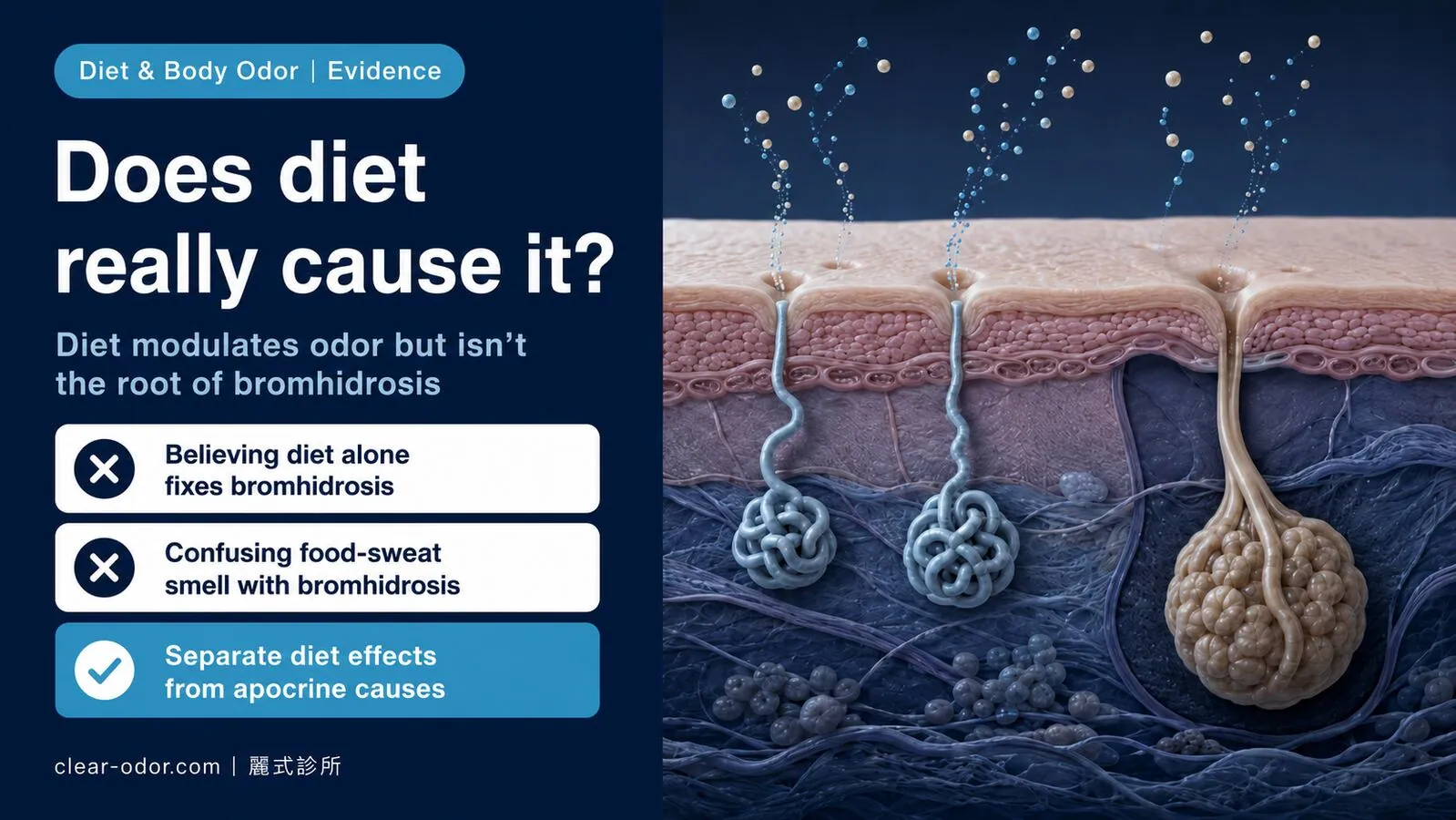
The honest answer: yes, diet does modulate body odor in the short term — but it is rarely the root cause of clinical axillary bromhidrosis. Mixing these two ideas together leads many people to chase elaborate "elimination diets" that never solve the underlying problem.
This article walks through the actual biology, the foods that genuinely affect body odor (with evidence), the myths that don't hold up, and one rare but real condition where diet truly is the cause: trimethylaminuria, the so-called fish odor syndrome.
How does the food you eat actually "get into" your sweat?
Volatile molecules from food enter your bloodstream after digestion and leave mainly through breath, urine, and sweat and skin. Diet can shift how underarm odor is perceived in the short term, but no study has shown that changing your diet makes bromhidrosis go away.
When you eat, volatile compounds from digestion enter the bloodstream and are excreted through three main routes:
- Breath (volatile molecules cross the alveolar membrane in the lungs)
- Urine (kidney filtration)
- Sweat and skin (the whole skin surface, where eccrine sweat glands are distributed)
Eccrine glands are everywhere — palms, soles, forehead, back, chest. They secrete a mostly watery fluid carrying electrolytes and small amounts of volatile metabolites. After people ate grilled garlic, allyl methyl sulfide (AMS) released from forearm skin peaked at about 30 minutes and then declined gradually (Sato 2020, PMID 31949194). Garlic metabolites in urine were highest 1–2 hours after eating, with a second rise at 6–8 hours in some participants (Scheffler 2019, PMID 31111029).
But here's the critical distinction: - Clinical bromhidrosis (the "B.O." that brings patients to a doctor) originates from apocrine glands, concentrated in the underarms, areola, groin, and external ear canal. - Apocrine secretions are odorless until skin bacteria break them down into the characteristic odor compounds. - Whether you have bromhidrosis is set by genetics and hormones, and no study has shown that diet makes it disappear. That said, small studies have found that ratings of underarm pad odor change with diet (see the garlic and red meat sections below), so it would be wrong to say diet has no effect on underarm odor at all.
Bottom line: diet ≈ a short-term modulator on top, not the root source of axillary bromhidrosis.
Does eating garlic make your armpits smell like garlic?
Garlic odor comes out mainly on the breath; the evidence that garlic makes underarm odor worse is weak, and the one direct study points the other way.
Right after eating garlic, the smell on your breath comes from your mouth. Later, allyl methyl sulfide (AMS) absorbed in the gut is exhaled through the lungs: in a study of 5 people who ate 6 g of garlic, AMS was the main sulfur gas in breath after 3 hours (Suarez 1999, PMID 9950816). AMS is barely metabolized by the gut or liver, which is why garlic breath a few hours later doesn't respond much to brushing.
Underarm odor went in the opposite direction. In a Czech study, 42 men wore underarm pads for 12 hours during a garlic period and a no-garlic period, and 82 women rated the samples. The first raw-garlic experiment showed no difference; after an increased garlic dose, underarm odor was rated more pleasant, more attractive, and less intense (Fialová 2016, PMID 26551789). The authors suggested garlic's antioxidant and antimicrobial properties as a possible reason, but that mechanism is unproven.
So the morning after a garlic dinner, your breath is the more likely concern. The study involved a few dozen men and measured how pleasant the odor seemed, so it can't tell us whether people with bromhidrosis would see the same result.
My armpits smell like onions or garlic. Is it something I ate?
An onion-like underarm smell usually comes from the components of bromhidrosis odor itself, not from food. Underarm secretions start out odorless; skin bacteria (Corynebacteria) break them down into sulfur-containing thiols called sulfanylalkanols, whose smell has been described as "pungent sweat/kitchen odor, also reminiscent of onions" (Natsch 2004, PMID 17191898). If the same smell persists after you cut out garlic and onions, look at the apocrine glands before adjusting your diet further. See Axillary Bromhidrosis for details.
Which foods actually have evidence of affecting body odor?
Only red meat and garlic have studies that directly rated underarm odor, and both are Czech studies of a few dozen men. For alcohol, 35–45% of East Asians carry an ALDH2 variant that slows acetaldehyde breakdown (PMID 27650066), so reactions vary widely; cruciferous vegetables, fenugreek, and curry spices can also change odor, but mostly in the short term and with large individual variation.
Allium family — garlic, onion, leek, shallot, scallion
Allicin in garlic is metabolized to allyl methyl sulfide (AMS), a small sulfur molecule that is barely broken down by the gut or liver and is exhaled on the breath (PMID 9950816). What the research shows about underarm odor is covered above in "Does eating garlic make your armpits smell like garlic?"
Characteristics:
- Distinct sulfurous, "lingering pot" quality; from the mouth right after eating, from the breath a few hours later
- AMS is also released from the skin (peaking about 30 minutes after eating grilled garlic, PMID 31949194)
- Breath odor a few hours later comes from gut-absorbed compounds, so brushing alone does little
Red meat
One study found that underarm odor was rated somewhat better without red meat. Seventeen Czech men each followed a "meat" and a "non-meat" diet for two weeks, a month apart, wearing underarm pads for the final 24 hours of each diet. Thirty women not using hormonal contraception rated the samples, and odor on the non-meat diet was judged more attractive, more pleasant, and less intense (Havlicek 2006, Chem Senses, PMID 16891352). It is a single small study, and it measured how appealing the odor was, not whether bromhidrosis improved.
Possible mechanisms:
- Specific amino acids and carnitine derivatives metabolize into volatile compounds excreted in sweat
- Higher protein turnover increases nitrogenous metabolite output
Caveat: this is a population-level statistical signal, not a guarantee. Individual variation is substantial — many heavy meat eaters have no noticeable odor change.
Alcohol
Ethanol is metabolized in the liver to acetaldehyde, then to acetate. The ALDH2*2 variant affects 35–45% of East Asians (about 560 million people) and slows acetaldehyde breakdown, causing the "Asian flush" (Van Wassenhove 2016, PMID 27650066). When acetaldehyde accumulates, it:
- Causes facial flushing (skin vasodilation)
- Affects breath (the well-known hangover breath)
Individual variability is huge — one glass of wine produces nothing in some people and 12 hours of persistent odor in others.
Cruciferous vegetables — broccoli, cabbage, brussels sprouts, kale
Sulfur-containing amino acids (methionine, cysteine) produce small amounts of volatile sulfur compounds during digestion. The effect is noticeably milder than allium foods and rarely reaches the threshold of social detection at normal portions. For people with trimethylaminuria it is the opposite: brassicas contain choline, and their indoles inhibit the FMO3 enzyme, so they are on the list of foods to limit (GeneReviews, PMID 20301282).
Fenugreek
An interesting case. The sotolon in fenugreek can give urine, sweat, feces, and possibly breast milk a distinctive maple-syrup sweetness (LactMed, PMID 30000838). When mothers took fenugreek during labour, their newborns developed the same odor, which led to a false suspicion of maple syrup urine disease (Korman 2001, PMID 11532065).
Curry, cumin, and heavily spiced cuisines
Sulfur compounds and volatile essential oils do appear in sweat. But here's a cultural observation: populations who eat these foods daily are "baseline-adapted" — observers who share the diet generally don't perceive the body odor as unusual. Perception is partly cultural calibration.
Do sugar, dairy, coffee, or "detox diets" really cause B.O.?
Mostly no consistent evidence — sugar, dairy, and coffee at most briefly affect breath or how much you sweat, without changing the apocrine gland chemistry that drives B.O.; and no diet or "detox" can reset the genetics-plus-hormones that set apocrine activity.
Myth 1: Eating too much sugar causes body odor
Reality: No consistent human evidence supports this. Uncontrolled diabetes can cause ketoacidosis, which produces a fruity (acetone) odor in breath and sweat — but that's a disease state, not the consequence of dietary sugar. Normal sugar intake has minimal effect on body odor.
Myth 2: Dairy causes body odor
Reality: Aside from lactose intolerance (which produces intestinal gas — flatulence and breath issues, not axillary odor), dairy has little impact on apocrine bromhidrosis. Anecdotal "I cut dairy and my B.O. improved" stories usually involve simultaneous changes to other variables.
Myth 3: Coffee causes chronic body odor
Reality: Caffeine briefly stimulates eccrine sweating and can intensify breath odor in the short term, but it does not alter apocrine gland chemistry. Heavy coffee drinkers may sweat more (and thus dilute or carry odor more), but coffee itself is not a source of chronic body odor.
Myth 4: "Detox diets" can reset bromhidrosis
Reality: Apocrine gland activity is set by genetics and hormones — no juice cleanse, colon flush, or detox protocol can change this basic biology. Reports of "odor disappearing after detox" are typically placebo effects or coincide with other changes (better hygiene, antiperspirant use, weight loss reducing skin folds).
Does fasting or dieting change body odor?
After 48 hours of complete fasting (water only), underarm odor was rated no differently in pleasantness or intensity than at baseline; 72 hours after eating resumed, it was rated more pleasant and less intense (healthy women, Fialová 2019, PMID 31130296). If you notice a fruity, acetone-like smell on your breath or body while dieting, that may be ketones rather than underarm odor. See Fruity Breath & Diabetic Ketoacidosis: Spotting DKA Early to tell them apart.
Is there ever a case where diet truly IS the cause of body odor?
Yes, but it's rare — trimethylaminuria ("fish odor syndrome") results from a deficient liver FMO3 enzyme that can't clear the trimethylamine made by gut bacteria, so a strong rotting-fish odor exits via breath, sweat, and urine and tracks closely with choline- and carnitine-rich foods and with seafood. This is a completely different mechanism from ordinary underarm bromhidrosis.
Trimethylaminuria (TMAU), commonly known as "fish odor syndrome," is a rare but genuinely diet-driven condition.
Mechanism
Normally, gut bacteria break down dietary choline, carnitine, and lecithin into trimethylamine (TMA). The liver's FMO3 enzyme then oxidizes TMA into the odorless trimethylamine-N-oxide (TMAO), which is excreted in urine. Seafood such as fish, cephalopods, and crustaceans already contains TMAO and is also on the list of foods to limit (PMID 20301282).
When FMO3 activity is deficient:
- TMA accumulates in the body
- Gets excreted via breath, sweat, and urine
- Produces a strong rotting fish odor
Trigger foods
Foods high in choline and carnitine worsen symptoms:
- Fish (especially saltwater), cephalopods, and crustaceans: contain TMAO (PMID 20301282)
- Egg yolks
- Peas, beans, peanuts, and soy products
- Organ meats and red meat
- Brassicas (Brussels sprouts, broccoli, cabbage, cauliflower): contain choline, and their indoles inhibit FMO3 (PMID 20301282)
Distinguishing TMAU from common bromhidrosis
| Feature | Trimethylaminuria | Axillary bromhidrosis |
|---|---|---|
| Odor character | Rotting fish, decomposing seafood | Pungent, sour, "onion-sweat" |
| Location | Whole body (breath, sweat, urine) | Mainly underarms |
| Mechanism | Hepatic enzyme deficiency | Apocrine glands + skin bacteria |
| Diet relevance | Direct (cornerstone of treatment) | Modulator only |
| Diagnosis | Urinary TMA/TMAO ratio | Clinical exam + history |
| Treatment | Low-choline diet, antibiotics, activated charcoal | Antiperspirant, botulinum toxin, surgery |
Can fish odor syndrome be cured?
There is currently no cure; treatment focuses on keeping the odor down over the long term. Primary trimethylaminuria is an autosomal recessive condition caused by FMO3 gene variants, and the measures GeneReviews lists all aim at reducing odor over the long term. Besides the dietary limits above, they include washing with acidic soaps and body lotions, activated charcoal and copper chlorophyllin to bind trimethylamine made in the gut, antibiotics to reduce gut bacteria, and riboflavin to support residual FMO3 activity (PMID 20301282). Cutting choline too hard causes nutritional problems, so the same source advises planning the diet so choline and folate intake meets recommendations, with no choline restriction during pregnancy or breastfeeding (PMID 20301282). For diagnosis and diet management, see TMAU (Fish Odor Syndrome): FMO3 Genes, Diagnosis & Diet.
If you suspect TMAU rather than ordinary bromhidrosis — a fishy odor that exits via breath and whole-body skin, strongly tied to specific meals — see a physician for urinary testing rather than self-diagnosing.
If your body odor changed suddenly with no link to food, or comes with other symptoms, start with Sudden Strange Body Odor or Breath? 5 Disease Red Flags.
When is adjusting your diet actually worth a try?
It's most worth trying when odor is mild and clearly tracks specific meals; the method is a 2-week food diary, cutting allium, red meat, and alcohol first, then reintroducing one at a time. For moderate-to-severe, one-sided, or puberty-driven apocrine B.O., diet does little — the mainstay stays antiperspirant → botulinum toxin → surgery.
Worth trying when:
- Mild axillary odor (grade 1–2) — faint, only occasionally noticed at close range
- Odor clearly tracks specific meals — noticeably worse each time you eat particular foods
- You prefer to start conservative before considering other treatments
Suggested approach:
- Two-week food diary: log every meal, alcohol, snack; rate your perceived odor 1–5 each day
- Eliminate three categories at once: cut garlic/onion, red meat, and alcohol for two weeks and observe
- Reintroduce one at a time: if odor improved, add foods back individually to identify the main driver
Not the right approach when:
- Persistent moderate-to-severe odor (grade 3+) — strong, detectable at social distance, present regardless of diet
- Unilateral or focal odor (e.g., only the left underarm) — classic apocrine pattern; diet has limited effect
- Adolescent-onset odor that intensifies with puberty — hormone-driven apocrine activation, not reversible by diet
For moderate-to-severe bromhidrosis, the treatment ladder remains: antiperspirant → botulinum toxin → minimally invasive surgery. Diet is, at best, a secondary lever. See the Bromhidrosis Guide: Causes, Diagnosis, Treatment & Recovery for full options.
FAQ
I ate a lot of garlic yesterday — how long will the smell last?
Garlic metabolites peak 1–2 hours after eating, and some people show a second rise at 6–8 hours. That comes from analysing 19 sets of urine samples, and peak levels differed between people by up to tenfold (Scheffler 2019, PMID 31111029). AMS released from the skin peaked about 30 minutes after eating grilled garlic and then declined (PMID 31949194), and AMS was the main sulfur gas on the breath after 3 hours (PMID 9950816). Odor a few hours later comes from gut-absorbed compounds, so brushing and showering help only a little. Before an important event, cutting back on garlic and onion ahead of time is the practical approach.
I've been vegan for a year and my bromhidrosis hasn't improved — why?
A vegan diet can reduce the "red-meat modulator" component, but it cannot change baseline apocrine secretion. If your odor is moderate to severe and persistent, the issue is apocrine gland chemistry and skin bacteria — not meat metabolism. Diet has a ceiling for moderate-to-severe bromhidrosis, and clinical evaluation for other treatment options is recommended.
Does drinking alcohol make my sweat smell the next day?
Alcohol on the breath the next day is common, but evidence that the sweat itself smells stronger is lacking, and individual variation is large. People with the ALDH2 variant (Asian flush phenotype) clear acetaldehyde more slowly and react more strongly to alcohol. If you notice this pattern in yourself, avoiding alcohol the night before important occasions is a simple and effective measure.
Does drinking milk cause body odor?
For most people, no. Unless you have lactose intolerance (which produces intestinal gas — not axillary odor), dairy does not alter the intensity of apocrine bromhidrosis.
Are there supplements that reduce body odor?
Chlorophyll, perilla extract, and activated charcoal have some anecdotal reports for mild odor management, but evidence is limited and individual variation is high. For moderate-to-severe bromhidrosis, supplements offer little real benefit. Focus on fundamentals (hygiene, antiperspirant) first; consider supplements only as adjuncts.
Will coffee make my body odor worse?
Caffeine temporarily stimulates eccrine sweating and can intensify breath odor, but it does not change chronic body odor character. Heavy coffee drinkers who report stronger odor are usually noticing the secondary effect of sweating more — not coffee directly altering apocrine chemistry.
Are there foods that make body odor smell better?
The evidence that any food makes body odor "better" comes down to a few small studies. Underarm odor was rated more favorably after two weeks without red meat (PMID 16891352) and after an increased garlic dose (PMID 26551789), but both were Czech studies of a few dozen men and measured how appealing the odor was. For moderate or worse bromhidrosis, there is a limit to what diet can do.
Conclusion
Diet does affect body odor — but it operates on a different layer than clinical bromhidrosis:
- What diet can change: a short-term "added layer" of odor, especially from allium, alcohol, and red meat
- What diet cannot change: the baseline character of apocrine secretion (genetics + hormones)
- The rare exception: trimethylaminuria — a genuinely diet-driven metabolic condition diagnosed via urine testing
For mild odor complaints, a two-week food diary plus a structured elimination is a reasonable first step. For moderate-to-severe bromhidrosis, diet adjustment is not the answer — clinical evaluation is the better path to identify whether your odor source is glandular, microbial, or metabolic. Dr. Ta-Ju Liu has over 20 years of experience treating axillary odor and over 15 years treating hyperhidrosis, with over 10,000 cases, and can help you separate the "dietary noise" from the underlying chemistry. Individual outcomes vary.
Related Reading
- Bromhidrosis Guide: Causes, Diagnosis, Treatment & Recovery
- 5 Bromhidrosis & Sweat Myths vs the Facts
- Underarm Odor: Antiperspirant vs Botox vs Surgery
- Axillary Bromhidrosis
- Hyperhidrosis & Compensatory Sweating
- How to Tell Three Body Odors Apart: Aging, Bromhidrosis, Sweat
- Do IV Drips Help Body Odor? What to Know Before You Try
- Body Odor After GLP-1 Weight-Loss Meds? 3 Changes to Know
- Midlife Body Odor & Aging Odor Guide
This article is for educational purposes. Individual outcomes vary. Suitability for any specific treatment requires in-person evaluation by Dr. Ta-Ju Liu.