"Doctor, does this surgery actually work?" It's the question I hear most often in clinic.
People usually ask because they've already done their homework. Search online and you'll find someone calling it a once-and-for-all fix, and someone else saying they paid for the operation and still smell. How can the same surgery produce two completely opposite stories?
To answer that, we need to shift the angle a little. Bromhidrosis, the way I see it, is a matter of "present or absent" — not "reduced by how much." That shift is what decides whether you'd call a given treatment "effective."
30 Seconds: What Bromhidrosis Surgery Is Actually Trying to Solve
There's a plain test for whether a treatment worked: afterwards, are you still afraid of being smelled?
What bromhidrosis really changes is rarely the smell in the abstract — it's behaviour. Reaching for something on a high shelf, holding the overhead strap on the train, raising a hand in class: those everyday movements get quietly avoided. Not because you don't want to, but because you have to think first, every time. The short video below is about exactly that, and it's the line I repeat in clinic: the odor is present or absent, not reduced by some percentage, and what decides the result is less how new the instrument is than the willingness to spend the time clearing the apocrine glands until nothing is left behind.
How the operation itself runs — the minimally invasive rotational curettage used to clear the apocrine glands, and what recovery involves — is set out on the underarm bromhidrosis surgery page. If your child is still school-age and you're weighing whether to treat it and whether a school holiday is the better window, see the pediatric bromhidrosis page. If you're still working out which condition you're dealing with, the conditions reference covers definitions, common symptoms, and when to see a doctor for underarm bromhidrosis and odor at other sites. Bromhidrosis is also highly heritable and often a whole family's business — when the whole family has it goes into that properly.
What does "effective" even mean? — "Present or absent" vs "reduced by X%"
When most people ask "does it work," what they really have in mind is "by how much": is halving the odor enough? Is an 80% reduction good enough?
But odor is unforgiving. At 80% reduced, in many situations the people around you can still smell it, and your shirt can still pick up that yellowish underarm stain. For the person living with it, the gap between "still detectable" and "no smell at all" isn't a 20% difference — it's the difference between "the problem is still here" and "the problem is solved."
So for more than twenty years, from the very first operation of this kind I performed, I've held to the same goal: clear the odor, rather than lower it a little. Not "much improved," but back to "absent."
Key point: Bromhidrosis deserves to be judged as "present or absent," not "reduced by how much." A treatment that cuts the smell in half looks great on paper, but for someone who can still detect it, the problem hasn't really left.
Why do some people say it "didn't work"? — Methods differ, and the reduction varies a lot
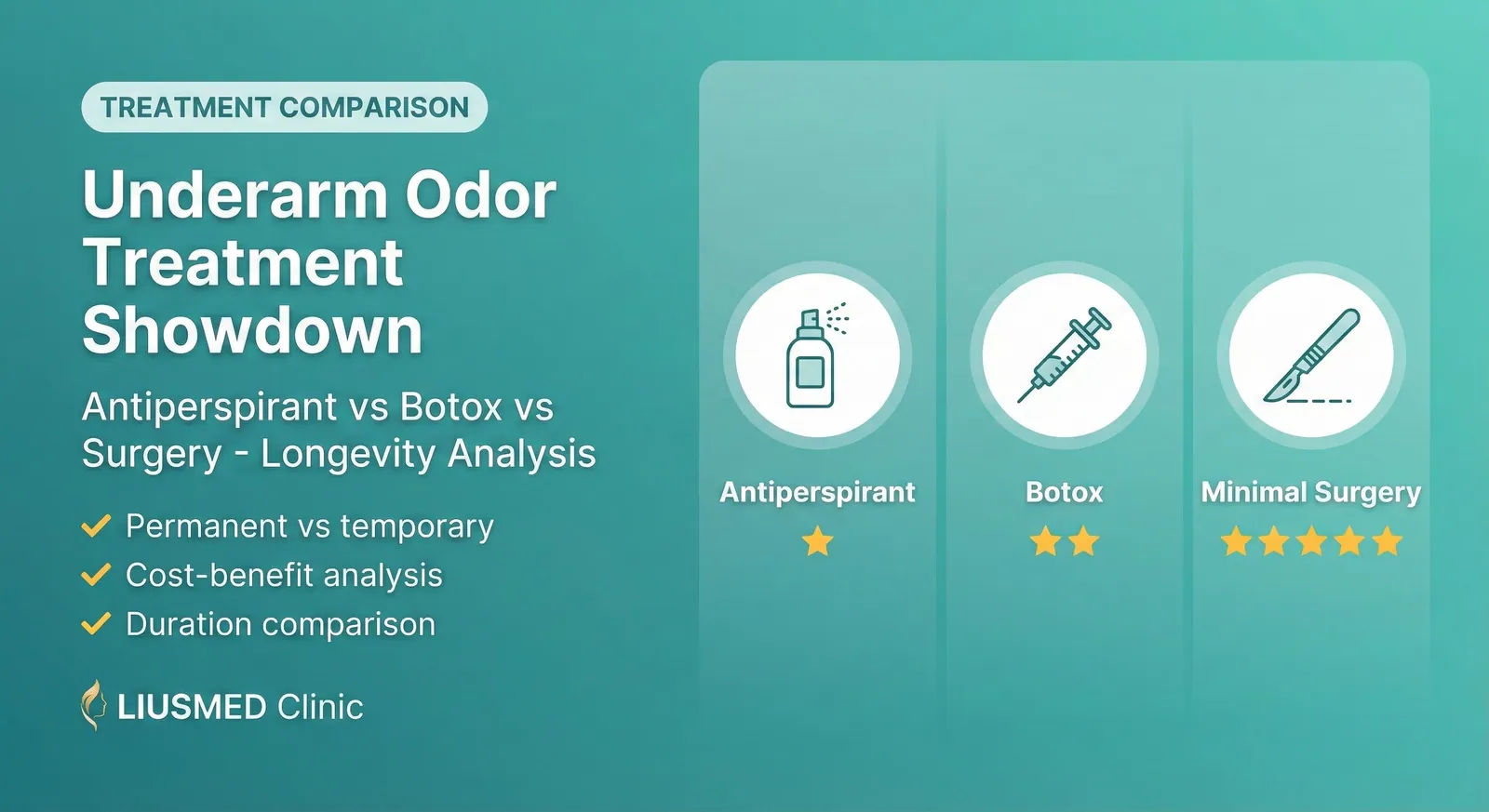
There are many ways to reduce the apocrine glands (the sweat glands responsible for body odor) and bring underarm odor down — from what you apply daily, to injections, energy devices, and surgery. Honestly, whether these methods "can address bromhidrosis" — the answer for most is yes; they all help with odor.
The catch comes next: the degree to which they bring the smell down varies enormously. Some only take it down partway, and only while you keep using them; some bring it down further but it returns after a while; only directly clearing the odor-producing apocrine glands gives a real chance of approaching "no smell at all."
| Method | What it targets | Tendency of odor improvement | Notes |
|---|---|---|---|
| Antiperspirant / deodorant | Surface, temporary | Small; needs ongoing use | Daily management; doesn't address the glands |
| Botulinum toxin injection | Temporary blockade of secretion | Moderate; fades over months | Needs repeating; symptomatic |
| Energy treatment (e.g. microwave, laser) | Partial destruction of glands | Moderate to large; depends on whether energy is sufficient | No surgery; result depends on how complete it is |
| Apocrine gland clearance surgery | Directly removes the glands | Aims for full clearance; most thorough | One-time; result depends on the thoroughness of clearance |
When people say "it didn't work," it's often not that the surgical route is useless, but that the method chosen could only reduce part of it to begin with, or the glands weren't cleared thoroughly. When expectations and a method's real capacity don't line up, the gap becomes disappointment.
That's exactly why the thing I spend the most time on at a consultation is laying out what each method can and cannot do up front — so you choose with the right expectations, instead of discovering the gap afterward.
Same surgery — so why are the results still different?
Here's a layer most people don't expect: even if you choose surgery, the result isn't automatically the same.
The key isn't which blade or which named technique is used. It comes down to two things: whether the surgeon is willing to spend the extra time to clear the apocrine glands thoroughly enough across the whole area; and whether, during clearance, they're willing to remove the glands properly and check that nothing is left behind before closing the wound. How completely the glands are cleared is directly related to how much the odor finally comes down.
That sounds obvious, but in practice the distance between "good enough" and "confirmed clean before closing" is often the same as the distance between "almost no smell" and "detectable again after a while." This part is hard to capture in a few sentences — it rests on judgment built up over many years.
Key point: What really decides "effective" isn't the device or the technique name, but how thoroughly the glands are cleared and whether the wound can heal well. Differences in skill end up showing, honestly, in the smell.
Surgically, how is "thorough clearance" actually achieved? That involves the judgment of how far and how deep to clear — a deeper topic, explained in full on the Minimal Cut Surgery page → Visit the surgical page to understand clearance thoroughness
"Clearing it" and "healing well" have to be balanced together
Some people think: so the cleaner and more aggressively you scrape, the better, surely?
Not quite. There's a "too much is as bad as too little" problem here. The more thoroughly the apocrine glands are cleared, the thinner the remaining skin becomes; skin that's too thin is more prone to breaking down, to poor healing, even to wound complications. So the real craft isn't only "clearing it clean" — it also includes judging how much skin thickness to preserve so it's just right: clearing the odor while still letting the wound heal back properly.
There's no single number for that balance that fits everyone; it depends on each person's tissue. It's the most experience-dependent part of this operation, and it's why I'd suggest looking for a surgeon who has done enough of these and followed patients long enough — not because anyone is "better," but because this kind of judgment genuinely has to be grown over time.
How long does it last? Will it come back?
This is the second most common question in clinic.
Once the apocrine glands are properly cleared, they don't "grow back" to their original number. In follow-up, our aim is complete apocrine gland clearance with no recurring problem over long-term tracking. In practice, what most people call "recurrence" more often comes from glands that weren't fully cleared the first time — meaning the issue usually isn't "it grew back" but "it was never fully cleared to begin with."
Put another way: getting this operation right matters far more than worrying about "will it come back later." How to tell genuine recurrence from "incompletely cleared the first time," and what to do if it happens, is a topic worth covering on its own — if you're stuck in that situation, you're welcome to come in with your specifics, and we'll assess case by case.
So — should I do it?
Lay all of this out, and "should I do it" really condenses into a few questions: is daily management (antiperspirant, deodorant, lifestyle adjustments) already enough for your situation? If not, are you hoping for "some reduction," or for "back to none"? That answer points directly to which path suits you.
Many people hesitate for a long time because the word "surgery" frightens them. Let me be clear about this: this operation uses gentle pain-relief anesthesia, not general anesthesia — you stay awake, the doctor can talk with you and adjust in real time throughout, and it's designed for greatly reduced pain (but I won't say "painless" — honestly, any surgery has its sensations; we simply work to keep them very low).
The best way to decide isn't reading what others said online; it's bringing your actual situation, daily difficulties, and expectations for the result into a consultation to talk through together. Details like cost and timing are also explained individually at that consultation, based on your circumstances.
Key point: "Should I do it" has no standard answer — only "is it right for you." The test is whether daily management is enough, and whether what you want is "reduction" or "none."
If you'd first like to understand the causes of bromhidrosis and the full range of approaches, start with this complete guide to bromhidrosis; to compare "non-surgical vs surgical" methods, see how to choose underarm odor treatment. When you're ready to talk through your own situation, you're welcome to read the underarm bromhidrosis surgery page, or simply book a consultation for a personal assessment by Dr. Ta-Ju Liu. Matching your expectations to reality is the first step in making the word "effective" actually hold true.
Frequently Asked Questions
Is bromhidrosis surgery done under general anesthesia, and will it hurt a lot?
It uses gentle pain-relief anesthesia, not general anesthesia. You stay awake, and the doctor can talk with you at any time during the procedure. The whole approach is designed for greatly reduced pain, but I won't call it "painless" — every surgery has its sensations, and we work to keep them very low.
Do both underarms need to be treated at the same time?
Most people have both treated together, but it still depends on your actual situation and needs. The details are discussed and arranged at the consultation based on your circumstances.
About how long until I can return to daily life after surgery, and what should I watch out for?
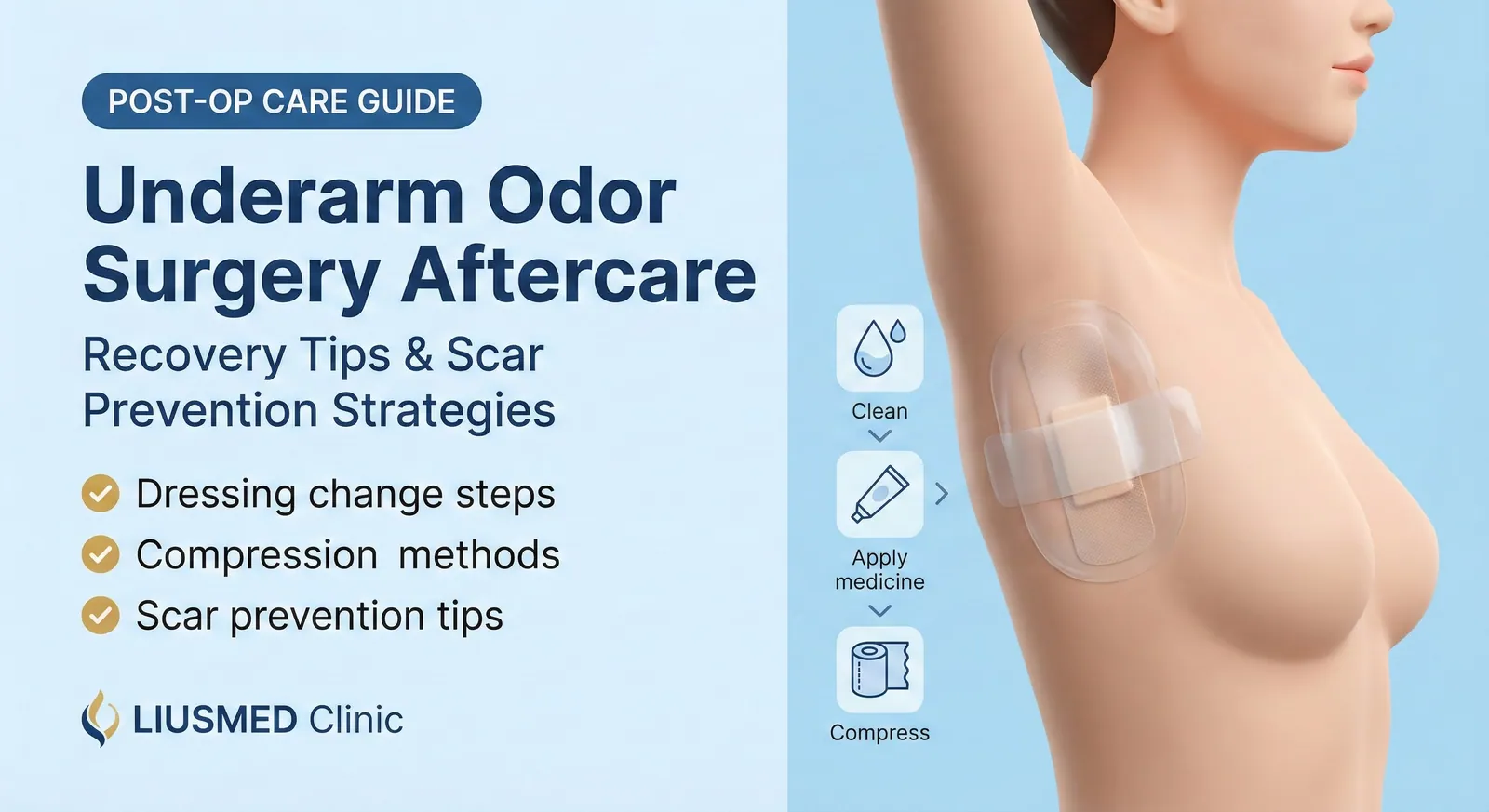
The key to recovery is letting the wound heal well, and how closely you follow wound care during this period directly affects the final result. The actual recovery plan and precautions are explained individually at the consultation, based on your daily life and work.
What's the real difference between antiperspirants, Botox, energy treatments, and surgery?
The first few are more about daily management or partial improvement — they need to be repeated, or the odor returns after a while. Directly clearing the apocrine glands gives a better chance of approaching "no odor at all." Each method has different things it can and cannot do, so it's best to bring your situation to a consultation to sort out together.