Beyond a Physical Problem
Perineal odor is rarely discussed openly, yet its impact often exceeds that of underarm odor: the odor in this area affects not only daily life but also intimate relationships and self-identity. What follows is not any one person's story. These are three patterns we see repeatedly in clinic — if you recognise yourself in one of them, that in itself tells you how common this problem is.
Pattern One: Self-Doubt That Started in Adolescence (Women in Their 20s and 30s)
The Most Common Misconception: Believing You Are Not Clean Enough
In this pattern the history almost always begins in adolescence, and the shared feature is that it has never been mentioned to anyone. For years the cause is attributed to personal hygiene: washing several times a day, cycling through intimate cleansing products — yet the odor still returns after sitting for a while or in humid conditions.
The clinical point to make first is that odor in this area comes from secretions of the apocrine glands (the sweat glands found in the underarm and perineal areas) being broken down by bacteria on the skin surface. It is not caused by inadequate washing. Over-cleansing does the opposite of helping: it damages the skin barrier and makes the area more prone to dryness, itching and inflammation.
How It Affects Daily Life
At work
- Reluctance to stay seated for long; frequent shifting of position in meetings
- Rising anxiety in summer and on long commutes
- Keeping a change of clothing on hand as a habit
In intimate relationships
- Avoiding opportunities for a relationship to progress
- Never saying out loud what the real reason for a breakup was
- Gradually tying "is something wrong with me" to a sense of self-worth
This psychological load is usually heavier than the physical symptom itself, and it is the main reason people wait ten years before seeing a doctor.
Seeking Care and Treatment Direction
Most people only book an appointment after finding the term "perineal odor" online and learning that it is something a doctor can assess. At this clinic, non-invasive thermolysis is currently the main direction for the perineal area — no open wound is needed and the post-treatment care burden is lighter. Whether it is appropriate, and how wide an area to treat, still requires an in-person examination; recovery time and the degree of improvement vary from person to person.
Pattern Two: Male Perineal Odor and the Marital Deadlock No One Names (Men in Their 30s and 40s)
Men Have It Too, and Find It Harder to Raise
Perineal odor is not exclusive to women. What men in this pattern share is knowing perfectly well that the problem is not in the underarms — but because it is widely misread as "poor washing", it is even harder to bring up.
💡 Doctor's Note: Treatment for male perineal odor differs from that for women. Due to the more complex anatomy of the male perineal area, minimally invasive surgery is less suitable. Instead, Botox injections are recommended to control the odor, with effects lasting 4-6 months and requiring periodic repeat treatments.
The Deadlock Is Usually Mutual Silence
The typical situation in clinic is that the partner noticed long ago but chose not to say so directly. On the surface, intimacy becomes less frequent and reasons to avoid it multiply; underneath, both people are guessing at what the other thinks. A problem that is never named is easily misread as "he doesn't care" or "the feeling is gone".
Raising It Is Usually Harder Than Treating It
The real turning point in clinic is rarely the treatment itself. It is the moment the patient is willing to say first: I know about this, and I am going to have it looked at. Framing it as a physical condition a doctor can assess — rather than an accusation about personal hygiene — is what allows the conversation to continue.
Botox injection is a maintenance approach that requires scheduled repeat visits; the treatment plan and intervals are decided case by case at consultation.
Pattern Three: Two Decades of Enduring It First (Women Over 40)
When Coping Strategies Become Daily Routine
In this older pattern the problem usually dates back to school years, when there was no one available to discuss it with — so an entire set of private coping strategies develops:
- Always washing before intimacy
- Masking with fragrance or clothing
- Keeping it brief, avoiding well-lit settings
- Treating "I can't relax" as a personality flaw
These strategies keep a person in a state of alertness for years, and over time a partner may misread that alertness as coldness or tension.
A Common Turning Point: Asking While Accompanying Family
Many people first raise the perineal area almost in passing, while bringing a child in for underarm odor, and learn for the first time that it can be assessed and treated as well. The realisation that "a doctor can actually look at this" is exactly where twenty years of being stuck tends to end.
Treatment and Follow-Up
What is actually done depends on the site, the extent and the patient's age, and is decided after an in-person assessment; follow-up visits are still needed afterwards to check the treated area and the change in odor, and the degree of improvement varies from person to person.
What These Patterns Show
Psychological Impact of Perineal Odor
| Aspect | Common Effects |
|---|---|
| Self-identity | Feeling "unclean," "defective" |
| Intimate relationships | Avoidance, fear, inability to relax |
| Social life | Worry about being detected, excessive cleaning |
| Emotional health | Anxiety, low self-esteem, even depression |
Treatment Addresses More Than the Odor Itself
What treatment improves is not only physical:
| Change | Description |
|---|---|
| Physical | Markedly reduced odor (degree varies by individual) |
| Psychological | Confidence restored, reduced anxiety |
| Relationships | Improved intimacy, better communication |
| Quality of life | No more "coping strategies" needed |
Frequently Asked Questions
Is perineal odor something only I have?
No. Perineal odor affects roughly 1–3% of people—it's not rare, only rarely discussed openly. You are not alone.
Is odor in the intimate area caused by my not being clean enough?
No. It's a constitutional issue caused by apocrine-gland secretions, unrelated to hygiene habits. Many people shower several times a day and still can't resolve it, because the problem isn't about cleanliness.
Will people laugh if I bring it up, and will the consultation be embarrassing?
No. A professional medical team handles issues like this every day—there are no laughs or strange looks. It's like seeing a dentist: you're seeking professional help. The clinic also uses a private, self-contained intake process.
Can men have perineal odor too?
Yes. Men can have it too—it's just harder to talk about. The treatment considerations differ from those for women and need to be assessed by the doctor at a consultation based on the individual situation.
Is perineal odor surgery dangerous?
Minimally invasive odor surgery in the perineal area involves small wounds and relatively quick recovery, and it's a mature treatment. Whether it actually suits you, and how it would be done, is determined by assessment at a consultation.
Can I come to the consultation on my own first?
Yes. You can come for a consultation alone first, and the clinic won't re-judge your odor. When you're ready, you can then decide whether to take any further steps.
For Those Still Hesitating
You Don't Need to Keep Suffering
If you're experiencing perineal odor, remember:
- This isn't your fault: It's a constitutional issue, not hygiene
- You're not alone: Many people have the same problem—they just don't speak up
- This can be solved: Modern minimally invasive techniques can safely and effectively treat it
- You deserve a better life: No need to keep enduring and worrying
Taking the First Step
| If you... | Suggested Action |
|---|---|
| Unsure if it's perineal odor | Schedule a consultation for evaluation |
| Worried about embarrassment | Choose an experienced clinic that prioritizes privacy |
| Afraid your partner will find out | You can consult alone first |
| Want to learn more first | Read related educational materials |
💡 Dr. Liu's Words: "Every patient who consults about perineal odor—I can feel how much courage it took them. I want everyone to know: the moment you walk through that door, you've already made a life-changing decision. Leave the rest to us."
Post-Surgery Psychological Adjustment
Give Yourself Time to Adjust
Even after successful surgery, some patients need adjustment time:
| Period | Possible Feelings | Suggestion |
|---|---|---|
| Early post-op | "Is it really fixed?" doubt | Normal—give yourself time to verify |
| One month later | Starting to believe the change is real | Try situations you used to avoid |
| Three months later | Building new confidence | Enjoy the freedom of not worrying |
Communication with Partners
If you have a partner, post-surgery communication matters:
- You can choose to openly share your treatment experience
- Or naturally let them feel the change
- Rebuilding intimacy requires understanding and patience from both sides
Conclusion
Perineal odor brings more than odor problems—it comprehensively affects confidence, relationships, and quality of life. But one thing is certain—this is a problem that can be brought to a doctor for assessment and treatment.
From these three patterns, we see:
| Pattern | Main burden | Common treatment direction |
|---|---|---|
| Young women with adolescent onset | Years of self-blame over hygiene; avoiding intimacy | Usually non-invasive thermolysis after in-person assessment |
| Male perineal odor | Hard to raise; relationship deadlock | Anatomy makes surgery less suitable; usually controlled with Botox |
| Middle-aged women after two decades | Coping strategies become a daily burden | Assessed by site and extent, with follow-up afterwards |
If you are experiencing something similar, we hope this summary shows you one thing: this is a problem you can bring into the consulting room.
Clear Odor Specialist Perspective
Perineal odor is frequently misclassified at general clinics as an infection, a hygiene issue, or a psychogenic complaint. At Clear Odor we treat it as a well-defined apocrine-gland anatomical question. Dr. Liu carefully distinguishes between apocrine-distribution odor, candidal infection, bacterial vaginosis, and over-hygiene microbiome disruption — four clinical entities that look superficially similar but require completely different treatment directions.
As a clinic dedicated to odor conditions, we run an absolutely-private intake flow for perineal cases: a separate consultation room, low-light examination, and text-first follow-up communication. Patients never have to disclose this issue in a general waiting area — a patient-experience detail only a single-condition odor clinic can fully arrange.
Full Treatment Information → · Book a Specialist Consultation →
Related Reading
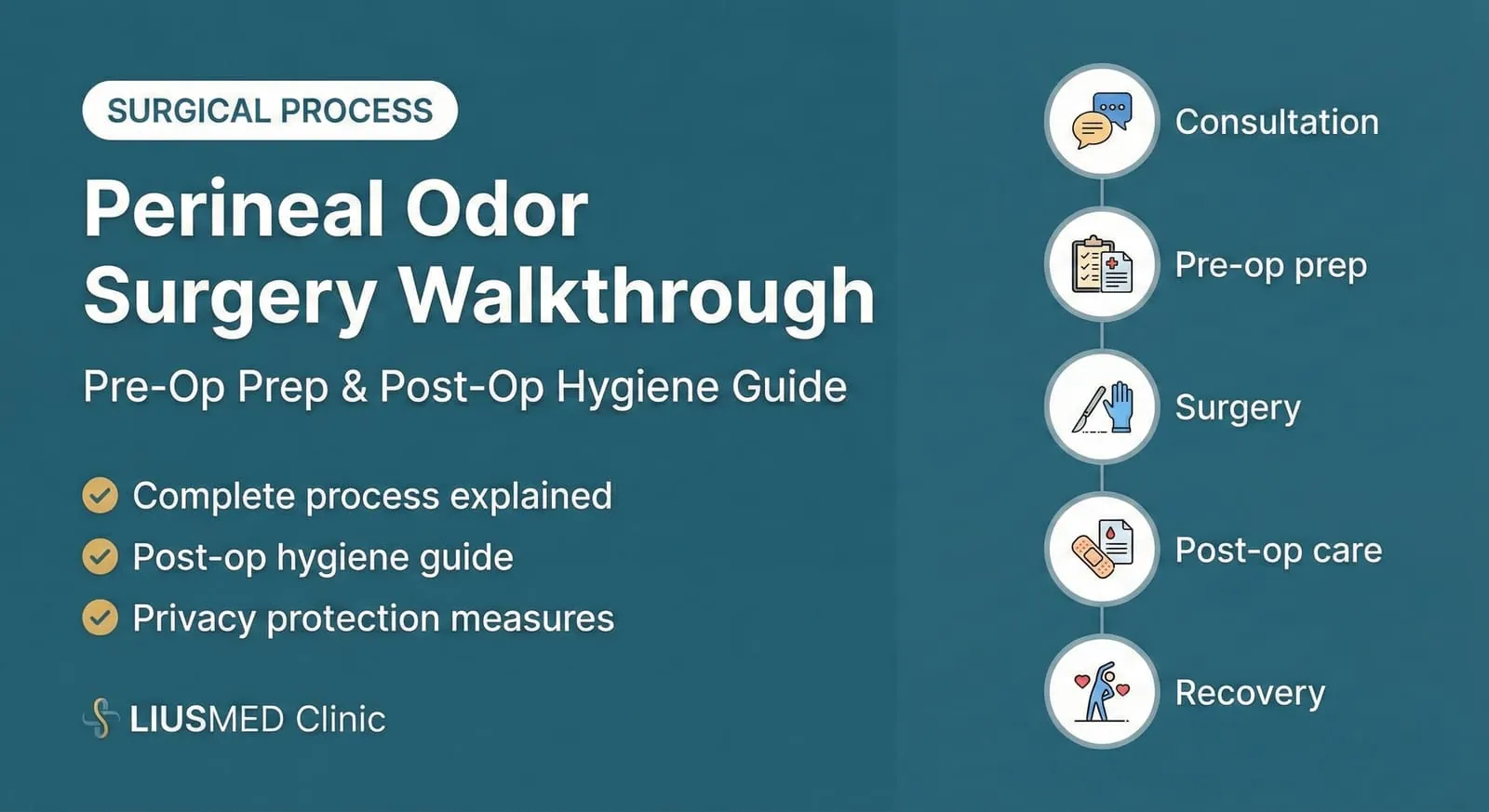
- Non-Invasive Perineal Odor Treatment: Steps & Aftercare
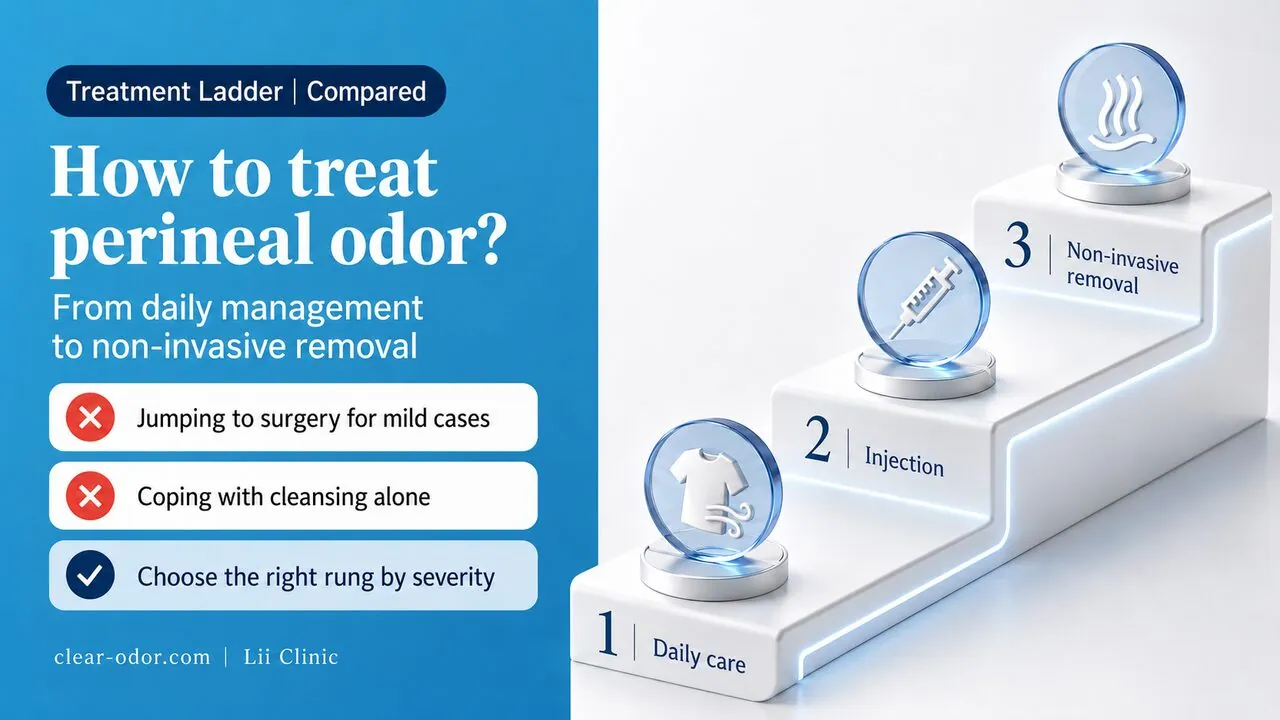
- Perineal Bromhidrosis: Treatment Options From Daily Care Up
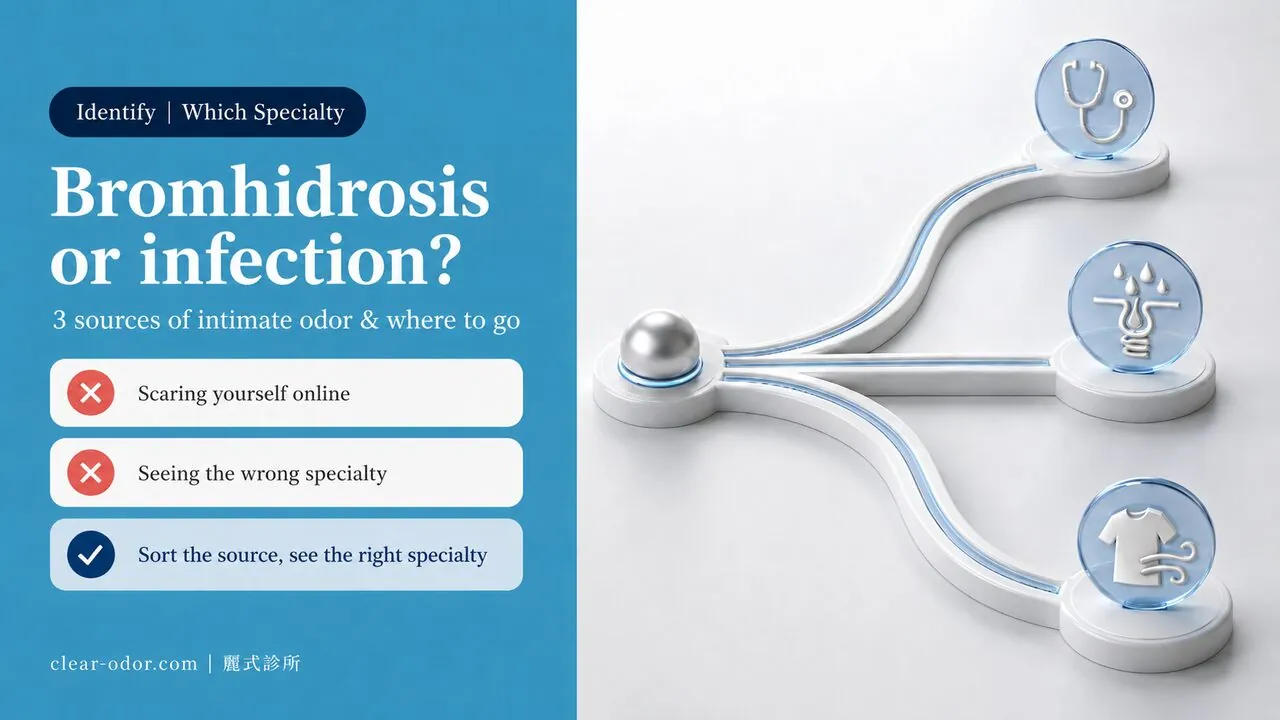
- Perineal Odor or Infection? 3 Sources & Which Doctor
- Perineal Bromhidrosis
About the Author
Dr. Ta-Ju Liu
- Current Position: Director, Clear Odor Clinic
- Specialties: Odor and hyperhidrosis minimal-incision surgery (underarm, areola, perineal bromhidrosis), hyperhidrosis treatment
- Experience:
- 20+ years of specialist experience in odor treatment
- Over 10,000 cases performed, with no recurrence reported on clinical follow-up
- Board-certified dermatologist (Taiwan)
- Philosophy: "Treating perineal odor isn't just about eliminating smell—it's about helping patients rebuild their confidence and quality of life. Every patient who gathers the courage to seek help reaffirms the meaning of my work."
The three patterns in this article are a composite description of situations commonly seen in clinic. They are not specific individuals, contain no identifiable personal information, and do not represent the treatment outcome of any individual patient.