Non-Invasive Treatment: A Pinhole-Entry Solution
Intimate area odor is a concern many women find difficult to discuss. Clear Odor Clinic uses "Non-Invasive Thermolysis" technology to precisely destroy apocrine glands with no surgery, only a pinhole entry, and no stitches. Post-treatment involves only 2-3 weeks of swelling, which keeps the aftercare burden low.
How Non-Invasive Thermolysis Works
Mechanism of Action
| Step | Description |
|---|---|
| Precise targeting | Professional equipment precisely locates the subcutaneous apocrine glands in the perineal area |
| Energy delivery | The device delivers specialized energy safely to the target area |
| Selective destruction | Energy absorbed by apocrine glands converts to heat, causing gland tissue to shrink and lose secretory function |
| Natural metabolism | Destroyed gland tissue is gradually eliminated through the body's natural metabolism |
Non-Invasive vs Minimally Invasive Surgery Comparison
| Comparison | Non-Invasive Thermolysis | Minimally Invasive Surgery |
|---|---|---|
| Wounds | No open wounds | Small incisions required |
| Pain level | Discomfort greatly reduced (varies by individual) | Post-op wound pain |
| Recovery period | 2-3 weeks of swelling | 2-4 weeks of wound care |
| Wound care | ❌ Not required | ✅ Daily dressing changes needed |
| Suture removal | ❌ Not required | ✅ Return visit for removal |
| Infection risk | Low | Higher |
| Odor reduction | Marked improvement in most patients | More thorough clearance |
| Sweat reduction | About 80% | About 85% |
The sweat-reduction figures come from our clinic records, not from the literature.
Advantages of Non-Invasive Thermolysis
| Advantage | Description |
|---|---|
| Non-invasive | No open wounds, greatly reduces infection risk |
| High safety | Energy precisely targets apocrine glands without damaging surrounding tissue |
| Long-lasting results | Destroyed apocrine glands lose secretory function on a long-term basis |
| No compensatory sweating | Unlike ETS surgery, doesn't cause increased sweating elsewhere |
| Short recovery | No wound care burden, daily life unaffected |
| Reduces sweating | Besides odor removal, also reduces perineal sweating by about 80% in our clinic records |
💡 Dr. Liu explains: "Non-invasive thermolysis leaves no open wound, so bathroom hygiene and daily dressing changes are off the list — mostly you are waiting for the swelling to settle. That said, on treatment day we shave the area first and then inject local anesthetic, and needle punctures are still a way through the skin, so we keep the same pre-treatment cleaning and sterile technique. The infection risk is low, but it is not zero."
Pre-Treatment Preparation
One Week Before
| Item | Details |
|---|---|
| Stop certain medications | Aspirin, fish oil, Vitamin E and other medications that may increase bleeding |
| Inform doctor of medications | Anticoagulants, chronic disease medications need special evaluation |
| Maintain regular sleep schedule | Adequate rest helps post-treatment recovery |
Day Before Treatment
| Item | Details |
|---|---|
| Adequate sleep | Don't stay up late before treatment |
| Prepare loose clothing | Comfort is priority afterward |
| Confirm transportation | A friend or family member must take you home; do not drive or ride a scooter that day |
Treatment Day
| Item | Details |
|---|---|
| Shower and clean | Shower beforehand, keep perineum clean |
| Wear loose clothing | Loose pants, cotton underwear |
| Follow the fasting schedule | Gentle pain-relief anesthesia is used: no regular or fatty meals from 8 hours before, no light solids or dairy from 6 hours before, clear liquids until 2 hours before; follow the fasting instructions the clinic sends you |
Complete Procedure Steps
Timeline Overview
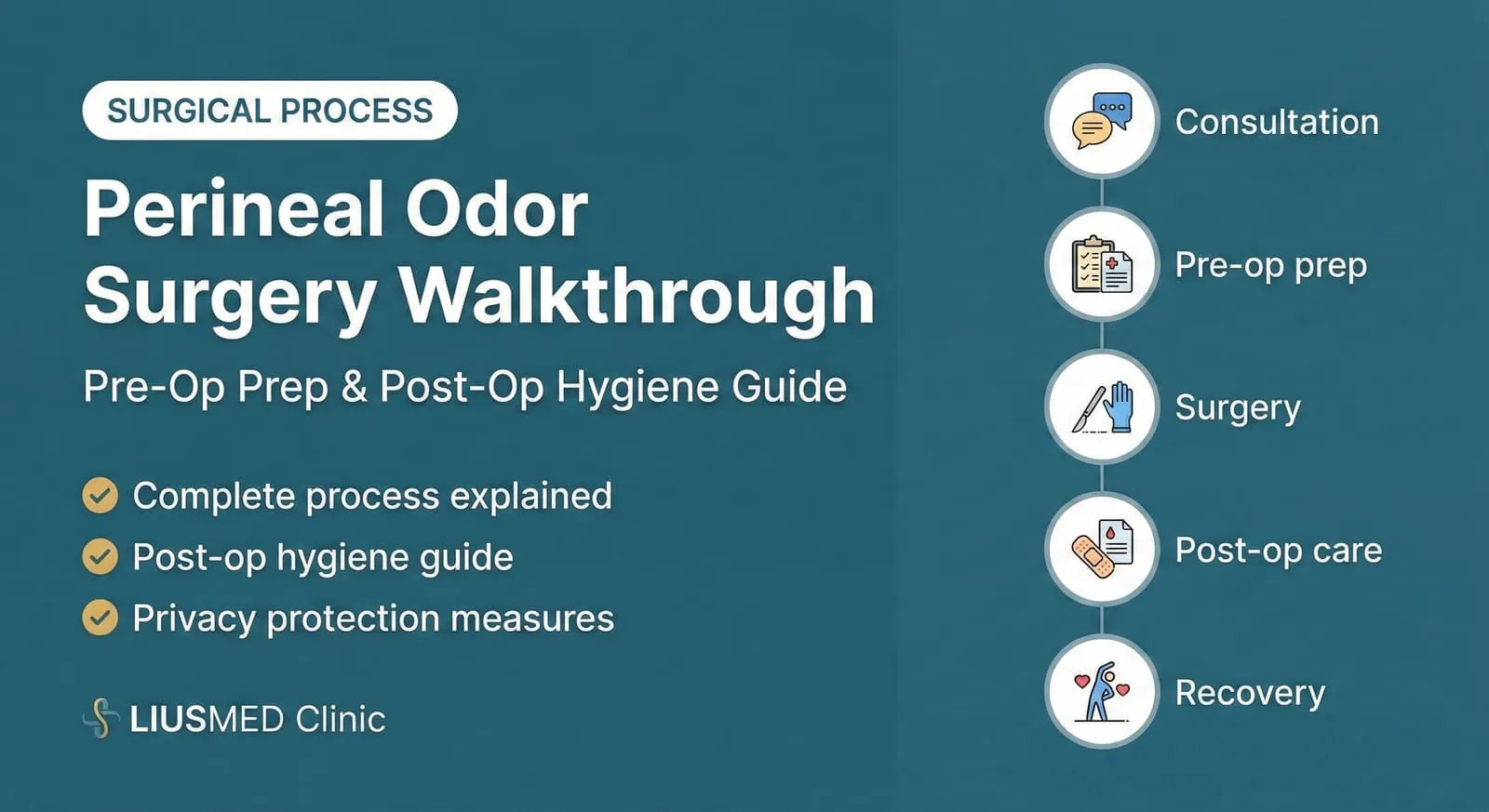
Check-in → Change clothes → Shave & mark → Anesthesia → Energy treatment → Ice & observe → Go home
10min → 5min → 10min → 10min → 60min → 20min → Leave
Total treatment time: About 2 hours
Detailed Steps
Phase 1: Check-in and Preparation (About 15 minutes)
- Check-in confirmation: Verify identity, sign consent forms
- Change into treatment gown: Wear gown provided by clinic
- Pre-treatment assessment: Doctor confirms treatment area
Phase 2: Pre-Treatment Preparation (About 10 minutes)
| Step | Description |
|---|---|
| Hair removal | Perineal area needs shaving for easier operation and energy delivery |
| Area marking | Doctor marks the treatment area |
| Positioning | Lithotomy position (similar to gynecological exam) |
Phase 3: Anesthesia (About 10 minutes)
| Item | Description |
|---|---|
| Anesthesia method | Clear Odor Clinic's special gentle pain relief technique |
| Pain level | Greatly reduced pain sensation |
| Effect | Entire treatment process is comfortable |
Phase 4: Energy Treatment (About 60 minutes)
| Step | Description |
|---|---|
| Probe operation | Doctor uses the non-invasive treatment device probe |
| Energy delivery | Evenly and precisely releases energy within marked area |
| Real-time monitoring | Ensures energy is delivered to correct locations |
| Sensation | May feel warmth; discomfort is greatly reduced |
Phase 5: Post-Treatment Care (About 20 minutes)
- Immediate ice application: Reduces swelling and discomfort
- Rest and observe: Confirm stable condition
- Post-treatment education: Nurse explains home care
- Medication instructions: How to use pain medication
- Schedule follow-up: Arrange tracking appointment
Post-Treatment Care (Much Simpler Than Surgery!)
Key Features of Non-Invasive Treatment Recovery
| Feature | Description |
|---|---|
| Pinhole entry only | No dressing changes needed, no suture removal |
| Main reaction | Swelling, resolves in about 2-3 weeks (up to 3-4 weeks for some) |
| Care focus | Ice for swelling, wear loose clothing |
📅 Days 1-3 After Treatment
| Item | Details |
|---|---|
| Ice | Apply ice appropriately to reduce swelling |
| Cleaning | Avoid water for 24 hours, then gently wipe clean |
| Clothing | Loose, breathable cotton underwear |
| Activity | Light daily activities OK; avoid long walks and strenuous exercise |
| Ointment | Apply as directed by doctor |
📅 Days 4-14 After Treatment
| Item | Details |
|---|---|
| Swelling | Gradually subsiding |
| Activity | Light daily activities OK |
| Cleaning | Normal showering OK |
| Avoid | Strenuous exercise, heavy lifting, hot baths, saunas |
📅 Day 14 to 1 Month
| Item | Details |
|---|---|
| Swelling | Mostly resolved |
| Lumps | May have mild lumps; most soften noticeably in 2-3 months, full recovery may take 6–12 months |
| Activity | Can resume all activities |
| Intimacy | Recommended after 2 weeks |
| Follow-up | Return at one month to confirm results |
💡 Biggest difference from surgery: Non-invasive treatment requires no daily dressing changes and no suture removal, which makes aftercare much easier. Having no open wound puts the infection risk below open surgery, but shaving and the anesthetic needle punctures are still entry points — not zero risk.
Possible Side Effects
| Side Effect | Frequency | Resolution Time |
|---|---|---|
| Swelling | Common | 2-4 weeks |
| Bruising | Occasional | 1-2 weeks |
| Lumps | Mild to moderate | Most soften noticeably in 2-3 months (full recovery may take 6–12 months) |
| Mild discomfort | Occasional | Several days |
| Pigmentation | Very rare | Usually temporary |
| Hair reduction | Common | Clinic records: pubic hair reduces by about 50-80% (individual results may vary) |
Frequently Asked Questions
Q1: How severe is the swelling after treatment?
A1: Swelling is the most common reaction, usually resolving in 2-3 weeks, though some may take 3-4 weeks. Swelling severity varies by individual but won't affect daily life.
Q2: Can I use the bathroom normally after treatment?
A2: Yes! This is one of the biggest advantages of non-invasive treatment. Since there are no open wounds, normal bathroom hygiene is fine—no special wound care needed.
Q3: How long do the odor reduction results last?
A3: The apocrine glands destroyed by non-invasive thermolysis don't regenerate, so results are long-lasting. Clinically, most patients see marked odor improvement, though the extent varies by individual.
Q4: Is the treatment process painful?
A4: Using Clear Odor Clinic's special gentle pain relief technique, the treatment process has greatly reduced discomfort. You may feel warmth; discomfort is greatly reduced.
Q5: When can I resume sexual activity?
A5: Recommend waiting 2 weeks after treatment, once swelling has subsided.
Q6: Can I have treatment during my period?
A6: Best to avoid menstruation. Optimal treatment timing is 3-5 days after period ends.
Q7: Will non-invasive treatment reduce pubic hair?
A7: Yes. In our clinic records, pubic hair volume drops by about 50-80% after treatment, and the extent varies by individual. If you're concerned about hair reduction, discuss this with your doctor beforehand.
Q8: What's the difference between non-invasive treatment and Botox?
A8:
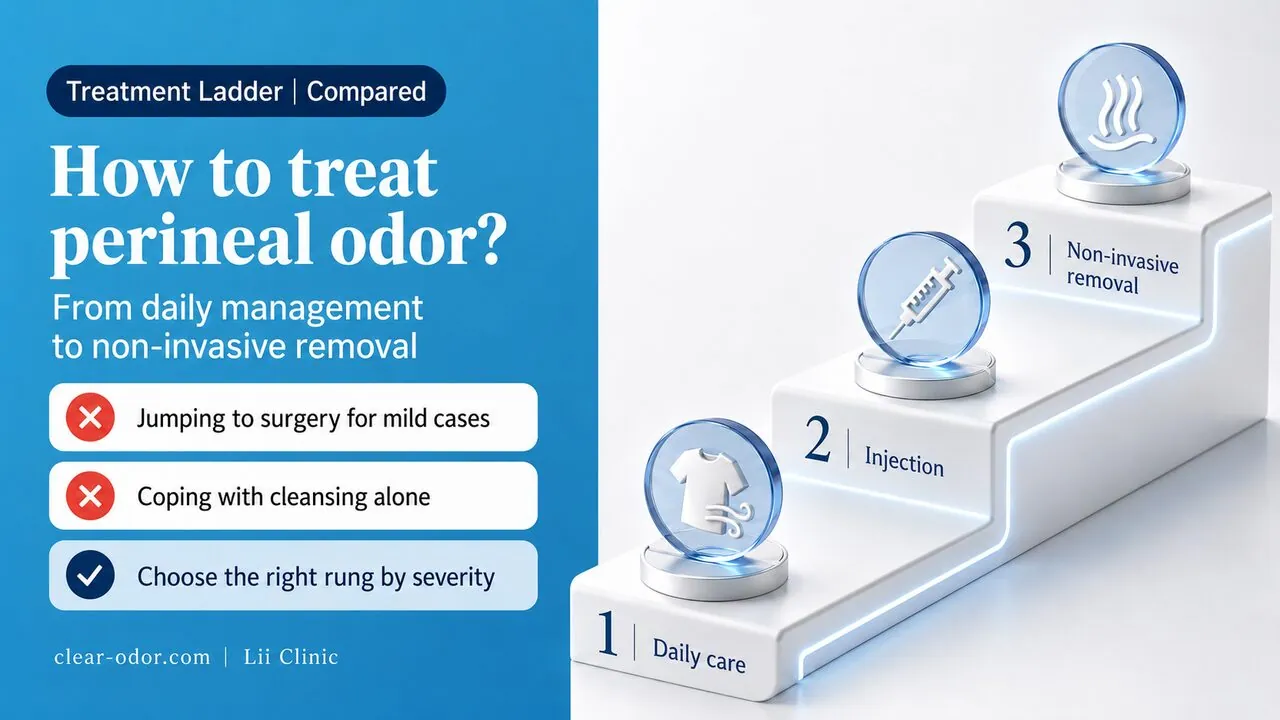
| Comparison | Non-Invasive Thermolysis | Botox |
|---|---|---|
| Duration of effect | Long-Lasting | 4-6 months |
| Mechanism | Destroys apocrine glands | Temporarily inhibits secretion |
| Repeat needed | No | Yes, periodic injections |
| Suitable for | Want one-time solution | Don't want surgery / Males |
Who Is Suitable for Non-Invasive Treatment?
✅ Ideal Candidates
- Women with perineal odor concerns
- Those wanting only a pinhole and a fast recovery
- Those who don't want daily wound care
- Those wanting a one-time solution
⚠️ Needs Evaluation
- Those with skin conditions or infections
- Pregnant or breastfeeding
- Those with certain chronic conditions
❌ Male Perineal Odor
Due to the more complex anatomy of the male perineal area, non-invasive treatment is less suitable. Botox injections are recommended instead.
Conclusion
| Item | Non-Invasive Treatment Features |
|---|---|
| Wounds | No open wounds |
| Aftercare | No dressing changes, no suture removal |
| Recovery period | 2-3 weeks of swelling |
| Results | Odor and sweating usually both improve markedly |
| Duration | Long-Lasting |
Clear Odor Specialist Perspective
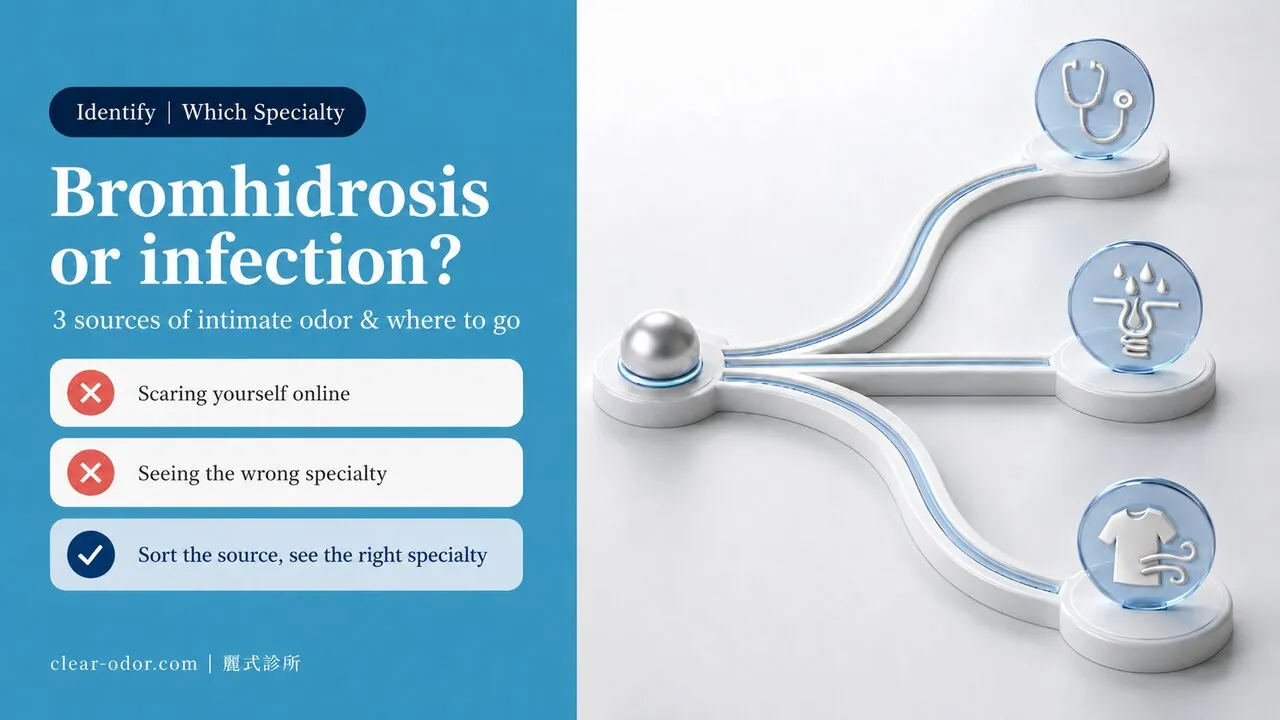
Perineal odor is frequently misclassified at general clinics as an infection, a hygiene issue, or a psychogenic complaint. At Clear Odor we treat it as a well-defined apocrine-gland anatomical question. Dr. Liu carefully distinguishes between apocrine-distribution odor, candidal infection, bacterial vaginosis, and over-hygiene microbiome disruption — four clinical entities that look superficially similar but require completely different treatment directions.
As a clinic dedicated to odor conditions, we run an absolutely-private intake flow for perineal cases: a separate consultation room, low-light examination, and text-first follow-up communication. Patients never have to disclose this issue in a general waiting area — a patient-experience detail only a single-condition odor clinic can fully arrange.
Full Treatment Information → · Book a Specialist Consultation →
Related Reading
- Perineal Bromhidrosis: Treatment Options From Daily Care Up
- Perineal Odor & Intimacy: Three Patterns We See in Clinic
- Perineal Odor or Infection? 3 Sources & Which Doctor
- Perineal Bromhidrosis
About the Author
Dr. Ta-Ju Liu
- Current Position: Director, Clear Odor Clinic
- Specialties: Odor and hyperhidrosis minimal-incision surgery (underarm, areola, perineal bromhidrosis), hyperhidrosis treatment
- Experience:
- 20+ years of specialist experience in odor treatment
- Over 10,000 cases performed, with no recurrence reported on clinical follow-up
- Board-certified dermatologist (Taiwan)
- Philosophy: "Non-invasive thermolysis makes perineal odor treatment more comfortable and simpler. Without the burden of wound care, patients can recover more easily and regain their confidence."