An Odor in the Intimate Area Is Not Necessarily "Bromhidrosis"
Odor in the intimate area is a trouble that causes anxiety yet is hard to talk about. Many people search online first thing and then fall into one of two extremes: either panicking that "I must have an infection," or deciding straight away that "this is perineal bromhidrosis" and looking for surgery.
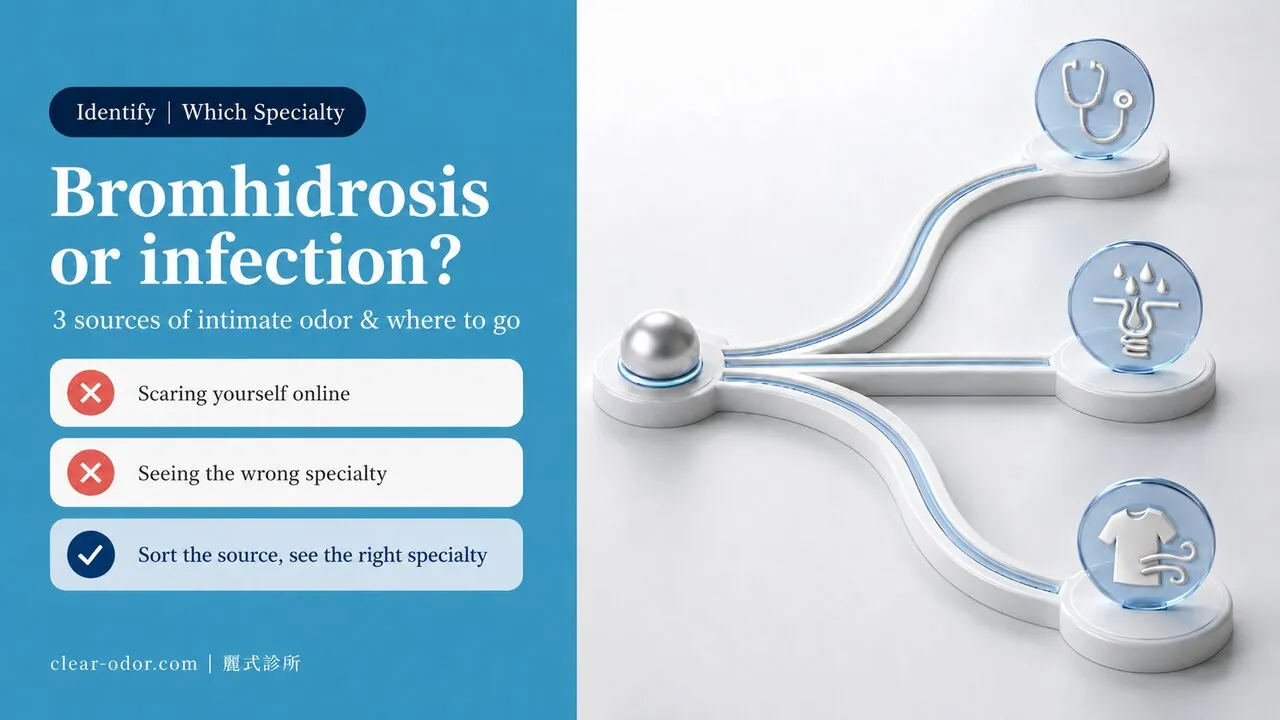
Both are too fast. Intimate odor has at least 3 different sources, and the directions are completely different — infection calls for a gynecologist, the apocrine type is the domain of an odor specialist, and the lifestyle type can often be improved simply by adjusting habits. Sorting out the source is the first step in addressing intimate odor — and the most important one.
Key point: The purpose of this article is not to let you "self-diagnose," but to help you judge "which direction to go and which specialty to see." If intimate odor shows any sign of infection, the correct first step is a gynecologist — not odor surgery.
The 3 Sources of Intimate Odor
| Source type | Odor and accompanying symptoms | Which specialty |
|---|---|---|
| Infection type | Abnormal discharge (yellow-green, foamy, cottage-cheese-like), fishy or foul odor, often with itching, burning, stinging | Gynecology |
| Apocrine type (perineal bromhidrosis) | A distinctive body odor similar to underarm bromhidrosis, no abnormal discharge, intensifies with sweating, heat, emotion | Odor specialist |
| Lifestyle type | An ordinary sweaty or stuffy smell, improves with cleansing and ventilation, no distinctive strong body odor | Mostly self-adjustable |
These three sometimes mix together (for example, lifestyle-type heat and dampness can trigger infection), but as soon as any one infection-type signal appears, gynecology should be the priority. Each is explained below.
Infection-Type Odor: These Signs Mean See a Gynecologist
Infection-type odor comes from infection of the vaginal or genitourinary tract, and is the category that most needs to be ruled out first. Common infections and their features:
- Bacterial vaginosis: typically a fishy odor, often with increased greyish-white discharge
- Candida (yeast) infection: cottage-cheese-like discharge, with marked itching
- Trichomonas infection: may have foamy, yellow-green discharge and a foul odor
- More serious situations such as pelvic inflammatory disease: may come with a foul odor, lower abdominal pain, fever
Whenever the odor is combined with any of the following, see a gynecologist first — do not think of odor surgery first:
- Discharge of abnormal colour or texture (yellow-green, foamy, cottage-cheese)
- Vulvar itching, burning, stinging
- Lower abdominal pain, pain during intercourse
- Fever
- The odor appeared suddenly recently or is changing quickly
Key point: Infection-type odor is a "medical problem" that requires diagnosing and treating the infection itself. Odor surgery is of no help here and should not be used for it. Perineal bromhidrosis surgery addresses the apocrine glands, not infection — going the wrong direction is not only wasteful, it delays the problem that truly needs attention.
Features of Apocrine-Type (Perineal Bromhidrosis) Odor
Once infection has been ruled out, if the odor still persists, the apocrine type — that is, true "perineal bromhidrosis" — should be considered.
The perineum, like the underarms and the areola, is a region where apocrine glands (large sweat glands) are densely distributed. After apocrine secretions are broken down by skin-surface bacteria, a distinctive body odor of the same origin as underarm bromhidrosis is produced. Its features are:
- The odor is similar to underarm bromhidrosis — a distinctive body smell, not the foul or fishy smell of discharge
- No abnormal discharge, no itching or burning (these belong to infection)
- Intensifies with sweating, heat, emotional tension or arousal
- Often co-occurs with underarm odor, or wet earwax and other constitutional clues
- Usually appears after puberty and is linked to genetics
For how to identify different odors, Body Odor, Sweat Smell & Bromhidrosis: 3 Different Smells has a fuller explanation. If perineal bromhidrosis clearly affects life and intimate relationships, it can be assessed and addressed by a doctor — Non-Invasive Perineal Odor Treatment: Steps & Aftercare covers this in detail.
Lifestyle-Type Odor: Heat, Clothing, Diet
The third category is the most common — and the easiest to improve — lifestyle-type odor. It is not a disease, but the result of environment and habits:
- Long-term wearing of non-breathable underwear and tight clothing
- Prolonged sitting, or not changing clothes promptly after exercise — heat and dampness
- Insufficient hygiene, or conversely over-cleansing that disrupts the normal flora
- Dietary factors (spicy food, certain foods)
Lifestyle-type odor usually eases noticeably after improving ventilation, choosing breathable clothing, and moderate cleansing. If the odor disappears after adjusting lifestyle habits, then it was never bromhidrosis nor an infection.
One Table: Which Type Does Your Odor Resemble?
| Clue | More like infection | More like perineal bromhidrosis | More like lifestyle type |
|---|---|---|---|
| Abnormal discharge present | ✅ | ❌ | ❌ |
| Itching, burning, stinging | ✅ | ❌ | Occasionally mild |
| Distinctive body odor (like underarm bromhidrosis) | ❌ | ✅ | ❌ |
| Co-occurs with underarm odor / wet earwax | ❌ | ✅ | ❌ |
| Improves noticeably with cleansing and ventilation | ❌ | ❌ | ✅ |
| Intensifies with sweating and emotion | Not necessarily | ✅ | Partly |
This table only helps you "find the direction" — it is not a diagnosis. True confirmation requires a gynecological examination for the infection type, and an odor specialist's assessment for the apocrine type.
Why "Sorting It Out" Matters So Much
Sorting out the source of intimate odor affects three things:
- Seeing the right specialty: infection goes to gynecology, the apocrine type to an odor specialist — seeing the wrong one causes delay.
- Not doing pointless work: odor surgery for the infection type is meaningless; any invasive treatment for the lifestyle type is unnecessary.
- Not missing the real problem: treating an infection as bromhidrosis misses an infection that should be treated.
This is exactly why the proper assessment process for perineal bromhidrosis has, as its first step, confirming "it is not an infection," before discussing addressing the apocrine glands.
Frequently Asked Questions
Q1: I have intimate odor but no abnormal discharge — is it perineal bromhidrosis?
Possibly, but it still needs a doctor's assessment. With no signs of infection, an odor similar to underarm bromhidrosis, and intensification with sweating, it leans toward the apocrine type — but confirmation still requires a doctor's judgement.
Q2: Can perineal bromhidrosis and infection exist at the same time?
Yes. The two are not mutually exclusive. If infection is suspected at the same time, it is still advised to have a gynecologist address the infection first, then assess the apocrine-type portion.
Q3: Which specialty should I see first for intimate odor?
Whenever there is abnormal discharge, itching, burning, stinging, lower abdominal pain or fever, see gynecology first. If none of these are present and it is only a distinctive body odor resembling bromhidrosis, you can consult an odor specialist.
Q4: Will intimate odor go away on its own?
The lifestyle type may ease after improving habits; the infection type needs treatment; the apocrine type is constitutional and usually does not disappear on its own.
Q5: Can perineal bromhidrosis be solved by cleansing alone?
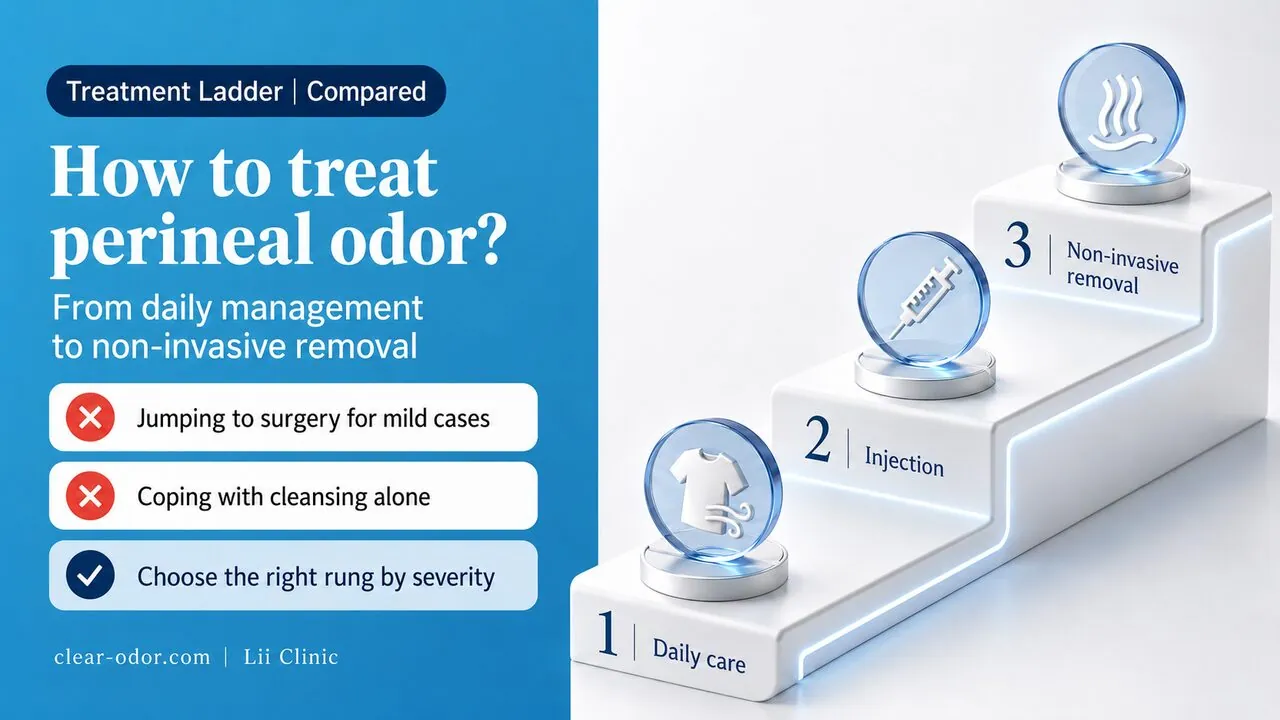
Cleansing helps control the odor but cannot remove the apocrine glands themselves. Mild cases can first be managed with cleansing; when life is clearly affected, a doctor can assess further treatment.
Related Reading
- Non-Invasive Perineal Odor Treatment: Steps & Aftercare
- Perineal Bromhidrosis: Treatment Options From Daily Care Up
- Stronger Body Odor After Birth or Menopause? Why & When
- Body Odor, Sweat Smell & Bromhidrosis: 3 Different Smells
- Perineal Bromhidrosis
- Midlife Body Odor & Aging Odor Guide
- Intimate-Area Odor (Areola & Perineal)
Conclusion
Intimate odor is not a single problem but has 3 different sources: the infection type calls for gynecology, the apocrine type (perineal bromhidrosis) is the domain of an odor specialist, and the lifestyle type is mostly improved by adjusting habits. The key to identification is "whether there is abnormal discharge and itching/burning" — if there is, see gynecology first; if there is not, and it is a distinctive body odor resembling underarm bromhidrosis, then assess for the apocrine type.
Going the right direction matters more than rushing to choose a treatment. Dr. Ta-Ju Liu has 20 years of experience in bromhidrosis treatment and offers professional assessment of perineal bromhidrosis (apocrine type). If you have ruled out infection and are still troubled by a distinctive intimate odor, you are welcome to book a consultation, or first explore the perineal odor specialist service.
Related Reading
- Non-Invasive Perineal Odor Treatment: Steps & Aftercare
- Perineal Bromhidrosis: Treatment Options From Daily Care Up
- Body Odor, Sweat Smell & Bromhidrosis: 3 Different Smells
- Perineal Bromhidrosis
This article is for health education and cannot replace diagnosis. If intimate odor is combined with abnormal discharge, itching or pain, please see a gynecologist first. The management of apocrine-type odor must be confirmed after an in-person assessment by Dr. Ta-Ju Liu.