Once Perineal Bromhidrosis Is Confirmed, What Are the Treatment Choices?
When you have confirmed that what troubles you is "perineal bromhidrosis" — that is, apocrine-type intimate odor — the next question is: how should it be addressed?
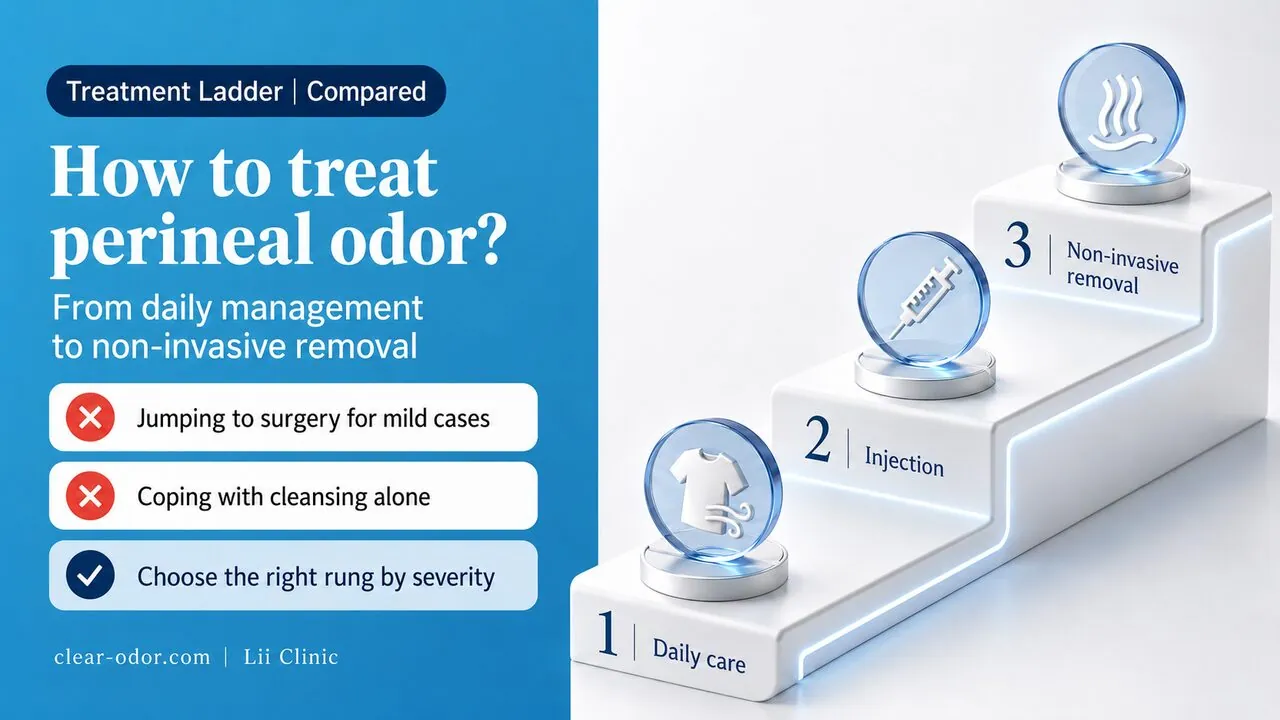
Treating perineal bromhidrosis is not an either/or of "to operate or not." It is a layered ladder: from daily management, through injection treatment, to non-invasive odor removal. Each rung differs in effectiveness, durability and recovery time. This article sets out and compares each option, to help you find the rung most suited to your own severity and life impact.
Key point: There is no "strongest one" in perineal bromhidrosis treatment — only "the one most suited to your current situation." Mild cases need not jump straight to invasive treatment; those whose life is clearly affected need not force themselves to cope with cleansing alone. The key is placing yourself at the right point on the ladder.
The Prerequisite Before Treatment: Rule Out Infection First
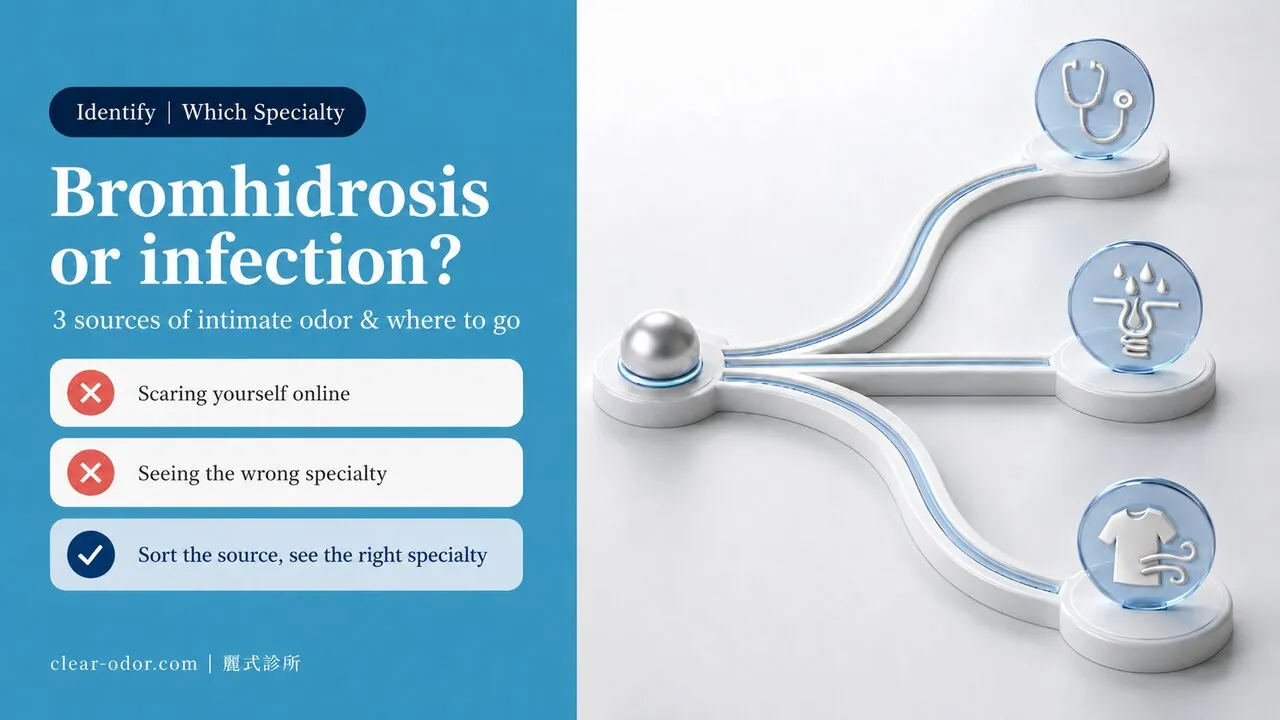
Before discussing any treatment, one thing must be confirmed: that your intimate odor really is apocrine-type perineal bromhidrosis, and not an infection.
Infection-type odor (bacterial vaginosis, candida, trichomonas, etc.) requires gynecological diagnosis and treatment; no odor treatment can help with it. Perineal bromhidrosis treatment addresses the apocrine glands, not infection. If your odor is combined with abnormal discharge, itching, burning, stinging, lower abdominal pain or fever, see a gynecologist first.
For how to distinguish the apocrine type from the infection type, Perineal Odor or Infection? 3 Sources & Which Doctor has a full method of identification. Confirming it is not an infection is rung zero of the perineal bromhidrosis treatment ladder.
First Line: What Daily Management Can and Cannot Do
For mild perineal bromhidrosis, the first line is daily management:
- Choose breathable underwear, avoiding prolonged heat and dampness
- Change clothes promptly after prolonged sitting or exercise
- Cleanse moderately, but avoid over-cleansing that disrupts the normal flora
- Watch for dietary factors that may intensify the odor
What daily management can do: reduce heat and bacterial growth, keeping the odor at a lower level.
What daily management cannot do: it cannot eliminate the apocrine glands themselves. The apocrine glands keep secreting, and the "source" of the odor remains.
So daily management suits people who are mild, with little life impact, as a baseline for long-term upkeep; but for those who are moderate to severe and whose intimate relationships and confidence are already clearly affected, it is usually not enough to solve the problem.
Injection Treatment: A Temporary Option to Reduce Sweat and Odor
Injection treatment (such as botulinum toxin injection) is the middle option on the treatment ladder. Its principle is to temporarily block the nerve signals to the sweat glands, reducing sweating and consequently lowering the odor.
- Advantages: no surgery needed, quick recovery
- Limitation: the effect is temporary, generally lasting several months, requiring repeat injections
- Suits: those who want to try a non-surgical approach first, or who are still deciding
The core feature of injection treatment is "reversible, but requiring ongoing follow-up." If you can accept repeating the injections at intervals, it is a low-invasiveness option; if what you want is a one-time, long-term stable result, look at the next rung.
Non-Invasive Odor Removal: The Long-Term Approach for Perineal Bromhidrosis
For moderate-to-severe perineal bromhidrosis where a long-term approach is wanted, non-invasive odor removal is the option on the treatment ladder that provides long-term results.
It uses non-invasive thermal ablation technology, applying thermal energy to the apocrine glands to address the source of the odor directly — rather than only managing it at the surface. Its features are:
- Pinhole entry only, no suture removal needed
- Only about 2–3 weeks of swelling after the procedure
- Addresses the apocrine glands directly, oriented toward long-term stability
For the full procedure steps and post-procedure care, Non-Invasive Perineal Odor Treatment: Steps & Aftercare has a detailed explanation. To understand real patients' journeys, see Perineal Odor & Intimacy: Three Patterns We See in Clinic.
Key point: The value of non-invasive odor removal is not that it is "the strongest," but that what it addresses is the "source." Daily management addresses the environment, injection addresses temporary nerve signals, while non-invasive odor removal targets the apocrine glands directly — which is why it can provide a longer-lasting result than the previous two rungs. Whether it suits you must still be assessed by a doctor according to your individual situation.
Comparison of Treatment Options
| Comparison | Daily management | Injection treatment | Non-invasive odor removal |
|---|---|---|---|
| What it addresses | Environment and bacteria | Temporary nerve signals | The apocrine glands themselves |
| Effect orientation | Keeps the odor lower | Temporary reduction of sweat and odor | Long-term stability |
| Durability | Must be done continuously | Several months | Long-lasting |
| Wound | None | Injection needle marks | Pinhole entry only, no suture removal |
| Recovery | None | Quick | About 2–3 weeks of swelling |
| Suitable for | Mild, little life impact | Those wanting to try non-surgical first | Moderate-to-severe, wanting long-term results |
Key point: The focus of this table is not "which column is best," but "which column matches your current severity." Treating it as a ladder rather than a ranking keeps you from overdoing it — and from not doing enough.
How to Choose: By Severity and Life Impact
The logic of choosing comes back to two questions: how noticeable is the odor? How great is the impact on life and intimate relationships?
- Mild, little life impact: start with daily management and observe whether it is enough.
- Moderate, wanting to try non-surgical first: injection treatment can be assessed, accepting the need for repeat injections.
- Moderate-to-severe, clearly affecting confidence and intimate relationships, wanting long-term results: a doctor can assess non-invasive odor removal.
Perineal bromhidrosis shares the same origin as underarm bromhidrosis; if you also have underarm trouble, raise it together at the assessment so the doctor can plan holistically. The final approach should still be decided by a doctor after an in-person assessment of your apocrine gland status, severity and life needs.
Frequently Asked Questions
Q1: Does perineal bromhidrosis have to be treated with surgery?
Not necessarily. Mild cases can first try daily management; moderate cases can consider injection. Only when the odor clearly affects life and a long-term approach is wanted is non-invasive odor removal assessed.
Q2: Can injection treatment cure perineal bromhidrosis?
No. Injection temporarily blocks nerve signals, with an effect of several months, requiring repetition. It does not address the apocrine glands themselves, so it is not a long-term solution.
Q3: Does non-invasive odor removal leave a scar?
Non-invasive odor removal uses non-invasive thermal ablation technology, with only a pinhole entry and no suture removal needed. See the article on the non-invasive perineal odor treatment procedure for the detailed process and post-procedure care.
Q4: Must I see a gynecologist before treatment?
If your odor is combined with abnormal discharge, itching, burning or other signs of infection, yes — see a gynecologist first to rule out infection. Only once it is confirmed not to be an infection does the perineal bromhidrosis treatment assessment begin.
Q5: Will perineal bromhidrosis recur after treatment?
Non-invasive odor removal addresses the apocrine glands directly and is oriented toward long-term stability. Actual results vary with individual constitution and post-procedure care, and require assessment and follow-up by a doctor.
Conclusion
Treating perineal bromhidrosis is a layered ladder: daily management (addressing the environment) → injection treatment (temporary reduction of sweat and odor) → non-invasive odor removal (addressing the apocrine glands directly, long-lasting). Rung zero of the treatment ladder is always to rule out infection first. Which rung to choose depends on your severity and life impact — not on "which one sounds strongest."
Dr. Ta-Ju Liu has 20 years of experience in bromhidrosis treatment and offers complete assessment and treatment planning for perineal bromhidrosis. If you have confirmed it is not an infection and want to know which rung of the treatment ladder suits you, you are welcome to book a consultation, or first explore the perineal odor specialist service.
Related Reading
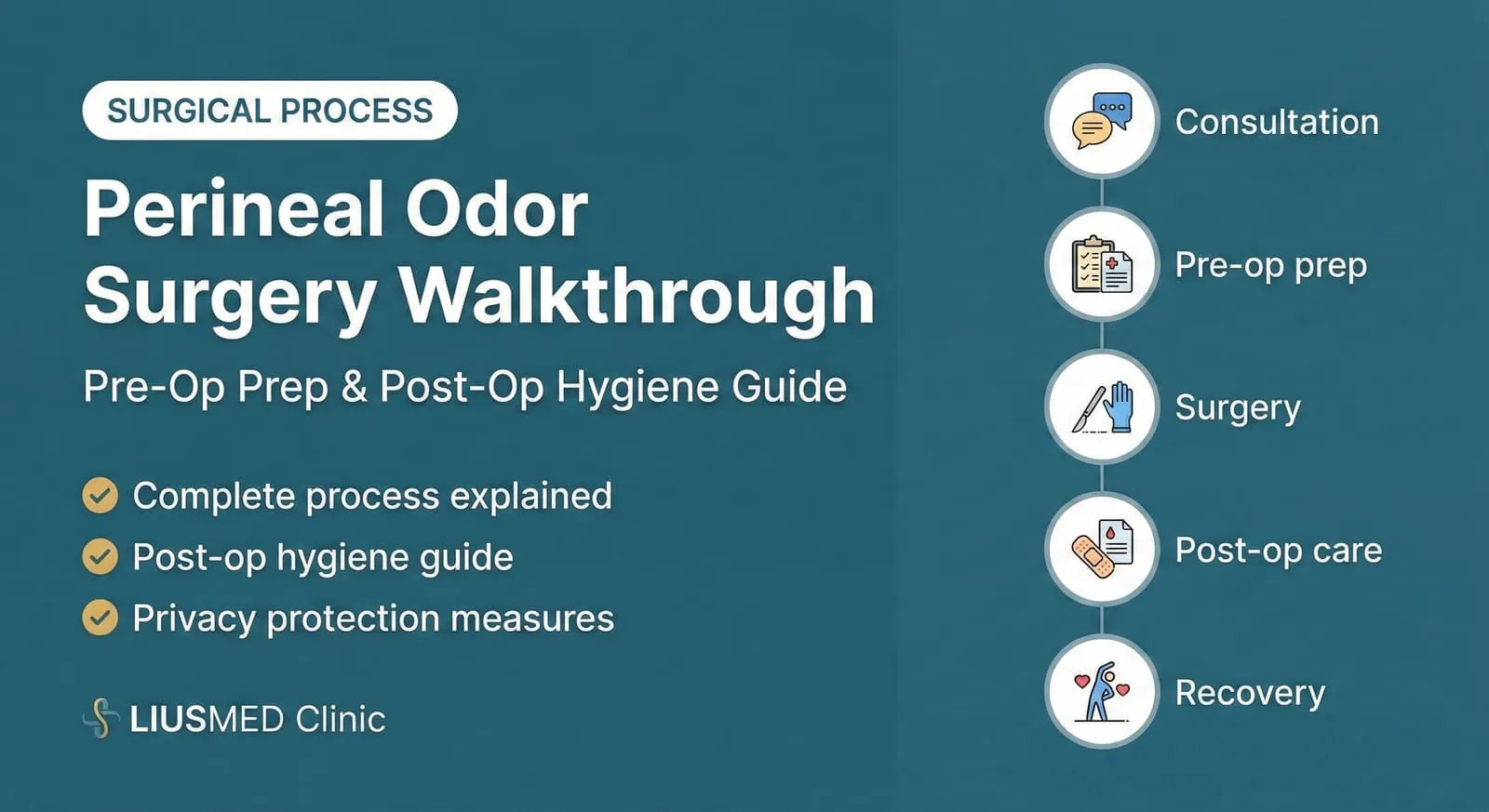
- Perineal Odor or Infection? 3 Sources & Which Doctor
- Non-Invasive Perineal Odor Treatment: Steps & Aftercare
- Perineal Odor & Intimacy: Three Patterns We See in Clinic
- Perineal Bromhidrosis
- Axillary Bromhidrosis
- Intimate-Area Odor (Areola & Perineal)
This article is for health education. Individual results may vary. The treatment method and suitability for perineal bromhidrosis must be confirmed after an in-person assessment by Dr. Ta-Ju Liu; if there are signs of infection, please see a gynecologist first.