"Doctor, every day before work I drench myself in perfume and pile on antiperspirant, but the moment I step into the air-conditioned office or sit down for a meeting, by afternoon I still feel like I smell — and I spend the whole day secretly reading people's faces. Is something wrong with me?"
This is a long-standing anxiety that quietly weighs on many office workers, service staff, and people whose jobs require close contact with clients. Let's start with the single most important idea — and the one most often missed: perfume, antiperspirant, and medical treatment are three completely different things. Perfume masks, antiperspirant temporarily reduces, and real treatment targets the source. For many people, the frustration isn't that they aren't trying hard enough — it's that they keep using "masking" to solve a problem that actually calls for "addressing the source." Of course it feels like "nothing works."
This article spells out workplace odor clearly: why perfume can't cover it, how the three approaches differ, why the workplace environment amplifies odor, how to first tell the source apart, and when an "odor you can't cover up" is actually a signal that it's time to see a doctor.
Want to quickly tell the source apart first? The odor you notice at work may come from the skin — sweat odor and aging odor — from the mouth (halitosis), or, in a minority of cases, from a whole-body metabolic issue. You can use the Midlife Body Odor / Aging Odor Integrated Guide or the Odor Map to sort out the source first, then come back here to decide how to handle it.
Why does drenching yourself in perfume fail to cover body odor — and sometimes make it worse?
Because fragrance molecules don't cancel the original smell — they mix with sweat and sebum odor into a heavier, more jarring "third smell," and in an enclosed air-conditioned room heavy perfume just hangs in the air and bothers those nearby.
Many people's first instinct when facing body odor is "then I'll just spray on more perfume to cover it." But both clinical experience and everyday life prove the same thing again and again: using perfume to mask body odor often backfires.
Fragrance + sweat = a third, more unpleasant smell
Sweat odor, bromhidrosis (body odor from apocrine glands), and sebum odor are mostly made of oily molecules that keep releasing from the skin and clothing. When you spray perfume on top, the fragrance molecules don't "cancel" the original smell — they mix with it, and the result is often a "third smell" that's heavier and more jarring than plain sweat. This is especially obvious when you layer perfume directly without cleaning first, while the odor source is still there.
In an enclosed air-conditioned room, heavy perfume becomes its own problem
The workplace is a relatively enclosed space. Overpowering perfume in an air-conditioned room doesn't disperse — it just hangs in the air, and after a while it gives the people around you headaches or nausea. That's exactly why many companies have started managing "perfume strength" as a matter of scent etiquette. In other words, trying to solve the problem by "spraying more" can easily turn one problem into two.
Key takeaway: Fragrance can be "a bonus once you're clean," but it can't replace removing the odor source. Handle the source first, then talk about fragrance — the order can't be reversed.
What's the difference between perfume, antiperspirant, and medical treatment? One table to see it
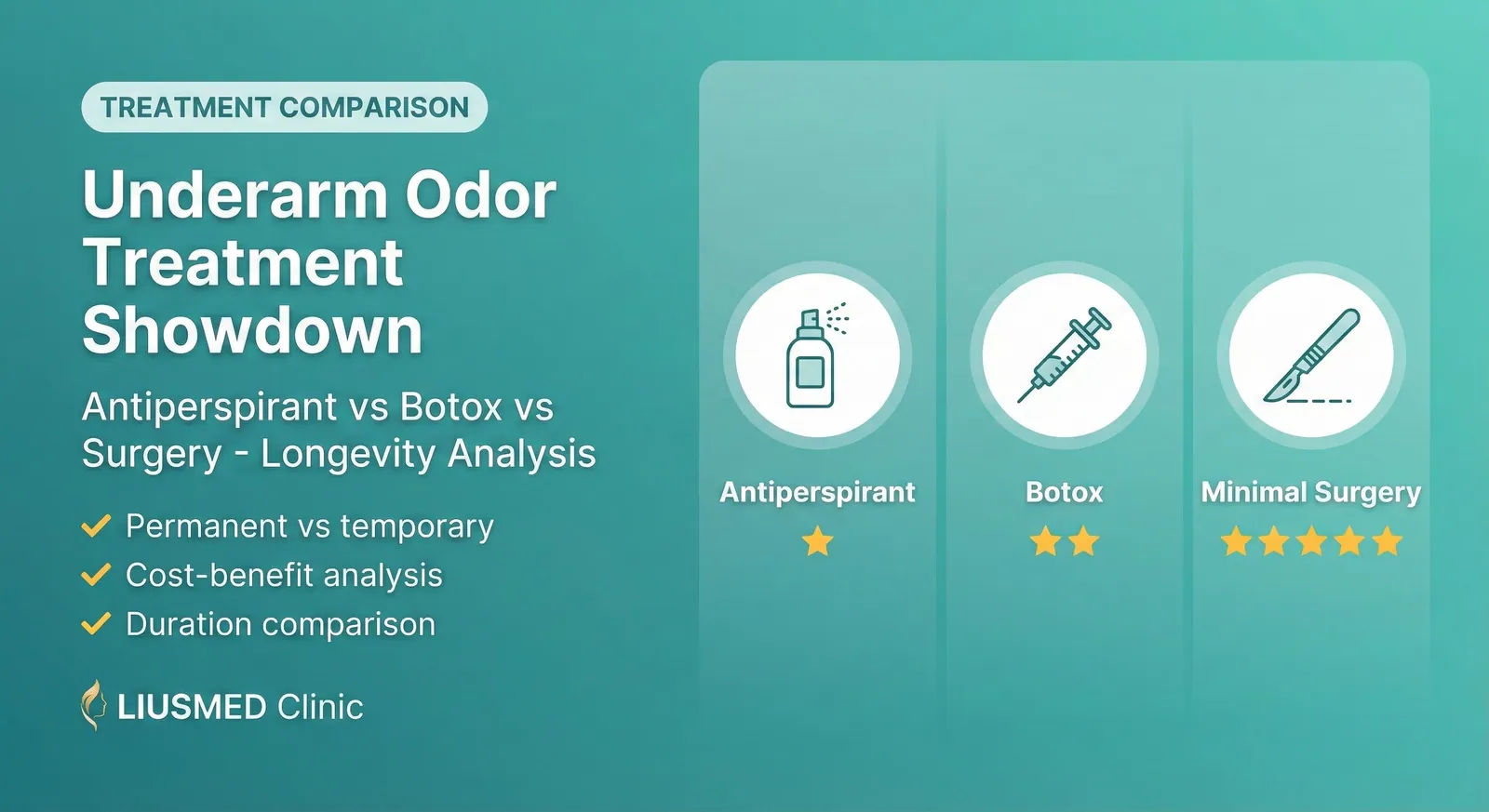
Perfume masks, antiperspirant temporarily reduces sweating, and medical treatment targets the source — three completely different mechanisms, with the first two having limited effect on moderate-to-severe bromhidrosis or marked sweating.
This is the single most important idea in the whole article. Many people treat "perfume, antiperspirant, seeing a doctor" as different intensities of the same thing — but their mechanisms are completely different:
| Approach | What it actually does | What it "can't" do | When it fits |
|---|---|---|---|
| Perfume / fragrance (masking) | Covers existing odor with fragrance | Doesn't reduce sweat, doesn't suppress bacteria, doesn't address the source; stop using it and you're back to square one | When the odor is mild and you want a bonus during a short social moment after cleaning |
| Deodorant / antiperspirant (temporary reduction) | Aluminum salts temporarily constrict sweat pores and reduce sweating; some contain antibacterial ingredients that lower bacterial breakdown | Not permanent, needs ongoing use; limited effect on moderate-to-severe bromhidrosis or marked sweating | Day-to-day control of ordinary sweat odor and mild-to-moderate hyperhidrosis |
| Medical treatment (targets the source) | Addresses the true source — the apocrine glands (the main culprit in bromhidrosis), sweat glands (hyperhidrosis), the mouth (halitosis), or sebum oxidation (aging odor) | Requires first correctly diagnosing "which kind of odor it is" so it can be treated accordingly | Moderate-to-severe cases that affect daily life and socializing, when no amount of masking works |
Once you understand this table, the most common frustration resolves itself: you've been using "masking" and "temporary reduction" to handle a problem that actually needs "targeting the source." Perfume and antiperspirant aren't wrong — they're handy everyday tools. But once an odor is clearly affecting your life, your social interactions, and your confidence at work, no amount of perfume does more than postpone the problem rather than solve it.
Key takeaway: Figuring out which layer you're stuck at is simple — if, after "thorough cleaning + correct antiperspirant use," the odor still can't be covered and keeps troubling you, that suggests the problem is at the "source." That's the moment to consider treatment, not to buy yet another, more expensive bottle of perfume.
Why do workplaces and enclosed spaces especially magnify odor anxiety?
Because the workplace has real environmental factors — close-range contact, enclosed air-conditioned rooms, poorly breathable uniforms worn while sitting all day, and stress sweating — and because body odor is tied to self-esteem and image, the anxiety snowballs on its own.
The same body odor you don't notice at home gets amplified the moment you reach the workplace. This isn't all in your head — there are real environmental factors:
Close range, long hours, no escape
- Close-range contact: in meetings, working side by side, or facing clients in service jobs, the distance is often within one meter — exactly the range where body odor is most easily noticed;
- Enclosed air-conditioned rooms: poorly ventilated spaces let odor (including sweat and overpowering perfume) accumulate and hang in the air;
- Uniforms and sitting for long stretches: uniform fabrics are often poorly breathable synthetics worn all day long, so sebum and sweat get trapped in the fibers and form an "odor reservoir", which starts re-releasing odor repeatedly by afternoon;
- Stress sweating: the tension of meetings and deadlines triggers apocrine gland secretion, and that's precisely the source of bromhidrosis odor — the more tense you are the more you sweat, and the more you sweat the more anxious you get, forming a vicious cycle.
Anxiety snowballs on its own
Workplace odor has another feature: it's tied to your self-esteem and image. Once you start worrying "did someone smell me?" you spend the whole day glancing at colleagues' faces and reapplying perfume, your attention hijacked. Understanding that "the environment really does amplify odor" helps you pull your focus back from "am I terrible?" to "this is a concrete problem that can be triaged and handled."
At work, are you smelling sweat odor, bromhidrosis, aging odor, or halitosis?
The four most common sources of workplace odor — ordinary sweat odor, bromhidrosis, aging odor, and halitosis — differ in mechanism and in how they're handled; they can be assessed and improved, and an integrated odor clinic can help sort out the source.
To treat it correctly, you first have to know which kind of odor it is. The four most common sources of workplace odor differ in mechanism and in how they're handled:
A quick look at the four sources
- Ordinary sweat odor: the sour smell from eccrine sweat being broken down by skin bacteria, most obvious after exercise or in stuffy heat. For most people, cleaning, antiperspirant, and breathable clothing keep it under control;
- Bromhidrosis (underarms / areola / groin): the distinctive smell from apocrine gland secretions being metabolized by bacteria, linked to body-type genetics (ABCC11, the gene for earwax type and body-odor tendency); masking and antiperspirant have limited effect, and this is the category where medical treatment helps most;
- Aging odor / midlife sebum odor: around age 40, oxidized sebum produces 2-nonenal (the key odor molecule of aging odor), which builds up on collars, behind the ears, and on the upper body — a different source from bromhidrosis and sweat odor;
- Halitosis (bad breath): eighty to ninety percent comes from the mouth itself (tongue coating, gum disease, tonsil stones, dry mouth), and it's usually not "a bad stomach"; after midlife, dry mouth makes halitosis more noticeable.
A table to match each to "which direction to handle it"
| What you smell / worry about | Most likely source | First-step direction |
|---|---|---|
| Sour, stuffy underarm smell, worse after exercise | Ordinary sweat odor | Cleaning + antiperspirant + breathable clothing |
| Distinctive underarm smell, family members have it too, antiperspirant can't suppress it | Bromhidrosis (apocrine glands) | Consider bromhidrosis treatment |
| Sweating so heavy it drips, soaks clothes, affects work | Hyperhidrosis | Consider hyperhidrosis treatment |
| Rancid, oily smell on collars, behind the ears, on pillows, appearing after 40 | Aging odor / sebum odor | See the cleaning strategy for aging odor |
| Smell when you speak, brushing doesn't get rid of it | Halitosis (mainly oral) | Start with the source of halitosis |
If you're not sure which kind you have — or you may have several at once — see the integrated triage in Body Odor and Halitosis: Which Specialty Should You See?, or have a doctor sort it all out in a single in-person consultation.
When does an "odor you can't cover up" actually call for a doctor, not another bottle of perfume?
When the odor is still obvious after thorough cleaning plus correct antiperspirant use, is already affecting your confidence at work and your social life, or shows up as a familial underarm smell or heavy sweating, the problem is at the source and it's worth having a doctor assess it.
Perfume and antiperspirant are handy everyday tools, but they have a "ceiling." If the situations below appear, the problem may be at the source, and it's worth having a doctor assess it:
Signs it's time to get assessed
- After thorough cleaning + correct antiperspirant use, the odor is still obvious and can't be covered;
- The odor is already affecting your confidence at work, your social life, and your relationships — you start avoiding meetings and close contact, even thinking about changing jobs;
- A distinctive, familial underarm smell that antiperspirant can't suppress at all (a classic presentation of bromhidrosis);
- Sweating heavy enough to soak your uniform, drip, or interfere with shaking hands or holding a pen (a classic presentation of hyperhidrosis);
- You've long kept it at bay by "spraying more and more," and the cost of perfume and the mental burden keep growing.
Treatment directions that target the source vary by source: for bromhidrosis, you can consider complete removal of the apocrine glands (with ultrasound guidance for precise localization — "you can only treat safely what you can see"; on long-term clinical follow-up recurrence is uncommon, and individual results vary); hyperhidrosis has staged options ranging from topical treatments and botulinum toxin to surgery; for halitosis and aging odor, start with correct cleaning and oral care. The key is: diagnose which kind it is first, then decide how to handle it — rather than masking everything with perfume.
Key takeaway: "Should you see a doctor" isn't about how strong the smell is — it's about whether it's affecting your life. If you're already anxious about it, avoiding situations, and spending heavily on masking, then it's worth getting the source clarified once and for all.
How do you handle a colleague's — or your own — body odor without hurting anyone or over-worrying?
For a colleague, keep it private, brief, and matter-of-fact, focusing on concrete things that can be adjusted; for your own worry, confirm the source objectively first so the anxiety doesn't snowball — the two directions are handled completely differently.
The other half of the workplace-odor challenge is the "people" part — how to deal with someone else's odor, and how to deal with the anxiety of "do I smell?"
If it's a colleague who smells: focus on "the environment and goodwill"
Saying "you stink" straight out is almost guaranteed to hurt. The higher-EQ approach is:
- Private, brief, matter-of-fact: pick a moment with no third person present, and frame it with "I watch out for this myself too," rather than a public or group-chat reminder;
- Focus on concrete things that can be adjusted (clothing, the space, offering help), not on judging the person;
- Understand that people often "can't smell themselves": because of olfactory adaptation (smelling the same odor long enough makes you go numb to it), people with body odor usually aren't indifferent — they genuinely don't notice.
If you're worried about your own odor: confirm objectively first, and don't let the anxiety snowball
Conversely, some people over-worry about their own odor — even when others say there's none, they remain convinced and keep showering and reapplying perfume. This "I feel I smell, but objectively it isn't noticeable" situation is medically related to olfactory adaptation, pseudo-halitosis, and even Olfactory Reference Syndrome (OlRS) (a condition of excessive worry about one's own body odor).
If you often get anxious to the point of disrupting your life over "do I smell?", confirming objectively first matters — if there's truly a source, treat the source; if there's actually no noticeable odor, the focus shifts to emotional and anxiety support rather than endless masking.
Key takeaway: Odor anxiety runs in two opposite directions — one is "there really is an odor but you can't smell it yourself," the other is "there's hardly any odor but you over-worry." The two are handled completely differently, so "confirm the source objectively first" is always the first step.
Which "smells" are actually red flags from the body, not just a perfume fix?
A fruity, ammonia, sweet-musty, or fishy smell — especially with excessive thirst and urination, sudden weight loss, jaundice, or altered consciousness — should prompt ruling out diabetic ketoacidosis, kidney, liver, or TMAU problems, and warrants seeking care promptly.
The vast majority of workplace odor falls within the normal range of sweat, sebum, and the mouth — telling the source apart and treating it accordingly clearly improves things. But a small number of odor patterns are the body sounding an alarm, and they should be ruled out first:
If you notice a fruity / nail-polish-remover smell (rule out diabetic ketoacidosis (DKA)), an ammonia / urine smell (rule out kidney problems), a sweet, musty smell (rule out liver problems), or a fishy smell (rule out trimethylaminuria (TMAU)) — especially together with excessive thirst and urination, sudden weight loss, jaundice, extreme fatigue, or altered consciousness — then it's not a perfume or antiperspirant issue. It's a signal to seek care promptly and have it ruled out by a physician (emergency / nephrology / hepatobiliary-GI / metabolic medicine).
The disease red flags behind these smells are compiled here — worth a read, so you don't treat every odor as "just put on perfume."
Common Q&A
Q1. Does spraying more perfume really make the smell worse?
When the odor source is still there and you haven't cleaned first, the fragrance mixes with sweat and sebum odor and often becomes a heavier, more jarring "third smell"; in an enclosed air-conditioned room, heavy perfume also tends to hang in the air and make those nearby uncomfortable. Perfume works as "a bonus after cleaning, when the odor is mild" — it isn't suited to covering an obvious body odor.
Q2. What's the difference between antiperspirant and deodorant?
Deodorant mainly masks with fragrance; antiperspirant contains aluminum salts that can temporarily constrict sweat pores and reduce sweating, and some contain antibacterial ingredients. The former masks, the latter temporarily reduces sweating — neither "treats the source," and both have limited effect on moderate-to-severe bromhidrosis or marked sweating.
Q3. I shower every day and use antiperspirant — why do I still smell?
If the odor still can't be covered after thorough cleaning + correct antiperspirant use, the problem may be at the "source" — for example bromhidrosis from the apocrine glands, marked hyperhidrosis, aging odor, or halitosis. What you should do then is tell the source apart and consider treatment that targets the source, rather than switching to a stronger antiperspirant or a more expensive perfume.
Q4. Workplace odor makes me really anxious, and I keep glancing at people's faces — is that normal?
Very common. The close range, the enclosed space, and the image pressure of the workplace naturally amplify worry about body odor. The key is to "confirm objectively" first: if there really is a source, treat it accordingly; if everyone says there's nothing but you remain convinced you smell, to the point it disrupts your life, that may be the more anxiety-driven "feeling you smell", where the focus should be on emotional support rather than constant masking.
Q5. A colleague has an obvious body odor — how should I bring it up?
Private, brief, matter-of-fact, focusing on concrete things that can be adjusted (for example the environment, clothing, offering help), framed with "I watch out for this myself," rather than publicly pointing out "you stink." Also understand that the person often "can't smell themselves" because of olfactory adaptation — they're usually not indifferent.
Q6. If I treat bromhidrosis or hyperhidrosis, will it come back afterward?
Proper treatment that targets the source aims to clear the source thoroughly. Taking bromhidrosis as an example, our clinic aims for complete removal of the apocrine glands, uses ultrasound guidance for precise localization, and on long-term clinical follow-up recurrence is uncommon (per in-clinic records; individual results vary). Which approach actually suits you and what results to expect need a doctor's in-person assessment based on your situation.
Closing Thoughts
"I drench myself in perfume and pile on antiperspirant, and I still feel like I smell" — the answer is often this: you're using "masking" to solve a problem that calls for "addressing the source." Perfume and antiperspirant are handy everyday tools, but they aren't treatment; once an odor is clearly affecting your confidence at work and your social life, no amount of perfume does more than postpone the problem.
The correct order is: tell the source apart first (sweat odor, bromhidrosis, aging odor, or halitosis), then decide whether to mask, to use antiperspirant, or to treat the source, while watching for those "can't-cover-it, very distinctive" red-flag signals. When you need help figuring out the direction, you're welcome to contact us online, and Dr. Ta-Ju Liu will assess your individual situation.
This article is integrated patient-education information and cannot replace a formal in-person consultation. Actual diagnosis and treatment still require a doctor's personal assessment.
Related Reading
- How to Tell Three Body Odors Apart: Aging, Bromhidrosis, Sweat
- Body Odor or Bad Breath: Which Doctor Should You See?
- Others Say You Smell but You Can't? Real vs Pseudo Odor
- Bad Breath Despite Brushing? It's Usually Not Your Stomach
- Sudden Strange Body Odor or Breath? 5 Disease Red Flags
- You Smell but Others Don't? Olfactory Reference Syndrome
- Midlife Body Odor & Aging Odor Guide
- The Odor Map (site-by-site triage)
- Axillary Bromhidrosis