The question parents bring in has usually been washed at for three months
The child is still in primary school. One day you pick them up and what you smell is not the milky smell of a small child. It is the smell of an adult who has been sweating.
What follows is almost always the same sequence. New body wash. Showers twice a day. Their clothes washed separately. A children's antiperspirant. Three months later the smell is still there. So the searching starts, and it lands on the word bromhidrosis, and then on the word surgery, and the family arrives in my clinic asking what age a child can be operated on.
I usually set that question aside and ask a different one: when did the smell start, and is anything else changing?
Because before we decide whether to treat body odor, something else comes first in the order.
If what you need is the decision layer — what age to assess, when I would advise waiting — read Which specialist treats childhood body odor? When to assess, and when I advise against surgery. This article is the step before that: whether the smell itself is telling you something.
One line to remember: 8 for girls, 9 for boys
There is a clinical threshold. Adult-type body odor, underarm hair or pubic hair appearing before a girl turns 8 or a boy turns 9 is what paediatric endocrinologists call premature adrenarche.
The term sounds alarming. In itself it is usually benign. All it means is that the adrenal glands have started producing androgens somewhat earlier than average, and the apocrine glands — the sweat glands in the underarm that generate odor — have been switched on by those hormones.
The point is not the label. The point is that this line is a threshold for "worth having it checked."
What this line refers to is adult-type body odor — the kind that lingers after the sweat has dried and comes back a few hours after a shower. A faint whiff of sweat after running around does not count; that can appear before 8 and still sit within the normal range.
Odor that appears after that line is usually just the normal sequence of development. Odor that appears before it does not automatically mean something is wrong, but it earns one appointment to be sure.
Is it odor alone, or odor with something else?
This is the part parents can observe at home. What matters is not how strong the smell is. It is whether the smell arrives on its own or alongside other signs of development.
| What you are seeing | What it more likely means | What to do |
|---|---|---|
| Adult-type underarm odor only, perhaps with oilier scalp or a few spots | More consistent with adrenal androgens starting early | Have it assessed once, to confirm nothing else is going on |
| Odor plus underarm or pubic hair appearing early | Same picture, but worth confirming sooner | Arrange an assessment |
| Breast development in a girl, or testicular enlargement in a boy | These are true secondary sexual characteristics — a different matter from odor alone | See a paediatric endocrinologist promptly |
| A sudden growth spurt; outgrowing trousers and shoes unusually fast | Bone age may be running ahead | See a paediatric endocrinologist promptly |
| Any of the above in a particularly young child (before about 6) | Needs a fuller evaluation | See a paediatric endocrinologist promptly |
Adrenal androgens starting early typically do not come with breast development or testicular enlargement, and usually do not produce a marked growth spurt. When those appear together, odor is no longer the thing to be looking at.
This table is not a diagnostic tool. It is there to help you decide whether to book an extra specialty. The actual judgement needs a doctor who has seen your child.
Why the smell starts early — and why it is not a washing problem
The part parents find most frustrating is that they are washing, carefully, every day, and the smell is still there.
That is because the smell does not originate on the surface of the skin.
The underarm has two kinds of sweat glands. Eccrine glands produce the watery sweat that cools the body and carries almost no odor. Apocrine glands produce a secretion containing lipids and proteins which, on its own, does not smell either — but bacteria living on the skin break it down into short-chain fatty acids, and those carry the characteristic smell.
Apocrine glands are essentially dormant through childhood. They wait for a hormonal signal before they start working. So a child who "suddenly smells" is telling you that the glands have switched on, not that they have become dirty.
Washing removes odor that has already formed. It does not reach the gland that is still producing it. That is why doubling the showers buys a few hours and no more.
For the full anatomy and physiology, see Apocrine glands explained: anatomy, physiology, disease and lifetime changes.
When I ask families to see a paediatric endocrinologist before talking to me about surgery
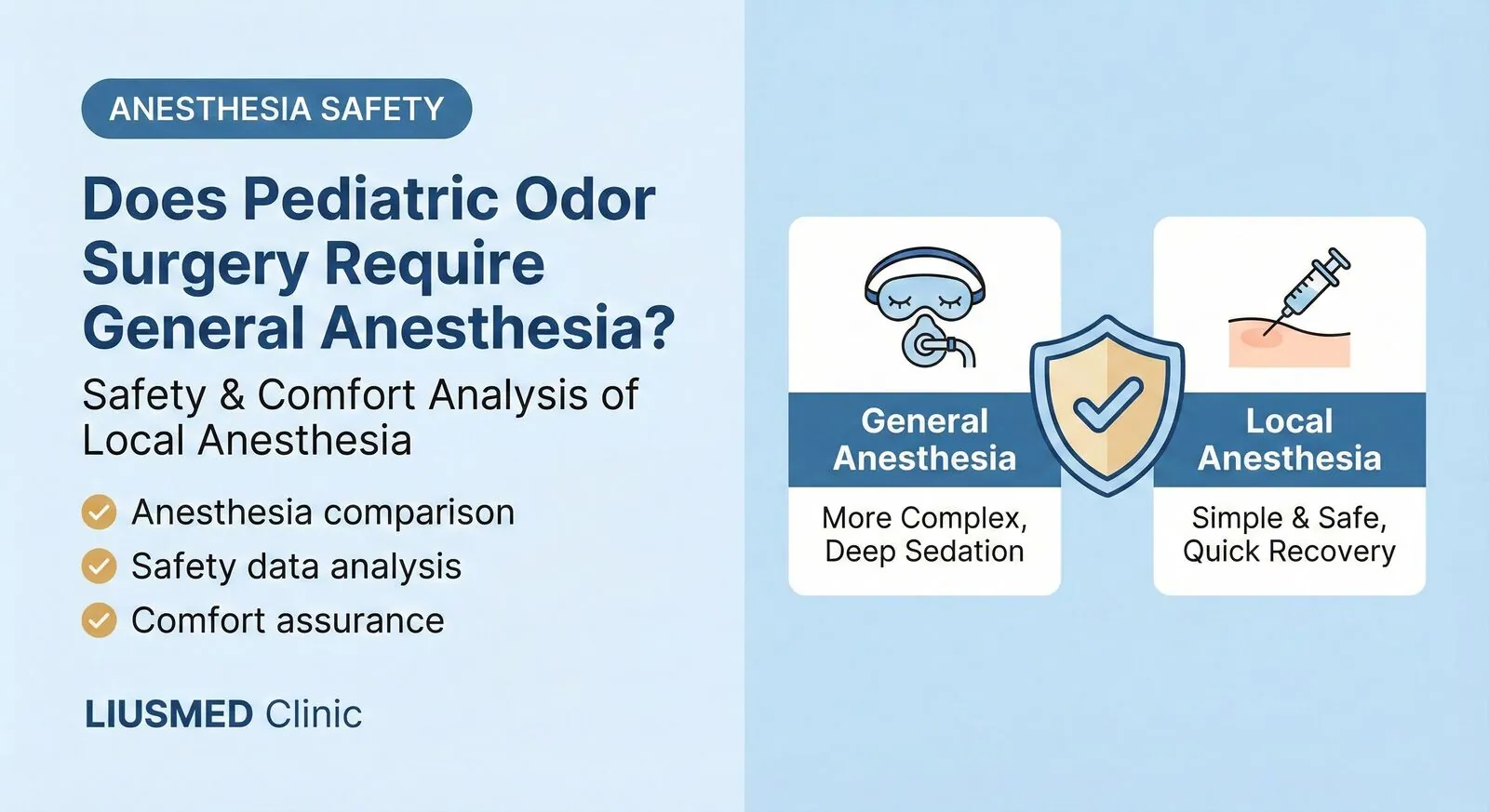
Most of my clinic time goes on how to clear the odor thoroughly. But in the following situations I ask parents to book paediatric endocrinology first and leave surgery aside:
- Clear adult-type body odor before age 8 in a girl or age 9 in a boy
- Odor accompanied by breast development, testicular enlargement, or an obvious growth spurt
- Parents who cannot place when the smell began, only that "it seems to have sped up"
The reasoning is simple. If the body is starting early, that is the thing to address — not the smell. Odor in that situation is a signal, and covering a signal does not remove what is underneath it.
There is also a surgical reason that happens to point the same way: operating while development is still moving is not good timing regardless.
What a paediatric endocrinology assessment involves
Parents often worry this means a battery of tests. A first assessment is usually not complicated:
- History and examination — which stage of development the child is at, whether secondary sexual characteristics are present, family history
- Bone age X-ray — of the left hand and wrist, comparing skeletal maturity against chronological age
- Blood tests — commonly DHEA-S (an adrenal androgen), 17-hydroxyprogesterone, LH and FSH, sex hormones, sometimes thyroid function
The bloods are there to separate early adrenal activity from true central precocious puberty, and to exclude the less common causes that need specific treatment. Where it is simply early adrenal activity, bone age is usually only modestly advanced, and management is often observation rather than medication. If the baseline values are inconclusive, a stimulation test may be arranged; that is part of the standard pathway and does not mean the situation is more serious.
I am deliberately not giving you reference ranges here. Those numbers only mean something read against a child's age, stage and overall picture. Comparing a single value in isolation tends to produce worry and nothing else.
If the assessment comes back as simply early, then we return to the odor
Suppose paediatric endocrinology concludes there is no central precocious puberty, the adrenal glands simply started early, and the child does have apocrine-type odor.
What comes next is the subject of the other article on this site — whether to treat now, when to treat, and how to get through the waiting period if the answer is not yet.
A few principles in short:
- While puberty is still running, odor intensity is still changing. This stage is about control and support, not about deciding quickly.
- For surgical timing I look at whether the odor has stabilised and at the child's own wishes, rather than at an age number alone.
- Whether it is the parent or the child who wants surgery matters a great deal.
The full decision map is in Which specialist treats childhood body odor?. For how we approach this age group and what a visit involves, see paediatric bromhidrosis care; once development has been cleared and you want the odor itself assessed, you can start from booking a consultation — a child's consultation is always attended by a parent, and the decision is made by parent and child together. For the adult picture, see The complete guide to bromhidrosis, or go straight to axillary bromhidrosis surgery.
The two things parents most often do at this stage, both of which backfire
The first: washing harder.
Two or three showers a day, strong antibacterial washes, scrubbing the underarms. The result is a damaged skin barrier — dry, itchy, sometimes inflamed — and the smell is unchanged. The child also receives a message: I am dirty.
Normal washing is enough. Choose breathable fabrics, change after sweating, and use an ordinary deodorant if needed; check with a doctor before using an aluminium-salt antiperspirant on a child (see Q6 for the age guidance).
The second: checking and discussing it in front of other people.
"Come here, let me smell you." "He's been a bit smelly lately." Said at the dinner table or in front of relatives, those sentences do damage that is not smaller than the smell.
In clinic I almost never assess by smelling. A child should not have to be checked for smelling bad in front of an unfamiliar adult; that experience leaves something behind. The same applies at home. Have this conversation privately, with the child, not about them.
Frequently asked questions
Q1: My child is only 7 and already has underarm odor. Does that mean precocious puberty?
Not necessarily. Early body odor most often reflects adrenal androgens starting early, which is usually benign and is not the same as central precocious puberty. But because it falls before the age-8 (girls) / age-9 (boys) line, an assessment is worth arranging — particularly if other signs of development are present too.
Q2: Which specialty should we see — paediatric endocrinology or dermatology?
If your child is below that age line, or if there are developmental changes beyond the smell, start with paediatric endocrinology. If they are past the line and the issue is purely odor, dermatology or plastic surgery can assess where the smell is coming from and what the options are. These are not in conflict; the order is what differs.
Q3: Will early body odor affect my child's final height?
Where it is simply early adrenal activity, bone age is usually only modestly advanced and the effect on final height is generally limited. Central precocious puberty is different: bone age can run well ahead and growth plates can close early, which is one reason early assessment matters. Individual cases vary, and this needs a paediatric endocrinologist looking at bone age and the growth chart.
Q4: Will blood tests be needed, and will my child cope?
A first assessment usually includes a bone age X-ray and one blood draw. It is a routine venous sample with no special preparation beyond what the clinic advises. Explaining beforehand what will happen generally goes better than explaining it in the moment.
Q5: If the endocrine work-up is normal, will the smell go away on its own?
Once the apocrine glands have been switched on by hormones they keep working through adolescence and adult life; they do not quieten down again simply because a child gets a few years older, so the odor does not usually disappear by itself at this stage. Its intensity does change as puberty progresses, and it can be managed without surgery in the meantime. The goal at this stage is not to eliminate the smell but to make daily life workable.
Q6: Can we use an antiperspirant at this age?
Our general guidance is to start over-the-counter aluminium-salt antiperspirants from age 10; between 8 and 10, begin with gentler measures such as frequent changes of clothing and baby powder products. And if a child under 8 already has clear adult-type body odor, the order is the assessment described in this article first, not a product to cover the smell. Test any product on a small area first and stop if it becomes red or itchy.
Three things for parents
- Start with the age line. Adult-type body odor before 8 in a girl or 9 in a boy earns one appointment.
- Notice whether the odor is alone. Alongside breast development, testicular enlargement or a marked growth spurt, paediatric endocrinology comes first.
- Do not spend your energy on washing. The smell comes from the gland, not the surface. Save that energy for the assessment, and for how your child is feeling.
The smell can be dealt with. How a child learns to see themselves is much harder to undo.
Further reading
- Child Bromhidrosis: Which Doctor, and When Not to Operate
- Apocrine Glands Explained: Anatomy, Function & Body Odor
- Bromhidrosis Guide: Causes, Diagnosis, Treatment & Recovery
- Body Odor or Bad Breath: Which Doctor Should You See?
Written by Dr. Ta-Ju Liu. Diagnosis and treatment require assessment by a qualified physician, and individual circumstances and outcomes vary. This article is health education and does not replace an in-person medical consultation. If you have concerns about your child's development, please consult a paediatrician or paediatric endocrinologist.