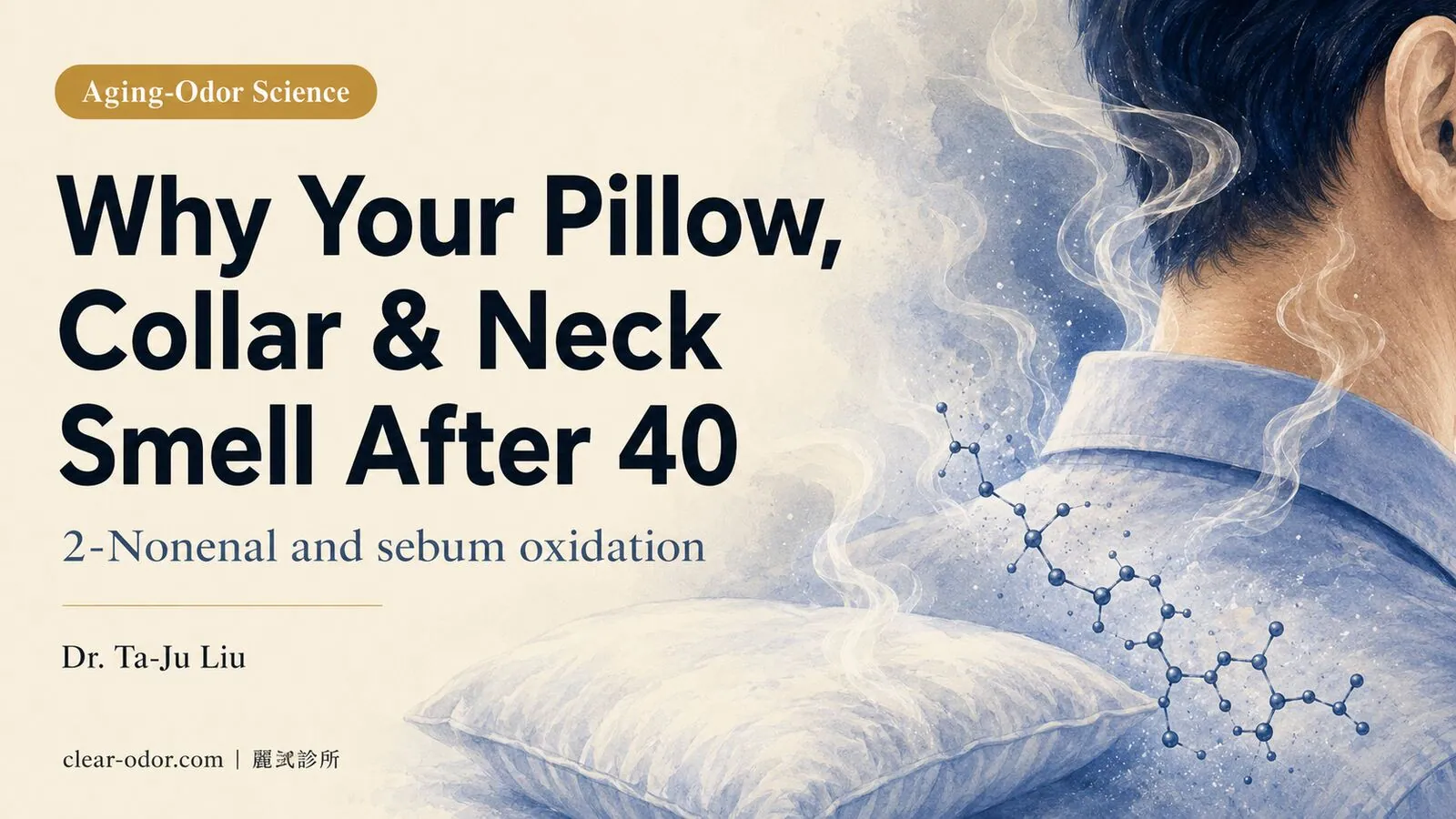
"Doctor, I shower every day and change my clothes daily, but my pillow, my shirt collars, my jacket — after a while they get this stale smell I can't quite describe. Is it something I'm not washing properly?"
This is a very common thing to hear after midlife. The bottom line first: most of the time this isn't a hygiene problem — it's aging body odor. It has nothing to do with being unclean. It happens because the sebum (oil) on the skin's surface oxidizes with age and produces an odor molecule called 2-Nonenal (trans-2-nonenal). The smell is often described as "oily, grassy, like old books, like a long-stored cardboard box, damp and musty" — not sweaty, and not the underarm smell of bromhidrosis.
This article isn't about masking the smell. It's about laying out the science of aging body odor clearly, so you know where to actually put your effort.
Smell coming from more than one place? If your concern isn't limited to one spot, start with the Midlife Body Odor & Aging Odor Integrated Guide to separate the three threads — aging odor, halitosis, and whole-body metabolism — then come back here to dig into the skin thread.
What is 2-Nonenal, the key molecule behind aging body odor?
Aging body odor's core molecule is 2-Nonenal — an aldehyde formed when the unsaturated fatty acids in sebum break down after oxidizing, not the smell of sweat itself.
It is a product of sebum oxidation, not the smell of sweat
2-Nonenal (trans-2-nonenal) is currently the most representative "age-related body odor molecule." It isn't the smell of sweat itself. Rather, it's an aldehyde produced when the unsaturated fatty acids in sebum (the oil the skin secretes) break down after oxidizing.
When a Japanese research team analyzed the body odor of subjects aged 26–75 back in 2001, they found that 2-Nonenal was detected almost exclusively in people over 40, and was barely measurable in younger subjects. A later 2016 study on skin volatiles further showed that 2-Nonenal emission rises with age in both men and women. In other words, it's a real phenomenon backed by a molecule and by data, not just a vague "getting-older feeling."
Aging odor ≠ bromhidrosis ≠ ordinary sweat odor
These three "smells" are often lumped together, but their sources are completely different:
| Type | Main source | Key factor | Common sites |
|---|---|---|---|
| Aging odor | Sebum oxidation | 2-Nonenal | Upper body, behind the ears, chest and back |
| Bromhidrosis | Underarm apocrine glands | ABCC11 gene | Underarms |
| Ordinary sweat odor | Eccrine glands + bacteria | Sour smell of sweat | Feet, underarms, high-sweat areas |
Get the category wrong and the whole management direction is wrong. For a full differentiation of all three, see What's the Difference Between Aging Odor and Bromhidrosis? Sources of Three Smells and How to Tell Them Apart.
Why does aging body odor tend to appear around 40 — is it a switch or a threshold?
Age 40 isn't a switch but a practical threshold: across large samples 2-Nonenal detection rises on average around 40, yet when it appears varies from person to person.
A lot of articles write "age 40" as though it were a switch — as if the moment you cross 40, everyone suddenly flips on an "old people smell." That's not accurate.
In the literature, "40" is better understood as a practical threshold: across large samples, the detection rate and amount of 2-Nonenal begin to rise noticeably, on average, around age 40. But this is a population average, not an individual guarantee:
- Some people pick up a faint hint at 35;
- Others are still barely noticeable at 50;
- It's influenced by many factors at once: sebum output, hormones, oxidative stress, lifestyle, and how clothing and bedding are managed.
So the right way to understand it is this: age pushes up the probability of developing aging body odor, but it's not a switch that everyone trips on schedule. Rather than worrying about "have I hit the age," it's more useful to put your attention back on the parts you can manage — sebum, and clothing and bedding (see Section 6).
How does sebum oxidize into 2-Nonenal?
The unsaturated fatty acids in sebum undergo peroxidation and split apart under rising oxidative stress and reactive oxygen species with age, producing aldehydes like 2-Nonenal.
Three steps
The mainstream mechanistic model for aging body odor can be broken into three steps:
- Sebum composition changes with age: the sebum on the skin's surface contains unsaturated fatty acids (especially monounsaturated fatty acids of the ω7 family).
- Oxidative stress rises: with age, the skin's antioxidant capacity declines and reactive oxygen species (free radicals) become relatively more abundant.
- Lipid peroxidation → aldehyde formation: unsaturated fatty acids are oxidized and split apart, and 2-Nonenal is one of the representative products.
This is also why Japanese health education on aging body odor consistently places "unsaturated fatty acids in sebum + lipid peroxides + oxidation" at the center.
An honest caveat: don't state "palmitoleic acid definitely rises" as fact
Articles often state flatly that "palmitoleic acid (an ω7 fatty acid) definitely rises with age." In reality, the literature isn't fully consistent on whether any single fatty acid necessarily rises with age — some studies even show certain monounsaturated fatty acids actually decreasing in older skin.
The more robust way to put it is: the link between increased lipid oxidation and rising 2-Nonenal is clear; but "one particular fatty acid definitely rises" should not be stated as an absolute. The mechanism is real — just don't overstate the details.
Why does aging body odor concentrate behind the ears, nape and upper back instead of the underarms?
Because these areas are rich in sebaceous glands and hard to smell on yourself, and sebum and 2-Nonenal get trapped in pillows and collars that re-release the smell — while bromhidrosis is what concentrates in the underarms.
One very handy way to tell aging body odor apart from bromhidrosis is location.
Where it tends to show up
Aging body odor is most often described in: the scalp, behind the ears, the nape of the neck, the chest, the upper back, and the zones in contact with collars, pillows, and bedding.
Why these areas?
- These areas are rich in sebaceous glands (especially the scalp, the area around the face, and the upper back), making them the main stage for sebum oxidation;
- They are hard to smell on yourself (behind the ears, the nape, and the back of the head are all in the blind spots of your own sense of smell), so family members often notice first;
- The smell gets trapped in fabric — sebum and 2-Nonenal accumulate in pillows, collars, and jacket linings, forming a "reservoir that re-releases the smell." That's why it feels like "the person is fine right after a shower, but the pillow and clothes smell as soon as they get close."
This overlaps heavily with scalp odor. If your smell concentrates on the scalp, the back of the head, and the pillow, it's worth also reading The Microbiome Truth About Scalp Odor and How to Manage It.
The key point: aging body odor leans toward the upper body and sebum-rich areas, while bromhidrosis concentrates in the underarms. If you keep staring at your underarms for the answer but find the underarms are actually fine and the smell comes from your upper back and collar, then it's time to correct course.
Is aging body odor only a men's problem, or do women get it too?
It isn't male-only — the 2016 study showed 2-Nonenal rises with age in both men and women; men just produce more sebum and get complained about more often.
Online posts about "my husband started to smell" far outnumber those about a wife, which often gives the impression that aging body odor is a men-only problem. It isn't. The 2016 study showed that 2-Nonenal rises with age in both men and women.
Why do men "get complained about more often"?
- Men, on average, produce more sebum, so there's more raw material to oxidize;
- Differences in how often, and how thoroughly, clothing and bedding are cleaned;
- Body odor is more likely to be noticed first, and brought up out loud by family members living in the same home.
So the more conservative — and more accurate — way to put it is: men, on average, are more likely to be complained about, but women get aging body odor too, especially around menopause and during stages of hormonal change, when body odor can also shift. Treating it as "a men's problem" and overlooking women may cause some people to miss a signal worth paying attention to.
What actually works against aging body odor — which countermeasures have evidence and which are still theory?
The mainstays with real evidence are targeted sebum management and washing clothing and bedding thoroughly; antioxidant diets have only small-study signals and should be a supplement, not a cure.
This is the part everyone most wants to know. Divide the countermeasures into two tiers and you won't waste your effort.
✅ Has some evidence, worth making the mainstay
- Sebum management of the key areas: focus your cleaning on the scalp, behind the ears, the nape, the upper back, and the chest — the sebum-rich zones that are the main stage for aging body odor — rather than anxiously over-scrubbing your whole body.
- Wash clothing and bedding often, and wash them through: sebum and odor molecules accumulate in pillowcases, collars, and close-fitting fabric, forming a smell reservoir that keeps releasing odor when washing is incomplete. Many people spend a lot on skincare products yet overlook that the pillow and collar are where the smell is actually stored.
- If hyperhidrosis is also present, address the excess sweating itself: getting the sweating under control reduces the environment in which bacteria metabolize and odor accumulates. For an integrated approach to excessive sweating, see Hyperhidrosis and Compensatory Sweating.
⚠️ There's a signal, but don't overstate it for now
Antioxidants, tea polyphenols, green tea, persimmon tannin, blackcurrant and similar "antioxidant diet/ingredients" — the current state needs to be described precisely: there is mechanistic plausibility and some small-study signals, but it's still a long way from "proven effective."
- Polyphenol soap: a small before-and-after study of about 20 men aged 43–75 over 4 weeks showed improvement in 2-Nonenal levels and odor scores;
- Blackcurrant: a small human study shows changes in the skin's volatile-molecule profile;
- Green tea, oolong tea, persimmon and so on: most of the evidence is still at the level of formulation studies, in-vitro aldehyde scavenging, or small-scale data;
- Clearing up a common misconception: the human studies that do exist focus on polyphenol soap and blackcurrant, not citrus. The claim that "eating citrus eliminates old people smell" goes beyond the existing evidence.
The reasonable attitude: these can serve as a supplement, but don't treat them as a cure — and don't let them distract you from the two real mainstays, sebum management and clothing management.
When is body odor after midlife more than aging odor — and a sign of disease?
When the smell stops being oily and musty and turns fruity, ammonia-like, sweet-moldy or fishy, or progresses fast with whole-body symptoms, treat it as a signal from the body and rule out disease.
The vast majority of body odor after midlife is aging body odor plus lifestyle — part of normal aging, and nothing to be overly anxious about. But there is one situation that calls for heightened vigilance: when the odor pattern is very unusual, or it progresses very fast.
These smells should be treated as signals from the body
If the smell isn't that "oily, musty" aging-odor type, but instead:
- fruity, like nail polish remover → rule out diabetic ketoacidosis;
- ammonia-like, urine-like → rule out kidney problems;
- sweet and moldy → rule out liver problems;
- fishy, present in sweat, urine, and breath all at once → rule out trimethylaminuria (TMAU).
Or if it comes with unexplained weight loss, extreme thirst and frequent urination, jaundice, or severe fatigue, then it shouldn't be treated as body odor alone — seek medical care promptly. These "red flags behind the smell" are laid out in Is a Suddenly Unusual Body Odor or Breath Your Body Calling for Help? 5 Major Disease Red Flags.
In other words: aging body odor is an "oxidized oily smell," not a "strange, unusual odor." When the smell clearly departs from the oily, musty range, please treat it as a signal from the body rather than simple aging.
Frequently Asked Questions
Q1. What does aging body odor actually smell like?
It's most often described as oily, grassy, like old books, like a long-stored cardboard box, damp and musty. It isn't the sharp underarm smell of bromhidrosis, nor the sour-sweat smell after exercise, but a more "musty, oily, stale" smell, with sebum-oxidation-derived 2-Nonenal at its core.
Q2. Why do my pillow and collar still smell even though I shower every day?
Because sebum and 2-Nonenal accumulate in fabric, forming a "reservoir that re-releases the smell." The person gets clean, but if the pillowcase, collar, and jacket lining aren't washed through, the smell keeps coming back. Washing bedding and close-fitting clothing often, and washing them thoroughly, often makes more of a difference than washing your body over and over.
Q3. Do only men get aging body odor?
No. Research shows 2-Nonenal rises with age in both men and women. Men tend to "get complained about" at a higher rate because they usually produce more sebum and are noticed earlier by family, but women get it too, especially around menopause.
Q4. Will I definitely get aging body odor the moment I turn 40?
Not necessarily. "Age 40" is a practical threshold in the literature — a population average, not a switch everyone trips on schedule. Some people start a bit earlier, others much later, and it's also influenced by sebum output, lifestyle, and clothing and bedding management.
Q5. Can drinking green tea, eating citrus, or taking antioxidant foods eliminate aging body odor?
The evidence is limited so far. Antioxidant ingredients have mechanistic plausibility and small-study signals (the human data is mainly in polyphenol soap and blackcurrant, not citrus), so they can serve as a supplement, but not as a cure. The mainstays that genuinely have some evidence are targeted sebum management and clothing and bedding cleaning.
Q6. Can aging body odor be "cured"?
Aging body odor is a physiological change that comes with age; the goal is to manage and reduce it, not to claim a "cure." With good sebum and clothing management, most people can clearly improve their day-to-day odor concerns. If there are also manageable factors like hyperhidrosis or scalp odor, addressing those together makes the overall experience better.
Q7. Which specialty should I see?
If it's mainly skin/sebum-type aging body odor, you can have it assessed at a dermatology clinic or an integrated odor clinic. If you're not sure whether the smell comes from the skin, the mouth, or the whole body, it's more efficient to first use the Midlife Body Odor Integrated Guide to pin down the source. If you have any of the unusual odors or red flags mentioned in Section 7, prioritize medical care to rule out systemic disease.
Closing
Aging body odor isn't "you're not clean enough" — it's the natural result of the skin's sebum oxidizing with age and producing 2-Nonenal. Understanding this is a relief, because it has a clear mechanism and there are things you can act on: focus your cleaning on the sebum-rich upper body, wash the pillow, collars, and close-fitting clothing often and thoroughly, and address any co-existing hyperhidrosis when needed. An antioxidant diet can be a supplement, but don't treat it as the only answer.
And when the smell clearly departs from "oily, musty" and turns fruity, ammonia-like, or fishy, or progresses quickly and comes with whole-body symptoms, please treat it as a signal from the body and seek care early. If you'd like to sort out your own situation and find which direction to prioritize, you're welcome to contact us online, and Dr. Ta-Ju Liu can assess based on your individual circumstances.
This article is integrated health-education information and cannot replace a formal in-person consultation. Actual diagnosis and management still require a physician's personal evaluation.
How midlife body odor can be assessed and improved
Midlife body odor and aging odor are not something you "just have to tolerate, or just keep washing away." They have clear sources, and there are places where you can actually make a difference — we first help you tell whether it's sebum oxidation, bromhidrosis, or something else, and then map out an individualized, overall direction for improvement based on your situation. The detailed assessment and arrangements are explained during the consultation, according to your particular circumstances.
If this is troubling you, you're welcome to book an assessment, where Dr. Ta-Ju Liu can help you tell the sources apart and discuss a direction that suits you.
Related Reading
- Oily Smell on Your Pillow After 40? Middle-Aged Scalp Odor
- Clothes & Pillows Still Smell After Washing? How to Fix It
- How to Tell Three Body Odors Apart: Aging, Bromhidrosis, Sweat
- Apocrine Glands Explained: Anatomy, Function & Body Odor
- Sudden Strange Body Odor or Breath? 5 Disease Red Flags
- When Does 'Old People Smell' Start? The 3 Age Stages
- Midlife Body Odor & Aging Odor Guide
- Axillary Bromhidrosis
- Scalp Odor Integrated Assessment