Your Ear Holds the Answer
In clinic, I often ask new patients a question that catches them off guard: "Is your earwax wet or dry?" Most look puzzled — what could earwax possibly have to do with body odor? In fact, earwax phenotype is the most useful at-home clue to bromhidrosis risk — no blood test, no lab. But it is reliable in only one direction: with dry earwax the odds are low, though not zero, while wet earwax only means "possible." That difference matters, and the numbers behind it come up in the next section.
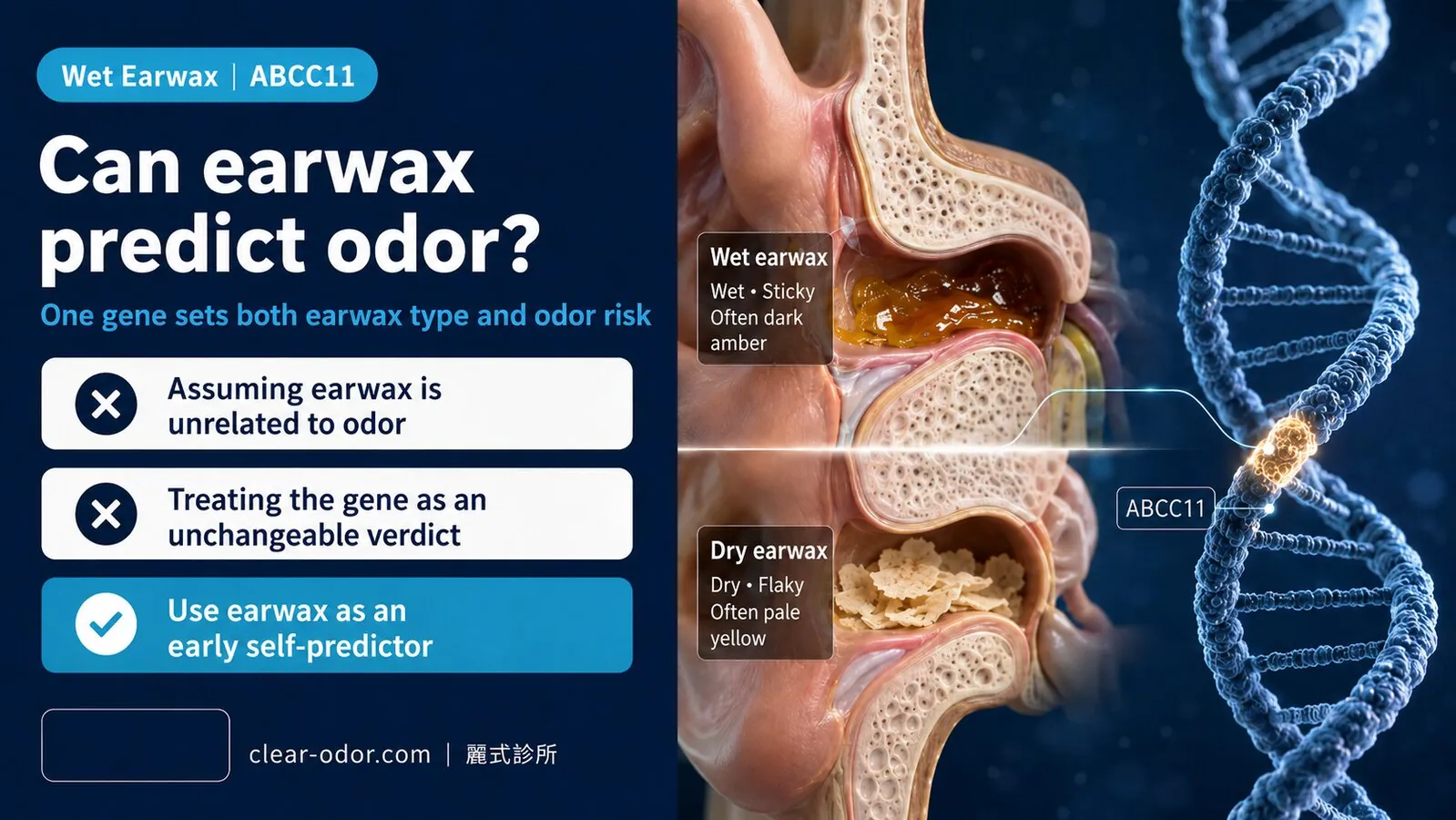
The science behind this connection traces back to a single gene called ABCC11, and a single base pair change (538G→A) that simultaneously determines whether your earwax is sticky honey-yellow or dry and flaky — and whether your apocrine glands churn out the precursor molecules that cause body odor. This article walks through the ABCC11 story, the striking population frequency differences across ethnic groups, and how to use your earwax to assess your own bromhidrosis risk.
The ABCC11 Story: One SNP, Two Phenotypes
ABCC11 stands for ATP-Binding Cassette transporter sub-family C member 11. The gene sits on chromosome 16, and everyone carries two copies of it, one from each parent; people differ only in which version they have at one position. It encodes a transporter protein — a molecular pump that exports lipid and protein precursors from apocrine gland cells into the duct. Those precursors are the raw fuel that skin bacteria later metabolize into the volatile compounds we recognize as body odor.
The decisive variant is at base position 538, catalogued as rs17822931:
- G allele (wild type, dominant): Functional transporter, exports precursors normally
- A allele (538G→A, recessive): The protein is recognized as misfolded inside the cell and degraded (Toyoda 2009, PMID 19383836); people with two A copies lose nearly all of the typical odor components in underarm sweat (Martin 2010, PMID 19710689)
By genotype:
| Genotype | Earwax | Underarm odor precursors | Bromhidrosis predisposition |
|---|---|---|---|
| A/A (homozygous recessive) | Dry, flaky | Almost none | Low |
| G/A (heterozygous) | Wet | Present | Present |
| G/G (homozygous dominant) | Wet | Present | Present |
Earwax comes in only two genetic types. G/A and G/G are both wet; only A/A is dry (Yoshiura 2006, PMID 16444273). Because G is uncommon in East Asia, most G carriers there are G/A: of 174 Han Chinese patients in Hangzhou who had apocrine gland surgery for osmidrosis, 158 were G/A (Ren 2017, PMID 28485377). Carrying a single G therefore does not predict a milder odor.
Earwax and underarm odor move together because the ceruminous glands that make earwax and the apocrine glands of the armpit belong to the same gland family, and both rely on ABCC11 to push their secretions out of the cell (Prokop-Prigge 2014, PMID 24572763).
Because the G allele is dominant, carrying even a single copy (G/G or G/A) produces wet earwax and apocrine glands that secrete odor precursors. This is why earwax type and bromhidrosis travel together — they share the same molecular cause.
Why East Asians Have Dramatically Lower Prevalence
ABCC11 538G→A is one of the most differentiated nonsynonymous variants (variants that change an amino acid) between East Asian and African populations (Ohashi 2011, PMID 20937735). Worldwide, the A allele is most frequent in Chinese and Koreans and declines toward the south and west (Yoshiura 2006, PMID 16444273). Only sourced figures are listed here:
| Population | Where the A (dry) type stands | Source |
|---|---|---|
| Chinese, Korean | Highest A-allele frequency in the world | Multi-population survey (Yoshiura 2006, PMID 16444273) |
| Han Chinese (Hangzhou) | 201 health-check controls: 21 of 402 alleles were G (about 5%) | Ren 2017, PMID 28485377 |
| Japanese | 35.4% of a 161-person general-population sample carried G (wet); roughly two thirds were A/A | Nakano 2009, PMID 19650936 |
| Southeast Asian, South Asian | Declines along a north-to-south, east-to-west gradient; wet type more common | Same survey (PMID 16444273) |
| European, African | Wet earwax predominates | Same survey (PMID 16444273) |
Each sample comes from a single region and a few hundred people at most, so none of these is a national census figure; frequencies also differ between northern and southern Han Chinese (Li 2023, PMID 37183951).
Why the A allele became so common in East Asia is still open. One hypothesis is adaptation to cold, since A-allele frequency tracks latitude (Ohashi 2011, PMID 20937735); another, proposed by Martin 2010 (PMID 19710689), is mate preference for partners with less body odor.
This translates to a fundamentally different cultural experience of body odor:
- In Western societies, wet earwax and detectable underarm odor are the norm — deodorant is a daily staple, like toothpaste, and the very concept of bromhidrosis as a medical complaint is uncommon.
- In East Asian societies, the A/A genotype is so dominant that bromhidrosis affects a small minority. Precisely because it's rare, those who do have it stand out socially, and the condition carries a stigma that surprises Western visitors.
This isn't cultural prejudice — it's allele frequency. Where dry earwax and low apocrine activity are the clear majority, the minority with wet earwax becomes acutely visible. Patients sometimes feel relief just learning their condition is biologically common worldwide, even if it's relatively rare locally.
Self-Test: What's Your Earwax Phenotype?
The easiest at-home check is to observe your own earwax. Here's what to look for:
Wet Earwax (G/G or G/A)
- Color: Yellow-brown, deep yellow, honey-colored
- Texture: Sticky, oily, tacky like wet mud
- Behavior: Builds up in the ear canal, doesn't fall out on its own
- Cleaning: Cotton swab comes out with visible sticky residue
- Concordance: nearly everyone with bromhidrosis falls in this group (98.7% of 79 Japanese osmidrosis patients carried G, PMID 19650936) — but the reverse does not hold; most people with wet earwax have no clinically troubling odor
- Earwax odor itself: earwax gives off volatile compounds too, mainly C2–C6 fatty acids; East Asians and non-Asians emit the same compounds in different amounts (Prokop-Prigge 2014, PMID 24572763)
Dry Earwax (A/A)
- Color: Grey-white, pale beige
- Texture: Dry, flaky, powdery
- Behavior: Falls out of the ear naturally, no need for cleaning
- Cleaning: Cotton swab picks up dry flakes only, no sticky residue
- Concordance: Low odds of bromhidrosis, though not zero
Can't Tell Whether It's Wet or Dry?
Genetically there are only two earwax types, and G/A is wet (Yoshiura 2006, PMID 16444273). Self-assessment is imperfect: among 174 Han Chinese osmidrosis patients, 14 reported an earwax type that did not match their genotype (Ren 2017, PMID 28485377). When in doubt, go by a clinician's assessment.
Keep the direction straight: with dry earwax the odds of bromhidrosis are low, though not zero — 98.7% (78/79) of Japanese osmidrosis patients carried G — but wet earwax does not rule it in: 35.4% (57/161) of the general-population controls in the same study carried G too, and most of them have no clinically troubling odor (Nakano 2009, PMID 19650936). Earwax is a clue, not a diagnosis.
Earwax Predicts Risk, Not Verdict
While earwax phenotype is highly predictive, it tells you about genetic potential, not actual odor intensity. There are well-documented exceptions:
Wet earwax but minimal bromhidrosis
- Some G/G individuals have intrinsically low apocrine gland density
- Mild puberty hormonal stimulation, leading to less apocrine activation
- Skin microbiome composition unfavorable for odor production
- Good hygiene habits and breathable clothing mask the signal
Dry earwax but noticeable underarm odor
- Most often this is regular sweat odor (eccrine sweat + bacterial breakdown), not true bromhidrosis
- May reflect diet (garlic, curry, alcohol), medication metabolism, or systemic conditions
- A/A individuals still have a sour sweat smell: every genotype produces short-chain fatty acids; what A/A lacks is a handful of volatiles specific to bromhidrosis (Harker 2014, PMID 24076068)
Beyond genotype, actual odor intensity is shaped by:
- Hormones — puberty, menstrual cycle, pregnancy, breastfeeding, menopause
- Skin microbiome — proportions of Corynebacterium and Staphylococcus species
- Body weight and sweating tendency — higher BMI and hyperhidrosis amplify the effect
- Diet and medications — high-fat meals, red meat, certain antibiotics
- Climate and stress — heat, humidity, and psychological stress all magnify perceived odor
Think of it this way: wet earwax loads the gun, but lifestyle pulls the trigger. Genetics sets your potential; environment and behavior determine what actually shows up.
What to Do If You Have Wet Earwax and Odor Concerns
If your earwax is wet and you're noticing underarm odor, work through this in order:
Step 1: Grade Your Own Severity
Severity is judged with a 5-level odor-severity self-assessment (Grades 0–4, ranging from barely detectable on a close sniff, to detectable at conversational distance, to noticeable the moment you enter a room). For the exact distance threshold of each grade, treat the table in the Bromhidrosis Guide: Causes, Diagnosis, Treatment & Recovery as the canonical reference — once you've placed yourself on the scale, match your severity to the ladder below:
Step 2: Match Severity to the Treatment Ladder
| Severity | Recommended approach |
|---|---|
| Grade 0–1 | Hygiene + breathable fabrics + standard antiperspirant if needed |
| Grade 2 | Aluminum chloride antiperspirants; Botox if persistent |
| Grade 3–4 | Consider surgical options (e.g., minimally invasive rotating-blade apocrine gland removal) |
Step 3: Is Genetic Testing Worth It?
Direct-to-consumer services such as 23andMe, as well as clinical genetic testing, can report your ABCC11 genotype (the rs17822931 SNP). Honestly, though, clinical scenarios where genetic testing changes management are rare:
- Earwax phenotype reflects the very same locus, so for most people it already gives the direction (self-assessment can be wrong, see above)
- Odor severity is graded clinically, not from a lab result
- Whether to treat is decided by odor severity
Genetic testing makes more sense if you're curious about ancestry, doing research, or trying to map an unusual family pattern. It rarely alters day-to-day clinical decisions.
For a full breakdown of treatments and decision logic, see the Bromhidrosis Guide: Causes, Diagnosis, Treatment & Recovery.
Frequently Asked Questions
Can I predict whether my child will develop bromhidrosis from their earwax?
Partially yes. ABCC11 genotype is fixed at conception, so a child with wet earwax has a higher baseline risk of developing bromhidrosis. However, apocrine glands don't activate until around puberty, so even a child with wet earwax typically has no detectable odor before then. Watch for yellow underarm staining and odor returning shortly after showering as puberty approaches. Adult-type body odor before age 8 in girls or age 9 in boys counts as early and is worth a pediatric endocrinology visit first (Novello 2018, PMID 29323690). For when treatment makes sense, see Child Bromhidrosis: Which Doctor, and When Not to Operate.
Does cleaning my ears more often change my earwax type?
No. Earwax phenotype is genetically determined and cannot be changed by cleaning frequency, shampoo, headphone use, or diet. Cleaning affects how much you see, not what's being produced.
Both my parents have dry earwax — can my child still develop bromhidrosis?
The probability is very low. If both parents are A/A, the child will almost certainly inherit A/A as well (barring rare new mutations). If a child of two dry-earwax parents develops underarm odor, it's usually ordinary teenage sweat odor rather than true bromhidrosis, and typically responds well to hygiene and antiperspirants.
Is 23andMe testing worth it for checking bromhidrosis risk?
For this specific purpose, it adds little clinical value — for most people, earwax inspection points the same way. Genetic testing makes more sense for ancestry curiosity, academic research, or untangling unusual family patterns. Treatment recommendations won't change based on the genotype report.
My earwax is somewhere between wet and dry — what does that mean?
Genetically there are only two earwax types, and a single G copy (G/A) already gives wet earwax (Yoshiura 2006, PMID 16444273); there is no intermediate type. "In between" usually just means it is hard to judge by eye. Carrying one G does not mean milder odor either: most Han Chinese osmidrosis patients who had apocrine gland surgery were G/A (Ren 2017, PMID 28485377). Whether to treat is decided by odor severity.
Does ABCC11 affect anything besides earwax and body odor?
Yes, modestly. Japanese women with the dry-earwax genotype (A/A) were more often without colostrum after birth and had smaller measurable colostrum volumes (Miura 2007, PMID 17394018). For breast cancer the findings are inconsistent: a Japanese case-control study reported an association (Ishiguro 2019, PMID 30883634), while German and Korean studies found none (Lang 2011, PMID 21655989; Na 2016, PMID 27268641). Earwax type cannot be used to judge breast cancer risk. In day-to-day life, earwax and bromhidrosis remain the practical manifestations.
Bottom Line
Earwax phenotype is the simplest at-home clue to bromhidrosis risk, and it is reliable in one direction: dry earwax means low odds, though not zero, while wet earwax only puts you in the "possible" group (see Nakano 2009, PMID 19650936 above). The underlying mechanism is the ABCC11 538G→A polymorphism, which simultaneously determines earwax phenotype and apocrine gland activity:
- A/A: Dry earwax + low bromhidrosis risk (the majority of East Asians)
- G/A, G/G: Wet earwax and a bromhidrosis predisposition, though most carriers have no clinically troubling odor
East Asian populations have such high A/A frequency that bromhidrosis becomes a "minority phenotype," which partly explains why the condition carries a heavier social burden in East Asia than in Western societies. But genotype only sets potential — actual odor intensity is also shaped by hormones, microbiome, body weight, and lifestyle factors, and individual results may vary.
If you have wet earwax and are noticing odor, start with the odor-severity self-assessment, then match severity to the treatment ladder. Dr. Ta-Ju Liu has 20 years of dedicated experience in axillary bromhidrosis treatment with over 10,000 cases, and can help you map out the right path.