"The Areola Can Have Body Odor Too?" — A Frequently Overlooked Question
Many people pause the first time they hear "areola odor": isn't body odor an underarm thing?
The fact is: bromhidrosis is not exclusive to the underarms. The areola is one of the body's regions where apocrine glands (large sweat glands) are densely distributed, so it can likewise produce the distinctive odor of bromhidrosis. Because it sits in a private location usually covered by clothing, it is generally noticed only during intimate contact or emotional arousal — and so many people are troubled by it for years without realising "this is also bromhidrosis, and it can be treated too."
This article answers one core question: are areola odor and underarm odor actually the same thing? The answer shapes how you understand your own situation and how you choose to address it.
Areola Odor and Underarm Odor: Same Origin, Different Location
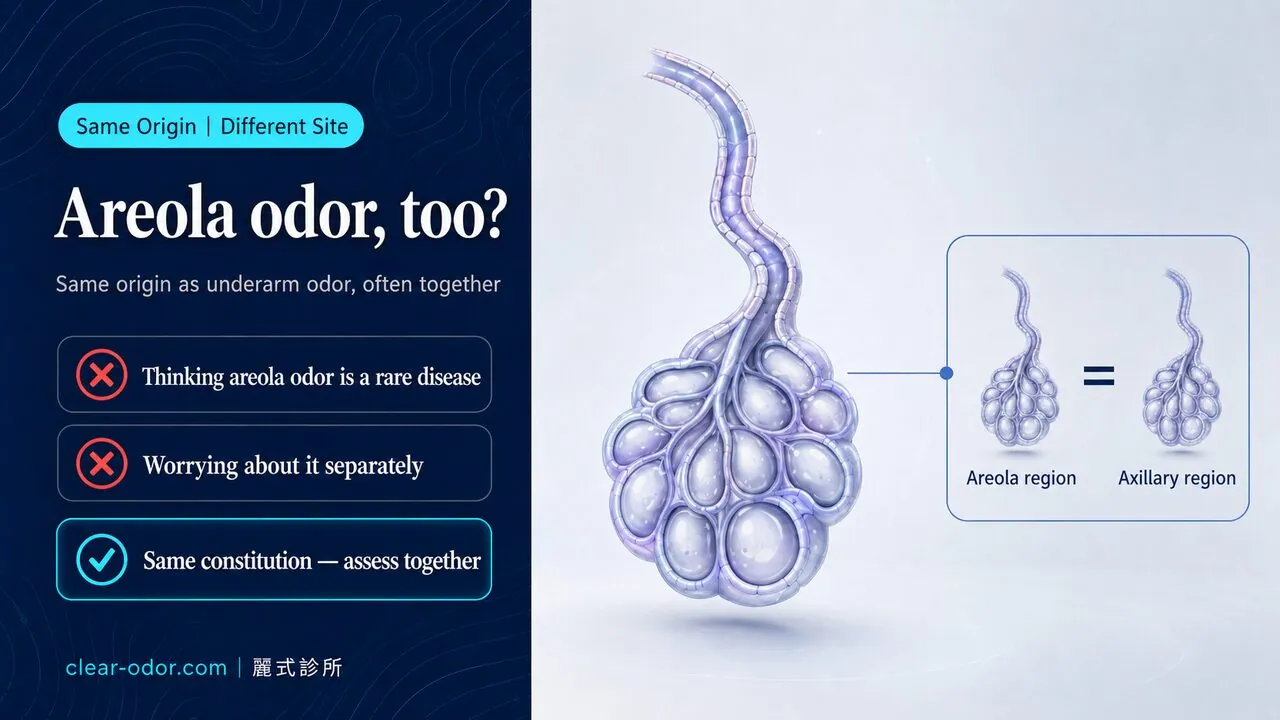
The conclusion first: in cause, areola odor and underarm odor are essentially the same.
The source of the odor in both is the same type of gland — the apocrine glands (large sweat glands). Apocrine secretions are themselves almost odorless and contain organic material such as proteins and lipids; when skin-surface bacteria break these secretions down, distinctive-smelling volatile compounds are produced — and that is "bromhidrosis."
This mechanism is exactly the same in the underarm and in the areola. The only difference is where on the body the apocrine glands sit. Regions where apocrine glands are dense include:
- The underarms (the most, and the most active)
- The areola
- The perineum and genital area
- The ear canal
- Around the navel
Key point: Areola odor is not a "special, rare, strange disease" — it is bromhidrosis, simply occurring at the areola. Understanding this matters: like underarm odor, it has a clear mechanism and can equally be assessed and managed — there is no need for excessive anxiety, or reluctance to see a doctor, just because it is "unheard of."
Why Does the Areola Have Odor? What the Two Share and Where They Differ
Setting areola odor and underarm odor side by side makes it clearer "where they are the same and where they differ":
| Comparison | Underarm odor | Areola odor |
|---|---|---|
| Source of odor | Apocrine secretions broken down by bacteria | Exactly the same |
| Genetic basis | Linked to the ABCC11 gene | Exactly the same |
| When it appears | After puberty, as apocrine glands mature | Exactly the same |
| When odor intensifies | Sweating, heat, nervousness | Sweating, emotional arousal, more noticeable during intimate contact |
| Situations where it is noticed | Within everyday social distance | Mostly at close range, intimate settings |
| Surgical incision location | Underarm crease | The colour border between areola and normal skin |
Same cause, same genetics — which is exactly why the "frequent overlap" discussed in the next section happens. For how the ABCC11 gene influences bromhidrosis and inheritance probability, see Is Bromhidrosis Genetic? Inheritance & When to Check Kids.
Areola Odor and Underarm Odor Often Appear Together
Since apocrine glands are influenced by the same gene and are distributed in several regions at once, a reasonable inference follows: a sizable proportion of people with underarm odor also have areola odor at the same time — it is just that the areola part is usually not easily noticed by oneself or others.
A common clinical scenario: a patient comes to be assessed for underarm odor, and during the consultation it emerges that the areola, and sometimes the perineum, has a similar trouble. This is not "odor spreading," but the same origin, co-existing from the start — only noticed at different points in time.
Key point: If you already know you have underarm odor and have long felt uneasy about an areola smell in intimate settings, these two are very likely different expressions of the same constitution — worth raising together when your underarm odor is assessed, rather than worrying about them separately.
Who Is More Likely to Have Areola Odor?
The groups prone to areola odor overlap heavily with those prone to underarm odor:
- Those with a family history: if one or both parents have bromhidrosis, the probability in the child is markedly higher
- Those who already have underarm odor: as noted above, the two often co-occur
- Those with wet earwax: wet (moist-type) earwax is linked to apocrine activity and the ABCC11 gene, and is often one constitutional clue
- After puberty: apocrine glands mature and become active only after puberty
On sex: both men and women can have areola odor. The higher proportion of women seeking care is partly because areola odor is of greater concern in intimate settings — not because women are "more prone" to it.
How Areola Odor and Underarm Odor Differ in Management
Although the cause is the same, the difference in location creates a few practical differences in management:
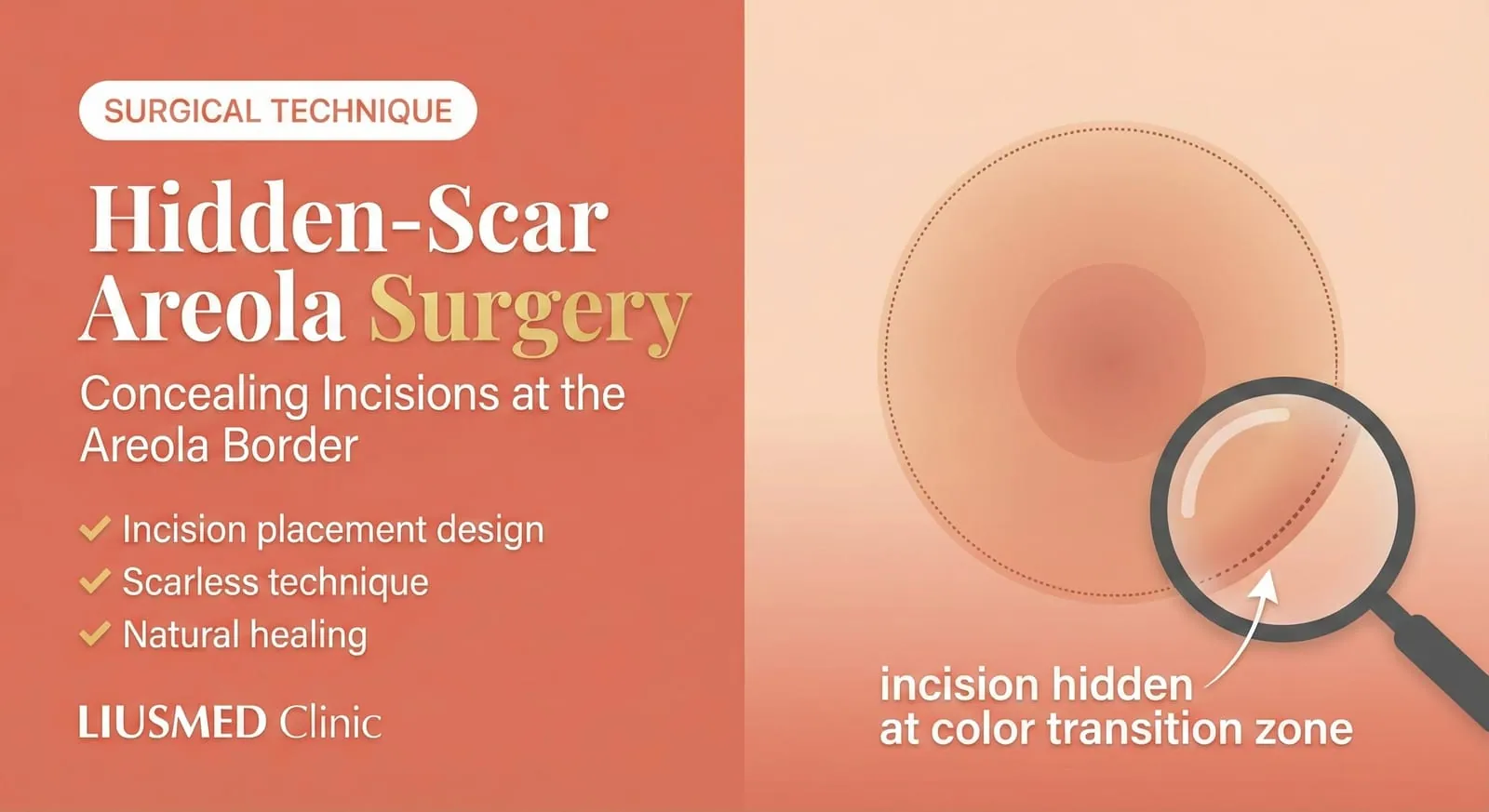
- Incision design: an areola procedure hides the incision at the border between the areola and normal skin tone, using the colour difference to make the scar inconspicuous; the underarm uses the underarm crease.
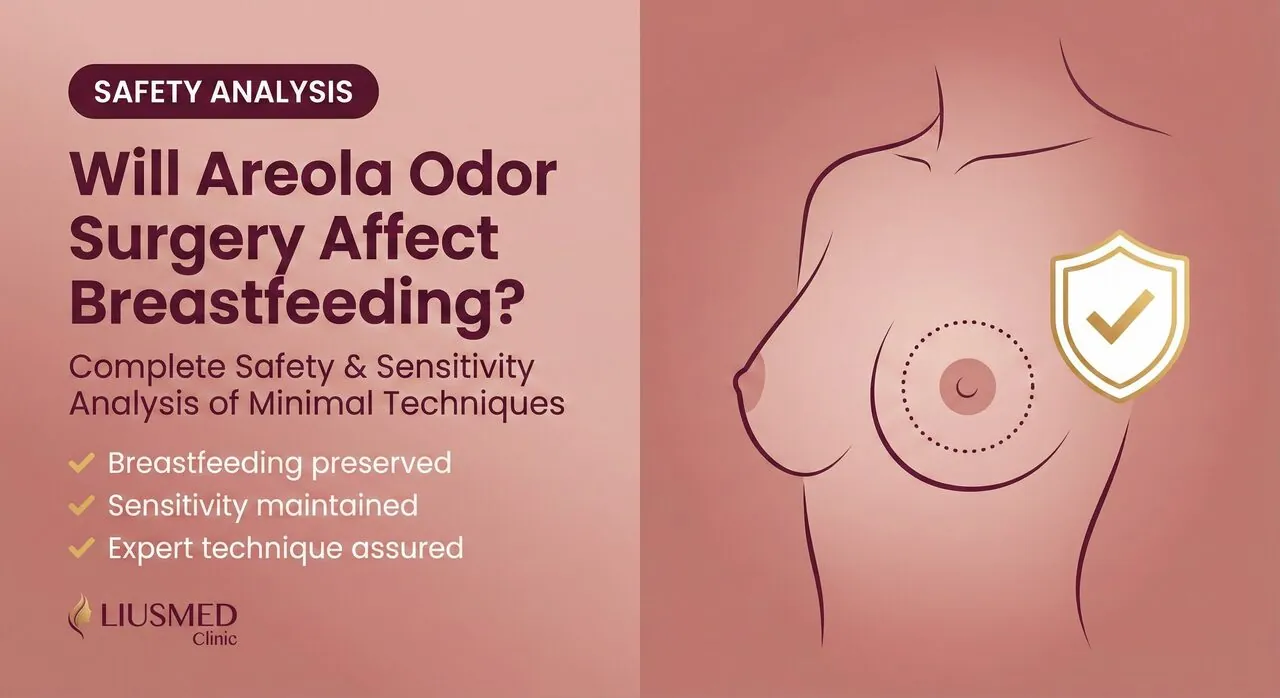
- Consideration of anatomical layers: beneath the areola lie the mammary gland and ducts, so the procedure must be precisely controlled at the superficial apocrine layer. Whether areola surgery affects breastfeeding and sensitivity is the question women patients care about most — fully addressed in Areola Odor Surgery: Will It Affect Breastfeeding?.
- Focus of assessment: an areola odor assessment specifically asks about pregnancy and breastfeeding plans, in order to decide on the timing of surgery.
In other words: the mechanism is the same, but "the areola as a location" brings finer considerations — which is why areola odor is best assessed by a doctor with relevant experience.
How to Tell Whether an Areola Smell Is Bromhidrosis
Not every odor around the areola is bromhidrosis. Simple directions for self-identification:
- Bromhidrosis type: the odor resembles underarm bromhidrosis, with a distinctive body smell; it intensifies with emotional arousal or sweating, and often co-occurs with underarm odor or wet earwax
- Plain sweat smell: appears after exercise or in heat, improves with cleansing, with no distinctive strong body odor
- Other sources: if accompanied by nipple discharge, skin redness, itching, or scaling, it may be another skin or breast issue and should be examined by a doctor
If you are unsure which one you are smelling, Body Odor, Sweat Smell & Bromhidrosis: 3 Different Smells offers a fuller way to identify it. The most accurate way is still an in-person assessment by a doctor.
Frequently Asked Questions
Q1: Only my areola has odor, not my underarms — is that normal?
Yes. Apocrine activity can differ between regions, and it is possible for only the areola to show odor. Whether it co-occurs with underarm odor varies from person to person.
Q2: Will areola odor "spread" or "transmit" to the underarms?
No. Bromhidrosis is not an infection, is not contagious, and does not "spread" from one region to another. Odor in multiple regions co-exists from the same origin — it is not spreading.
Q3: Can areola odor and underarm odor be operated on together?
A doctor can assess this. The two regions and incision designs differ; whether to address them in one session depends on the individual situation and recovery planning.
Q4: Can men have areola odor too?
Yes. Areola odor is unrelated to sex — both men and women can have it.
Q5: Does areola odor have to be treated with surgery?
Not necessarily. Mild cases with no clear life impact can first be observed and managed with cleansing; when the odor clearly affects confidence and relationships in intimate settings, a doctor can then assess whether surgery is suitable.
Conclusion
Areola odor and underarm odor are essentially the same in cause, genetics and mechanism — both are the distinctive odor of apocrine secretions broken down by bacteria, influenced by the same gene, which is why they often appear together. Their real difference is "location": location determines the settings in which they are noticed, the design of the surgical incision, and whether breastfeeding must be considered in the assessment.
If you already have underarm odor and are also troubled by an areola smell, these are very likely different expressions of the same constitution, worth assessing together. Dr. Ta-Ju Liu has 20 years of experience in bromhidrosis treatment and offers integrated assessment of underarm and areola odor. You are welcome to book a consultation, or first explore the areola odor specialist service and the underarm odor specialist service.
Related Reading
- Areola Odor Surgery: Will It Affect Breastfeeding?
- Areola Odor Surgery Recovery: Swelling, Scars & Nursing
- Is Bromhidrosis Genetic? Inheritance & When to Check Kids
- Areola Bromhidrosis
- Axillary Bromhidrosis
- Intimate-Area Odor (Areola & Perineal)
This article is for health education. Individual results may vary. The cause and management of an areola smell must be confirmed after an in-person assessment by Dr. Ta-Ju Liu.