There is a particular kind of patient I see in clinic: someone who has already read up on iontophoresis, knows it sits between antiperspirants and surgery on the treatment ladder, and has decided to buy a unit for home use. What they come to ask is "which one should I buy?"
That question is harder than it looks, because "sweaty hands machine" is not a defined product category. Search that phrase and you get everything from properly licensed medical devices, to consumer appliances that advertise "electrophoresis" with no registration data behind them, to units bought in from overseas. Their current design, safety circuitry and adjustability vary enormously.
So this article does not cover whether iontophoresis works — that is in The Complete Guide to Iontophoresis for Sweaty Palms: Devices, Frequency and Maintaining Results. It deals with what actually stops people who are buying a machine: how to confirm a device is a legal medical device in Taiwan, how to use it once it is home, and who should not use it.
Taiwan Approval and US Approval Are Two Separate Things
Start with the thing people most often conflate, because getting it wrong has consequences.
"FDA approved" appears so often in Taiwanese advertising that people now hear it as "the government has approved this." But the US FDA and Taiwan's Food and Drug Administration are independent regulators, each reviewing on its own terms. A device cleared under a US 510(k) is not thereby legal to sell in Taiwan, and the reverse holds too.
What determines whether a device is a legal medical device in Taiwan is its medical device licence number. They look like this:
| Prefix | What it means |
|---|---|
| 衛部醫器製字第 XXXXX 號 | Domestically produced medical device, manufactured in Taiwan |
| 衛部醫器輸字第 XXXXX 號 | Imported medical device, manufactured abroad and cleared on entry |
| 北市衛器販字第 XXXXX 號 | A distributor's licence, not a product licence |
The third one is the one used to muddy the water. A vendor page showing a 北市衛器販 certificate looks official, but what it certifies is that the company may sell medical devices, which is a different claim from the device itself having passed review.
Take STOPWET from Taiwan Medical Electronics as a worked example: its Taiwan licence number is 衛部醫器製字第008613號, and it separately holds a US FDA 510(k) under K242041. Those two numbers record two independent facts, not one fact stated twice.
Key point: Before buying any machine that claims to treat hyperhidrosis, ask the seller for the licence number, then look it up yourself in the Food and Drug Administration's medical device licence database. It counts only if the record exists, the product name matches, and the validity period is current. If they cannot produce a number, treat it as unlicensed regardless of what certification marks are printed on the box.
(Source for the approval details in this section: Taiwan Medical Electronics official product page; verified 2026-09-10. Treat the live Food and Drug Administration database as authoritative for the licence number.)
How a Home Unit Divides Work With In-Clinic Sessions
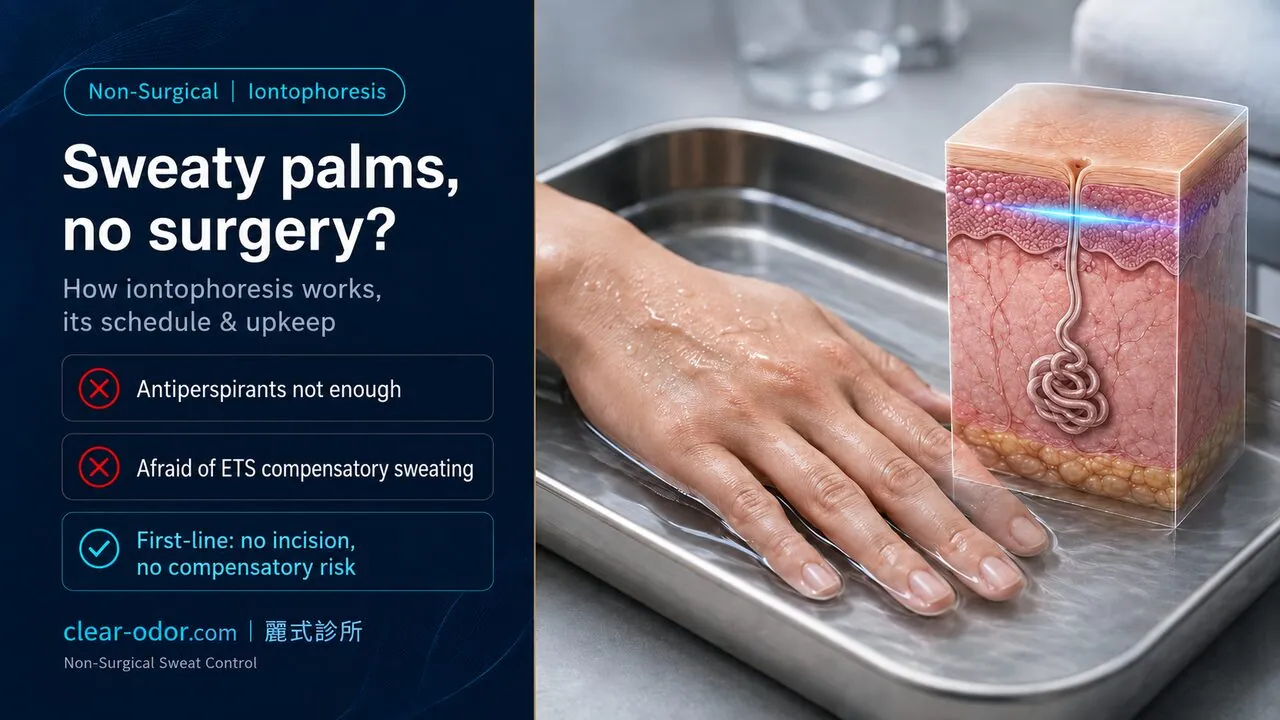
Iontophoresis works by placing the palms or soles in a tray of tap water and passing a weak current through it, which temporarily reduces output at the sweat duct openings. No drugs, no needles, no incision; the working parts are the ions in the water and the current.
One property of this treatment is what makes it suited to home use: it has to be repeated, and it has to keep being repeated. The effect fades once you stop, which is simply how it works. Very few working adults or students sustain two or three clinic visits a week past the three-month mark.
So the division of labour that works in practice looks like this:
| In-clinic | Home unit | |
|---|---|---|
| Main job | Confirm you respond, find your workable current range | Long-term maintenance |
| Current | Higher, adjusted by clinical staff to your response | Limited by safety standards, usually gentler |
| Right phase | Induction | After induction is established |
| If it fails | Parameters adjusted on the spot and retried | Needs a review visit to judge parameters vs unsuitability |
Confirming a response in a medical setting first, then moving to a home unit for maintenance, saves time compared with buying a machine and working it out alone. This matters most if several weeks produce nothing at all: you will want someone to judge whether that means the current is too low or the treatment is not right for you. Those two conclusions lead somewhere completely different.
What Results to Expect, and Over What Timeframe
I am not going to give you a success percentage. Severity varies enormously between patients, and the clinical data behind most home units is incomplete. Manufacturer sites do not generally publish efficacy trial data either.
The honest version is this: on the hyperhidrosis treatment ladder, iontophoresis has consistently occupied the space after antiperspirants and before surgery. Patients who respond usually need several weeks of consistent, regular use before dryness improves noticeably; people who stop after two or three sessions have mostly just not got going yet.
Set expectations accordingly:
- This is control, not cure. It drifts back once you stop.
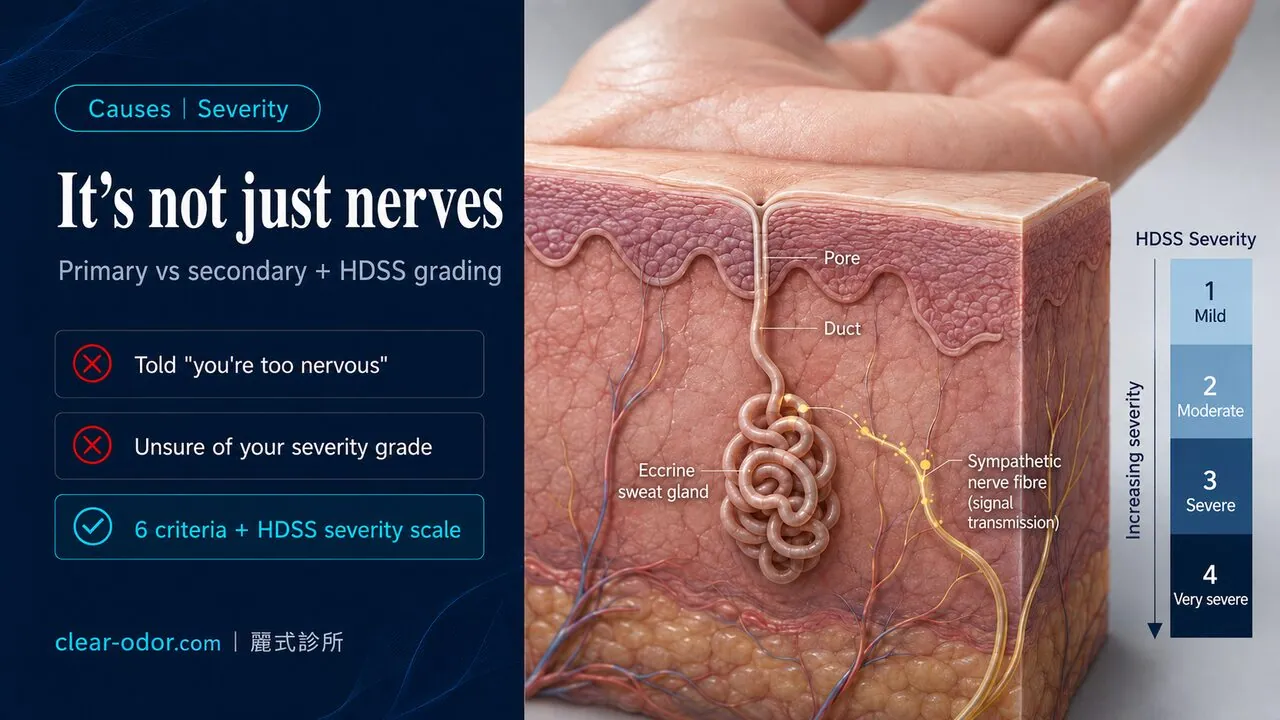
- It addresses sweat volume, not other sources of odour. If your problem is smell rather than wetness, sort out the source first — see Why Does Palmar Hyperhidrosis Happen? Primary vs Secondary Causes and Self-Grading.
- Results vary between individuals. The same device at the same frequency can give two people quite different outcomes.
Key point: If a machine's marketing tells you that a few sessions will fix this permanently, that is not how the treatment behaves. The value of iontophoresis is that it is safe, you can keep doing it at home indefinitely, and it does not cause compensatory sweating. The price is that you have to keep doing it. People who understand that before buying end up much more satisfied.
Scheduling Induction and Maintenance, and Setting the Current
This is where people who own a machine most often go wrong. They use it by feel for a few days, decide it is not working, and put it in a cupboard.
Iontophoresis runs in two phases of quite different intensity.
Induction: the goal is to bring the sweating down. Sessions are closer together, commonly two to three times a week, around 20 minutes each. This phase cannot be skipped or done sporadically, because the effect accumulates.
Maintenance: once sweating is down to a level you can live with, reduce frequency and find the lowest interval that still holds it. For some people once a week is enough; others need twice. You work that number out yourself; there is no standard answer.
On current, STOPWET's published starting values are Level 3 for hands and Level 5 for feet (the sole's thicker keratin needs a higher setting for the same effect). Start at the suggested value and step down if you feel sharp stinging. A mild tingle is expected; pain that makes you pull your hand out means it is too high.
Common operating mistakes:
- Using purified or distilled water. Iontophoresis conducts through the mineral ions in the water, so purified water will not carry the current and the session is wasted. Tap water is correct.
- Untreated cuts, hangnails or cracked skin. Current concentrates at breaks in the skin, which hurts there and risks a burn. Small cuts can be covered with petroleum jelly first.
- Leaving rings on. Metal concentrates the current; take them off.
- Assuming more pain means more effect and turning the current to maximum. Stinging is not a measure of efficacy.
Who Should Not Use Iontophoresis
This section covers contraindications for iontophoresis as a treatment, not the labelling of any one device. They apply to any brand, and they are what you should check before buying.
The following should not self-treat without a doctor's assessment first:
- An implanted pacemaker or other implanted electronic device
- Pregnancy
- Metal implants in the treatment area
- Extensive broken skin, infection or active eczema in the treatment area
- Known history of epilepsy
Separately, if your sweating did not begin around puberty but started recently, or comes with night sweats, weight loss or fever, secondary hyperhidrosis needs ruling out first. Those situations can have another disease behind them, the direction of management is entirely different, and buying a machine first is a detour. See Hyperhidrosis vs Compensatory Sweating: Before ETS Surgery.
Three Things to Settle Before You Buy
- Can you find the licence number? Ask the seller, then look it up yourself in the Food and Drug Administration database. Product name, company and validity period all have to match.
- Are you sure it suits you? Do any of the contraindications above apply? Is the sweating primary or secondary? Get those wrong and the machine sits unused.
- Can you find the time? Induction means two or three 20-minute sessions a week, roughly an hour weekly. If that is not realistic, work out the scheduling before buying rather than after.
FAQ
Q1. Are a sweaty hands machine, an electrophoresis machine and an iontophoresis machine the same thing?
Broadly yes. "Iontophoresis" and "electrophoresis" are two renderings of the same treatment, and "sweaty hands machine" is the consumer shorthand. Note though that the colloquial name is no guarantee the device is a registered medical device: some products marketed for sweaty hands hold no medical device licence. The number is more reliable than the name.
Q2. Is a home unit weaker than the clinic's?
Home units are limited by safety standards and typically run gentler currents, so reaching the same result may take more sessions. Their advantage is that you can keep going, and sustained regularity is what this treatment depends on. The two divide the work rather than substitute for each other.
Q3. Do I have to see a doctor before buying one?
A home medical device does not necessarily require a prescription, but I would suggest an assessment first. What needs establishing is contraindications, whether the sweating is primary or secondary, and whether the severity makes iontophoresis a sensible starting point. Those are not questions you can answer at home.
Q4. How long until I can stop?
Iontophoresis has no "course completed" point; stopping lets things drift back. The sensible goal is finding the lowest maintenance frequency, rather than a date you can stop.
Q5. Can children use it?
STOPWET is reported as indicated for ages 13 and above under its US FDA 510(k). Hyperhidrosis in children and adolescents has to account for developmental stage and cooperation, so an assessment with a parent present is the right way to decide.
Related Reading
- Iontophoresis for Sweaty Palms: Devices, Frequency, Results
- Sweaty Palms Without Surgery: Iontophoresis, Topicals, or Botox?
- Why Palms Sweat: Primary vs Secondary & a Severity Check
- Sweating by Area: Palms, Underarms & Feet Treatment
- Palmar Hyperhidrosis
Conclusion
The hard part of buying a machine for sweaty hands is not picking a brand. It is settling three things first: whether the device is a legal medical device in Taiwan (read the licence number, not the certification marks), whether iontophoresis suits you (contraindications, primary vs secondary), and whether you can commit the induction schedule.
Taking STOPWET as the worked example, its Taiwan licence number is 衛部醫器製字第008613號 and its US FDA 510(k) number is K242041. Those are two independent authorisations; do not read one as the other.
Dr. Ta-Ju Liu has spent 20 years working in odour and sweat treatment. If you are considering iontophoresis for sweaty hands but are unsure whether it suits you, or where to start, you are welcome to book a consultation so severity can be assessed, secondary causes ruled out, and the home route decided together. The full range of options is also covered under Palmar Hyperhidrosis specialty care.