I hear this in clinic all the time: "I've tried antiperspirant. It works on my underarms, but it barely does anything for my hands."
You didn't pick the wrong brand. Palms are a hard place to treat with anything you rub on. The outer layer of skin there is much thicker than in the underarm, so the product has trouble getting in. And during the day you keep washing your hands, holding things and typing, which wears off whatever you put on. So for hand sweat, both the choice of product and the way you apply it need to be thought through separately from the underarm.
The topicals available for sweaty hands today fall into two broad groups. One is the familiar aluminum-salt antiperspirant, which works by plugging the sweat ducts. The other is Apohide (安薄汗, oxybutynin 20% lotion), an anticholinergic (blocks the nerve signal that tells sweat glands to work) lotion developed in Japan and approved in Taiwan as well. It works by keeping the sweat glands from receiving the signal to sweat. Below I'll go through how to choose between the two, how to apply each, how long before you notice a change, and what side effects to watch for.
Why Palms Are Harder to Treat Than Underarms
Start with the mechanism. Once an aluminum-salt antiperspirant goes on, it forms a small gel-like plug near the opening of each sweat duct, holding sweat inside the skin. For that plug to set properly, the skin has to be dry, and it needs several hours without being disturbed.
The underarm meets both conditions. The palm meets neither:
| Comparison | Underarm | Palm |
|---|---|---|
| Thickness of the outer skin layer | Thin; the product works easily | Thick; the product has trouble getting in |
| After application | Covered by clothing, rarely rubbed off | Handwashing, holding things, typing: constant friction |
| Tolerance to irritation | Relatively good | Dries, cracks and peels easily; once cracked, it stings even more |
| Effect of a regular antiperspirant | Most people notice a difference | Often not enough; needs a higher concentration or a different type of drug |
That gives two principles for treating hand sweat with a topical. First, apply it at night before bed, so it gets a whole night without being touched. Second, look after the skin first. Don't force a high concentration onto dry, cracked hands.
Key point: When an antiperspirant doesn't seem to work on the palms, the usual reasons are not enough contact time, skin that's too damp, or the product getting rubbed off. The product itself may be fine. Get the application right first, then decide whether to switch.
Two Types of Hand Sweat Topicals: Aluminum Chloride Antiperspirants vs Anticholinergic Lotion
| Aluminum chloride (aluminum-salt) antiperspirant | Anticholinergic lotion: Apohide | |
|---|---|---|
| Ingredient | Aluminum chloride hexahydrate and other aluminum salts, from regular drugstore strength up to high concentration | oxybutynin 20% topical solution |
| Mechanism | Forms a plug at the sweat duct opening and physically blocks sweat | Absorbed through the skin; inhibits acetylcholine (the nerve messenger that switches sweat glands on), so the glands don't receive the signal to sweat |
| How to get it | Regular strength can be bought over the counter; talk with a doctor first about high concentrations | Prescription drug; requires a doctor's assessment |
| Approved use | Per the product label; usually used on the underarms, so for hands choose a suitable strength and formulation | Primary palmar hyperhidrosis in ages 12 and up; palms only |
| How to apply | Before bed on completely dry skin; wash off the next morning | Once daily before bed, about 5 pumps for both hands; wash off the next morning |
| Time to notice a change | Needs several days of consecutive use before a difference shows; then switch to a maintenance schedule | Evaluated in the trial after 4 consecutive weeks |
| Common side effects | Stinging, itching, dryness, cracking and peeling | Dermatitis and eczema at the application site; occasionally thirst; blurred vision if it gets in the eyes |
| NHI coverage | Not listed | Not currently listed by Taiwan's NHI |
One doesn't replace the other. If your sweating is mild and only bothers you in certain situations, getting an aluminum-salt antiperspirant applied correctly is often enough. The prescription lotion is worth discussing if aluminum salts crack your hands and still don't control the sweat, or if hand sweat was already getting in the way of writing and shaking hands from the start.
What Is Apohide? Who It Suits and What the Clinical Trial Showed
Apohide is registered in Taiwan under the Chinese name 安薄汗擦劑 20% (MOHW import license No. 028910). The active ingredient is oxybutynin chloride 20%, and it was developed by Hisamitsu Pharmaceutical in Japan. Oxybutynin started out as an oral drug for overactive bladder. Made into a lotion, it goes directly onto the palms, but some of it is still absorbed into the body, so most of the precautions for oral anticholinergic drugs also apply to the lotion.
The approved indication in Taiwan is primary palmar hyperhidrosis in patients aged 12 and older. So two things need saying up front:
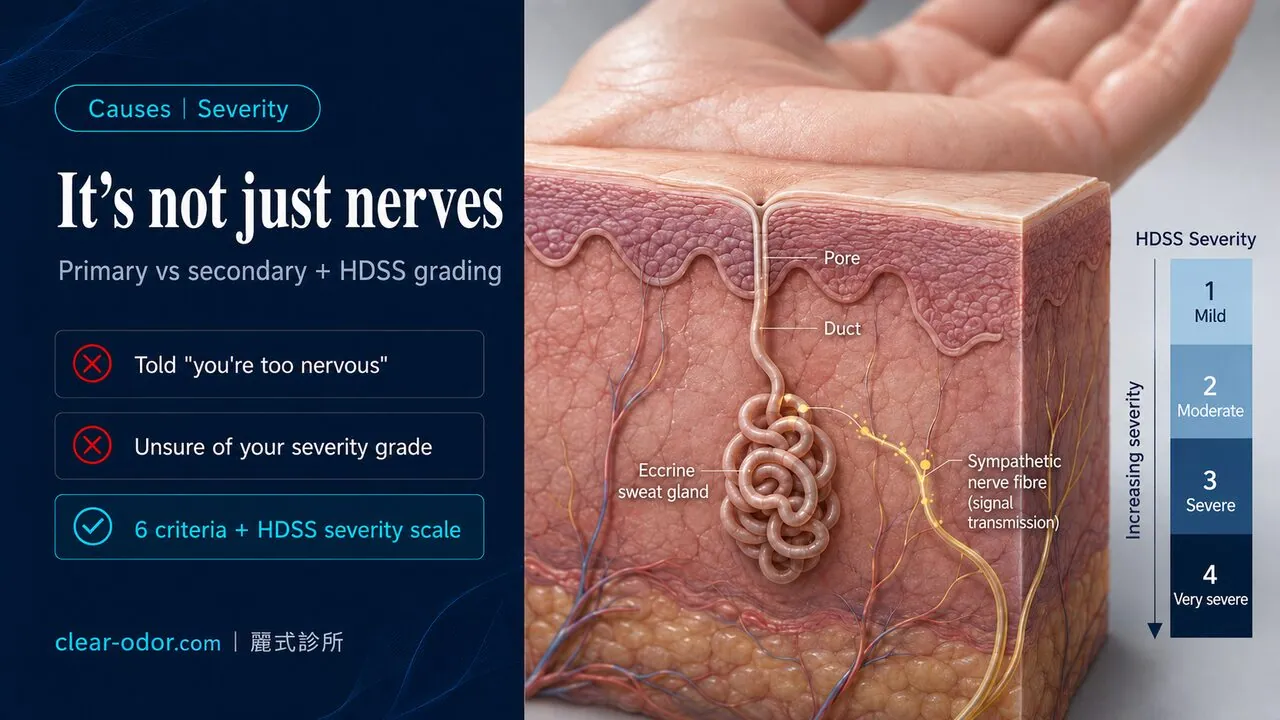
- It's a prescription drug. A doctor first has to confirm that your hand sweating is primary, and not secondary hyperhidrosis caused by a thyroid problem, a medication or another illness. For how that distinction is made, see Why Palms Sweat: Primary vs Secondary & a Severity Check.
- It's approved for the palms only. Sweaty feet and underarms are outside the approved scope, and the package insert states clearly that it should not be applied anywhere other than the palms.
On the clinical data, the key study is a Japanese phase 3 randomized double-blind trial. 284 patients aged 12 and older with primary palmar hyperhidrosis applied it once a day for 4 consecutive weeks, and their palm sweat output was measured with an instrument. The share of people whose sweat dropped by half or more was 52.8% in the Apohide group and 24.3% in the placebo group (Fujimoto et al., J Am Acad Dermatol 2023; PMID 36990320).
Read that figure carefully on two counts. First, about half the people using the drug reached the "cut by half" mark, but about a quarter of those using placebo reached it too, so the drug itself added a gap of roughly 30 percentage points. It doesn't work for everyone. Second, the trial was industry-led and followed patients for only 4 weeks; the later 52-week open-label extension study was mainly designed to look at long-term safety (PMID 37605375). Whether it works for you, you'll only know after using it. Results vary from person to person.
Key point: Apohide suits people confirmed to have primary hand sweating whose hands either aren't helped enough by aluminum salts or can't tolerate them. It gives you one more option. It won't leave everyone's hands dry.
How to Apply Them So They Actually Work
Aluminum chloride antiperspirant
- Apply it at night before bed. Your hands must be completely dry; if you've just washed them, towel off and wait a few minutes first.
- A thin layer is enough. Putting on more won't work better, and it irritates more.
- Rinse it off with plain water the next morning.
- For the first few days you can apply it every night. Once the sweating has clearly dropped, switch to once every few days to maintain it. The maintenance interval varies a lot between people; just adjust it to how quickly your sweating comes back.
- If your hands already have wounds, eczema or cracks, stop for now and resume once the skin has healed.
If it irritates a lot, don't push through. You can apply it less often, switch to a lower concentration, or come back and talk it over with your doctor.
Apohide
Use it as the package insert and your doctor direct. The key points:
- Apply once a day before bed. Dry your palms thoroughly first.
- Use about 5 pumps each time, spread evenly over both palms.
- Don't touch the bedsheets until the lotion has dried. After applying, don't wear airtight gloves, and don't get your hands wet.
- When you get up the next morning, wash both hands thoroughly under running water. There's no need to reapply after washing.
- Until you've washed your hands in the morning, keep them away from your eyes, mouth and face, and hold off on brushing your teeth, showering or putting in contact lenses. If any lotion gets in your eyes, rinse them with water right away.
- If your palms have wounds, eczema or dermatitis, ask your doctor first whether you can apply it.
The lotion contains flammable ingredients, so keep it away from open flames both while applying it and in storage.
Side Effects and Who Shouldn't Use Them
With aluminum-salt antiperspirants, the usual problem is local irritation: stinging, itching, dryness, cracking and peeling. Palms dry out easily to begin with, and more so in winter. Most of the time it settles once you apply less often or take a few days off.
In the 52-week extension study of Apohide, the more common reactions were application-site dermatitis (about 9%) and eczema (about 6%), mostly mild. Thirst, linked to the anticholinergic effect, was about 3% (per the Taiwan package insert; PMID 37605375). Pay particular attention to your eyes. Rubbing them with hands that still have the lotion on can dilate the pupils and blur your vision, which is why the insert keeps reminding you not to touch your eyes before washing your hands.
Under the Taiwan package insert, Apohide is contraindicated, and should not be used, in the following situations:
- Angle-closure glaucoma
- Urinary retention
- Serious heart disease
- Gastrointestinal obstruction, paralytic ileus, or severely reduced gut motility
- Gastric or intestinal atony
- Myasthenia gravis
- A previous allergy to any of its ingredients
- Breastfeeding
If you are pregnant or may be pregnant, need to spend long periods in hot environments (with less sweating after applying it, your body temperature rises more easily and heatstroke is possible), or need to drive and notice blurred vision, dizziness or drowsiness after applying it, talk with your doctor first as well. With long-term use, your doctor may recommend regular blood tests to check blood counts and liver function.
If you get severe redness, burning or blistering while using it, or ongoing discomfort after it gets in your eyes, stop using it and come back to the clinic.
Still Not Enough? The Next Step
Topicals have one built-in limitation: you have to apply them every day, and once you stop, things go back to how they were. If you've tried both types and hand sweat still gets in the way of writing, shaking hands or handling papers, the usual next step is iontophoresis.
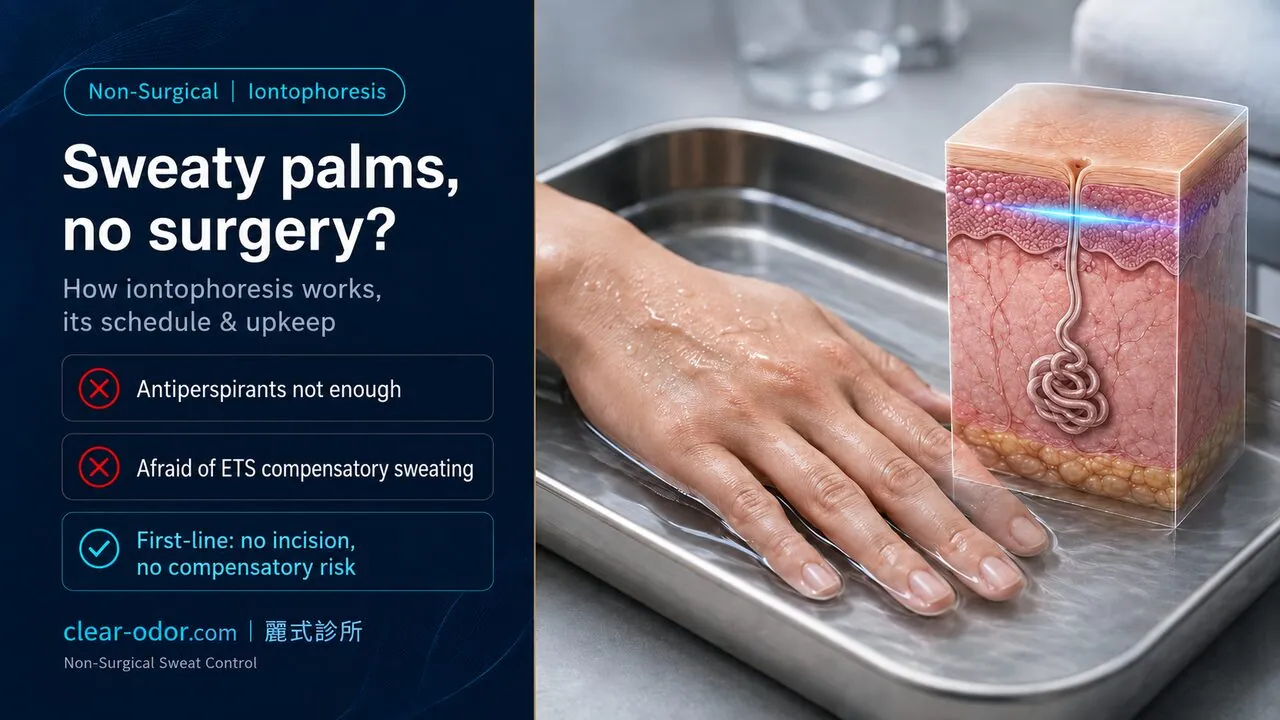
Iontophoresis means resting your hands in trays of water while a weak electric current passes through. It doesn't involve injections either, and you can buy a home device and do it yourself. It can be combined with topicals and works differently from them, so it's worth trying if topicals aren't enough, though results still vary from person to person. For how it's done and how often, see Iontophoresis for Sweaty Palms: Devices, Frequency, Results. For how home devices differ, see Choosing a Home Iontophoresis Machine for Sweaty Hands in Taiwan.
If iontophoresis isn't enough either, Botox injection is another option. The treatment and the anesthesia approach are explained in full on our clinic's Minimal-Cut Surgery page: Botox for sweaty palms.
To get a sense of whether your hand sweat is mild or severe, try the Hyperhidrosis Severity Self-Check: 5 Quick Questions. Choosing an underarm antiperspirant is covered separately in Choosing the Right Antiperspirant: Ingredients & Strength.
Frequently Asked Questions
Q1: What are the side effects of Apohide?
The more common ones are dermatitis or eczema where it's applied, mostly mild. A few people feel thirsty. If hands with the lotion on them touch your eyes, your vision may blur for a while. People with angle-closure glaucoma, urinary retention, serious heart disease, or who are breastfeeding, among other conditions, should not use it; see the list above for the full contraindications.
Q2: How long does Apohide take to work?
The trial assessed sweat output after 4 weeks of daily application. When people start to notice a difference varies. I'd suggest applying it regularly for a while, as your doctor directs, before you judge it. Don't stop just because you felt nothing after a few days.
Q3: Can I use Apohide on sweaty feet or underarms?
The approved scope in Taiwan is primary palmar hyperhidrosis, and the package insert states that it should not be applied anywhere other than the palms. For feet and underarms, talk with your doctor about other approaches.
Q4: Do drugstore antiperspirants work on hands?
For mild hand sweat, they help some people. But thick palm skin and constant daytime friction mean the effect is often weaker than on the underarms. Always apply before bed to completely dry hands, wash it off the next morning, and give it at least a few days before judging.
Q5: Can children use these for sweaty hands?
Apohide is approved for ages 12 and up. Aluminum-salt antiperspirants easily irritate children's skin. For younger children, I'd suggest having a doctor take a look first and confirm it's primary hand sweating before deciding how to handle it.
Q6: What happens if I stop using a topical?
With both aluminum salts and Apohide, sweating usually drifts back to where it was once you stop. They control the symptom, so they only keep working as long as you keep using them.
Conclusion
Whether a hand sweat topical works for you depends half on choosing the right product and half on how you apply it. Aluminum-salt antiperspirants suit people with mild sweating who are willing to be patient and adjust how they apply them. If you're confirmed to have primary hand sweating and aluminum salts aren't enough or your hands can't tolerate them, you can discuss a prescription anticholinergic lotion with your doctor. If you've tried both and it still isn't enough, iontophoresis is the next step.
Dr. Ta-Ju Liu has treated hyperhidrosis for more than 15 years. In clinic, he first determines your type and assesses severity, then suggests a starting point based on your daily life and the kind of work you do. If you'd like an in-person assessment, you're welcome to book a consultation. For the full range of options for hand sweat and hyperhidrosis, you can also start from the Odor · Sweat Overview.
Related Reading
- Why Palms Sweat: Primary vs Secondary & a Severity Check
- Iontophoresis for Sweaty Palms: Devices, Frequency, Results
- Hyperhidrosis Severity Self-Check: 5 Quick Questions
- Choosing the Right Antiperspirant: Ingredients & Strength
- Hyperhidrosis & Compensatory Sweating
This article is for health education. Individual results may vary. Apohide is a prescription drug, and whether it is suitable for you must be assessed by a doctor; use it according to the package insert and your doctor's instructions.