Lately people often come into clinic with a business headline about a "new hyperhidrosis drug" open on their phones. The question is usually the same: when will this be available in Taiwan, and should I hold off on surgery and wait for it?
Fair question, but it needs two separate answers. The first is what the news story actually says — it reports a commercial licence, not a prescription you can fill. The second is the medicine: what this drug does, how well, who it suits, who must not use it, and where it sits in the order of treatment.
Let me take those in turn. How the news is written is one thing. Whether you should postpone a treatment plan depends entirely on the second part.
What actually happened: a licence is not a launch
The public timeline is short — two points:
- January 2026: Orient Europharma (TWSE: 4120) signed with Maruho, the Japanese dermatology specialist, acquiring the Taiwan rights to glycopyrronium tosylate hydrate (marketed in Japan as Rapifort).
- October 2026: the two companies extended the licence to ten ASEAN markets — Singapore, Malaysia, the Philippines, Indonesia, Thailand, Vietnam, Brunei, Cambodia, Laos and Myanmar.
Both items are about licence territory. Holding the rights to a drug in Taiwan is a commercial contract; marketing authorisation here still has to go through Taiwan's own drug registration process. When that approval arrives, and when a physician can actually write the prescription, has not been announced. Rearranging your treatment plan around the headline means waiting for something with no date attached.
Key point: When a headline says "new drug licensed," ask three questions — what indication was approved in Japan, does it have Taiwanese marketing authorisation yet, and is my body area inside the approved indication. If you cannot answer one of them, it is not yet time to change your plan.
What Rapifort is: one wipe, once a day, underarms only
Rapifort Wipes 2.5% contains glycopyrronium tosylate hydrate, an anticholinergic. It holds Japanese marketing approval (approval number 30400AMX00009000) and went on sale in Japan on 23 May 2022.
The mechanism is what separates it from an ordinary antiperspirant. Aluminium salts form a plug at the sweat duct opening and block sweat physically. An anticholinergic instead blocks the acetylcholine signal, so the sweat gland never receives the instruction to sweat. One works on the exit; this one works on the signal.
The format is also unfamiliar: not a cream or a roll-on, but a single non-woven cloth sealed in its own sachet. The approved Japanese directions are specific — once daily, using the one cloth in the sachet, apply the solution to both underarms. One cloth covers both sides; it is not one sachet per side.
The approved indication is primary axillary hyperhidrosis. Every word in that phrase constrains it:
- Primary — secondary causes such as thyroid disease, infection, medication or menopause have to be ruled out first. Skip that step and the whole direction may be wrong from the start. How the distinction is made is covered in the hyperhidrosis guide.
- Axillary — underarms. Palms, soles, scalp and face are outside it.
- Hyperhidrosis — it addresses sweat volume. Underarm odour comes from apocrine secretions broken down by skin bacteria, which is not the same thing as sweat volume. Less sweat usually means somewhat less odour, but that is not treating bromhidrosis. The distinction is set out in bromhidrosis vs ordinary body odour.
What the Japanese trial achieved: read the number next to its control arm
The pivotal evidence is a Japanese phase II/III randomised, double-blind, vehicle-controlled, multicentre study of 497 patients aged 9 and over with primary axillary hyperhidrosis of at least 6 months' duration and a measured sweat threshold in each axilla, randomised to glycopyrronium tosylate 3.75%, 2.5% or vehicle once daily and assessed at week 4 (Yokozeki et al., J Dermatol 2022;49:86–94; PMID 34636057; DOI 10.1111/1346-8138.16188).
The primary endpoint was deliberately strict: a patient had to achieve both a 2-point-or-greater improvement on the HDSS severity scale and at least a 50% reduction in sweat production, at week 4. The results were 51.6% for 3.75%, 41.1% for 2.5% and 16.4% for vehicle, with both active arms significantly ahead of vehicle (PMID 34636057). The strength marketed in Japan is 2.5%.
Here is how I would read that:
- The vehicle arm reached 16.4%. So within the 41.1% on the 2.5% strength, the margin genuinely attributable to the drug is something in the twenties of percentage points — not four in ten patients succeeding because of the drug.
- The bar was "both" conditions at once. Missing it does not mean nothing changed, only that both lines were not crossed together.
- The assessment point was week 4. That is short-term efficacy, not a long-term conclusion.
- It is symptom control. An anticholinergic blocks a signal; stop the drug and the signal returns, and sweating generally drifts back toward baseline. Holding the benefit means continuing to use it.
Key point: A number means little without its control arm. "Four in ten improved" read alongside "so did one in six on vehicle" is the honest shape of this drug — it is one more option, not a guarantee of dry underarms for everyone.
Side effects and contraindications: the cost shows up in the eyes and the bladder
Anticholinergics do not suppress sweat glands alone. Some of the drug is absorbed through the skin into the circulation, so the classic anticholinergic effects can appear. In the 2.5% arm of the Japanese study, the more frequently recorded events included mydriasis (pupil dilation) 3.6%, dysuria 3.0% and photophobia 2.4%, alongside contact dermatitis at the application site (PMID 34636057).
Mydriasis and photophobia deserve a specific warning, because they are usually a hand problem: you rub your eyes or handle a contact lens before washing the drug off, and it travels. The Japanese labelling makes thorough handwashing after use a headline instruction.
Per the approved Japanese labelling, the following are contraindications — do not use:
- Patients with closed-angle glaucoma
- Patients with urinary obstruction due to prostatic hyperplasia
- Patients with previous hypersensitivity to the drug's components
The labelling also notes that no clinical trials have been conducted in children under 9 years of age. The study above enrolled from age 9 as well.
All of that is the Japanese regulatory position. If marketing authorisation is granted in Taiwan, the indication, age limits and precautions will be whatever the Taiwanese labelling states, which need not be word-for-word identical. When it comes to actually using it, follow the labelling in force and your physician's instructions at the time.
What is available for underarm sweating now: putting the news back on the ladder
Topical anticholinergics are not a new concept in Taiwan — Apohide, already approved here, is the same class, with oxybutynin as its active ingredient. But its approved area is the palms; underarms are not included. That is precisely the gap at present, and precisely why this news matters.
Until then, the usual options for underarm sweating look roughly like this:
| Option | How it works | Durability | When it fits |
|---|---|---|---|
| Aluminium-salt antiperspirant | Plugs the duct opening, blocks sweat physically | Needs regular use to maintain | Mild to moderate; start here |
| Topical anticholinergic | Blocks the sweating signal | Needs continued use to maintain | Approved area in Taiwan is currently the palms; underarms await regulatory progress |
| Oral anticholinergic | Blocks the signal systemically | Works while taken | Multiple areas at once, but systemic effects are more noticeable |
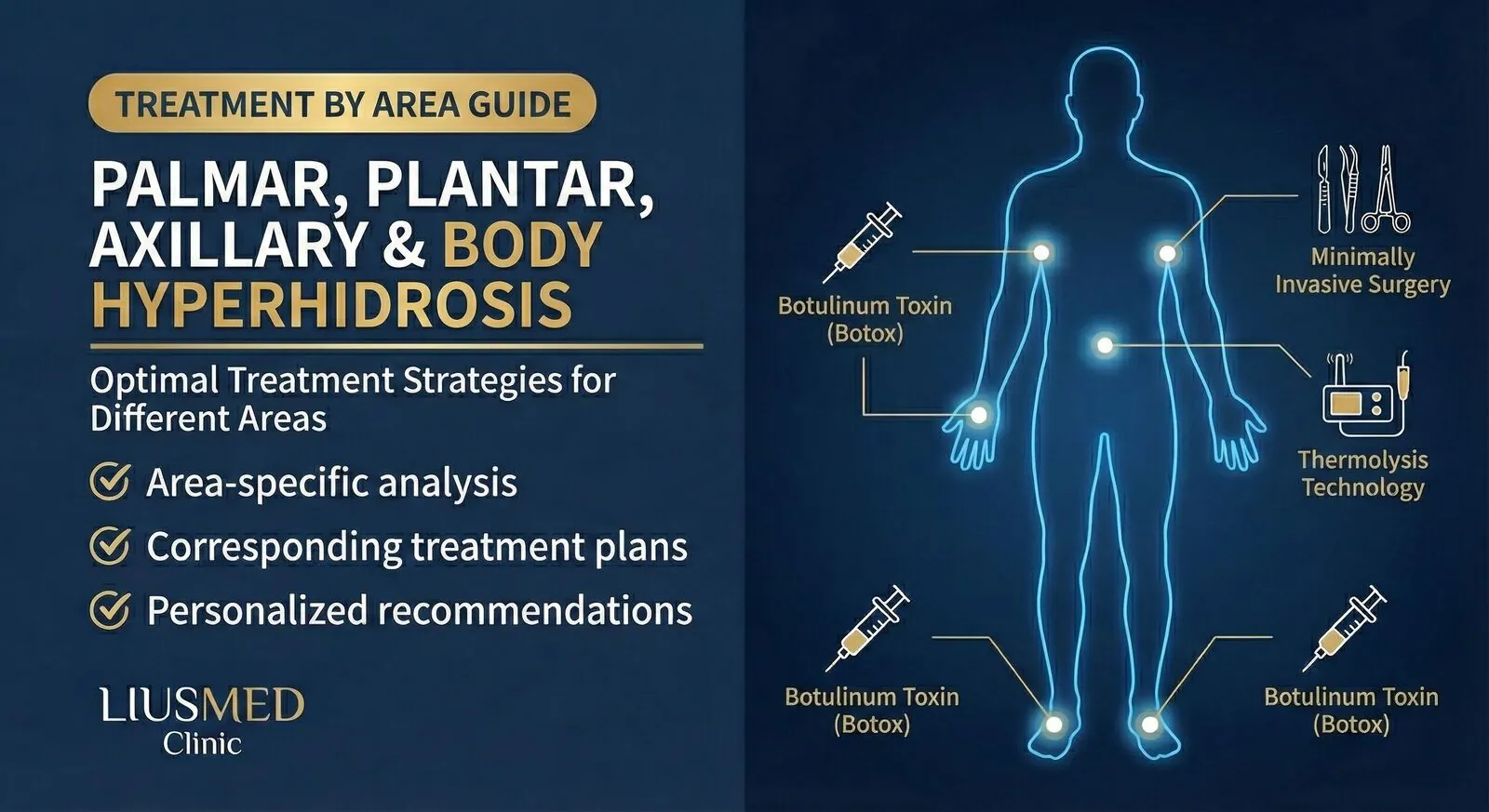
| Botulinum toxin injection | Blocks nerve transmission to sweat glands | Months; repeat visits needed | Antiperspirant not enough, and daily application is unappealing |
| Microwave / energy-based | Renders underarm sweat gland structures non-functional | Long-term after the course | Wanting fewer repeat procedures |
| Sweat gland surgery | Addresses the underarm glands directly | Long-term after surgery | Severe, with earlier steps tried and life still affected |
What the table is saying is that Rapifort fills the middle of the ladder — the slot where antiperspirant is not enough but injections or surgery are not yet wanted. It will not replace surgery and it will not make antiperspirants obsolete. It adds one option to an existing order.
As for whether to delay your plan waiting for it, I would decide on severity. If you are mild and only troubled in particular situations, you can afford to wait, and using antiperspirant properly in the meantime often helps considerably (the selection logic is in choosing an antiperspirant). But if you are already changing clothes twice a day and avoiding situations for fear of sweating, a topical wipe is not the right battlefield — take the 5-question severity self-check first to see which band you fall into, then decide whether to wait or move forward.
The full approach to hyperhidrosis and compensatory sweating is on the hyperhidrosis · compensatory sweating page; if your real problem is odour rather than sweat volume, start at underarm bromhidrosis.
FAQ
Q1: Can I get Rapifort in Taiwan now?
Public information goes as far as Orient Europharma holding the Taiwan and ASEAN-ten licence. Drug registration still follows, and no launch timeline has been published. Rely on later official announcements rather than adjusting your treatment schedule to a headline.
Q2: Can it be used on palms or feet?
The approved Japanese indication is primary axillary hyperhidrosis — underarms. The palms have a separate topical anticholinergic already approved in Taiwan (Apohide); for the soles there is no equivalent approved topical. Do not extend an underarm product to other areas on your own.
Q3: Will it cause compensatory sweating elsewhere?
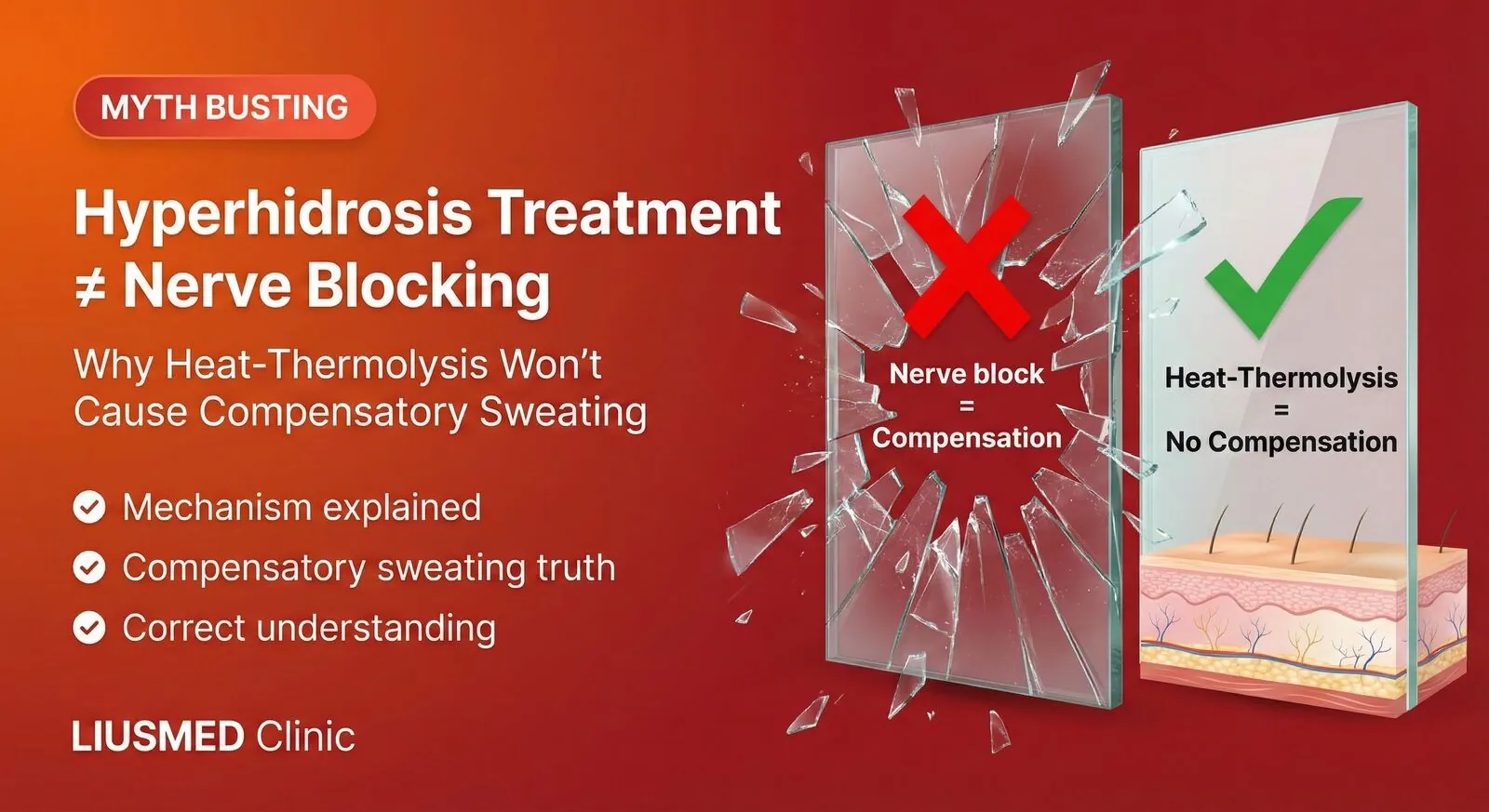
A topical anticholinergic acts on the sweat-gland signal at the site of application, which is a different mechanism from surgery that cuts a sympathetic nerve. Compensatory sweating is associated mainly with nerve-interruption procedures; the difference in principle is explained in thermal sweat gland ablation is not nerve interruption. Individual responses to any drug still vary, so if something unexpected develops, go back and be seen.
Q4: Will it also treat underarm odour?
It addresses sweat volume. Bromhidrosis comes from apocrine secretions being broken down by skin bacteria — a separate line. Less sweat and less moisture usually mean somewhat less odour, but that is not the same as treatment directed at the apocrine glands.
Q5: What happens when I stop?
A topical anticholinergic controls symptoms. Once stopped, the signal returns and sweating generally drifts back toward baseline. It suits people willing to use it regularly and long-term; if what you want is not having to deal with this daily, the conversation is about a different group of options.
Q6: Can children use it?
The Japanese labelling notes no clinical trials in children under 9, and the pivotal study also enrolled from age 9. For children and adolescents, a physician should first confirm the sweating is primary, then discuss which step to start from. Applying adult practice on your own is not advisable.
Conclusion
This news is worth knowing, but what it changes is that Taiwan may gain one more option in future — not that you can now wait. Rapifort's position in Japan is clear: primary axillary hyperhidrosis, once daily, one cloth for both sides, symptom control, with a defined group who must not use it. It fills the middle rung of the ladder, and fills it well, but it is not the end of the ladder.
The practical move is to settle the classification and the severity first, and use the rungs that already exist properly. By the time Taiwanese authorisation genuinely arrives, you will also know whether it is for you.
Dr. Ta-Ju Liu has treated hyperhidrosis for over 20 years. In clinic we classify first, assess severity, then suggest which rung to start from based on your daily life and work; what suits you individually is explained in person after your condition has been evaluated. To be assessed face to face, you are welcome to book a consultation.
Related Reading
- Hyperhidrosis Guide: Types, Severity, Treatments & ETS
- Hyperhidrosis Severity Self-Check: 5 Quick Questions
- Topicals for Sweaty Palms: Apohide vs Aluminum Chloride
- Choosing the Right Antiperspirant: Ingredients & Strength
- Hyperhidrosis & Compensatory Sweating
This article is educational information; individual results may vary. Rapifort as described here is a prescription drug approved in Japan; for its status and indication in Taiwan, rely on the competent authority's announcements and the Taiwanese labelling. Whether it is suitable for you requires a physician's assessment.