"I'm not sure which one I'm supposed to book"
One kind of message arrives almost every week. The sender describes their situation clearly — which area, when it is worse, what they have already tried — and then stops on the same sentence: I'm not sure which one I'm supposed to book.
Getting stuck there is reasonable. Almost everything written about body odor circles the underarm, so when the smell shows up at the areola, at the perineum, or inside the range covered by underwear, the first reaction is usually "this probably isn't bromhidrosis." From there people look toward infection, toward hygiene habits, toward some vague idea of a weak constitution — and it can take a long detour before anyone mentions apocrine glands.
This article is not another explanation of what bromhidrosis is. It puts four areas side by side: where they are the same, where they differ, what each one most often gets mistaken for, and — if you have more than one area involved — which to address first.
Start with what is shared: one gland type, four locations
The underarm, areola, perineum and groin have one thing in common: all of them carry apocrine glands. Apocrine secretion itself has little smell. The odor appears only after that secretion reaches the skin surface and is metabolized by the resident bacteria there. That is the basic pathway for bromhidrosis-type odor, and it does not change from site to site.
It also explains several things that get confirmed over and over in clinic:
- It is often more than one area. Underarm plus areola, or underarm plus perineum, is not an unusual combination — the constitutional background that sets apocrine activity is systemic, so it does not pick one location and stop there.
- The character of the smell is similar. Bromhidrosis at different sites belongs to one family of odor. What differs is intensity and whether other smells are mixed in, not the odor turning into something entirely different.
- It is out of proportion to how much you wash. However diligent the cleaning, if the secretion and the bacterial conditions are still in place, the smell returns. That disproportion is the most useful line between a body-odor problem and a hygiene problem.
On the constitutional side, Does Wet Earwax Mean Bromhidrosis? A Home Self-Check covers the relationship between earwax type and bromhidrosis constitution — the easiest clue to check at home. The gland itself is covered in Apocrine Glands Explained: Anatomy, Function & Body Odor.
The four areas, one at a time
Underarm: most information, most options, and the easiest place to skip a step
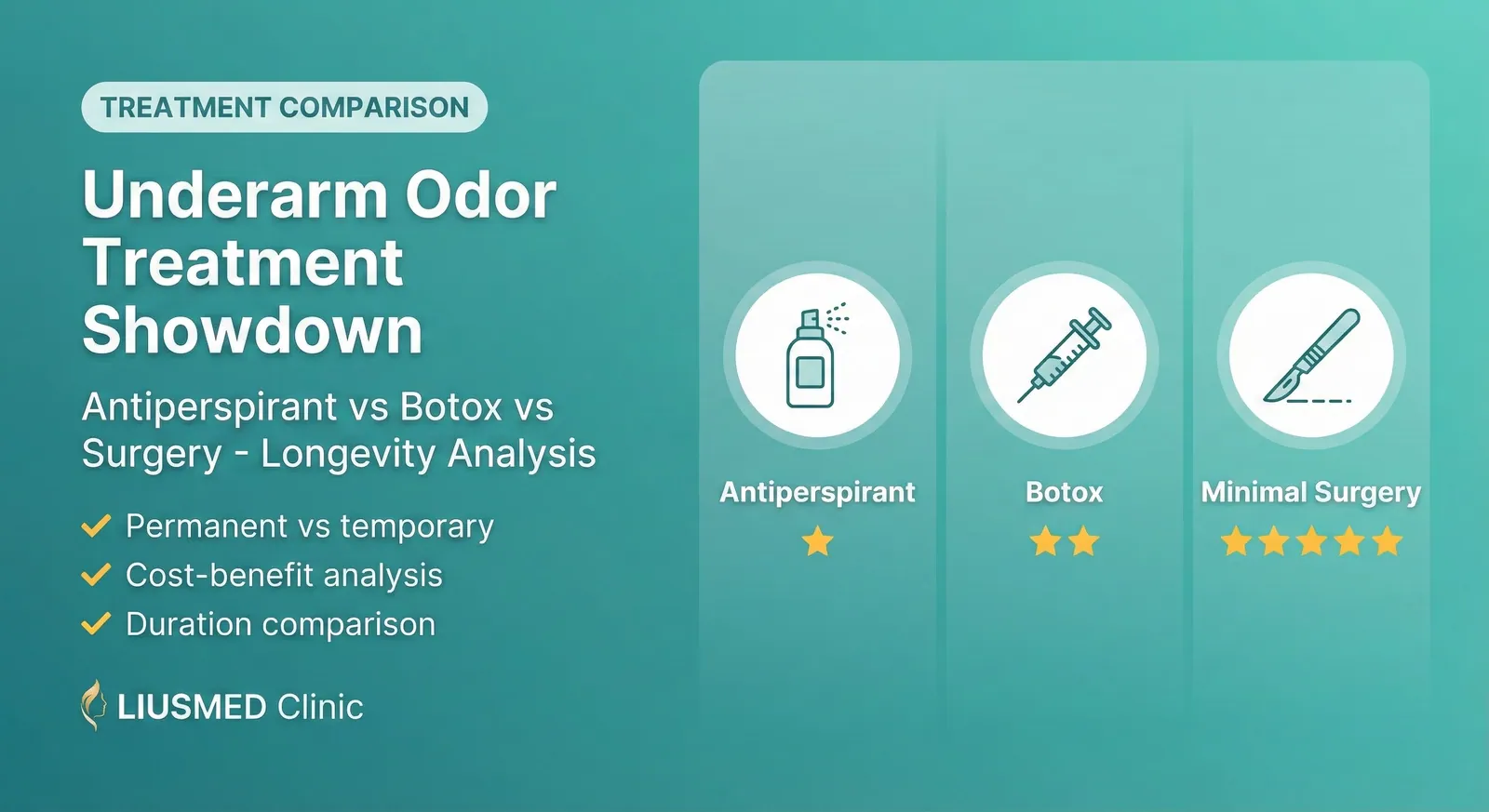
The underarm has the densest apocrine distribution and the deepest body of clinical handling experience. Because there are so many options, the real difficulty here is not whether something can be done — it is sequence. Antiperspirants, injections, energy-based treatments and surgery do not all aim at the same target: some address sweat volume, and only some address the smell itself.
Getting that sequence backwards is usually not dangerous. The cost is time spent on the end that was never going to solve your main complaint. Underarm Odor: Antiperspirant vs Botox vs Surgery lays those routes out against each other; the full underarm line is at underarm odor · apocrine gland surgery.
Areola: a covered location, so usually the longest time troubled
The area around the areola is another site of apocrine distribution. What is distinctive about it is not the mechanism but the way it gets noticed. Because clothing covers it, most people only register it during close contact, after exercise, or when emotionally stirred — and it is very hard to get feedback from anyone else. The result is that the troubled period runs unusually long; some people spend years not knowing this also counts as bromhidrosis and also has a route to handling.
The other common situation is areola and underarm together. They share an origin, but the skin conditions and surrounding structures differ, so handling has to be assessed separately rather than transplanted from the underarm. The details are in Areola Odor vs Underarm Odor: Same Cause? Do They Overlap?, and the service line is areola odor assessment.
Perineum and groin: the apocrine type, and it has to be separated from infection first
The perineum and groin carry apocrine glands too, so an apocrine-type perineal odor genuinely exists, sharing its mechanism with the underarm. But one thing has to come before any handling at this site: confirming the smell is not coming from infection or inflammation.
The dividing line is not hard to read. Apocrine-type odor is usually odor alone — no itching, no burning, no pain, no clear change in the character of discharge. Once those accompanying symptoms appear, the direction is not deodorizing but assessment in gynecology or urology. Perineal Odor or Infection? 3 Sources & Which Doctor is written specifically for that differentiation, and once the apocrine type is confirmed, handling is at perineal odor treatment.
The intimate area as a whole: the most mixed box, where routing matters more than treating
Widen the frame to the whole intimate area and apocrine glands are no longer the only story. Odor here may come from apocrine glands, from a change in the microbiome, from a shift in hormonal state, or simply from non-breathable clothing plus groin sweating keeping moisture in place — and these sources very often coexist.
This box gets its own row because it is the one most easily sent in the wrong direction. Treating something that needs gynecological assessment as a deodorizing problem, by cleaning harder and harder, is not just a detour: over-cleaning itself can make the odor and the discomfort more pronounced. Intimate Odor — Integrated Assessment is built to sort the source before routing: the apocrine type stays in-house, while microbiome- or hormone-related findings are interpreted and referred.
Four-area comparison
| Comparison | Underarm | Areola | Perineum / groin (apocrine type) | Intimate area overall |
|---|---|---|---|---|
| Main odor mechanism | Apocrine secretion metabolized by surface bacteria | Same, shared origin | Same, shared origin | Apocrine / microbiome / hormonal / trapped heat, often coexisting |
| How long until noticed | Faster; others react visibly | Slow; covered, little outside feedback | Slow, and often taken for infection first | Slow, and often taken for a hygiene problem first |
| Most often mistaken for | Heavy sweating, unwashed clothes | A problem with the breast itself | Infection, inflammation | Insufficient cleaning, a weak constitution |
| Rule out before handling | Separate the sweat complaint from the odor complaint | The individual skin and structural conditions at that site | Infection and inflammation | Microbiome, hormonal and gynecological factors |
| Breadth of options | Widest; sequence is what matters | Assessed individually by site conditions | Options exist, but differentiation comes first | Depends on which source the sorting identifies |
| Route in | underarm line | areola line | perineal line | intimate integrated assessment |
The most common routing error is sending odor that comes with other symptoms down the deodorizing line.
Itching, burning, pain, a change in the character of discharge, redness or broken skin alongside the smell — that cluster points to infection or inflammation, not to a body-odor problem. In that case please get assessed in gynecology, urology or dermatology first. Do not start by trying to remove the smell.
The reverse holds as well. If every test comes back normal and you have been treated repeatedly for infection with the odor never changing, that is exactly when the apocrine type deserves a second look. People go wrong in both directions, and in both the cost is time.
Three questions to decide which line to enter
- Besides the smell, are there other symptoms? Itching, burning, pain, changed discharge — gynecology, urology or dermatology first. Odor only — take the body-odor line.
- One area, or more than one? With a single area, entering that area's service line directly is quickest. With two or more troubling you at once, an integrated read to set the order saves more time than booking each in turn.
- Is what you most want solved the smell, or the sweat volume? These two get blended together especially easily at the underarm, but they aim at different targets. Being clear about which one actually bothers you keeps the assessment from laying groundwork in the wrong direction.
If the third question is hard to answer, start with Bromhidrosis & Sweat Treatment: How to Choose What Fits You, which breaks the decision into separate dimensions.
If more than one area is involved, how to set the order
When several areas are involved at once, the least efficient approach is booking them one at a time starting with whichever bothers you most — because the priority between sites often does not match the subjective intensity of the complaint.
The more workable approach is to lay all the areas out and rank primary and secondary sources: which one contributes most of the actual disruption, which is really a secondary factor being amplified, and which needs to be referred out first so other causes can be excluded. Once that order exists, the list of things to actually handle is often shorter than expected.
The Odor Map does exactly that site-by-site sorting. If you are not yet sure which specialty should take your case, Body Odor or Bad Breath: Which Doctor Should You See? has the full specialty cross-reference.
What this clinic's role is on this question
Stating the scope plainly saves wasted trips. This clinic handles the body-odor, apocrine-type side — apocrine-type odor at the underarm, areola, perineum and groin can be assessed directly. Within the intimate-area box, whatever belongs to the microbiome, hormonal or gynecological domain gets integrated interpretation and referral, not primary management.
The standard of treatment is stated as the goal of complete apocrine gland clearance. Recurrence is uncommon on long-term clinical follow-up, and individual results vary — every operation carries individual variation, and nobody can offer that kind of assurance beforehand. As for the principle that you can only handle safely what you can see, it matters most at structurally complex sites like the perineum and the areola: precision presupposes localization, and handling blind costs more at these sites than at the underarm.
To talk through your own combination of areas and the order to take them in, start at appointments and enquiries. An initial consultation sorts the sources into layers first, then decides which part stays and which part goes out.
Frequently asked questions
Is bromhidrosis at different sites the same condition?
Mechanistically it shares an origin — apocrine secretion metabolized by surface bacteria. But shared origin does not mean shared handling: the skin conditions, surrounding structures and the other causes that have to be excluded differ by site, so each needs its own assessment.
If the underarm has been treated, will the areola or perineal odor improve too?
No. Handling applies to the site that was handled; apocrine glands elsewhere are unaffected. If you know more than one area troubles you, say so at the first assessment rather than coming back after one site is done.
My areola has an odor — should I see a breast surgeon?
If there is a lump, discharge or a skin change on palpation, breast specialty assessment should come first. If examination is clear and the trouble is the smell itself, the apocrine type is more likely, and the body-odor line is the better fit.
My perineum has an odor but my discharge has changed too — which first?
Gynecology first. When the character of discharge changes, or there is itching or discomfort, infectious and inflammatory causes take priority; once those are excluded, come back to the apocrine-type part. Doing it in the other order leaves both halves unfinished.
Can intimate-area odor be solved by cleaning more thoroughly?
If the source is trapped heat and retained sweat, adjusting fabric and cleaning promptly after sweating does help. If the source is apocrine glands or the microbiome, harder cleaning does little — and over-cleaning or douching can disrupt the normal microbiome and make the picture more complicated.
I can smell it but my family says there is nothing — does that count as a problem?
That gap is quite common. You may be more sensitive to your own smell, or your family may have acclimatized. In a small number of cases it falls into a grey zone where subjective perception and objective findings diverge widely, which takes a different approach. An objective assessment is the better starting point than escalating the cleaning.
Can one assessment look at every area together?
Yes, and for multi-area trouble that is the more efficient route. The point of an integrated assessment is to rank the sites, then decide the scope and order of handling.
Further reading
- Areola Odor vs Underarm Odor: Same Cause? Do They Overlap?
- Perineal Odor or Infection? 3 Sources & Which Doctor
- Underarm Odor: Antiperspirant vs Botox vs Surgery
- Bromhidrosis Guide: Causes, Diagnosis, Treatment & Recovery
- Does Wet Earwax Mean Bromhidrosis? A Home Self-Check
- The Odor Map (site-by-site sorting)
Closing
Bromhidrosis is not an underarm-only condition, and once that is clear, a lot of multi-year detours get shorter. The odor at the four sites shares an origin, but what can be done and what has to be excluded first are not the same — which is why "which one do I book" is worth answering properly, instead of picking whichever looks closest.
If only one area troubles you, entering that line directly is quickest. If more than one does, set the order before acting. And whenever there are symptoms beyond the smell, in any area, exclude infection and inflammation first — that step has no exceptions.
Dr. Ta-Ju Liu / Integrated Odor Clinic